

No pat-down, body scan protests observed at Detroit Metropolitan Airport
The government's new airport pat-down procedures have inspired public outcry this week — not to mention a plethora of satire and viral videos.
Then the call for "National Opt Out Day" was born.
But by mid-morning today, Detroit Metro Airport spokesman Scott Wintner said he hadn’t observed any slowdowns or travelers opting out of the body scans.
“There’s no one in line. There’s nothing going on. It's smooth sailing,” he said.
Wintner said he wasn’t sure what group was behind the initiative to render the day before Thanksgiving as “National Opt Out Day.”
But the idea encourages passengers to refuse the body scans in protest. That way, they'd slow lines and disrupt travel by being subjected to the more time-consuming pat-downs.
Safety v. intrusion
New this month, passengers who refuse a body scan will undergo new Transportation Security Administration pat-down procedures.
Despite no reported passenger-TSA showdowns at Detroit Metro, civil rights concerns remain.
The TSA insists scans and pat-downs are being used to keep the public safe, while groups like the American Civil Liberties Union say the procedures go to far.
"TSA screening procedures change regularly, said we base them on intelligence and risk," said TSA spokesman Jim Fotenos, noting that pat-downs have long been used at virtually every other nation with a similar risk-based approach to security.
Pat-downs, Fotenos said, can be used to detect hidden and dangerous items, like the explosives the would-be underwear bomber used in the failed Christmas day 2009 attack at Detroit Metro.
Setting off a metal detector or carrying a suspicious object detected by the body scan technology will also result in a pat-down, Fotenos said. But according to the TSA, 99 percent of passengers prefer the scans.
On its blog, the ACLU insists old-fashioned intelligence and law enforcement tactics work better than advanced "naked machines" and intrusive pat-downs. The usefulness of the technology doesn't justify the intrusion, according to that group. Nine hundred individuals have sent complaints in to the organization via its website.
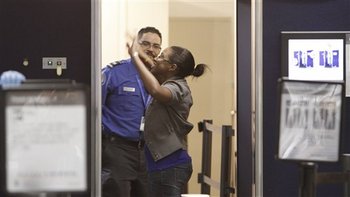
After setting off an alarm, a traveler gets a body scan at the Fort Lauderdale, Fla. airport before she boarded a plane Tuesday.
J Pat Carter | The Associated Press
Body scans have been available for Detroit Metro TSA screeners since July 2008. They detect metallic and non-metallic objects and explosives. Detroit Metro passengers could see more of them by Christmas, Wintner said.
The scanners at Detroit Metro are available for use by TSA screeners at five of seven security checkpoints. Each checkpoint has multiple lanes.
It’s hard to let travelers know what to expect — and the TSA wants it that way, said Wintner.
“TSA’s goal is to make security screening predictably unpredictable," he said. "They are striving for inconsistency because they want to take the would-be terrorists off guard. No two times are necessarily the same.”
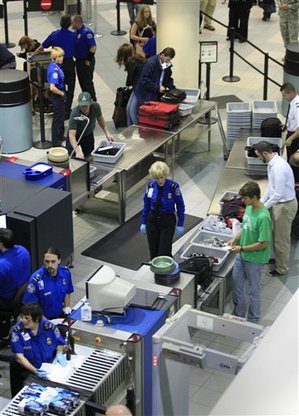
Travelers wait in line as their carry-on baggage is scanned by TSA employees at the Manchester/Boston Regional Airport Monday. (AP Photo/)
Charles Krupa | The Associated Press
An ABC/Washington Post Poll this week states 48 percent of Americans think the pat-downs are just fine.
A CBS poll cited by the TSA on its website says 81 percent of Americans don’t mind the body scans.
But do body scans carry health risks?
Radiation concerns have prompted some passengers to refuse the body scanners, according to media reports.
One expert says passengers shouldn’t be concerned.
At Detroit Metro, passengers aren't exposed to X-rays — the scans use millimeter wave technology similar to what is used by a cell phone, according to radiologist and University of Michigan Medical School professor Ella Kazerooni. The radio waves are otherwise known as "non-ionizing electromagnetic radiation,” Kazerooni said.
The back scatter technology used in scanners at other airports does emit X-rays or what people generally consider radiation. But a person would have to walk through a machine 300 times to receive a dose of radiation equivalent to one chest X-ray.
According to the American College of Radiology, an individual is exposed to more radiation on a flight than by a screening with either device.
What do you think? Do you have a pat-down or body scan tale to tell? Take our poll and post a comment below.
Comments
A2Rez
Thu, Nov 25, 2010 : 10:13 a.m.
I am pretty concerned about the government trampling on my rights. I'm also really concerned because I agree with many posters that the pat-downs and body scanners do not make us safe. That said, I have had 3 cross-country flights in the past month (all starting out of DTW), and I don't think I've been through a body scanner yet. Either that, or I simply cannot tell the difference between the body scanners and the old metal detectors. I flew out of DTW yesterday (Wed before Thanksgiving). At security, there were no lines, no waiting, no hassles. I was through security in maybe 5 minutes. It seemed to me that all the security people were making an extra effort to be friendly. So while I think this is an issue we need to be concerned about, I haven't seen anything come of it yet.
dogpaddle
Thu, Nov 25, 2010 : 10:07 a.m.
While I'm all for using a boycott or something like it as a peaceful means of protest, this is not the time or place for it. I am really glad the majority of people didn't waste theirs or anyone else's time opting out of the scans. I'm a card-carrying member of the ACLU, too, but this isn't the 1970s anymore when the worst you had to worry about was someone getting on a plane with a knife or gun and hijacking a plane to Cuba. There are people all over the world who are willing to sacrifice their own lives or light their owns crotches on fire for a little money. I don't see this as an invasion of privacy or a loss of personal freedom. I agree with whomever said that flying is a privilege, not a right. If you want to fly, this is what we have to do now. I don't care if my whole body gets scanned and I don't care if I get selected for a pat down. Just thank the TSA for doing what they can do to make this privilege a little safer. Do you really think they enjoy touching your private areas? Yes, maybe less than one percent might. So do less than 1 percent of doctors. But we don't opt out of medical care (those fortunate enough to have it). Now if we can get the airlines to cooperate, too, and not penalize you if you are slowed down by a pat down and miss your flight. After all, it should be a partnership. And to loves_fall, "an edge on the war on drugs"? Really? That billion dollar waste and disaster? I really hope the focus at airports is on keeping crazies from blowing up planes and airports and that the only thing they should be worried about people trying to smuggle are explosives or weapons. I really hope that's where they are focusing ALL of their energies. My safety is not affected by fellow passengers bringing a little ganja on their trip.
Chris
Thu, Nov 25, 2010 : 5:17 a.m.
Often, the "underwear bomber" is cited as a reason for the body scan. It's my understanding that these scans cannot detect plastic or chemicals. They would not have been effective in that case. He also embarked overseas. That said, what makes the body scan better than a metal detector? More importantly, every case involving acts of terror or their attempts was preventable by investigation. The people involved in these acts were already flagged because of involvement with known entities (I'm being as general as I can). Why is it necessary to use body scans and/or pat down everyone without any other observation? Why not simply follow up on leads? Good thing I'd rather drive when I travel.
ypsiborn
Thu, Nov 25, 2010 : 5:10 a.m.
The last time I flew out of DTW was in August 2010 with my 86 year old mother. She had in her carry on Scissors and old fashioned curling irons which set off the detector. The TSA agent went through all of my mothers carry on and placed everything she found right back. Now tell me how safe you feel with people who are paid $8.00 an hour checking and making sure things are safe. I could not believe that she put the scissors right back in there, 911 didn't they use box cutters? Our only safety is in God's hands.
Left is Right
Thu, Nov 25, 2010 : 1:10 a.m.
jcj, I often fly to the US from Amsterdam and Paris and have at various times had both body scans and pat downs (as well as in the US). So yes, those traveling to DTW from at least some other parts of the world *are* subjected to the same treatment (well before it was implemented in the US, BTW). It's no big deal to me. I do acknowledge that privacy is an issue for some but as obviouscomment aptly pointed out, air travel is a privilege and not some inalienable right. It's always possible to develop countermeasures to detection (it's somewhat of an arms race, after all). And no detection technology is perfect: there will always be a fraction of those carrying some weapon that will pass through (and yes, it seems like a big fraction given events over the past couple years) while some posing no threat will be incorrectly flagged as threatening. So it goes. In any case, not advancing detection technology--or not using the technology we have--really opens us to attack.
bunnyabbot
Wed, Nov 24, 2010 : 10:59 p.m.
@alpha, not surprised at all hackers would like to get thier hands on scanner porn. All those great hacker minds will waste thier time on that while the chinese gov't hacks their way into our gov't systems. as for your second paragraph, insert ominous music here, dododododo, sounds like the smoking mans having another meeting with the inner circle.
Macabre Sunset
Wed, Nov 24, 2010 : 10:57 p.m.
It's sad to see people so willing to give up their privacy for what only amounts to a show. The scanners do not make air travel safer.
AlphaAlpha
Wed, Nov 24, 2010 : 9:49 p.m.
Two items: Word is, there is a competition among hackers to get to the fed's large and growing stash of body scan images. Scanner porn? Stay tuned... And, former TSA head Chertoff, now of The Chertoff Group, has a big financial interest in seeing body scanners deployed; his group is advocating for more scanners in many more places such as bus lines, railroads, government buildings, etc.
obviouscomment
Wed, Nov 24, 2010 : 9:29 p.m.
flying is not a right, it's a privilege...if you don't like what you have to do to enjoy that privilege, then find another way to travel
Brad
Wed, Nov 24, 2010 : 9:21 p.m.
"If you don't want the pat down go through the X-ray machine or don't fly quit being a pain for the rest of us." Sure. The last think I want to do is impede the sheep.
bobr
Wed, Nov 24, 2010 : 7:13 p.m.
I want the airlines to scan, search, profile, etc. If there is new technology, use that too. I think the main concern by the people who don't want scanning is that the scans may reveal they've eaten too many Cheetos.
LRF
Wed, Nov 24, 2010 : 5:57 p.m.
The thing about security at the airport is that it's driven by political correctness rather than the actual need to provide tough security policies and measures. They don't care how much it offends patriotic Americans as long as they can be sure not to offend the ones that security should be aimed at. I don't recall ever hearing of a terrorist on a flight that originated from Detroit Metro. We will never be safe from terrorism in the air until people in high places demand that we institute profiling aimed at the ones that have been proven to commit those acts on previous ocassions. I have also never heard of any 85 to 90 year old grandmother being found trying to get aboard a flight with a bomb or some type of explosive device. So lets keep doing things the same way we have been doing and target the general public rather than the ones that are true culprits! Yeah that's it we sure as hell don't want to offend the enemy.
bunnyabbot
Wed, Nov 24, 2010 : 5:56 p.m.
also Helen, while many of the people know we are at war with terrorists the current administration fails to state as much or WHO we are at war with repeatedly.
bunnyabbot
Wed, Nov 24, 2010 : 5:46 p.m.
the difference Helen is the war is making us hostage to the terrorists by having us be subjected to raised security when they could just PROFILE people instead. Perhaps those that would be angry to be profiled could just "rather suffer the inconvenience and be safer rather than sorry" for the rest of us.
Ypsisucks
Wed, Nov 24, 2010 : 5:43 p.m.
If you don't want the pat down go through the X-ray machine or don't fly quit being a pain for the rest of us.
HBA
Wed, Nov 24, 2010 : 5:40 p.m.
We travel by air a couple to three times/year and both my husband and I require part-downs--he after going through the scanner--due to hip replacement, and me because of my pacemaker. Yes, they are intrusive and an inconvenience, but they are necessary. What some in the public don't realize is that we are at war--not of our own making--by terrorist extremists hell-bent on destroying us/our economy. We'd much rather suffer the inconvenience and be safer rather than sorry.
bunnyabbot
Wed, Nov 24, 2010 : 5:37 p.m.
the amount of radiation they say the machines expose you to is only when the machines are set or calibrated properly (which you know never seems to be the case). and if you have something shoved up your woohoo it wouldn't show anyway.
5c0++ H4d13y
Wed, Nov 24, 2010 : 5:11 p.m.
@Jaime almost no one owns a CRT TVs these days. Flat screens don't give off X-rays.
bunnyabbot
Wed, Nov 24, 2010 : 4:51 p.m.
the attemps of the shoe bomber and underwear bomber came from outside the US traveling from places where the body scanners were not in place. Additionally the body scanners are not at all airports within the states (a complete list of where they are located can be found online) at those airports where they don't have them they are still using the metal detectors, those airports are not doing the aggressive patdowns as a choice to walking through the body scanners. Additionally, they say they are not storing the images BUT images have been stored "accidentally", the question is will they, the government want to store images down the road and what will they want to do with these stored images in the future? Google earth can find where you live (or hide) with a sattelite, your cellphone can locate you as long as you have it with you and on. Pretty soon they just put the GPS chip in you. Different groups already use fingerprints, facial recognition software, retina "print" softwear. They already profile people (it's human nature) case in point the last time I flew (within the states) my bag gave off a strange xray and I was waived through by a supervisor who didn't even open my bag, just looked at me and waived me on. It's an errosion of freedom and no, I won't be flying again unless it is by a charter.
Jaime
Wed, Nov 24, 2010 : 4:39 p.m.
Okay so body scans are ineffective because the terrorists know they exist. But if we didn't have body scans it would just make it easier for them to get on a plane. Its just another tool. They are not dangerous. They produce less radiation than you get sitting in front of a TV. Whats dumb is that someone developed and patented software in 2006 that would distort the view of the body without affecting the objects that are being scanned for. The scanner manufacturers rejected it. Don't want to get scanned? Take the train!
Ignatz
Wed, Nov 24, 2010 : 4:34 p.m.
I'm glad that folks are showing some sense while going through to airports.
Tex Treeder
Wed, Nov 24, 2010 : 4:08 p.m.
Traveling with my family a few days ago, I decided to submit to the full body scan rather than get the pat-down. Other than the fillings in my teeth, I had no metal on my person and nothing in my pockets. However, I was told I moved during the scan (I'm pretty sure I didn't) and needed to have a pat-down as well. I suspect it was my "bad attitude" that encouraged the TSA folks to single me out for extra scrutiny. I didn't respond to their questions with the appropriate amount of subservience and acquiescence, I suppose, since my responses basically stated, "What choice do I have if I want to fly on time and with my family?"
jns131
Wed, Nov 24, 2010 : 4:07 p.m.
Yanno what? They say the radiation is under fire for what children go thru at dental offices and now they say we are exposed to much radiation at the airport. We need to do what they do in Israel, interview them. At least that is what this one reporter says. Israel interviews each person going thru check in at boarding. Go figure. I don't fly and can't afford it. Plus I like driving hither and yon. Happy flying and happy prodding.
Technojunkie
Wed, Nov 24, 2010 : 3:41 p.m.
I agree with bedrog. El Al has offered to train TSA people but our politicians would rather play security theater. Anyone who thinks that minding our own business will solve the problem needs to read up on the Barbary Wars, for starters.
Dog Guy
Wed, Nov 24, 2010 : 3:33 p.m.
TSA is part of the testing/habituation for FedGov gestapo tactics. Basically, if you are being x-rayed or patted down, you are an inmate or have been arrested. I don't know whether a frog will jump out of a pot of water if the temperature is raised gradually, but I recognize compliance with abuse unacceptable a decade ago. Shame on all of us.
Ian
Wed, Nov 24, 2010 : 3:33 p.m.
I flew out of DTW yesterday and I opted out. They are forcing everyone, except those with children, to go through the microwave. At least that is what I was told. Not a single person in line at the Nazi security check point. We Maybe people are avoiding the airport. It is surprising how uninformed people in Michigan are regarding the Underwear bomber since it happened at DTW. If people knew the facts, we would not be molested by the TSA. The Underwear Bomber incident was a staged event. Here are the facts most people are not aware of: 1. Our intelligence agency ORDERED the Underwear Bomber on the plane even though the U.S. State Department opposed it. Go to YouTube and watch the undersecretary of the State Department, Patrick Kennedy, testify in front of the Senate. He admits that is what happened. 2. The Underwear Bomber was ordered on the plane even though he had no passport, he was on the No Fly list and his father, two weeks before, reported his son to the CIA because he was involved with a terrorist organization. That is right. He was a patsy. 3. A man at DTW was arrested by the FBI because a bomb detecting dog smelled explosives in a man's luggage. FBI told people to clear the room where all the passangers were being held because there could be bombs in the area. 4. A man was video taping the entire incident on the plane. Why can't we see that video? That would prove what we were told. The whole thing was staged to take away more of our rights and so Michael Chertoff could make millions selling the full body scanners. Go to YouTube and type in Kirk Haskell. He is a Detroit lawyer that witnessed the Underwear Bomber being helped on the plane. Since the Underwear Bomber incident was a staged event by people in our government, the full body scanners is not needed. It is dangerous and not effective. The entire TSA thing is a method to condition us to accept more and more control by big brother. Wake up people.
Juliana Keeping
Wed, Nov 24, 2010 : 3:30 p.m.
The Consumer Reports blog arm, The Consumerist, has rounded up reports from around the country of "National Opt Out Day" protests in this post: http://tinyurl.com/377lr9p
David
Wed, Nov 24, 2010 : 3:26 p.m.
I favor the U. S. Government minding their own business...getting out of Iraq and Afghanistan...stop bullying the rest of the world, and start living in peace.
David
Wed, Nov 24, 2010 : 3:25 p.m.
I favor the U. S. Government minding their own business...getting out of Iraq and Afghanistan...stop bullying the rest of the world, and start living in peace.
bedrog
Wed, Nov 24, 2010 : 3:07 p.m.
The only critics of the current policies who have any demonstrable real- world credibility are the Israelis. They profile, they dont waste time on little old ladies from dubuque... and they dont have 'events' although being targeted more than we are...and by the same kinds of people.
5c0++ H4d13y
Wed, Nov 24, 2010 : 3:02 p.m.
There is no check or balance to TSA these days. If a traveler has a bad day and gets angry with TSA it's a sure bet they will cuffed, stripped, jailed, banned from air travel for X number of months and endure lengthy court proceeding trying to maintain their innocence. People engaged in legal activities are scrutinized and threatened by the TSA. They have become the nation's extra-constitutional drag net. But we can always "opt out" of course. Flying is a privilege not a right after all. Does anyone really believe that garbage? Freedom of movement is not a right? Where's the TSA rat squad? What happened to the TSA agent that planted drugs on two people? What happens when they humiliate cancer survivors? Complain a little too much and you're in the airport prison.
Cash
Wed, Nov 24, 2010 : 2:52 p.m.
The people who complain about security would also be screaming if an incident happened, especially if it involved someone they knew or loved. Either let the experts do their job or don't travel.
loves_fall
Wed, Nov 24, 2010 : 2:38 p.m.
I agree, the pat downs and screenings seem like a last ditch effort to try and secure things when everything else has failed. But maybe it will give us an edge in the war on drugs? These people couldn't even identify a terrorist whose own father called to report that he may be a threat. No wonder they need all the help they can get from technology.
Top Cat
Wed, Nov 24, 2010 : 2:37 p.m.
This is a result of choosing political correctness over security. It is unlikely to make us more secure.
jcj
Wed, Nov 24, 2010 : 2:20 p.m.
Bob Spoken by someone that does not have to endure pat downs correct? I could care about the pat down or the screening. But it will not make us safer! Does someone flying to Metro from the all other parts of the world go through full body scans or the same pat downs? If not then whats the point? Making such a big deal about it is crazy. But don't try to convince me that this is a cure all!
Bob Krzewinski
Wed, Nov 24, 2010 : 2:10 p.m.
As an 27 year airline pilot (who by the way supports the TSA security policy), I asked a few TSA people around the country over the past few days how the "revolt" was going. The TSA people I talked to really did not see any real passenger slowdown actions but the strange thing to them was all the comments they (the TSA) were receiving thanking them for keeping everyone safe. Oh, by the way, the common sentiment I hear from other airline flight crew members is that if someone does not like going through airline security, they can always drive, take Greyhound or ride Amtrak. Bob Krzewinski
rusty shackelford
Wed, Nov 24, 2010 : 2:06 p.m.
Although they come to the same conclusion, it's interesting to see how a reporter who actually reports does the same story: http://www.nytimes.com/2010/11/25/us/25travel.html?_r=1&hp You know, going to an airport and talking to passengers, getting a quote from the other side of the issue. Not just talking to the PR rep of the entity involved. But hey I understand the resistance to that kind of story, it actually involves minimal effort, which is clearly too much. I look forward to the next copy and pasted news bulletin from UMICH DPS.