

No phone service? No problem: U-M tries to fix bad reception at Michigan Stadium
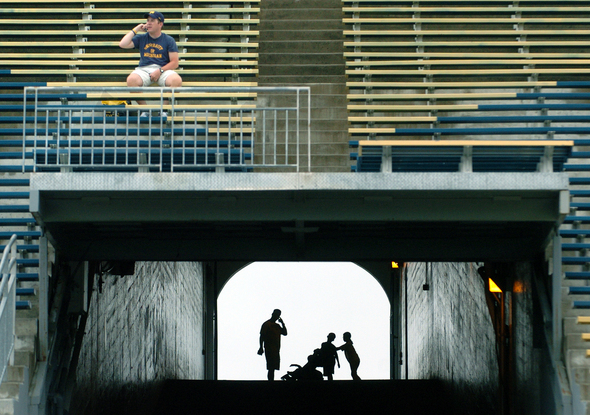
A fan uses his cell phone at the Big House. It's empty, so he's probably not encountering any problems.
Lon Horwedel | AnnArbor.com
Yes. We know, it's annoying.
You're at the Big House, trying to call a friend about the unbelievable pass you just saw Denard Robinson throw (it's complete!) and... nothing.
No voice on other end. No ring tone. No operator. No service.
How many times have you been denied cell phone use at the Big House because there's just too many people and not enough service capacity? Too many, based on customer complaints.
"You’ve got a small city in a very small space so trying to get them all the service they want is pretty difficult," said Andrew Palms, U-M executive director of communications systems and data centers.
For Verizon customers, this annoyance has been allayed lately due to a new antenna system deployed at Michigan Stadium.
They can call, text and even tweet with no problems.
And soon, AT&T customers may join in the cell phone call-making and -receiving bliss.
The university recently installed a distributed antenna system as a part of its Enhanced Cellular Coverage Program. Since the beginning of the football season, Verizon has taken advantage of the system. The technology can service multiple carriers.
According to Palms, AT&T is taking heed.
The cellular service giant is in the process of testing the new Distributed Antenna System, a technology designed by ExteNet Systems.
Sprint is also considering joining, Palms said.
Participating companies pay ExteNet for use. ExteNet in turn pays U-M for access to university facilities and space.
Palms declined to disclose U-M's financial gain in the deal.
"The carriers and the third-party provider would rather that I not give that information out freely," he said. "At the end of the day what the university is really interested in is just providing the coverage."
Coverage is primarily a problem during halftime and immediately before and after a game.
"People are trying to find each other and link up; all of a sudden it gets really clogged up," Palms said, adding that at halftime "people must be taking pictures and wanting to send them to their friends."
"It's actually a very interesting problem," he said.
The university also has plans to install the system in more than 200 campus buildings and parking structures over the next two years, improving cellular coverage in more than 25 million square feet of space.
Kellie Woodhouse covers higher education for AnnArbor.com. Reach her at kelliewoodhouse@annarbor.com or 734-623-4602 and follow her on twitter.
Comments
Tom Teague
Sat, Oct 29, 2011 : 3:30 p.m.
This isn't a complaint, just an observation: During football games, cell coverage at our home -- also about a mile from the stadium -- is terrible. Incoming calls often sound like Martians from a 1950s science fiction movie and we have to wait minutes while the phone dials outgoing numbers.
a2citizen
Sat, Oct 29, 2011 : 2:45 p.m.
Just received a call from the old lady on my cell. Excellent quality. No issues. That's four successful calls in the last 45 minutes. (1.1 miles from S. Main and Stadium).
DBH
Sat, Oct 29, 2011 : 8:41 p.m.
Thanks, a2citizen. I wouldn't know, but perhaps your carrier (or your phone itself?) accounts for your success. Clearly, others are having difficulties. Your success could be a vote in favor in trying Virgin Mobile.
a2citizen
Sat, Oct 29, 2011 : 7:43 p.m.
DBH, about 4 months ago I moved to Virgin Mobile. They use Sprint towers.
DBH
Sat, Oct 29, 2011 : 7:15 p.m.
a2citizen, I am happy for you. What network do you use?
a2citizen
Sat, Oct 29, 2011 : 7:02 p.m.
36 seconds left. One more successful call. Still trying to figure out why people complain about cell phone service during a football game.
a2citizen
Sat, Oct 29, 2011 : 6:57 p.m.
DBH, I just made two more calls, back to back. No issues.
DBH
Sat, Oct 29, 2011 : 3:16 p.m.
I don't think calling before game time is an appropriate test. Trying calling 12:30-3:30 and see how it is then. Hopefully, your service will be intact but calling at 10:45 AM really tells you next to nothing.
ChrisW
Sat, Oct 29, 2011 : 2:25 p.m.
Chrysler Center on North Campus needs a cellular booster too.
Halter
Sat, Oct 29, 2011 : 2:01 p.m.
While all the smart-alecks seem to be out in full force on this one, it's more than just a problem at the stadium. On Game days, anyone that lives within a three mile radius of the game GETS NO CELL COVERAGE....that is a much much bigger problem than the fans at the game itself. That includes medical centers, offices, houses, and all the other businesses within that region. This is a problem that really DOES need to be addressed.
a2citizen
Sat, Oct 29, 2011 : 2:34 p.m.
Also, why do medical centers need commercial cell phone service? I'm being serious. Think about it for a second. Why? Is a surgeon going to start texting after he opens a patient up? Medical centers all have land lines, and they have land lines for a reason. Offices? This is Saturday. In Ann Arbor. There is a football game scheduled. What offices rely on commercial cell phone service on Saturdays? Regarding "...all the other businesses within that region...". If the business owners did not take into account Michigan football on six or seven autumn Saturdays a year when formulating their initial business plan, then they were doomed to fail from the start.
a2citizen
Sat, Oct 29, 2011 : 2:22 p.m.
Halter, that's a bit of an exaggeration I live 1.1 miles from the stadium. I just made three successful test calls.
a2citizen
Sat, Oct 29, 2011 : 1:54 p.m.
You think fans at the game have it tough? I can't leave home during a game just in case somebody gets through and is able to make a phone call to my land line. I need to be there to answer it in case it's an emergency.
a2cents
Sat, Oct 29, 2011 : 1:53 p.m.
So, the u installed new poles on city property (across the street from their precious turf along S. State)... to generate revenue for themselves (i.e. its not just a benevolent service for the almighty fans). Where's the city's cut (?) & thanks for impeding traffic. I wonder how they'll managed to keep the rabble (residents) from some benefit -or- will we be billed separately..
a2cents
Sat, Oct 29, 2011 : 2:01 p.m.
oops, sorry. The impeded traffic was mostly in the multiple-purpose-cum-bikelane, so the blockage was entirely acceptable, if not encouraged.
Ricardo Queso
Sat, Oct 29, 2011 : 1:05 p.m.
I don' think Yost was concerned about cell phones. How did those early fans survive? What methods did they use to find each other at half time or after the game? How did they communicate their excitement about the game? Were they forced to not only speak to each other but do it face to face?
DBH
Sat, Oct 29, 2011 : 1:18 p.m.
After UM (Bo's first year) defeated OSU (with Woody Hayes) in 1969 24-12, my brother sent me a telegram congratulating me (as if I had anything to do with it) on the victory and expressing his excitement. Even then a telegram was unusual. I think I still have that around somewhere.
Rob MI
Sat, Oct 29, 2011 : 12:57 p.m.
"Coverage is primarily a problem during halftime and immediately before and after a game." On the Sprint network, I can tell you it's a problem from around 30 minutes before to around 30 minutes after a game, with absolutely no service available in between, even at games where there appear to be fewer than, oh, 105,000 people in the stands. Were it not for the fact that I can sign on to the UMich wireless network running in the press box for Internet access (still doesn't help me with calls, though), my phone would be as valuable at the stadium as my Tate Forcier jersey.
Dr. Rockso
Sat, Oct 29, 2011 : 12:50 p.m.
I'm waiting for the legislation to come down to deal with distracted sports fans!
DBH
Sat, Oct 29, 2011 : 1:26 p.m.
That's Dr. Rockso (as the avatar is named), from Metalocalypse. See <a href="http://www.google.com/search?q=dr.+rockso&hl=en&biw=1424&bih=787&prmd=imvns&tbm=isch&tbo=u&source=univ&sa=X&ei=FP6rTq_QEYSosQLAvLHvDg&sqi=2&ved=0CDwQsAQ" rel='nofollow'>http://www.google.com/search?q=dr.+rockso&hl=en&biw=1424&bih=787&prmd=imvns&tbm=isch&tbo=u&source=univ&sa=X&ei=FP6rTq_QEYSosQLAvLHvDg&sqi=2&ved=0CDwQsAQ</a>
Ricardo Queso
Sat, Oct 29, 2011 : 1:06 p.m.
Nice avatar. ICP?
WalkingJoe
Sat, Oct 29, 2011 : 12:15 p.m.
In response to the previous post until the first game of the season I felt this was just a minor annoyance too. But if you will recall that was the game where there were some severe storms and the stadium had to be evacuated. I was at that game with my nephew. His mother and aunt were in another part of the stadium and trying to call each other to see what we were going to do not getting any service was more than an inconvenience. Luckily it wasn't a real disaster like a fire or tornado.
Craig Lounsbury
Sat, Oct 29, 2011 : 1:03 p.m.
I won't dispute the handy nature of cell phones...I have one. I won't dispute they can be more than just a "toy" in an emergency but we did manage OK in the face of storms and tornado's minus cell phones for decades. And folks should always have an emergency plan B that doesn't include a cell phone or the Internet.
Craig Lounsbury
Sat, Oct 29, 2011 : 11:31 a.m.
I am relieved to know people can now make phone calls from their seats while watching the game. This disaster has kept me awake night after night. Now if only I could make a phone call from inside my house instead of having to go out in my back yard.......curse you t-mobile.
Jake C
Sat, Oct 29, 2011 : 7:41 p.m.
Just a heads-up, if you call your cell company and complain about horrible service in your home, they will often provide you with a free "cell repeater" device that plugs into your internet and boosts your signal dramatically. Check it out.
City Confidential
Sat, Oct 29, 2011 : 11:54 a.m.
Seriously. My phone is basically only for texting in my house this point because I can't use it for voice or internet. I'm told it's because my house is ancient and has all kinds of metal in it - lead paint under the new paint, aluminum in the old insulation, metal lattice work in the stucco, etc.