

When the cops are called to your noisy party, it's best to cooperate
In the Ann Arbor area, the most common type of disturbance call is for a noisy party or noise disturbance. They're usually called in by a neighbor who is trying to sleep or study. These noise complaints can range from a few friends listening to a stereo or talking too loudly to huge street-closing block parties encompassing whole neighborhoods.
During the football season, the Ann Arbor Police Department assigns extra officers on the street specifically to deal with underage drinking and unruly parties. These extra patrols are, not surprisingly, called “Party Patrols.”
Normally what happens at these types of calls is officers respond, and if the party isn’t already flowing into the street and out of hand, the officers contact the party host. The officers warn the party is too loud and must be quieted or shut down. The host is identified and is informed it is his or her responsibility to quiet the party. The officers will also let the party host/responsible person know that if the police are called back to the party because it is noisy again, the host will be issued a ticket.
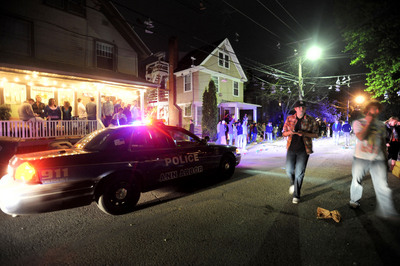
Ann Arbor police break up the annual Greenwood Avenue block party last April.
Angela J. Cesere | AnnArbor.com
The police mission here is to quiet the party. The officers will also cite any obvious underage drinking, but again, the object is to bring the gathering into compliance.
It is a source of pride for officers to take care of a “job” (call for service), so the problem doesn't cause work for other officers or the next shift coming on. Therefore, responding officers may cite a party host on the first call if it appears that cooperation in quieting the party is less than enthusiastic or if the address has been a party problem in the past.
The police, city attorney’s office and courts have been dealing with these parties for years, so there are standardized procedures, fines and punishments in place. Second or subsequent noise offense violations issued to the same address or person are dealt with more severely by the criminal justice system. The Ann Arbor area criminal justice system handles party complaints very efficiently.
For instance, one of the “games” played by party hosts is to ignore the police officer’s insistent knocks on their door. These particular party hosts feel self-righteous and steadfast in their belief that our forefathers fought a revolution and drafted a constitution to protect their kegs, stereos and beer pong equipment from warrantless search and seizure.
Unfortunately for them, this is the digital age. Fill-in-the-blank search warrants - coupled with cell phones, fax machines and understanding judges and magistrates - have made obtaining search warrants to enter the premises of an offending party rather quick. Once inside, the officers will take a “zero tolerance” approach to ending the party. They will cite any and all violations they encounter and may be forced to seize as evidence noise-making equipment such as stereos and amplifiers.
It has been my observation over the years, and should be common sense for most, that the level of cooperation demonstrated by an offender is inversely proportional to the level of law enforcement administered. That is to say - the more cooperative a violator, the fewer citations that person will likely receive. Conversely, less cooperation on the part of the violator results in more vigorous enforcement of the law (i.e. more citations and or arrests).
If you're hosting a party, keep it quiet and small, keep the party favors legal, and don't serve alcohol to intoxicated people or anyone under the age of 21. If your party is getting out of control, take the high road and call the police yourself to help close it down. Most importantly, invite your neighbors, and they'll be less likely to call the police to complain about your party.
Have fun, enjoy, but keep it legal.
Lock it up, don’t leave it unattended (especially drinks at parties), be aware and watch out for your neighbors.
Rich Kinsey is a retired Ann Arbor police detective sergeant who now blogs about crime and safety for AnnArbor.com.
Comments
inbredbears
Wed, Oct 6, 2010 : 10:10 p.m.
@fredmdfira I couldn't agree more when you said, "I'm sorry, when Police start seeing constitutional protections such as the fourth amendment, and human or civil rights as an obstruction to doing their job, they can no longer be trusted to wear a badge!" Police absolutely never were and never are above the law, nor do they have any right to act that way. When an officer performs his job, there is an expectation of him upholding a lawful standard, not filling a quota or disregarding personal rights while trying to send a message that he is in charge.
Lokalisierung
Fri, Sep 10, 2010 : 11:54 a.m.
"These particular party hosts feel self-righteous and steadfast in their belief that our forefathers fought a revolution and drafted a constitution to protect their kegs, stereos and beer pong equipment from warrantless search and seizure." Nice one Rich. Totally condecending and smarmy; great job.
redblue
Fri, Sep 10, 2010 : 1:20 a.m.
fremdfirma, I don't understand what shocking admission Mr. Kinsey revealed to you that demonstrates he and officers like him can not be trusted with a badge anymore. I'm sorry but if I'm an officer responding to an incident where the the the person in question goes out of their way to hinder my investigation and refuses to cooperate, I'm not going to go out of my way to accommodate them or give them any kind of "break". Nothing he stated in his article violates anyones civil rights or suggests any kind of wrongdoing. I don't understand why their is such a strong anti-police sentiment anytime Mr. Kinsey tries to offer some advice in any of the articles on here.
fremdfirma
Thu, Sep 9, 2010 : 5:22 p.m.
(Quoted from story) "Unfortunately for them, this is the digital age. Fill-in-the-blank search warrants - coupled with cell phones, fax machines and understanding judges and magistrates - have made obtaining search warrants to enter the premises of an offending party rather quick. Once inside, the officers will take a zero tolerance approach to ending the party. They will cite any and all violations they encounter and may be forced to seize as evidence noise-making equipment such as stereos and amplifiers." You say this like it's a good thing? That "fill in the blank warrants" are available and that pesky little probable cause issue can be skipped right over, right? I'm sorry, when Police start seeing constitutional protections such as the fourth amendment, and human or civil rights as an obstruction to doing their job, they can no longer be trusted to wear a badge! And he follows this with an all-but-admission that they will retaliate for the uncrime of "contempt of cop"? Look, I understand they have a job to do, and that wild, disruptive parties can be a hazard, social annoyance, and a disturbance of the peace, but this perspective is quite chilling when you realize the meaning of the words used here, and the admission that the checks and balances which are required to prevent abuses are seen as a hinderance by officers rather than a code which protects their honor and legitimacy - is it any wonder that such attitude would result in a corresponding amount of disrespect from the members of the community confronted with it? I would very much advise officers even of this day and age to remember the principles and intentions of Sir Robert Peel, the father of modern policing, especially the much quoted nine. They are part of the community, not above it, and should remember this, because forgetting it, acting otherwise, tends to escalate a situation that could have been resolved much easier if the officer in question would treat fellow citizens as equals instead of peons to be managed. I had thought we left those attitudes behind in the modern world.
jgold47
Thu, Sep 9, 2010 : 4:03 p.m.
When I was in college and we would throw a large party, there was an expectation that the cops would come at some point and break it up. To combat this to some extent, I would call the non-emergency dispatch number earlier in the day and leave my name and cell # as a contact. All I asked was that if there were any noise issues or otherwise that they give us a heads up first before coming out. More often than not I would get a call either askign us to keep it down or else, or a heads up that they were on the way. We were able to cut the music, get everyone inside, etc... I think this helped the cops as I cant imagine two guys (gals) in a car want to deal with a house full of drunken college kids. The mutual respect thing seemed to work and we never got ticketed, just shut down.
resident of hadleyburg
Thu, Sep 9, 2010 : 2:45 p.m.
what if the noise is comeing from the stadium? now they even have multiple speakers facing out. It's often much louder than neighbors and not just on football saturdays.
breadman
Thu, Sep 9, 2010 : 12:44 p.m.
When the cop's are called for a noisy party on my block' They just forget the call. And there are underage drunks, not drinkers at this block.
jameslucas
Thu, Sep 9, 2010 : 11:40 a.m.
I agree with Rick Kinsey, when the cops are called to your noisy party, its best to cooperate. The police mission is to quiet the party. Do not debate the law with officers, there job is to us the law to complete there mission. They could care less with things like the bill rights and how they apply to your party. You should be polite and cooperate. However cooperation does not include admitting to any wrong doing, or letting the officer inside without a warrant nothing good can come from doing this.
greg formella
Thu, Sep 9, 2010 : 10:55 a.m.
The only wise thing to do is attend Chess parties. This student interaction thing has gone too far. Ever since the Waltz fell out of the top 10,it's been downhill. In the old days we'd slip 'em 50 bucks for the policeman's ball...but I guess they don't have any now.
bunnyabbot
Thu, Sep 9, 2010 : 10:53 a.m.
I like Kinseys columns!
Craig Lounsbury
Thu, Sep 9, 2010 : 9:59 a.m.
"For instance, one of the games played by party hosts is to ignore the police officers insistent knocks on their door. These particular party hosts feel self-righteous and steadfast in their belief that our forefathers fought a revolution and drafted a constitution to protect their kegs, stereos and beer pong equipment from warrantless search and seizure." Another possibility is they didn't hear the knocks on the door. They police after all are on the porch responding to a loud party. Your assumptions about motive speak to someone more concerned with making an arrest than truth.
Joe
Thu, Sep 9, 2010 : 9:07 a.m.
I have to agree with Rusty. If you want your life to go well, you will give the police no reason or particular desire to make your life hell. Respect and cooperate with the police, but don't let them into your home without a warrant. Likewise, never admit wrongdoing, because you may be admitting to something they weren't even interested in. In fact, never give them any information they didn't specifically ask for. Their stated goal is to ensure public safety, but their unstated goal may be to issue as many citations and conduct as many arrests as possible. Don't help them. Also, while many students could benefit from a bit of education on how to successfully interact with the police, I doubt any of them are reading AA.com.
Rasputin
Thu, Sep 9, 2010 : 8:57 a.m.
I think his column is fine. while it may seem a bit elementary, I have witnessed plenty of belligerent students actually assault officers when asked to comply with the ordinances. So, clearly, this was a good reminder! Let's try to respect each other.
Forever27
Thu, Sep 9, 2010 : 8:11 a.m.
@trespass, it's not like he's saying anything controversial or outrageous. Especially with this article. It's not a big deal for people to relax and have a good time, just when it gets out of hand and the cops are called just be respectful. That's the crux of this whole piece is respect. Respect for your neighbors and respect for the officers just doing their job.
rusty shackelford
Thu, Sep 9, 2010 : 8:03 a.m.
Best course of action--answer your door, step on to the porch and close it behind you. If the officer asks to come in, decline politely. As Kinsey said, cops can get a warrant to enter for a noise violation (this is a big overstep in terms of civil rights, but like he said, there's a compliant judiciary.). However, if you answer the door and address the problem directly and privately, there is no longer cause to obtain a warrant. Be respectful and say you will quiet things down. However, at no point admit wrongdoing. Say something like, "I'm sorry, I didn't realize neighbors thought we were being too loud. I'll ask everyone to keep things quiet. I'm sorry you had to come out for this." Always remember that if you let a cop into your dwelling, nothing good can come of it, and that if you admit to breaking city ordinances it WILL be used against you later.
tdw
Thu, Sep 9, 2010 : 7:46 a.m.
What?? someone has a problem with Kinsey's article's no matter what? No way!
daytona084
Thu, Sep 9, 2010 : 7:29 a.m.
I also enjoy Rich Kinsey's articles. Those who don't like them don't have to read them.
trespass
Thu, Sep 9, 2010 : 7:22 a.m.
@jcj- Oh this piece doesn't upset me. Its just not journalism. The ones that upset me are when he ignores the dangers of using tasers when they are not justified. Are Tasers really safer than guns (CBS)- http://www.cbsnews.com/stories/2010/09/02/eveningnews/main6830743.shtml "a study of major U.S. cities, found deaths in-custody actually rise sharply - nearly six times - during the first year a department uses tasers" I am sure he will defend the officers that shoot a taser at someone who has a party that is too loud- "take that-now are you going to turn down your stereo?"
ChrisW
Thu, Sep 9, 2010 : 7:07 a.m.
I like Kinsey's articles. Always good to get a different perspective on things and a little insight into the internals of an organization as important as the police department.
jcj
Thu, Sep 9, 2010 : 6:59 a.m.
@trespass "I would much rather read an investigative journalism piece than one of these puff pieces." Well just run your cursor on down the page right past his "puff piece" and you won't get so upset!
trespass
Thu, Sep 9, 2010 : 6:49 a.m.
"Semper Cop"- Always a Cop. That pretty well sums up all of Rich Kinsey's columns. Police propaganda. It is always a little bit of information mixed with a large dose of cheerleading. I would never expect to hear any hard truths in one of his columns. I would much rather read an investigative journalism piece than one of these puff pieces. They do nothing for the reputation of AnnArbor.com as a news organization.
Homeland Conspiracy
Thu, Sep 9, 2010 : 5:56 a.m.
cooperate...or else! & for god's sake don't have a couch on your porch.