

University of Michigan's $175 million North Quad complex ready for students
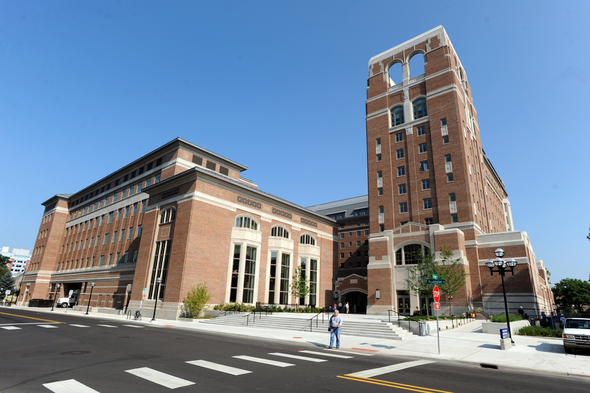
The media got a tour of the University of Michigan's new North Quad Residential and Academic Complex today.
Lon Horwedel | AnnArbor.com
Jutting seven to 10 stories above Ann Arbor's streets, the University of Michigan’s latest massive building project is almost complete.
Now, all the North Quadrangle Residential and Academic Complex needs is students.
“We envision this space as a new gateway and magnet for the rest of campus - an energized, innovative, always-active center close to the heart of downtown Ann Arbor,” U-M President Mary Sue Coleman said in a written statement.
Three years after construction began, the 360,000-square-foot, $175 million building on State Street between Huron and East Washington is ready to house 450 sophomore-and-above students.
They'll fill out the new facility by Sept. 3.
North Quad is the keystone of Coleman’s ongoing Residential Life Initiatives, a project to improve residential halls and strengthen living-learning opportunities on campus.
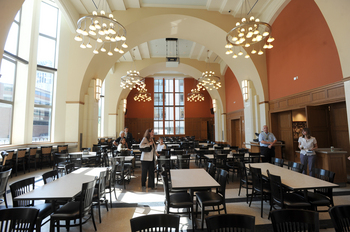
The dining hall in the University of Michigan's new North Quad Residential and Academic Complex is shown.
Lon Horwedel | AnnArbor.com
North Quad will house the School of Information and four academic units of U-M's College of Literature, Science and the Arts.
Its top floors will house students in single and suite-style room arrangements. Academic facilities on the bottom two floors will include 19 classrooms and three technology-rich labs for use by the School of Information. A 180-seat dining hall will serve international cuisines.
In keeping with the School of Information’s goal to explore and create connections between people and technology, a multi-screen display lab could, for example, help AIDS researchers in different countries interact with large sets of data and each other, said Judy Lawson, director of admissions and student affairs for the school.
With the completion of North Quad, the school’s undergraduate, master’s and doctoral programs will be housed under the same roof for the first time.
Those both living and learning at the complex will include 65 students with a new global scholars program. The goal of that program, director Jennifer Yim said, is to help students interested in social justice become “global leaders who are interested in affecting positive change.”
One student who participated in the global scholars pilot program last year spent the summer studying poverty in the slums of Bombay, India, Yim said.
Those students will take one required dialogue-based course - for example, one will include discourse on Arab-Jewish conflicts. And monthly, beginning in September, the program will host lectures open to the public.
The first topic is close to home. A lecturer on Ojibwe language preservation will kick off the series with a focus on this area’s first nations.
The look
North Quad’s “collegiate gothic” red-brick-and-stone architecture reflects a number of prominent buildings on campus.
Its two C-shaped towers frame a courtyard, and a colonnade connects them. The courtyard is a "civic space" open to the community just a few steps from the street, as well as a green roof to academic facilities below it. The roof is one of many examples of environmental sustainability and energy efficiency that have set a new building standard on campus, said Sue Gott, a university planner.
North Quad stands on the site formerly held by the Frieze Building, which was demolished in 2007.
The Frieze Building had several previous lives. It was anchored by the Carnegie Library, the city’s first free standing public library built in 1905. In 1907, Ann Arbor High School was built around the library. Then, U-M purchased the building in 1957 and used it for its department of theatre until 2007.
U-M preserved a portion of the Carnegie Library facade and integrated it in to the construction of North Quad. The Carnegie Library facade now overlooks Huron Street, and different elements from the old building have been made into public art on the grounds.
The new building’s classic look belies the technology-rich facilities within.
Students can use multiple flat screens in public areas to share data or throw a Nintendo Wii party. Wireless Internet access is a given, but extras like digital and video projection and sound are also available to students.
What students won’t find when they arrive is parking - and that’s not an accident, university officials said.
Gott said the lack of parking options will encourage students to walk, ride a bike and take the bus. With building entrances near the street, the State Street businesses are literally a few steps away.
Editor's note: Judy Lawson's title was changed to reflect her dual role as director of admissions and student affairs for the U-M School of Information.
Juliana Keeping is a higher education reporter for AnnArbor.com. Reach her at julianakeeping@annarbor.com or 734-623-2528. Follow Juliana Keeping on Twitter
Comments
edstudent
Tue, Aug 10, 2010 : 3:04 p.m.
U of M certainly did have a string of ugly buildings-- the addition to the back of the Graduate Library, the MLB, not to mention the monstrosity that is Bursley Hall. Frankly, I also think the modern-looking Hill "Marketplace" attached to MoJo looks gross next to the regal beauty of Stockwell and Mosher-Jordan Halls. That's why I'm thrilled at how classic North Quad looks! If only we can make all of the University buildings look like this.
kimbro
Mon, Aug 9, 2010 : 2:51 p.m.
I'm from the U-M Public Affairs Office. FYI, the campus community and general public will be invited to an open house event March 31, 2011. At that time most programs and spaces will be moved in and functioning. Continue to watch our Web site (umich.edu) for more detailed information as we get closer to the date.
Rasputin
Sun, Aug 8, 2010 : 7:48 a.m.
@ mw, it is faux brick in that large facade sections where prefabbed (off site) and lowered into place making up the exterior walls. The "brick" is called face brick and is similar to a veneer and measures about 1/4" in width and is placed over insulation. However, I'm glad you agree that the North Quad is beautiful, but I still think that Ann Arbor city council needs an education when it come to approving of more buildings. They clearly have no design aesthetic unlike UM which has been very good.
mw
Sun, Aug 8, 2010 : 6:34 a.m.
That horrendously ugly faux brick nightmare with the Buffalo Wings place in it! Meh -- it's not faux brick. The corner-house apartments use panelized brick construction, but they're still real bricks. No, it's not a beautiful building, but it doesn't stick out like a sore thumb, and it's pedestrian friendly and even fairly attractive at the street level. Private companies can't afford to spend money like the U and still turn a profit. But even so it's a hell of a lot better than the low-rent-looking modernist building that the U threw up next to it: http://maps.google.com/maps?f=q&source=s_q&hl=en&geocode=&q=ann+arbor&sll=37.0625,-95.677068&sspn=48.688845,72.861328&ie=UTF8&hq=&hnear=Ann+Arbor,+Washtenaw,+Michigan&ll=42.280313,-83.740062&spn=0.002798,0.004447&t=h&z=18&layer=c&cbll=42.280316,-83.739942&panoid=5PE023Y3AjEZi69k_8fWPw&cbp=12,233.01,,0,5 North Quad is beautiful, though. Now if only we could institute a policy where the U had to tear down one of its monstrosities at the same time. Put up North Quad and dynamite the MLB -- that would be ideal.
Rasputin
Sat, Aug 7, 2010 : 7:02 a.m.
@ kermdd7, it's not that kind of building. Here, you actually have to work to get anything and they even make you pay for the honor, it's called an education; an investment in your future so that you won't need public housing.
hailstudent13
Fri, Aug 6, 2010 : 10:37 p.m.
As a U of M student, and a Michigan resident, I can say that not only am I paying taxes, but I am also paying the tuition of nearly 100 grand by the time I graduate. And that is nothing compared to the nearly quarter of a million dollars the out-of-state student will have paid after four years. The money that the school has to spend is ridiculous. PS. if you didn't know, the state of Michigan actually owed the university money.
djhutch
Fri, Aug 6, 2010 : 3:34 p.m.
I'll be the third to ask. Will there be any public open house or tour? I would very much like to see the place. Can annarbor.com find out, please?
KGS
Fri, Aug 6, 2010 : 11:47 a.m.
@Amalie - the slideshow is not working, in either Mozilla or Internet Explorer. Seems to be a problem with Flash...? @MRunner - I asked the same question on the tour, whether that patio-like room was open or not. This area is just an architectural feature and is emphatically *not* open to anyone, public or student, due to concerns about suicide risks, etc. There is a mechanical unit or two up there, and no one but the maintenance guy will get to enjoy the view. Kinda sad and a waste of money IMO.
CountyKate
Fri, Aug 6, 2010 : 11:18 a.m.
Juliana, as you probably know, Huron and East Washington do not intersect. What you want to say is on State Street BETWEEN Huron and East Washington. Someone else pointed out that this was an error, but it bugs me, too. And I agree about the parking issue. While this is, indeed, a beautiful building, foresight about parking should have been a consideration. I expected better from you, President Coleman.
ex734
Fri, Aug 6, 2010 : 11:04 a.m.
Looks great! I wish this had been an option when I was an undergrad.
johnnya2
Fri, Aug 6, 2010 : 11 a.m.
All I keep thinking is what a cluster blank that will be during move in and move out. No other large residence hall is right smack in the middle of a business district where people would be going that might not be University affiliated.
schultz2005
Fri, Aug 6, 2010 : 9:32 a.m.
where's the "slideshow"??
schultz2005
Fri, Aug 6, 2010 : 9:28 a.m.
that's right. When will the public get to tour the building?? Especially I was a UM student and lots of my money probably went into that building. Can we just walk in and do a self-tour??? Get some free cookies and punch and gifts???
kermdd7
Fri, Aug 6, 2010 : 8:58 a.m.
Will there be a public open house to tour the building?
81wolverine
Fri, Aug 6, 2010 : 7:54 a.m.
A beautiful building for sure and nice place for the students to stay. But, at some point, costs need to be reigned in at U-M and other universities to limit tuition increases. Students and families are become LESS able to afford a college education, not more. And when tuition hikes of greater than the inflation rate keep coming out year after year to pay for expensive new facilities, U-M will simply be feeding the "student loan bubble" that is going to burst sometime in the future.
MRunner
Fri, Aug 6, 2010 : 7:42 a.m.
What a beautiful building! I was surprised at first that the "windows" in the main tower are open- during the construction, I was expecting these to be finished. I like it now, but very curious as to what is in that tower? Is that open patio-like space for people to enjoy, or just an architectural feature?
Rasputin
Fri, Aug 6, 2010 : 7:02 a.m.
Well done UM. A truly magnificent building! I was really concerned about losing the old A2 High School, but based on the tour, I have to say this is a worthy replacement. Now, if someone could do something about that eyesore across the street on the corner of Washington and State street!? That horrendously ugly faux brick nightmare with the Buffalo Wings place in it!
E
Fri, Aug 6, 2010 : 5:37 a.m.
I'm amazed that we've heard NOTHING about the city council changing all of the parking in the Kerrytown/4th Ward area from all day to 2 hour, just to accommodate the students moving into this brand new building. There are new signs up, covered by plastic bags (some of which are falling off) but no notification to the people who WORK in the area, and will be out of luck starting Aug. 15. Why does the city continually bend over backwards for a non-tax paying institution, who could have included parking in their multi-million dollar site plan, at the cost of city residents? Instead, the city council sneaks in a parking change which will make living and working in the Kerrytown area even more difficult - just after the penalties for parking tickets increase!
yohan
Fri, Aug 6, 2010 : 3:01 a.m.
"at the intersection of Huron and East Washington" Why is the concept of proof reading so foreign to those who write for AA.com? Do you ever read what you write?
racerx
Fri, Aug 6, 2010 : 12:53 a.m.
@Truffledog-Im willing to bet you dont even work at any of the medical facilities to be concerned with walking up the hill. @Somewhat Concerned-gee, cant you take it down a 1000? WTF? will be brainwashed with the politically correct drug of the day. Where is this coming from? Colleges and universities are institutions that prompt the growth of independent thinking. Its not until after you leave these environs that you mind become jaded and closed. Oh, but you know this. Kudos to the U. What a wonderful building in a great location.
Truffledog
Thu, Aug 5, 2010 : 10:15 p.m.
I f the U can afford 175M for this building on State they have the resources to build medical center parking somewhere besides a city park along the river. Period. Let the Regents put up a parking structure in the Arboretum. Sacrilege? Oooh is greenspace suddenly sacrosanct where it already belongs to UM? It is a far more practical option and does not require a long walk across the river and uphill for commuters.
Tom Joad
Thu, Aug 5, 2010 : 7:45 p.m.
Magnificent building. They got this one right
Craig Lounsbury
Thu, Aug 5, 2010 : 6:30 p.m.
"Is your house half as nice?" No but my house doesn't accommodate 450 people either.
oldgaffer
Thu, Aug 5, 2010 : 6:24 p.m.
I think its the best looking building on campus. Classic and timeless architecture-- with lots of outside seating in the courtyard. The University has built a lot of just plain awful buildings but this time they got it right.
Somewhat Concerned
Thu, Aug 5, 2010 : 6:06 p.m.
It looks like a beautiful place, not unlike a resort build 100 years ago. Students lucky enough to get in should be happy. It's a real bargain at $175 million, and just what Kwame Sue Coleman likes - a center for students who will be brainwashed with the politically correct drug of the day. Her sense of geography is off if she thinks it is close to the heart of downtown, unless the northern part of State Street has become the new downtown. Your tax dollars at work. Is your house half as nice?