

On the grow: University of Michigan graduate students work to establish a campus farm
Lindsey MacDonald wants to give University of Michigan students, faculty and staff a chance to get their hands dirty.
MacDonald is one of four School of Natural Resources and Environment graduate students working to establish a campus farm on the grounds of Matthaei Botanical Gardens. The farm would bring people from a number of academic disciplines together to plan, implement and work on a small farm while also creating a centralized sustainable food program at the university.
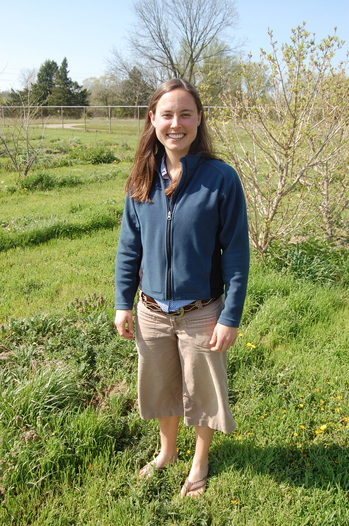
Lindsey MacDonald, University of Michigan masters student in the School of Natural Resources and Environment, is working to establish a campus farm at the botanical gardens. She on standing on the land, an old nursery for the botanical gardens, which would be used for the farm.
Janet Miller | For AnnArbor.com
As a first step, a pilot farm - a 250-square-foot plot - is being established this spring at the botanical gardens, on land adjacent to the proposed farm, which currently is unplowed. It will be used to test crops and the harvest will be donated. “It will allow us to get our hands dirty,” MacDonald said.
Eventually, MacDonald said, plans include establishing a one- to two-acre farm on the botanical gardens grounds, on land that at one time served as a nursery for the gardens. A farm manager would be hired to run and coordinate the operation, MacDonald said. That could happen as early as next year if funding can be found, she said.
But that’s the hitch. MacDonald and the other graduate students won a $42,000 grant that can be used to fund the farm - buy equipment and fund interns to work the farm. But the grant hinges on first hiring a farm manager, a move that could cost between $60,000 and $70,000 a year. MacDonald said they are looking to foundations, alumni and a number of university departments for help with funding.
While the -local food movement has been growing in Washtenaw County, U-M has not moved forward on the idea of a campus farm. The idea of a campus farm has been discussed for at least the past six or seven years, said Bob Grese, director of the botanical gardens and Nichols Arboretum.
Many other college campuses support farm operations, from Oberlin College to Yale University to the University of Wisconsin at Madison. Dickinson College in Pennsylvania has a 50-acre organic farm and some schools are turning their campus farms in to profit centers. Of course, Michigan State University, a land-grant school with a strong agriculture program, has a student organic farm. “We’re really behind peer institutions,” MacDonald said. A campus farm could be used as a recruiting tool for students, she said.
It would be the first campus farm at U-M, at least in the 26 years Grese has been at the university, he said. There have been a few plots on campus that, over the years, have supported small gardens, such as a small plot run by the student organization Cultivating Community, at the Ginsberg Center. Students in the U-M’s Outdoor Adventures program last summer had a small garden that produced locally grown food to take on their adventure trips.
But there’s never been anything that goes beyond a small garden, despite growing interest over the past decade. “It’s been hard to fit it into and campus landscape, and area that has a large amount of flat land,” Grese said.
But the botanical gardens has both.
The farm could serve as a focal point for issues studied across campus, from how food is grown to land use impact to urban food issues. “Food is an evolving issue, and a farm could be integrated across different fields,” Grese said. “Having a hands on experience can make all the difference in the world.” Areas such as public health, natural resources, business, ecology and urban planning could use the campus farm.
A campus farm would also serve as a hub for other food organizations and issues, supporting films, lectures and other educational events, MacDonald said.
Understanding food issues and a small farm operation would also help students preparing to enter the Peace Corps, Grese said. “U-M is one of the biggest suppliers for the Peace Corps.”
Comments
JRW
Sat, Jun 9, 2012 : 2:56 p.m.
Of course the UM will turn it into a "revenue generator" and probably try to sell the organic produce at the overpriced A2 Farmer's market, which is nothing more than a boutique market with jacked up prices and little competition. Hardly a place to feed the urban poor. Or UM will "use" this so-called farm as a recruiting tool. I guess the idea of doing a project just for the sake of learning doesn't exist at UM any longer. Real farming is hard work, something pointed out by other posters, and surely UM will figure out a way for the real hard labor to be done by underpaid interns; I doubt the $70,000 executive will get his or her hands dirty. Let Michigan State do the ag bit.
casual observer
Wed, Nov 28, 2012 : 3:24 a.m.
I think it is great that students chose to tackle this project. I am under the impression that students in SNRE choose projects that they are interested in, while you make it seem like there is some evil-UM A2 farm market bureaucrat enslaving poor students like serfs. As far as the farmer's market goes, I recently left Ann Arbor, and the farmers markets here are scattered, small, and on weekdays while I'm at work. The couple of times I have made it out, the prices were no different than Ann Arbor. I think we should all be happy with what we have and praise the students in our community who take initiative for something with such great potential as this as opposed to bashing them.
xmo
Thu, May 3, 2012 : 3:52 p.m.
Someone from Michigan admitting that they are not the best? ""We're really behind peer institutions," MacDonald said." What next?
E. Daniel Ayres
Thu, Apr 26, 2012 : 2:12 p.m.
The last time U. of M. "went after" the Arboretum, it was to tear up a large portion of it for new hospital buildings. The lawsuit which ensued funded the Michigan Stewardship Network start-up. IMHO SNRE students should consider carefully the practicality of trying to steal even more ground from a shrinking public space which was committed to that use because it was "hilly" and not well suited as farmland. The "lets build yet another institution" mentality is a delusion of the 20th century. Success in the 21st century will come from collaboration and community, NOT expanding via "new" initiatives making the same mistakes over and over again.!
ag
Fri, Apr 27, 2012 : 5:09 p.m.
The campus farm would actually be at the Matthaei Botanical gardens not the Arboretum. The location is planned to be in an open space that has been used for experiments in the past and is currently vacant.
CakeRoll
Tue, Apr 24, 2012 : 3:26 a.m.
This is an idea who's time has come. By the way: Lindsay MacDonald, did you go through the Ann Arbor Public Schools? And if so, Kindergarten @ Burns Park? If YES, I was your Kindergarten teacher and am beaming with pride for you. If not, I'm still very proud of your accomplishments, congratulations!
Sustainable Wolverine
Mon, Apr 23, 2012 : 8:23 p.m.
Let's clarify some facts here: 1st: The 250 square foot plot is simply a "pilot" project, not the farm itself. 2nd: The proposal calls for the farm/large garden to be up to 2 acres, which will require dedicated oversight. 3rd: The proposed "farm manager" would also have significant responsibilities related to student/community education, outreach, and engagement.
pegret
Mon, Apr 23, 2012 : 4:54 p.m.
I think that Carole, Matt, and Andy get it, and said it best with their comments. Way to go, Lindsey and fellow students!
Koivu Tree
Mon, Apr 23, 2012 : 4:17 p.m.
Well it's about time. I thought U of M would've caught on years ago. This is fabulous news.
AndyJ
Mon, Apr 23, 2012 : 3:50 p.m.
Those who have written that the farm is too small, too expensive and won't feed many people are largely missing the point. It is true that the farm (or "garden" if you prefer) will not come close to feeding the university or even a fraction of it. However, the educational value of the farm if used well will far supersede the cost of maintenance. Getting even this humble taste for the difficulties of growing and the stresses of farming will make these students appreciate the people who do this for a living and appreciate the food that they eat. Maybe then they'll be willing to cough up a little extra at the farmer's market rather than buy cheap food shipped in from out of the country. It is important that people have a healthy appreciation for farming and farmers in this country and opportunities to learn should NOT be isolated to the land grant universities. While the model may not be perfect, it has huge potential as an educational tool at one of the leading research and educational institutions in the world.
bhall
Mon, Apr 23, 2012 : 3:40 p.m.
Great idea. I wish the students good luck!
cmayhew
Mon, Apr 23, 2012 : 3:33 p.m.
My backyard garden is 300 square feet, bigger than their proposed first year garden. My husband helps me for a weekend with repairs and compost hauling in the spring. After that, I work the plot by myself in a few hours a week. Plants are growing there from April to December with no special equipment. I really can't see how 250 square feet will occupy 4 grad students or cost so much!
djm12652
Mon, Apr 23, 2012 : 3:48 p.m.
I agree! We had a farm, not big 120 acres total...my garden was 60 by 25...big enough for a couple each of melon and cucumbers plants, along with the rest of my veggies...tomatoes, beans, peas, brussel sprouts, cabbage, carrots...and so on...including corn. Outside of the fencing we put up to keep the deer out [by we I mean my ex husband] the remainder of the garden up-keep was done by one old broad...me! Generally no more than a couple of hours in the evenings twice a week.
Technojunkie
Mon, Apr 23, 2012 : 2:54 p.m.
Nice idea, but I'm not sure it makes much sense given the U's insane cost structure and lack of open land. Is this project going to do anything that Growing Hope in Ypsi can't do better? If you're really serious about farming you're probably better off taking the six figures you would have spent on tuition, room and board and buying some land, books, interning at a farm (WWOOF will set you up), etc.
gat
Tue, Apr 24, 2012 : 6:02 p.m.
The article pointed out that there is already land available for this project. Growing hope is going great things, but this project is targeting the ~40,000 students who come to Ann Arbor to study then go off to all corners of the world. The point is not to create a school of farmers, there are places for that, or to feed the world, but to increase the level of understanding about food and production while the students are here already.
Matt A
Mon, Apr 23, 2012 : 2:13 p.m.
Those commenting on this article need to calm down. Lindsey isn't the one setting the standards for how much a farm manager should make. She's working within the constructs and needs for this position given U-M's salary and benefits structure. Additionally, this manager wouldn't be someone to only farm - this person will have to market the farm to students, work on continued funding, establish relationships with campus schools and programs, etc. Additionally, U-M isn't an ag school, so any sized 'farm' is a start and, if supported and successful, will have the opportunity to grown. Many of the comments on this article are so snarky and not insightful at all. Get a life. Additionally, you don't even know how old Lindsey is - why comment on it?
pegret
Mon, Apr 23, 2012 : 4:52 p.m.
I agree, Matt. You'd think from some of these comments that Lindsey was spraying grafitti around town or giving illegal tatoos in basements instead of working hard to accomplish something that will be both useful and educational. Hats off to this young woman and her friends.
cibachrome
Mon, Apr 23, 2012 : 1:47 p.m.
Please don't call it a 'farm'. Its a garden. Calling it a farm is an insult to those of us who 'farm' for a living. There are inspections, forms, insurance, rules and regulations, animals, maintenance, codes, sweat, inflation, devaluation, non-stop labor,and Federal and State taxes in actual farming operations. Enjoy your Garden of Eden. It won't feed many people for very long. Better yet, ask a 'farmer' to be a co-op student (for course credit) or volunteer to row crop, put up hay, drive a tractor, shovel manure, fix fences, milk cows, change a huge tire, or fill out hundreds of pages of compliance forms. That's 'farmng'. If she were older, you could maybe still call it Old MacDonald's Farm just for the good humor. Go visit the 'Farm' at Kensing ton Metro Park to see what feel-good 'farming' is all about. Then you can 'Like' it on Facebook and go onto another subject.
Stephen Landes
Mon, Apr 23, 2012 : 1:19 p.m.
SNRE used to be a school where the science behind the management of natural resources (forests, plains, fisheries, animals) were taught and learning how to manage them together was emphasized. If students want to learn about farming there is a another University in this State well adapted to this study. I suggest they transfer.
gat
Tue, Apr 24, 2012 : 5:56 p.m.
They're creating the farm to serve an educational role at the school. It is a whole campus project not just an SNRE project. People are finally opening their eyes to the environmental harm that industrial farming is having on fisheries through pollution runoff, greenhouse gas production by livestock and land use changes, social inequity resulting from government agriculture policies, and public health concerns created by poor diets, pesticides and heavy antibiotic use. Food brings all of these issues together and I think raising awareness and bringing scholarship to these issues is central to the proposed farm, even if this article didn't fully capture all the detail.
Stephen Landes
Mon, Apr 23, 2012 : 7:33 p.m.
As an alumnus of SNR (before the "E" was added) I find it painful to see a fine professional school lose its way. To all of you who think this little garden is such a good idea I hope it makes you happy. After years of working to save SNR from the university chopping block, I am not pleased.
Dog Guy
Mon, Apr 23, 2012 : 1:53 p.m.
Decades ago, MSU had a garden plot program called "Spartan Gardens". A U of M student was hired for a weekend to plow the area using MSU equipment. Apparently none of the horticulture students at our state land-grant agricultural university had ever plowed a field, but were former botany students.
Dog Guy
Mon, Apr 23, 2012 : 1:14 p.m.
The year I rototilled a 30' X 30' plot in my backyard I had no idea that I was creating a 900 sq. ft. farm and would need a $70,000 farmer or two. What a blessing that bunnies and white-tailed rats ate my produce before I got in trouble! MacDonald does not appear old enough to have a farm. Stupid me didn't even think of applying for a grant.
David Rhoads
Mon, Apr 23, 2012 : 12:35 p.m.
I am glad to see the students take an interest in growing food stuffs locally. However, the idea of spending $60 -70,000 for someone to manage a 1 to 2 acre farm, boggles my mind. This is a very part time job, and I would suggest that a local farmer would take it on for $100 to $200 per week. Lindsay, I wish you well, but please come back down to earth. The existing $42,000 grant should be more than enough to do what is outlined above. Also, why should interns have to be hired to work the small plot? Use student volunteers and let them benefit from working the soil and sharing in the crops.
average joe
Mon, Apr 23, 2012 : 10:49 a.m.
I would suggest that with the land resources they have & the population of the U of M, this project is thinking extremely small. (250 sq ft, 1-2 acres?) I sincerely wish them the best.
Carole
Mon, Apr 23, 2012 : 10:36 a.m.
I believe that this is a fantastic idea and truly hope they can get the rest of the funds to allow the program to move forward. The more, we the people, can be self-reliant, the better for all. Best wishes on the farming project.