

Watch Venus pass across the sun Tuesday evening or wait 105 years
University of Michigan astronomist Joel N. Bregman expects hundreds of people Tuesday evening to crowd the lawn of Angell Hall and the intersection of Ann and Observatory streets in Ann Arbor.
Why? To catch a glance at a once- or twice-a-life time visual: Planet Earth's neighbor Venus will slowly pass across the sun.
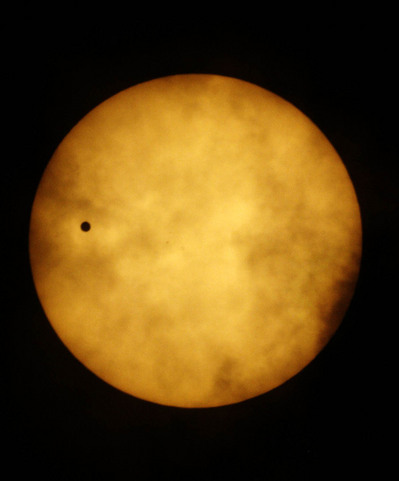
Venus will pass across the sun and be visible from Ann Arbor starting at 6:04 p.m. Tuesday.
AP Photo
The last visible passes before that were in 1882 and 1874.
And astronomers predict it wont happen again until 2117.
"It's about every hundred years and it occurs in pairs," explained Bregman. "It's a slow thing, it takes hours to go across the sun."
Seven hours, to be exact.
Starting at 6 p.m. Tuesday U-M will have telescopes lining the roof of Angell Hall, as well as the sidewalks near Detroit Observatory at Ann and Observatory streets in Ann Arbor. The telescopes will be set up until 9 p.m., or shortly before the sun sets. U-M will also stream Venus' passing in Angell Hall Auditorium B.
Venus orbits the sun every year. It passes between the Earth and the sun every 564 days; however, Venus' orbit is rarely visible because it doesn't move on the same plane as Earth.
"When you look very closely their orbits are tilted relative to one another," Bregman explained. "If you think of two dinner plates that are tilted to one another, there is a point when the two dinner plates line up."
That point is called a node.
A similar phenomenon occurs during lunar eclipses, when the sun, Earth and moon align briefly and the Earth's shadow blocks out the moon.
But Venus' orbit of the sun takes much longer than the moon's orbit of Earth, and thus Tuesday's glimpse of Venus passing across the sun is more rare than an eclipse.
Bregman recalls watching Venus pass across the sun in 2004.
"I saw it from the roof of Angell Hall. We had a lot of people up there and violated fire code," he said.
From Earth, Venus appears to be roughly one-thirtieth of the sun's apparent width. Its transit will be visible using the naked eye Tuesday, although Bregman suggests looking through smoked glass in order to avoid staring directly at the sun. Venus will look like a small dark disk passing across the sun's surface.
"It's nice, it's so rare and it's of historical interest because people tried to use it in science," Bregman said. Astronomists throughout history have used the orbit of Venus to try to determine the size of the solar system. "You're probaly going to look at it and say 'Well that's pretty interesting,' but you're not going to fall over and weep."
Kellie Woodhouse covers higher education for AnnArbor.com. Reach her at kelliewoodhouse@annarbor.com or 734-623-4602 and follow her on twitter.
Comments
kathe
Wed, Jun 6, 2012 : 1:45 a.m.
http://events.slooh.com/ Here Is a cool site of live feeds of the event from around the world.
Madeleine Borthwick
Wed, Jun 6, 2012 : 12:49 a.m.
Thank you, annarbor.com!!! I was able to get some really neat pic's which will be stored every way imaginable. I am hoping that someday my grandchildren will be able to show their children these pictures. So. from a grateful wife/mother/grandma, on behalf of my family, thank you many millions of times over for making me aware of this event.
Tesla
Tue, Jun 5, 2012 : 9:39 p.m.
Looks like the cloud cover is going to ruin this for the enthusiasts. Gah!
Madeleine Borthwick
Wed, Jun 6, 2012 : 12:51 a.m.
WRONG, TESLA. you should see some of the pictures I got from the live feed from the roof of Angell hall. NYAAAAAAAAH!!!!
Bertha Venation
Tue, Jun 5, 2012 : 8:43 p.m.
I see a bad moon a-risen'
bedrog
Tue, Jun 5, 2012 : 8:25 p.m.
'astronomist'....is that like a 'geologer' only with outer space???
Billy Bob Schwartz
Tue, Jun 5, 2012 : 7:36 p.m.
I looked at the picture in the article. Nice. Next!
treetowncartel
Tue, Jun 5, 2012 : 7:15 p.m.
Nice, this along with Roger Waters performing "The Wall" tonight could make for one heckuva Cosmic Charlie kind of evening. I sure hope Quinn arrives by dinnertime.
Rugeirn Drienborough
Tue, Jun 5, 2012 : 6:13 p.m.
I'm glad somebody de-hyped this thing at long last. Yes, it's a very interesting astronomical event, but visually, it's just a little black spot very, very slowly crossing the sun. Kinda like watching grass grow. Also, it has no significance. It's just an alignment that happens occasionally because the orbits of the Earth and Venus happen to be the way they are. Kinda like the way two buildings happen to line up if you look at them from just the right spot. It doesn't mean much. It's just kinda cool.
Woman in Ypsilanti
Tue, Jun 5, 2012 : 5:34 p.m.
What?!? This isn't going to make me fall over and weep. Well forget it then ;)
GeeWhiz
Tue, Jun 5, 2012 : 5:25 p.m.
Hmmm - is this finally going to help men understand women better or take another 100 years since men are from Mars and women from Venus?
Jojo B
Tue, Jun 5, 2012 : 6:44 p.m.
Could have been funnier if you didn't spell out the punchline too much.
Dan
Tue, Jun 5, 2012 : 3:39 p.m.
I've heard conflicting reports about the safety of smoked glass for sun viewing. Welder's glass is supposed to be safe.
Mike S
Tue, Jun 5, 2012 : 7:14 p.m.
Arc welding helmets would filter some or all of the UV; not sure about regular gas welding goggles.
Madeleine Borthwick
Tue, Jun 5, 2012 : 5:53 p.m.
Dan, thank you for the info! maybe I can use my husband's welding helmet.
dotdash
Tue, Jun 5, 2012 : 3:33 p.m.
Thanks for posting this article. I would have missed it.
Paul Wiener
Tue, Jun 5, 2012 : 3:24 p.m.
Strange. I just finished reading Shirley Hazzard's great and award-winning novel, Transit of Venus!
Nicole Casal Moore
Tue, Jun 5, 2012 : 2:11 p.m.
a2gretta, I know that it will be broadcast on NASA TV. Details at http://venustransit.nasa.gov/transitofvenus/
a2gretta
Tue, Jun 5, 2012 : 1:20 p.m.
Is there any chance a view through a telescope can be live broadcast on UM television for those who can't come to the viewing areas today?
mkm17
Tue, Jun 5, 2012 : 1:14 p.m.
We've made a pinhole viewer and are all set for the transit. Thanks for the article!
zeeba
Tue, Jun 5, 2012 : 12:15 p.m.
Hopefully, it will be clear but hazy, so the transit will be directly viewable for a brief period at sunset. I got up early to watch the 2004 transit, which occurred at sunrise here, and Venus looked like a beauty spot on the red face of the sun. Of course, I could only watch for a few minutes until the sun rose out of the haze and became too bright to look at.
discgolfgeek
Tue, Jun 5, 2012 : 12:11 p.m.
Correction: Venus is roughly 1/113 the size of the sun.
Julie Baker
Tue, Jun 5, 2012 : 1:27 p.m.
We've reworded that sentence. Thanks.
treetowntenor
Tue, Jun 5, 2012 : 1 p.m.
Kellie - that doesn't fix the problem. What you actually wrote was that Venus is 1/30 the size of the sun: "Visually, Venus is roughly one-thirtieth the size of the sun's apparent width".
Kellie Woodhouse
Tue, Jun 5, 2012 : 12:37 p.m.
Thanks for reading! I added the word 'visually' to make the sentence clearer.
zeeba
Tue, Jun 5, 2012 : 12:19 p.m.
Actually, it's about 1/1000th, the same as Earth - but visually, it covers about 1/113th of the sun's disk, or is about 1/30th as wide as the sun, so you're both correct and wrong at the same time.