

Q&A with Susan Martin: Eastern Michigan University president talks about state budget cuts
Growing up on a Michigan dairy farm set the stage for Eastern Michigan University President Susan Martin. After taking a test in high school and scoring well, she earned a scholarship that paid her tuition and fees at Central Michigan University. She was a first-generation college student in her family, and following graduation ended up only $1,000 in debt.
Upon my own graduation from the University of Michigan in 1983, it took two full-time jobs and eight years to pay off my student loans. Higher tuition costs impacted by dwindling resources are strapping today’s students and colleges at an even greater rate.
Dr. Martin recently appeared before lawmakers in Lansing, making an impassioned plea against the proposed cuts in state funding aimed at Michigan universities. She joined my colleague, Dean Erskine, and me on 1290 WLBY one morning this past week.
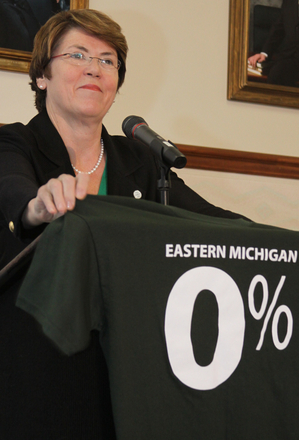
EMU President Susan Martin is shown last spring displaing a 0% T-shirt signifying the university's tuition freeze for the 2010-11 school year.
Ronald Ahrens | For AnnArbor.com
Dr. Martin: Well it’s a very difficult impact. As you know, we’ve held the line on tuition. We haven’t been doing increases of 5-7 percent, or anything like that. In fact, last year we did zero, zero, zero tuition, room and board, while still investing in facilities like the science complex, renovating resident halls, living and learning communities, hiring new faculty, and increasing financial aid. Now to absorb a 20 percent cut in our state appropriation is draconian. We expected some cuts, but nothing in the size of 20 percent. I know the governor says he’ll reinvest in the future of higher education but to put it in perspective, our appropriation has gone from about 70 percent of our funding over the past 20 or so years down to about under 20 percent next year. We currently get $76 million and this will cut it to about $61 million. Let’s say things go well in fiscal 2013 and they reinvest in higher education; that would probably be a 2 percent increase, which would get us back to $62 million, maybe $63.5. I’ll be long retired if we ever recover to $76 million, even if there is an intent to reinvest. We will have to do some serious work to figure out what we are going to do to absorb this cut without damaging our students’ education and trying to keep it affordable.
Lucy Ann: Dr. Martin, that drop in state appropriations from $76 million to $61 million, how does that contrast to your overall budget?
Dr. Martin: Our overall budget is about $280 million, so it’s about a 4-5 percent reduction.
Lucy Ann: The majority of your funding comes from tuition?
Dr. Martin: Yes, from our students. As states reduced their funding support over the last several years, we are now 50th of the 50 states in support of higher education. With this newest cut that will assure we hold that title in the indefinite future.
Lucy Ann: Are you considering a tuition increase at EMU?
Dr. Martin: We will have to consider that. We are working very hard to come up with a recommendation for our Board of Regents. We would like to keep it as low as possible but would also like to provide an educational environment and financial aid to support our students, so we have to invest in things that will give them a cutting edge education that is going to make them competitive in the workplace.
Dean Erskine: Dr. Martin, the University of Michigan has a cash cow in its athletic department that funds their athletic teams. EMU does not. Could there be anything on the table that would cut athletics?
Dr. Martin: Well, that’s a very small portion of our budget - it’s only $10 million. I think at all the MAC schools we try to provide our athletes with an opportunity to participate at a very modest price to the university. Many of these students have higher graduation rates than our overall population, and they are a great addition to our campus. Many of them are paying full tuition fees and are not on scholarships. We will work at making our two key sports - football and basketball - more competitive and revenue driven to support athletics. I’m not sure even Michigan is self-supporting. I think there are only a couple schools in the country that are.
Lucy Ann: So you are not planning to make changes to athletics?
Dr. Martin: We’ll do some reductions in athletics and all of our areas, but the potential there to reduce anything is insignificant compared to other things we can do. For instance, we are analyzing our purchasing. What do we buy, how can we get it at an affordable price. I think there are a lot of other opportunities that would be better for us to look at than to fool around with dropping athletics, which could cost us a lot of money in the long run.
Lucy Ann: Gov. Rick Snyder has made it very clear that some money can be made up by reconstructing how we do education in Michigan. Talk about the cost-saving tactics you have already made at EMU.
Dr. Martin: Well, we reduced our employees over the past several years - our staffing levels by 140. More significantly in terms of health insurance, we have about 75 percent of our employees that are paying approximately 20 percent of their overall health costs. That is a big change that we recently negotiated. We will be looking at that as we approach upcoming contracts. We’ve reduced our energy costs a couple of million dollars and we did a pay freeze for top administrators. We’ve shown that we’ve controlled costs by keeping tuition affordable, and unfortunately there hasn’t been much reward.
Lucy Ann: What kind of response did you get from the Legislature?
Dr. Martin: Overall, positive. But I think there seems to be a sense in the Capitol of rolling up the budget and just voting on it with large cuts. We’ll see what the Republican Caucus and Senate come up with in their budget proposal. It’s discouraging, to be honest with you, because this state is falling behind in college degrees and education is the future. When you look at states with good populations, half their adult population has college degrees. Michigan is at about 34 percent. If we were to graduate over a million people with college degrees, a little over 9,000 a year, by 2025 we could get 60 percent of adults. Giving higher education a 20 percent funding reduction is going to make it difficult. It is going to raise costs for students and not a lot of people will be able to afford going to college. It will be not a ticket to the middle class, but a privilege to go to higher education in Michigan.
Lucy Ann Lance is co-owner of Lance & Erskine Communications, which produces “The Lucy Ann Lance Business Insider” (M-F, 8 a.m.-11 a.m.) and “The Lucy Ann Lance Show” (Saturdays, 9 a.m.-12 p.m.) on 1290 WLBY. The programs are live streamed at www.1290WLBY.com, and podcast on www.lucyannlance.com. The complete audio interview with Dr. Susan Martin is posted on her website.
Comments
Macabre Sunset
Sun, Mar 27, 2011 : 3:31 p.m.
Did it ever occur to macjont that maybe both the Democrats and Republicans are run by extremists who have very specific, self-serving agendae? There was a time when a university campus was a place for diverse thought and innovation. Not today. Today, there is an Orwellian control over diversity, and you have to evade a minefield of thought police to get a good education.
macjont
Sat, Mar 26, 2011 : 11:09 p.m.
Macabre says: "Unfortunately, this is the result of college campuses being campaign headquarters for one party. It's an unlikely coalition - college professors and union leaders." Did it ever occur to Macabre, and anyone else who shares this view, that college campuses take positions favoring one party because evidence, facts, and logic, intelligently viewed, favor those positions?
Technojunkie
Sat, Mar 26, 2011 : 7:48 p.m.
Bring EMU's admissions and grading standards back up to what they were 20 years ago and state appropriations would go a lot farther. This notion that everyone should go to college is a scam. It used to be true that a college degree added substantially to earnings but that was only true because students qualified for university were smart to begin with. Sorry, but most people are better off going straight to work after high school. Vast amounts of resources are being squandered pretending otherwise. And it's pretty obvious that having so many more MBAs has not been beneficial. Worse, vocational training has been gutted to support this must-get-a-degree ideology. I suppose that doesn't matter so much since the MBAs shipped so many such jobs overseas, but still. All that said, Dr. Martin is the best EMU president I can remember. Digging out of the mess her predecessors made is going to take a while.
Cash
Sat, Mar 26, 2011 : 8:25 p.m.
What was the EMU admission standard in 1990 and what is it now?
Macabre Sunset
Sat, Mar 26, 2011 : 7:05 p.m.
Cause and effect isn't often taught at modern universities. Higher education has a value, but it's not easily measured. Universities are being watered down by the thought control that's substituting for liberty and independence these days. There is no diversity of thought on today's campuses. And this is having an effect on the quality of the education. As for the article, what it illustrates is that if a group becomes 100% beholden to one extremist party, when the other extremist party takes control of the government, handouts disappear. She should have put all her eggs in one basket. Her response to the last question was very telling - Republicans are her bogeyman, as is the case for most who live in the ivory towers.
Macabre Sunset
Sun, Mar 27, 2011 : 5:43 a.m.
It was her statement, not mine. It's what's being taught at the university and her influence that matters here, not the makeup of the board.
Cash
Sat, Mar 26, 2011 : 7:13 p.m.
You do realize her entire board is almost all Republican don't you?
Cash
Sat, Mar 26, 2011 : 6:45 p.m.
Macabre: "What is the value of an education watered down by concepts like equal outcome rather than equal opportunity? Teaching to the lowest common denominator? Focusing on social engineering rather than an education that will prepare you to earn a living?" Value of an education: WASHINGTON (AP) -- How much is a bachelor's degree worth? About $23,000 per year extra. That is the average gap in earnings between adults with bachelor's degrees and those with high school diplomas, according to data from the Census Bureau. College graduates made an average of $51,554 in 2004, the most recent figures available, compared with $28,645 for adults with a high school diploma. High school dropouts earned an average of $19,169 and those with advanced college degrees made an average of $78,093.
Macabre Sunset
Sat, Mar 26, 2011 : 5:59 p.m.
Unfortunately, this is the result of college campuses being campaign headquarters for one party. It's an unlikely coalition - college professors and union leaders. But it makes decisions rather easy when it comes time to cut the budget. With higher education becoming so politicized in recent years, the value of that education is undoubtedly lower. Why help a company when its primary goal has become churning out kids who are hostile to you? And make no mistake about it, universities are gigantic companies that receive a large public subsidy. What is the value of an education watered down by concepts like equal outcome rather than equal opportunity? Teaching to the lowest common denominator? Focusing on social engineering rather than an education that will prepare you to earn a living? Martin states that her goal is getting 60% of Michigan's adults a college degree. That's a big part of the problem with higher education. The "higher" is being removed (and thus, so is the "hire"). To reach that goal means making a big piece of what a university traditionally does irrelevant. We already have trade schools. They need to be emphasized and university professors need to focus on their expertise rather than their politics. Until then, I am completely in line with these budget cuts.
Audion Man
Sat, Mar 26, 2011 : 8:09 p.m.
Can the report abuse link be used to report an abuse of logic and reason?
Cash
Sat, Mar 26, 2011 : 6:32 p.m.
No idea where you got this from the article above...wow! However, the funding cut is the same for all state schools. And yes, let's keep all but the elite in their place. Send them to trade schools. Oy!
DBlaine
Sat, Mar 26, 2011 : 6:25 p.m.
I couldn't agree with you more. When one party is so hostile to knowledge and understanding, it's difficult for us as a nation and state to move forward. I mean, just look at the undergraduate majors at Eastern! Accounting! Obviously a liberal trick. Cell biology. We know where that's heading... Health administration! Can anybody say Death Panels!!! Written communications! Only liberals would teach how to write. Don't they know we'll all communicate by twitter post in two years! and education. Well, don't get me started on that one! It's really unfortunate that anybody ever makes the connection between education and income. Of course, that's just what the studies at the Bureau of Labor Statistics do, but we all know that's an Obama administration trick. <a href="http://www.bls.gov/emp/ep_chart_001.htm" rel='nofollow'>http://www.bls.gov/emp/ep_chart_001.htm</a>
Cash
Sat, Mar 26, 2011 : 2:55 p.m.
A very thoughtful interview...good questions and answers. Maybe it's not what we want to hear, but we need to hear it. And in defense of EMU, they have in my opinion, been very frugal for several years now. And I was really disappointed that after holding the line on any increases last year, they received nothing in the form of recognition for it....even a pat on the back from Lansing - either party- was deserved, but not received. In fact funding for construction was given to UM instead of EMU this winter. Wow.