

Faith & Politics: Seek to understand, or to be understood?
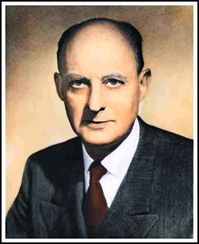
Reinhold Niebuhr
Greg Garrett’s Faithful Citizenship is the new book we’ve considered all week: how politics trumps faith, that God should come before country, how we rise and fall together as a society, and the model of faithful citizenship as an answer to the deep divide in politics and religion. We end the week today by continuing to talk about what faithful citizenship means.
Do we first seek to understand, or to be understood?
From Greg’s book:
“We might remember the life of Reinhold Niebuhr, once America’s most renowned religious thinker, a sort of theological celebrity.… What Niebuhr offers us above all is a sense of intellectual restraint, fairness, thoughtful consideration. As E. J. Dionne pointed out at a panel on the resurgence of Niebuhr (President Obama’s favorite theologian), ‘Niebuhr is the person we turn to for balance. We turn to him when things get out of hand. He is a critic of the left’s utopianism and he’s a critic of the right’s tendency to deify our own country….One great Niebuhrian quote should hang over all seminars. Niebuhr once said ‘We must always seek the truth in our opponents’ error, and the error in our own truth’.’”
This excerpt reminded me of Habit 5 in Steven Covey’s bestseller, The 7 Habits of Highly Effective People: “Seek First to Understand, Then to Be Understood.” Most often, Covey points out, we focus on the second part—trying to get our point across. Only after that do we (sometimes) attempt to understand the other person. Reflect on current political debates and advertisements. Do they seek to understand the other person? To see truth in what the other says?
Seeking first to understand puts the onus on each of us to understand the other person’s position, motivation, and reasoning—no matter how we disagree at first. Wouldn’t it be refreshing to have Republicans and Democrats first seek to understand?
Do you know of any political figures who first seek to understand?
Do you agree that seeking to understand should be the first objective?
What conclusions have you reached after our discussion this week?
Dr. Wayne E. Baker is a sociologist on the faculty of the University of Michigan Ross School of Business. Baker blogs daily at Our Values and can be reached at ourvaluesproject@gmail.com or on Facebook.
Comments
KMHall
Fri, May 18, 2012 : 11:57 p.m.
If "being effective" was the primary goal, then the politician might take this advice. I think that getting elected and hanging onto power, by whatever means, are the first priorities.
mermaid72
Fri, May 18, 2012 : 3:19 p.m.
You don't need to be a "Good Christian" to be an good American citizen or even a good person. That's really what Mr. Baker needs to understand. American is made up of many different beliefs and even non-beliefs. All of them should be separate from politics. Period.
arborani
Fri, May 18, 2012 : 10:47 p.m.
Amen to that.