

Government must close Chicago locks to halt dangerous Asian carp invasion
Michigan has seen its waters invaded by zebra mussels and goby. But a far greater threat is headed toward the Great Lakes, and we’re rapidly running out of time to halt it.
As invasive species go, the Asian carp is a menace out of a B-grade horror movie. These fish can weigh 60 pounds or more and are known to leap out of the water and crash into boaters and fishermen, causing serious injuries. Of far graver concern, however, is their potential impact on the Great Lakes ecosystem.
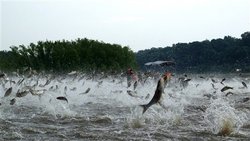
These giant, fresh-water carp have been called “locusts of the river’’ because they devour plankton, the base of the food chain for other aquatic life, decimating native species. They have wreaked havoc as they’ve worked their way up the Mississippi River into Illinois. Now, they’ve been found near Chicago in the Des Plaines River, which puts them within striking distance of Lake Michigan. The International Joint Commission calls Asian carp the “foremost threat to the biological integrity of the Great Lakes.’’
The migration of this invader must be stopped now, and we are convinced that best available solution is a closing of the locks of the Chicago Sanitary Ship Canal, at least temporarily, while other measures are considered and put in place. The man-made canal connects Lake Michigan to the Des Plaines River, and represents our last chance to keep the carp from advancing. Michigan and other Great Lakes states have pushed aggressively to close the canal.
The state of Illinois and the U.S. Army Corps of Engineers oppose the closing, saying it would disrupt commercial shipping and pose a flooding risk. Those concerns are legitimate, but not insurmountable, and the case for keeping Asian carp out of the Great Lakes is more compelling. It is essential that the federal government step into this dispute and take the steps necessary to protect the world’s largest fresh-water supply before it’s too late.
|
To sign a petition asking the U.S. Army Corps of Engineers to close the locks in the Chicago Sanitary Ship Canal, go to |
Though many people living in Michigan have been slow to become aware of the peril posed by Asian carp, the threat has been clear for a decade. Since 2002, the Army Corps has operated an underwater electronic barrier designed to keep carp from entering the Chicago canal, and a second barrier was completed in 2007. But the International Joint Commission and many other groups fear that the barriers could be breached by a power outage or a flood
They are adamant in saying that nothing short of a physical separation of the Des Plaines River from the Chicago canal can guarantee that Asian carp will be halted. Last week, Michigan Gov. Jennifer Granholm was in Washington, D.C., to meet with key officials from the Obama administration to discuss the need for urgency in addressing the issue of Asian carp.
In conjunction with that meeting, the White House Council on Environmental Quality announced a $78 million plan to protect the Great Lakes from carp, but Granholm called the plan disappointing and inadequate, and we agree. While the federal government has understood the threat of Asian carp, its response has been glacially slow. More studies and more promises of preventive measures to come are no longer enough. The crisis is at our doorstep today.
Michigan and other states are currently before the Supreme Court, trying to win a closing of the Chicago locks. U.S. Rep. Dave Camp, R-Midland, also has introduced legislation to accomplish the same thing.
The threat that Asian carp pose to the Great Lakes is real and potentially catastrophic. There have been estimates that it could compromise billions of dollars in economic activity and 800,000 Michigan jobs. If the surest chance of stopping the carp right now is to close the Chicago locks, then close the locks and protect our lakes while we still can.
Comments
RobertinSaline
Mon, Feb 15, 2010 : 10:28 p.m.
Commericialize this fish - no fishing license required to harvest Asian Carp - these fish would quickly disappear from rivers and lakes. Use the federal dollars for a fish processing plant - more jobs & more food; the asian carp is often used in ethnic cooking - surely we can export something back to China?
Brian
Mon, Feb 15, 2010 : 1:19 p.m.
Yes, they do jump. Not only when they are agitated by an eletrical current but also from the whine of a propeller under water. When a boat is on plane and the engine is wound up, they can jump into the path of the boat. (Of course, when there is an electrical current, they are all jumping out of the water at once, not just a few at a time.) Just review the the videos on You Tube, or read some of the other articles that hve been published. I also feel it is too late for the Great Lakes since our beloved politicians have to have their little battles instead of doing what is right. Yes, it would hurt the shipping, but then again, maybe we could hold the fish farms accountable down south that utilize the carp to keep their ponds clean?
tdw
Sun, Feb 14, 2010 : 8:02 p.m.
BTW carp junp. Just go to Ford or Belliville lake in the summer and you will see them jump every where, its whats they do
tdw
Sun, Feb 14, 2010 : 6:24 p.m.
Actually they do jump I've seen it on sportsmans/nature shows before the electric barriers were even tried
dfossil
Sun, Feb 14, 2010 : 6:12 p.m.
Since it is clear that Washington will play politics with this issue and delay with committees & studies until it is too late as they ALWAYS do, Why isn't our State asking Canada to intervene on the international scene? They have as much if not more to loss the we do!
tdw
Sun, Feb 14, 2010 : 5:03 p.m.
Do they have visas or green cards?
mike from saline
Sun, Feb 14, 2010 : 4:32 p.m.
first they came for the lamprey eel's, and I remained quiet, because I wasn't a lamprey eel. Then they came for the zebra muscles, and I remained quiet, because I wasn't a zebra muscles, and then they came for the Asian carp and I remained..........OK, you can prob- ably see where I'm going with this. God, I love this blogging.
Duane Collicott
Sun, Feb 14, 2010 : 3:17 p.m.
The supreme Court has decided against an emergency measure to close the canal, and with Obama being from and indebted to Chicago, who wants the locks to stay open regardless of the damage, there is little chance that the plan he proposed last week will have any bite in it.
TripleVSix
Sun, Feb 14, 2010 : 3:07 p.m.
Longfellow and mike are right. Those who oppose the migration of these fish are definitely just specieist haters. These fish are only doing the job (jumping out of the water) that American fish won't do.
mike from saline
Sun, Feb 14, 2010 : 2:40 p.m.
Dear Longfellow. Not only do they come here to make a better life for themselves and there family's, but they make an important contribution, by adding to the "rich diversity" of the Great lakes.
tdw
Sun, Feb 14, 2010 : 12:03 p.m.
@Alan I dare to say that there are a lot of folks in this area that use the lakes and parks quite often.And we all do live in the "Great Lake State"
Alan Benard
Sun, Feb 14, 2010 : 11:36 a.m.
Way to take a stand on something which affects your service area minimally and which costs your reputation nothing, no matter the outcome. Gutsy.
Bill Wilson
Sun, Feb 14, 2010 : 9:57 a.m.
Tony and all of you negative people should be ashamed of yourselves. These carp are no different than any other immigrant: they're only coming here to try and make a better life for their families. Who are we to stop them?
The Picker
Sun, Feb 14, 2010 : 9:45 a.m.
Has anyone come up with any good recipe for these beasts? We have fished a species out of existence before.
tdw
Sun, Feb 14, 2010 : 9:29 a.m.
Thus far Oboma has refused to have the locks closed and I'm sure this will bring out posters to defend their messiah
Jim Pryce
Sun, Feb 14, 2010 : 9:11 a.m.
I have info I received from the Michigan United Conservation Clubs that there is a public hearing scheduled for Wed. Feb. 17th at the Marriott at Eagle Crest in Ypsilanti 1275 S. Huron from 3pm-6pm. The discussion will be about plans & recommendations on control efforts of Asian Carp. Senior Representatives from the International Joint Commision, the U.S.Enviromental Protection Agency, U.S. Fish & Wildlife Service, U.S.Army Corp of Enginners, U.S. Coast Guard, Great Lakes states, provinces, municipalities,and tribes(invited) White House Council on Enviromental Quality, and scientific experts.The meeting will also be available via live web stream at http://epa.gov/greatlakes/live. Those who cannot attend the meeting in person can submit questions on the website. When available, the framework and a transcript of the meeting will be posted on http://www.asiancarp.org/regionalcoordination.Comments on the framework can be also submitted online at the web site above. Please visit & sign the online petition at www.stopasiancarp.com
jondhall
Sun, Feb 14, 2010 : 8:52 a.m.
Where are Senators Levin and Stabenow? Just keep electing them, they have done absolutely " nothing " for the state of Michigan since going into office. Come on Debbie strut your stuff, show them where you are from! It appears our Governor can not stand up to them! these is only congress do not take them seriously, please let's do something this time!