

Overgrown lawns, excessive landscaping can prove problematic for many motorists
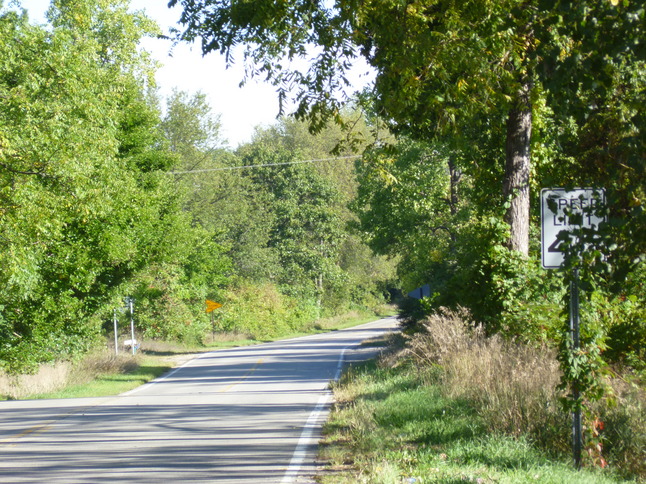
One of the many traffic signs blocked by excessive foliage and overgrown grass.
Richard Kinsey I Guest Columnist
This summer's drought made my lawn look like an ugly beige savannah and made me glad for the crabgrass in my lawn, because it was the only part of the lawn that was green. It seems that drought the Midwest felt all summer would have eliminated some of those vegetation hazards, but it was not so.
In fact, for the last two or three years there have been a lot more road signs that have been obstructed by vegetation. Perhaps cutting the grass and weeds on the side of the roadway took on less priority with the loss of state revenue sharing and the tightening of local budgets.
It makes sense that administrators would figure trimming the grass and weeds half as much would similarly cut their strained budget by half. However, what are the long-term costs?
In years past while on patrol, officers would radio to communications if vegetation was covering regulatory signs. It behooves us all and keeps us much safer when grass, weeds and other vegetation are cut back. The sooner motorists can spot signs that warn of danger or intersections, the more time drivers have to react those hazards.
Traffic courts have acknowledged this problem. When motorists who are ticketed for various violations like speeding or running stop signs can show the court with photographs or videos they reasonably could not react to a sign that was blocked by vegetation, the courts dismiss the traffic violation.
For this reason, officers are taught to make sure regulatory signs are in place and visible prior to taking enforcement actions in an area. If signs are missing or covered by vegetation, officers are instructed to report the problem so that the proper road commission or street authority — in Ann Arbor the “Sign Shop” or Forestry section — can correct the problem.
Another problem that did not happen ten years ago was “ornamental grass” blocking the view of drivers pulling out past the tall stalks. What is now viewed as lovely ecologically-friendly landscaping alternatives used to be called “noxious weeds.”
When ornamental grasses are placed on lawn extensions, they become OB-noxious vision obstructions for drivers — especially when they are near intersections. Furthermore these ornamental grasses must not be considered “turf grass” because Ann Arbor City Ordinance states: “On private property, no turf grass shall be permitted at a height greater than 12 inches.”
Furthermore near intersections the ordinance states: “Vegetation adjacent to intersections shall be maintained to allow for adequate sight distance.”
Most jurisdictions have similar ordinances or statutes. These ordinances are not just to give the community a neat and tidy appearance, but there are practical considerations as well.
Municipalities have found that vacant lots that were not mowed became fields of long grass. The long grass could hide a lot. Unattended vacant lots with tall grass often become ad hoc trash dumps, which invite vermin.
From a police standpoint, the areas of heavy vegetation also invite criminals. The vegetation can conceal the actions of criminal predators who can hide from or pull potential victims into brush and be invisible from the street.
If you enjoy landscaping with ornamental grasses, bushes or shrubs, further out and away from your home, remember to be a good neighbor. Make sure whatever you plant will not block the view of your neighbors as they back out of their driveways.
Neighbors backing out of driveways not only have to see oncoming cars, but well before that they must see what is coming down the sidewalk. Pedestrians, children on bikes, trikes, Big Wheels, skateboards and scooters can all be hidden by dense shrubs or jungles of ornamental grass. Be considerate and talk to your neighbors before embarking on a grand botanical, ecologically friendly, landscaping extravaganza. Your idea of beautiful may be your neighbor’s vision obstruction or blind spot.
Looking ahead to old man winter, I am hoping the drought that caused less mowing and trimming near the roads can be used to buy more salt and fund road crews this winter. You will recall many road commissions were warning the public that, due to budget cuts, they did not have the money to keep the roads as clear as they had in the past — and last winter was incredibly mild.
The longterm forecast from the Farmer’s Almanac calls for a colder winter, but less than average precipitation. Maybe those who administer the budgets of the winter road crews will luck out again. If they do I hope those administrators can save that money in a slush-fund — pun intended — for subsequent years. Remember as old timers will tell you, “It always rains after a dry spell.”
Lock it up, don’t leave it unattended, be aware and watch out for your neighbors.
Rich Kinsey is a retired Ann Arbor police detective sergeant who now blogs about crime and safety for AnnArbor.com.
Comments
Epengar
Sat, Sep 15, 2012 : 3:22 a.m.
In case you want to actually do something about this problem, instead of just whining about how things aren't like they were in the good ole days, or having a hearty group-crank in the comments section, here are some ways that you could get off your behind and contact your local government: the place to start in the City of Ann Arbor is the Online Citizen Request form: (even has a specific request type: "grass or vegetation on private property too long" http://www2.a2gov.org/A2CSR/CSRRequest.aspx or just call them: (734) 794-6320 in Ypsilanti, you can submit a request through their Action and Request Center: http://www.cityofypsilanti.com/ActionRequestCenter or call the Department of Public Services http://www.cityofypsilanti.com/Government/Departments/PublicServices In Pittsfield Township you can submit a request for code enforcement: http://www.pittsfield-mi.gov/Ordinance_Enforcement.html I guess in Ann Arbor Township and Ypsilanti Township you have to go to the County Road Commission. They just set up a new website in July: http://www.wcroads.org/ContactUs
Myles
Thu, Sep 13, 2012 : 8:12 p.m.
I think we should take better care of our highways because the overgrown grass is an issuer and it just looks ugly. Plus I think there should be street lights on the highways (94, 23,and 14) because it is extremely hard to see at night especially when there aren't that many other cars on the highway and it's just dangerous for the deer that run out and the motorist
MRunner73
Thu, Sep 13, 2012 : 4:56 p.m.
Amazing how the city wants to beautify the city at entry points such as South State Street and wants to plant more tress and proabaly shrubs. Yet, there have been past articles and comments where trees were planted but not properly watered. Now overgrown plants blocking road signs is featured. It is par for the course. Don't expect these overgrown problems to be solved. Yes, cooler weather will eventually solve the problem for the next few seasons. The Old Farmer's Almanac ALWAYS predicts a cold winter. We saw how that turned out last winter.
justcurious
Thu, Sep 13, 2012 : 1:50 p.m.
I agree, but the lack of mowing on the sides of the highways has been going on for years now.
Bugsy
Thu, Sep 13, 2012 : 1:19 p.m.
Thank you, Mr. Kinsey, for highlighting these hazards to drivers and pedestrians. I've noticed the same patterns and cannot understand the neglect by authorities to address these concerns. Also, property owners would be better land stewards and citizens by caring for the safety of others. Do we really have to wait till the leaves drop to see the signs?
Jaime
Thu, Sep 13, 2012 : 12:50 p.m.
Turning left from Madison onto Seventh is always difficult because of the landscaping on the corner.
Brad
Thu, Sep 13, 2012 : 1:39 p.m.
If it's over 36" high just let Community Standards know about it.
Katherine Griswold
Thu, Sep 13, 2012 : 12:35 p.m.
Ann Arbor has overgrown vegetation in the roadway and over sidewalks because the majority on city council, including the mayor, refuses to address the problem in a proactive way. Funding is not at issue; a proactive approach would cost less than the current ineffective, reactionary process. Seekids.org has a link to all the applicable ordinances, recommendations for city council and a benchmark study. As background, Chapter 40, the applicable city ordinance, was amended in 2005, to allow for more "green" in our city. The standard "sight-distance triangle" model used in most progressive cities including Portland and Bolder, was replaced with a reference to "the criteria in the AASHTO (American Association of State Highway Transportation Officials) Policy on Geometric Design of Highways and Streets, 5th Edition (2005), or as subsequently amended." I cannot find this document online and it costs over $200, although I was able to review an older edition in the Ann Arbor engineering department. This makes it very difficult for a citizen to understand the law, yet the ordinance is citizen-complaint based. A staff member who recently examined the overgrown vegetation at the corner of Green and Glazier Way (in response to my complaint) told me that visibility was adequate, as the AASHTO standard applied to drivers. The vegetation blocking visibility in the bike lane was not within the scope of AASHTO standards. Do we have a sight-distance ordinance that excludes non-motorized transportation? Please encourage city council to adopt a sight-distance ordinance with proactive enforcement and clear language for non-motorized transportation, such as those recommended in SeeKids.org.
PhillyCheeseSteak
Thu, Sep 13, 2012 : 12:22 p.m.
Mr. Kinsey - maybe in a future column you can write about the sorry state of lane markings on TOO MANY roads in the Ann Arbor area?
EyeHeartA2
Fri, Sep 14, 2012 : 2:16 p.m.
"Cars scuff off bike lane markings just for fun & to prove ownership" Could you tell me how to do this? I know a few bike lane I would like to scuff off so I have more room for my Hummer.
bobslowson
Thu, Sep 13, 2012 : 4:57 p.m.
Yep, last week got fresh yellow and white paint on the side of my car at Dexter and Stadium...they were re-painting at noon rush hour! Why don't they paint these after dark when traffic is less?
brimble
Thu, Sep 13, 2012 : 2:23 p.m.
The City finally repainted many of the lane markings just last week -- my favorite was the completely faded double yellow on the south side of the Jackson/Maple intersection, between the Roadhouse and Bigby coffee. People regularly make illegal left turns in both directions, perhaps because they never realized that they shouldn't.
a2cents
Thu, Sep 13, 2012 : 1:49 p.m.
Cars scuff off bike lane markings just for fun & to prove ownership
bunnyabbot
Thu, Sep 13, 2012 : 12:58 p.m.
I agree with this one, sometimes, when there is no other traffic, I can turn onto an unfimiliar road and it is "well, I will know where the lane really is at some point". There are a number of streets that as a townie I know shift a bit after an intersection, several on four lane roads, but the car to the right of me drives as if in two lanes, one of which is mine. Extra aggervating in winter when exposed bits of road have no lines showing at all and the left over paint is under the snow.
Brad
Thu, Sep 13, 2012 : 11:58 a.m.
Not to mention that an extension full of "native species" looks just plain bad. If you want to live around weeds move to the country, eh?
Brad
Thu, Sep 13, 2012 : 1:43 p.m.
Also known as "weedscaping".
aanative
Thu, Sep 13, 2012 : 11:47 a.m.
Totally agree with you Mr. Kinsey, but repeated calls to the City regarding a chronically-offending property have resulted in nothing. Maybe when there's an accident there will come a response.
treetowncartel
Thu, Sep 13, 2012 : 11:44 a.m.
I remember when the city of Ann Arbor planted ginormous plants on the island at the Washtenaw and Stadium Split. You Couldn't see the traffic heading west on to Stadium from westbound Washtenaw when you were coming east on Washtenaw. I agree, it is amazing some times what people plant near their rightaways.
PhillyCheeseSteak
Thu, Sep 13, 2012 : 12:21 p.m.
Now that area is just a bunch of weeds - so unsightly.
Arieswoman
Thu, Sep 13, 2012 : 11:28 a.m.
I cannot even get the City of Ann Arbor to clean up the undergrowth on Eisenhower Parkway! It is hard in a small car to do the turn around on the Parkway with all the scrub growth. I have contacted my council person too! They trimmed it once. Now it has grown back.
Suzanne
Thu, Sep 13, 2012 : 6:14 p.m.
No one has been killed yet...
bobslowson
Thu, Sep 13, 2012 : 1:45 p.m.
Almost got hit by a dear running out of that brush in the median on Huron Pkwy....poor thing didn't know which way to go with traffic on both sides. Luckily everyone stopped so it could cross...
A2Ray
Thu, Sep 13, 2012 : 12:58 p.m.
Good luck, if the invisible women are your ward representatives!!
Buzz
Thu, Sep 13, 2012 : 11:14 a.m.
I still call them noxious weeds.
Brad
Thu, Sep 13, 2012 : 11:53 a.m.
That is so non-PC. They are now "native species".