

Ann Arbor is headed in the right direction with its street repair program
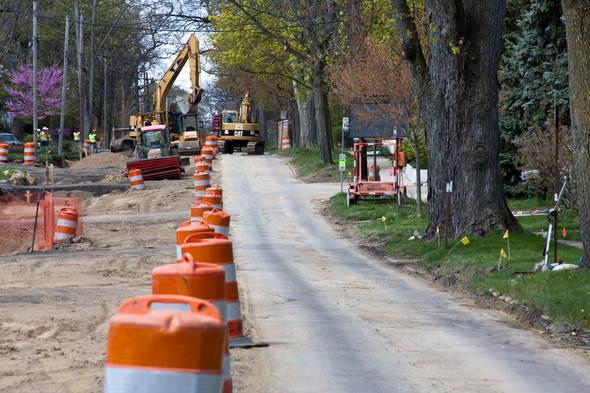
Ann Arbor will see two years of record-breaking street improvement, says City Council Member Carsten Hohnke.
Steve Pepple | AnnArbor.com
Regretfully, Mr. Ranzini relies upon tainted data, tired innuendo, and faulty reasoning to paint a grossly inaccurate picture of the facts and motives behind the city’s approach to investing in infrastructure. Governing a city is serious business. It is best served by positive, fact-based contributions from all; unfortunately Mr. Ranzini chooses to generate heat rather than cast light.
Carsten Hohnke represents the 5th Ward on the Ann Arbor City Council.
Ann Arbor does indeed face challenges with respect to street maintenance. Road revenues have fallen sharply over the years due to the dramatic economic shift in our state and the related decrease in Ann Arbor property values. Meanwhile construction costs have increased significantly. Additionally, as many readers know, Ann Arbor prudently retained millions of dollars in road monies over the past few years in case federal dollars for the Stadium Bridges didn’t come through. They did. Now we will see two years of record-breaking street improvement in Ann Arbor.
Mr. Ranzini suggests that we should have taken on debt to fix our roads, and taken on more debt to fix our bridges. He makes this suggestion without explaining how he would have repaid the bonds. Taking on unnecessary debt would have been deeply irresponsible. If we had followed that advice and borrowed to fix the bridges, we would have left $14 million of resources on the table. Would we be better off paying $14 million plus interest over the next few years to fix the bridges? Or will we be better off using the competitive federal grants that we won to fix the bridges, and using our future tax receipts to fix the roads? The answer is obvious.
Mr. Ranzini’s tired attacks on (and silly nicknames for) the Municipal Center and the Library Lot are also misguided. Each of these projects will be paid for from revenue streams or cost savings generated by those investments. Neither investment has an adverse impact on the General Fund or our ability to deliver safety services and street maintenance.
Additionally, Mr. Ranzini’s characterization of these projects as “boondoggles” is false. Ask the police who are out of their over-crowded, decrepit basement stationhouse, that was intended to be temporary when set up in the 1960s, whether the Municipal Center is a boondoggle. Ask the District Court that lost its space at the county building and now has a home from which it can operate in a professional, secure manner, and from which it can realize efficiencies from its proximity to the police. Most of all, look forward to 2038 when the Municipal Center is paid off and the city will be able to enjoy decades of rent-free savings thanks to our investment. Boondoggle? For whom? No, this was wise investment.
With regard to the Library Lot, ask the merchants clamoring for additional parking whether the 600 new spaces are a luxury. Ask the businesses who want to relocate in our award-winning downtown and create jobs, but cannot due to insufficient parking. Luxury? For whom? No, this was a wise investment.
Mr. Ranzini then appears to be frustrated by the potential of bike lanes being added to Jackson Road. He pretends that Ann Arbor bases its transportation planning on a vision of a “car-less, pedestrian, and bicycle ruling elite city.” This is pure demagoguery. Not one person on staff or council believes that non-motorized transportation will supplant the automobile in Ann Arbor or anywhere else. Investing in an underground parking structure is a funny way to advance this elitist bicycling Nirvana.
The move to transition Jackson Road from four lanes to three was generated by professionals in the interest of vehicular efficiency and safety. The city and MDOT employ traffic engineers with decades of training and expertise. Traffic design is not something that a bank president (or City Council member) can simply intuit. You wouldn’t build a home without consulting a professional - why would you ignore expertise when building a road?
MDOT and Ann Arbor’s traffic professionals are uniform in their assessment that the transition on Jackson Road from four lanes to three will improve traffic flow and substantially increase safety. The engineers know about rush hour, garbage pickup, bus stops, and left hand turns. They have modeled these factors thoroughly, and validated their assessments with direct experience from successful road dieting on Packard, Platt, and Stadium. We used to suffer from 25 accidents a year on Platt; now we average less than 10. It would be irresponsible not to take advantage of advances in traffic safety.
We have a lot to talk about in Ann Arbor. We have serious decisions to make. We can only find the best solutions together if the public debate rests on accurate facts and clear thinking. Mr. Ranzini’s recent effort offers neither of these.
Carsten Hohnke is an Ann Arbor City Council member representing the 5th Ward.
Comments
say it plain
Tue, May 1, 2012 : 2:52 a.m.
I'm sorry...I got through the first couple of sentences of this silliness from Hoenke before I had to stop reading... I don't care *a whit* what he claims a biased survey found about Ann Arbor Roads... I call them as I feel them, and the roads in Ann Arbor *are terrible*, worse than surrounding communities by far. Michigan in general is bad, but Ann Arbor *in the last five to seven years* has managed to be crazy-stupid-shake-your-head-in-disbelief bad. Does Mr. Hoenke not drive on them?! Must be... So glad to hear we're about to finally see some fixes, after sitting on money for forever while our cars took such a beating. Glad to hear it will be "record breaking" improvement lol...like, 'breaking the record' Ann Arbor has developed for sitting on unspent road repair funds, exasperating its poor car-driving citizens?!
Left is Right
Sun, Apr 29, 2012 : 1:13 a.m.
While Mr. Hohnke has every right to express his naked opinions in a guest column, that "right" does not automatically make it a wise decision. In general, this piece comes off as saying, "We know best. We've got top people. Top people." I would have far preferred a piece that (1) acknowledges controversy and (2) presents convincing evidence that the best decisions have been made. Instead, we have something written from a weak position that says (as one example) that MDOT and city traffic engineers and simulations are smarter than the rest of us. Really? Ever hear of the wisdom of crowds? (Well, except for lynch mobs, I suppose.) Granted, there's not enough space to provide such evidence in a brief column. (So why write it?) And if council consistently demonstrated thoughtful decisions, I might not need it. But it's my impression that this council has shown a persistent tone-deafness to its constituents as well as a propensity toward making poorly conceived and executed ordinances. The trust just isn't there. This column does nothing to dispel that impression.
Stephen Lange Ranzini
Sat, Apr 28, 2012 : 10:58 p.m.
@Steve Pierce: Between the actual debt and the unfunded pension fund and post retirement fund liabilities, according to the most recent financial audit and adding in the new waste water treatment plant bond, Ann Arbor City is now roughly $620 million in debt. Luckily we are a wealthy city, however ultimately if we keep up this pace of debt accumulation we will also get into trouble. When Mayor Hieftje took office the debt was less than the cash on hand. What I had advocated was a temporary debt to be paid off within a year or two from the balances already in the road millage account which had accumulated a $29mm or $15mm surplus (depending upon whose figures you believe).
Steve Pierce
Sat, Apr 28, 2012 : 9:51 p.m.
" Taking on unnecessary debt would have been deeply irresponsible." -- Carsten Hohnke Too bad the elected leaders in Ypsilanti never learned this lesson. - Steve
Mikey
Sat, Apr 28, 2012 : 9:23 p.m.
what an embarrassing attack brought on by an elected official against a private citizen; so glad I am not an Ann Arbor resident...
hermhawk
Sat, Apr 28, 2012 : 6:53 p.m.
I tend to agree with councilman Hohnke with one major exception, I do NOT like the reduction on Huron Street/Jackson Avenue to 3 lanes. Too much rush hour traffic makes this action an unwise decision. Traffic jams will only make it worse. Why not build sidewalks and use those for the bike lanes; that would make more sense.
G. Orwell
Sat, Apr 28, 2012 : 3:07 p.m.
Google, "Planned Opolis." This is what the privileged class want for us commoners. Unfortunately, the city of AA is complying. This cartoon is actually shown to school kids in England to endoctrinate them about what future life will be like. That this is acceptable and good. It's Orwellian.
DBH
Sat, Apr 28, 2012 : 4:50 p.m.
@G. Orwell, what is it with the repeated (I count 5!) postings on "Planned Opolis?" We get it. Please stop.
G. Orwell
Sat, Apr 28, 2012 : 3:05 p.m.
Google, "Planned Opolis." This is what the privileged class want for us commoners. Unfortunately, the city of AA is complying. This cartoon is actually shown to school kids in England to endoctrinate them about what future life will be like. That this is acceptable and good. It's Orwellian.
Dave Gear
Sat, Apr 28, 2012 : 2:51 p.m.
Mr. Osborne: The new sewage treatment plant is paid for with sewer fees. Again, a funding stream is in place. Major utility work is always paid for this way.
Silly Sally
Sat, Apr 28, 2012 : 5:49 p.m.
@Dave Gear - I advocated that the city should not have immediately obtained a bond, bonded to use your term, but instead waited to see if federal money was coming. You keep repeating, "If the city had bonded for the bridges..." no federal money would be coming True. But you state this as if the city did not have a third choice, which was to wait. I'll spell out the 3 choices: 1) Immediately get bond money for bridges - no federal money for bridges. Money is available for continued road maintenance. 2) Wait for Federal money- do not spend on roads. Use savings for bridge if no federal money ever comes. Roads meanwhile fall further into disrepair. 3) Wait for Federal money- spend money on roads. If no federal money ever arrives, then seek a bond for the bridge. Repay bonds from future income stream from gas taxes. The City chose option 2. Many others advocate for option 3. You keep repeating option 1, which is foolish and no one is advocating.
Dave Gear
Sat, Apr 28, 2012 : 5:06 p.m.
Sally: The city was patient and did the right thing and got the federal award for $15 million. If the city had bonded for the bridges instead of waiting, the federal money would have gone to some other bridge someplace else. The city did the right thing.
Silly Sally
Sat, Apr 28, 2012 : 4:42 p.m.
@Dave Gear says "Bonding for the bridge would have meant missing out on $15 Million in federal funding" NOT TRUE! Perhaps if the bonds had been already in place, but IF the city had been patient and simply waited for federal funds and not seeked a bond, the city would be eligible for the federal money. Then, once it was determined that the feds were never going to give Ann Arbor money, at the same point in time that the city would decide to spend its saved money, it could decide to get a bond. @Dave Gear acts as if the city could not have been wise and been patient and waited. On this last count, perhaps he is correct.
Dave Gear
Sat, Apr 28, 2012 : 4:36 p.m.
Bonding for the bridge would have meant missing out on $15 Million in federal funding, that would have been a bad mistake. And, bonding for the road repairs would have meant spending money on interest when they didn't have to. Again, a mistake. Now the roads are being fixed and the bridges are going up.
Jim Osborn
Sat, Apr 28, 2012 : 4:03 p.m.
And this is very similar to a funding stream from future gas taxes that could pay for a bridge that would last for another 80 or 90 years. Long term capital projects should be financed via bonds so that those who benefit from them pay for their use
Alan Goldsmith
Sat, Apr 28, 2012 : 2:49 p.m.
"Carsten Hohnke is represents the 5th Ward on the Ann Arbor City Council." Not at all. Hohnke represents a core of out of touch, arrogant and ineffective political hacks who current have a majority on Council, but with each passing election are growing smaller and smaller in number. He's a puppet of the Mayor, special interest and the venom and vile of his words in this hit piece are appalling Roads have been crumbling for years, neighbors are flooding, police and fire staff have been gutted and Honnke still doesn't get it or why the public is outraged. Here's to hoping Honnke and his ilk are a tiny minority after the August Primary and the November general election.
Dave Gear
Sat, Apr 28, 2012 : 2:48 p.m.
Mr. Hohnke is right on with this column. Borrowing to replace the bridges or fix the streets made no sense. A difference that should be obvious to all is that there is a funding stream to pay for the bonds for the parking structure; DDA $$ that are dedicated to downtown and parking revenues. The new police station and court house: the funding plan uses something like $800 K from saved rents and more DDA $$ dedicated to downtown. They were careful not to have much if any effect on funding for the police or fire departments. Anybody who toured the old police station knows they needed a new one and where would the courts be now?? The county moved their own juvenile courts into their court house after they moved the city out. Now they are fixing the roads and building the bridges without new taxes or debt! I think the city handled this well just as they are with the overall budget, probably the most solvent city government in the state.
Dave Gear
Sat, Apr 28, 2012 : 5:03 p.m.
Bob: Yes, the city is using saved money and current income from the streets millage and state gas taxes to resurface and repair the roads. Not borrowed money. The city is using federal funds to replace the bridge. They are using the money that was saved in case the federal funds did not arrive on the roads. The city handled this well.
Basic Bob
Sat, Apr 28, 2012 : 4:49 p.m.
They are fixing the roads and building the bridges without either current income or savings. My conclusion is that it is being paid first with debt, but ultimately with taxes. Not sure how you came to a different result.
Jim Osborn
Sat, Apr 28, 2012 : 3:59 p.m.
The DDA's "$$" funding are parking fees, a tax to park on the street, just as the roads and bridge are funded from gas taxes. The DDA also gets other tax money, I believe. The "saved rents" were still paid via tax money. Ultimately, these bonds are repaid by tax money.
Ron Granger
Sat, Apr 28, 2012 : 2:48 p.m.
How dare you interject reality into this topic! Ranzini's original piece was mostly tired soundbites and cliche's. I was surprised it was even printed.
JDed
Sat, Apr 28, 2012 : 2:44 p.m.
I was driving east on Jackson Road yesterday before 3 o'clock. I was leaving the vets park. I sat through two lights, then i made it through the intersection on the third one. I do not need a traffic engineer to tell me that one lane would be better then two. It just could not be for a situation like that. I am also a fifth ward resident. I tried to call councilman Honhke once. I thought that he must have never gotten my message, until he called me back two months later and said "Ive been busy." I have no faith in him I was able to go through the light
JDed
Sat, Apr 28, 2012 : 7:01 p.m.
Im trying to make a case for an edit comment button I was driving east on Jackson Road yesterday before 3 o'clock. I was leaving the vets park. I sat through two lights at the Jackson and maple/stadium intersection. I eventually made it through the intersection on the third light. 3 o'clock is not rush hour traffoc. My real world experience tells me not to believe the a traffic engineer to tell me that stretch of Jackson road would function better as one lane each way then two. Additionally, I am a fifth ward resident and have no faith in Mr. Honhke. I tried to call him once with an urgent matter. He did not pick up and I left a message. I thought that he must have never gotten my message, until he called me back two months later and said "Ive been busy." Luckily, I was able to speak with Coucilman Anglin in an appropriate amount of time required for the situation.
David Misek
Sat, Apr 28, 2012 : 6:30 p.m.
Everyone, at one point in their life, will go through the light........
Silly Sally
Sat, Apr 28, 2012 : 5:54 p.m.
What are you trying to say???
G. Orwell
Sat, Apr 28, 2012 : 2:24 p.m.
Google, "Planned Opolis." This is what the privileged class want for us commoners. Unfortunately, the city of AA is complying. This cartoon is actually shown to school kids in England to endoctrinate them about what future life will be like. That this is acceptable and good. It's Orwellian.
Jim Osborn
Sat, Apr 28, 2012 : 2:13 p.m.
Mr. Stephen Ranzini advocated continuing road maintenance while the city seeks federal money to rebuild the Stadium Road bridges. This is to prevent long-term damage to roadways that if left unabated, necessitate rebuilding from the dirt up instead of the much less expensive resurfacing. This is similar to fixing a leaking roof while waiting to see if a homeowner's loan will be approved. The city chose to allow the roof to leak until inside damage has happened. Many roads will cost a lot more to rebuild than if maintenance had not been delayed. Carsten Hohnke then states, "Would we be better off paying $14 million plus interest over the next few years to fix the bridges? Or will we be better off using…federal grants …to fix the bridges, and using our future tax receipts to fix the roads?" This is a tricky way of implying that Mr. Ranzini did not wish to seek federal money, which is not true. His position was to continue to maintain the roads with current tax revenues, and then if a federal grant never happens, to borrow via a bond to rebuild the bridge and slowly pay it back over the years with a small portion of the road money, maintaining the roads all the time. Some of the savings to Ann Arbor taxpayers by having federal money for our bridge has been squandered due to much higher road rebuilding costs caused by the poor road conditions that we now face. Meanwhile, many Ann Arbor residents and visitors have higher auto repair costs due to these bad roads and longer driving times. Why is it "prudent" to have "retained millions" for bridge construction but not for the BIG DIG or the Rog Majal, which were funded by bonds? The city council authorized $120 million in bonds to finance renovations and improvements to the city's wastewater treatment plant. Why was this bridge not financed the same way (in case no federal funds were available) and our roads maintained? That, as Stephen Ranzini argues, would have been the better option
Basic Bob
Sat, Apr 28, 2012 : 4:46 p.m.
Mr. Hohnke also looks to the "revenue stream" of the underground parking and federal grants. In his eyes, these projects pay for themselves. This is far from the truth. These projects are paid by taxpayers, just like all other public projects. Does Mr. Hohnke believe that parking fees and auto repair costs miraculously appear from outer space, or does he believe that these hidden taxes are justifiable because they are don't come out of the general fund?
G. Orwell
Sat, Apr 28, 2012 : 2:05 p.m.
Google, "Planned Opolis." This is what the privileged class want for us commoners. Unfortunately, the city of AA is complying. This cartoon is actually shown to school kids in England to endoctrinate them about what future life will be like. That this is acceptable and good. It's Orwellian.
Ivor Ivorsen
Sat, Apr 28, 2012 : 7:52 p.m.
... or you could read about Alex Jones (the kook behind the consipracy website "Infowars" and the source for this clap trap) here: http://www.adl.org/special_reports/rage-grows-in-America/alex-jones.asp
RUKiddingMe
Sat, Apr 28, 2012 : 1:38 p.m.
This is the text under the picture of the guy: "Carsten Hohnke is represents the 5th Ward on the Ann Arbor City Council."
Steve Pepple
Sat, Apr 28, 2012 : 3:21 p.m.
The error has been corrected. Thanks for pointing it out.
1bit
Sat, Apr 28, 2012 : 1:57 p.m.
You is read that correct.
Sparty
Sat, Apr 28, 2012 : 1:37 p.m.
Have to agree - Ranzini's opinions on every topic ad nauseum with facts (?), numbers pulled out of reports that can be easily questioned with a number from 2 lines down, questionable motives (fire capabilities in high rises when he lives in a penthouse, building regulations when he wishes to expand commercial bank parking in a residential area, possible elected office hopes, etc.). He ought to state his opinion and then give it a rest, but goes on and on, arguing every detail to the nth degree, and then has corrections to his own posts - its like the Ranzini blog on many topics.
Sparty
Sun, Apr 29, 2012 : 4:06 a.m.
I agree ArborComment, the analogy does apply to you. Congrats for recognizing it. Have a blessed day.
Arborcomment
Sat, Apr 28, 2012 : 7:07 p.m.
Pot meet kettle. Kettle meet pot.
G. Orwell
Sat, Apr 28, 2012 : 1:32 p.m.
"MDOT and Ann Arbor's traffic professionals are uniform in their assessment that the transition on Jackson Road from four lanes to three will improve traffic flow and substantially increase safety." How? How does reducing four lanes to three "increase traffic flow?" This is like saying if I use a smaller hose, I will get more water to flow? How does it "substantially increase safety" when you are reducing the number of lanes and adding bike lanes. Not to mention the pedestrian death crosswalks. Does anyone use common sense anymore or is what experts say the word of god. What if the experts we hire have an agenda? Agenda being to incrementally reduce the use of cars like they have done in the city of London. Just Google, "Planned Opolis."
Ivor Ivorsen
Sat, Apr 28, 2012 : 7:48 p.m.
Orwell, "Planned Opolis" is just more paranoid rubbish from conspiracy monger and noted anti-Semite Alex Jones. the Anti Defamation League has some great background on this nut here: http://www.adl.org/special_reports/rage-grows-in-America/alex-jones.asp
Diane
Sat, Apr 28, 2012 : 11:56 a.m.
O f course this is an election year so all of DEMOCRATS are bringing their best foot forward so you'll vote for them. Sneaky little B- - - - - - ds. I'm sure gas prices will go down too.
aawolve
Sat, Apr 28, 2012 : 12:49 p.m.
As an independent, I would like to smugly add that REPUBLICANS are the same as DEMOCRATS when it comes to this sort of thing.
nattiejames
Sat, Apr 28, 2012 : 11:46 a.m.
Councilman Hohnke has been nothing but professional in executing his elected duties, responsible in his decision making, and ethical in his deliberations. He is a man this city will miss when he leaves council at the end of this year. And no, I have no connection to Councilman Hohnke or the Mayor - I'm simply a member of the 5th ward who has kept an eye on my representative's work in City Council as an interested citizen. I have not always agreed with Councilman Hohnke's decisions, but I have never doubted that he made decisions based on careful and honorable deliberations. What his article is calling for, I think, is responsible discourse, not "group think" as 1Bit insinuates. I served under a Dean of Faculty years ago who would sometimes say, "can we disagree without being disagreeable?" Can't we do better in our disputes than assigning impertinent pet names to city projects? Shouldn't any proper debate start with a clear and fair articulation of the opposition's position? The councilman's opinion piece comes across as reasonable and informed. If it's a tad indignant, perhaps that emanates from a frustration that blunderbusses playing fast and loose with facts seem to rise to the top of the online forum. The "more heat than light" admonishment is a metaphor worth thinking about. Too many times we are influenced by the heat because we find it entertaining rather than by the light. Rather a shame, I think.
jim
Sat, Apr 28, 2012 : 2:40 p.m.
"I have not always agreed with Councilman Hohnke's decisions, but I have never doubted that he made decisions based on careful and honorable deliberations." I have a feeling that many of those "deliberations" started (and ended) with the words, "What do you think, John?"
1bit
Sat, Apr 28, 2012 : 12:42 p.m.
I will humbly disagree with your assessment of the above opinion. I believe you are giving the Councilman a wide berth here. Let me point out the following quotes: 1. "Mr. Ranzini relies upon tainted data, tired innuendo, and faulty reasoning" 2. "Mr. Ranzini's tired attacks" 3. "We have serious decisions to make. We can only find the best solutions together if the public debate rests on accurate facts and clear thinking. Mr. Ranzini's recent effort offers neither of these." Again, I don't know Mr. Ranzini other than his comments here, but I can spot when someone feels threatened and the recent comments by Ms. Lowenstein and Mr. Hohnke come across exactly in that vein. I also didn't insinuate that the above opinion calls for groupthink, I flat out said that the Council has succumbed to it. We need more diversity of opinion on the Council and I am certainly willing to listen to Mr. Ranzini's or other's comments. Why can't the Council or DDA members do the same without resorting to "tired" insults.
Diane
Sat, Apr 28, 2012 : 11:45 a.m.
About time
motorcycleminer
Sat, Apr 28, 2012 : 11:34 a.m.
The mayor's mouth piece...talk about spin...I get dizzy just reading the article...Cudo's to Mr. Ranzini for trying to keep the prince john and his merry band in the spotlight of reality ....
Stephen Lange Ranzini
Sat, Apr 28, 2012 : 11:22 a.m.
The police were in substandard quarters in the basement of City Hall. However the space could have been renovated. When my father was still alive, as a side business he was a homebuilder, and built homes with a radon shield that allowed zero radon to penetrate basement areas. Radon shields can be built and asbestos remediated a lot cheaper than building a $50 million building, at $400 per square foot! A building so expensive truly deserves the name "Rog Mahal", in honor of the original "Taj Mahal".
1bit
Sat, Apr 28, 2012 : 11:21 a.m.
First it was Joan Lowenstein and now it is Carston Hohnke. I'm a bit surprised that a2.com will publish two "hit" pieces against Mr. Ranzini. I don't know him, but he sure seems to have ruffled someone's feathers. As for the substance of the opinion above, it certainly takes Mr. Ranzini's comments out of context. The dismissive tone of the opinion reflects poorly on Mr. Hohnke and suggests a groupthink mentality from our overlords. How about we all try to get along instead of thinking up our best linguistic takedowns of each other?
Brad
Sat, Apr 28, 2012 : 12:49 p.m.
Dismissive indeed. And as far as I'm concerned, not just toward Mr. Ranzini, but also directed at all the "little people" who dare to not agree with the trememdous wisdom provided by council (just ask them). They might need to ask themselves why it is that in the smartest city in the Milky Way galaxy (or whatever we are this week) the people don't seem to be smart enough to appreciate them.
Stephen Lange Ranzini
Sat, Apr 28, 2012 : 11:13 a.m.
In my essay I noted that City Council could have chosen to continue to repair our roads at the normal pace instead of sharply curtailing road repairs while waiting for the funds from the federal government to replace the Stadium Bridges. What I suggested was to borrow to bridge the funding gap. Bankers call this a bridge loan. You borrow for two years, comtinue to repair our roads and repay the loan with the expected proceeds you are anticipating. City council instead accumulated $29,207,631 or perhaps as low as $15,422,531. Since the interest rates on municipal borrowings of a city like Ann Arbor for the past few years have been under 1% per annum, this loan would have been very inexpensive, far less expensive than allowing our roads to seriously deteriorate all across the city. Any highway engineer will tell you that preventative maintaince is cheaper in the long term than replacing neglected roads that have to then be rebuilt from the dirt up. Of course, city council also did not consider carefully enough the option of *not* rebuilding the Stadium Bridges and replacing them with a roadway at grade, which could have been done avoiding the whole problem entirely, and without expanding the easements, but that is a topic best left for another discussion.