

New 'ramp' at downtown Ann Arbor library raises concerns with disability advocates
When Allen Hizer first saw the new entryway at the Ann Arbor District Library’s downtown branch, he says he couldn’t believe his eyes.
The Ann Arbor resident, who has been a professional caregiver for people with disabilities for years, said he was shocked to see the new “ramp” leading up to a wide-open concrete platform had no handrails or barriers to keep people from walking or wheeling off the edges.
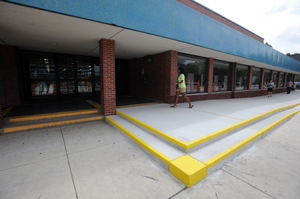
The new entrance at the AADL downtown branch
Lon Horwedel | AnnArbor.com
A yellow line is the only physical marker warning people exiting the library of the platform’s drop-off.
“You know they moved the Washtenaw Library for the Blind here,” Hizer said. “Well, how does a blind person see a yellow painted edge?”
Hizer is one of about 20 people who have expressed concerns about the new entrance over the past month to the Ann Arbor Center for Independent Living. I learned of the concerns during a conversation with Carolyn Grawi, CIL’s director of advocacy and education.
I talked with Grawi and Library Director Josie Parker several times over the past two weeks, sometimes relaying opinions back and forth. I also spoke with a local architect and a city official about whether the new entrance meets codes.
The design appears to meet ADA requirements and building codes. But it doesn’t appear the library or the DDA, which funded the construction of the entrance, solicited input from people with disabilities on the project’s design. If they had, they may have learned the design makes a lot of people feel unsafe.
Now, some are asking the library to consider additional enhancements to the entrance.
The new entrance was constructed by the DDA in June, when it became necessary to close the library’s existing wheelchair ramp due to construction on the adjacent Fifth Avenue underground parking structure.
The entrance consists of a gradually sloping walkway leading to an open platform in front of the library’s porch. The platform has a step on the north and west sides. A portion of the previous front steps leading to the library’s porch remains to the north of the platform. None of the steps have handrails.
Parker said she’s proud of the new barrier-free entrance, which is ADA-compliant, and handrails aren’t required because it isn’t steep enough to be considered a ramp.
Parker said the new entrance will be in place for at least one to two years. Once Library Lane — a new street running from Fifth to Division between the library and garage — opens, a new entrance may be constructed on that side of the building, she said.
I took a look at the new entrance with Grawi. As a mom, I have to admit the sight of it made me uneasy. I immediately pictured my 3-year-old son tumbling down the open steps.
Grawi, who is legally blind and uses a cane for guidance, pointed out how easy it was for her to trip over the walkway’s edge because the yellow stripe indicating the drop-off doesn’t show up well on the white concrete. She said she’d like to see a concrete post marking the beginning of the slope, and a higher-contrast color like red or blue replace the yellow.
Then we walked over to the steps, which Grawi said are even more problematic. “A person in a wheelchair with low vision who comes out of the library can easily come rolling off the edge,” Grawi said.
Grawi called the low incline of the walkway “fabulous,” but said “the wonderful, accessible, zero-step entry has steps off the side of it. They opened it up and didn't protect the sides.”
Robin Bennett, an Ann Arbor resident who frequently visits the library and uses a wheelchair, said she has seen people walk off the edge of the platform and doesn’t think it’s safe.
“I've actually witnessed people walking out and walking right off the end, not noticing there was a step down,” Bennett said. “Or taking one step and not realizing there are two.”
Architect David Esau of Cornerstone Design questioned whether the new steps were necessary at all. “From a safety standpoint, it might be better to just close it off, since there are (the older) steps there.”
Parker said she declined to consider adding railings around the steps because they would have negative unintended consequences: people would climb on them, and they would narrow the entrance, which could make it more difficult for emergency personnel to access the library.
Ann Arbor Chief Development Official Ralph Welton said the design went beyond state building code by adding the step off the platform. Code would have allowed it to just drop off, with no step or handrails.
However, he said, “If Josie were to ask me, I would recommend them coming up with a way for people to have something to grab on to when coming out of the library. But if it's not required by the code, then I can't require it.”
In the few minutes I stood at the entrance with Grawi, we saw a man climbing the old steps, clutching a nearby brick column to help himself up.
Esau also suggested putting “detectable warnings” at the top of the stairs. Grawi said detectable warnings don’t have to be the raised bumps you see at curb ramps. They could be tar strips or etchings in the concrete — just something that a seeing person could detect visually and a blind person could detect with a cane.
Parker said detectable warnings at the steps would be a tripping hazard for people without disabilities. She said she has to consider the needs of everyone using the library, not only the disabled.
“I think the edge is the signal,” Parker said. As for people rolling off, she said, “that could happen in any stairwell in the city.”
Of Grawi’s request for a concrete post marking the beginning of the incline, Parker said, “I'm not sure I can do that. But because she's indicating a need for a physical marker, I’m going to look at that and see if we can find a compromise.”
Parker agreed to add signs explaining how to navigate the entrance. She also agreed to remove a yellow line at the top of the walkway that some people found confusing. She also has two more meetings scheduled with people who have concerns about the entryway, and said she may change her decisions based on those discussions.
Grawi said the whole situation could have been avoided if the library and DDA had consulted with the CIL or others who specialize in accessibility.
“I made a statement to the library board a year ago asking for them to call on us when they make any physical changes to their buildings,” Grawi said. “Here they didn't consult us, and now people are unhappy with it and feel unsafe.”
Jen Eyer is on the Community Team at AnnArbor.com, and she writes a citizen advocacy column. Do you have a problem you’d like to share? Contact Jen at jeneyer@annarbor.com or 623-2577, or fill out this form.
Comments
snapshot
Tue, Aug 17, 2010 : 10:43 p.m.
Katmando, These folks here are brutal. I have a question for you....How can anyone even FIND a handicap parking place with every meter painted handicap blue? It seems Ann Arbor folks can make the simplest tasks so complicated as to make it unmanageable. It's seems to defy common sense. I agree that the new ramp is awkward and needs an adjustment.
BHarding
Tue, Aug 17, 2010 : 8:16 a.m.
What is the harm in making the ramp even safer? I agree with Katmando that we shouldn't be satisfied with minimum standards. An ounce of prevention is worth a pound of cure, it would be nice to border the edges of the ramp with a 14" planter, or planters of staggered heights, provide some greenery and extra safety.
Carl
Tue, Aug 17, 2010 : 7:19 a.m.
I didn't realize I was walking off the ramp. I caught myself but my knee is hurting. Something needs to be done
Speechless
Mon, Aug 16, 2010 : 10:58 p.m.
"... Grawi called the low incline of the walkway 'fabulous,' but said...'They opened it up and didn't protect the sides.'" "...'I've actually witnessed people walking out and walking right off the end, not noticing there was a step down'...'Or taking one step and not realizing there are two.'" "... Well, how does a blind person see a yellow painted edge?" Those points pretty much sum it up.  When will AADL bring closure to this? Questions:  How much would railings obstruct emergency personnel, and would a narrower (railed) ramp have significantly lessened these concerns? Or, did the DDA wish to leave out railings primarily as a cost savings move? "... I talked with Grawi and Library Director Josie Parker several times over the past two weeks, sometimes relaying opinions back and forth...." In the late 1980s, a Rolling Stone writer flew to London to interview George Harrison, who picked him up outside a west end transit station. On the drive back to the musician's estate, the writer mentioned having briefly interviewed Paul McCartney before leaving New York. Keeping his eyes fixed on the road, George casually inquired how Paul was doing in general.
MyOpinion
Mon, Aug 16, 2010 : 10:37 a.m.
How about putting some big pots spaced at 2 feet intervals along-side the first 8 feet or so of the sloped ramp? It might be visually attractive and would not impede a walker from approaching the library using the shallow steps. It would serve as a visual cue to a person exiting the library that this is not the normal/suggested route to exit the library. Folks should be using the sloped walk or the steps on the north side of the slope. Otherwise, I'd suggest some railings with breaks for pedestrians for the first 8 feet or so of the sloped sidewalk. The breaks should be large enough for a pedestrian to walk through but not allow a wheelchair to fall through. This is most critical at the exit door where a person may roll out the door and continue west.
huangxiaohan
Mon, Aug 16, 2010 : 2:28 a.m.
FREE sHIPPING Hello, summer, good place for shopping, fashion, sexy, personality, maturity, from here to begin. Are you ready? =======http:// www.nbanikes.com ======= Air jordan(1-24)shoes $32 Air jordan(1-24)shoes $32 ======= http:// www.nbanikes.com ======= Accept paypal FREE sHIPPING
huangxiaohan
Mon, Aug 16, 2010 : 1:36 a.m.
FREE sHIPPING Hello, summer, good place for shopping, fashion, sexy, personality, maturity, from here to begin. Are you ready? =======http:// www.nbanikes.com ======= Air jordan(1-24)shoes $32 Air jordan(1-24)shoes $32 ======= http:// www.nbanikes.com ======= Accept paypal FREE sHIPPING
huangxiaohan
Mon, Aug 16, 2010 : 1:34 a.m.
FREE sHIPPING Hello, summer, good place for shopping, fashion, sexy, personality, maturity, from here to begin. Are you ready? =======http:// www.nbanikes.com ======= Air jordan(1-24)shoes $32 Air jordan(1-24)shoes $32 ======= http:// www.nbanikes.com ======= Accept paypal FREE sHIPPING
Tex Treeder
Sun, Aug 15, 2010 : 9:34 p.m.
I miss the trees at the entrance. Now it just looks like another sterile piece of architecture. Too much concrete, not enough plantlife.
es
Sun, Aug 15, 2010 : 9:19 p.m.
The safety concerns due to lack of railings, etc. affect more than just a minority or 'fringe group'... In addition to the blind and physically impaired, please add anyone with some form of vision loss. For example, reduced vision in one eye can impair one's depth perception and safety on stairs. It is estimated (http://www.nei.nih.gov/eyedata/pbd_tables.asp) that a significant proportion of seniors (over 65) have some form of vision loss. Seniors are a devoted clientele of the library. Is this the way to treat your most loyal customers? By the way,The Washtenaw Library for the Blind and Physically Disabled at the Downtown Branch serves these low vision folks as well.
Mary D.
Sun, Aug 15, 2010 : 6:20 p.m.
A ramp similar in design was installed at the front door of the elementary school in my neighborhood last year. The area is often full of children and adults congregating outside of the door, especially at school dismissal or after events held in the evening. I have stepped back off the edge of the ramp while in conversation and fortunately caught myself before landing on my rear. I wonder how many other people have done the same thing. Maybe even while holding a baby. (Shudder.) The handrail on the side of the old ramp was apparently "misused" by some children as a climbing apparatus, but I can't see the logic of not having a safety barrier for a drop-off of, I'm estimating, 6 inches. It's an accident waiting to happen when you consider the safety of people milling around in crowds and, most importantly, those for whom it is providing barrier-free access. Painted lines are not enough to keep wheelchairs and people from drifting off the side of the ramp and toppling to the level below.
katmando
Sun, Aug 15, 2010 : 5:04 p.m.
Dear EyeheartA2: doesn't happen all the time nor even most of the time. And angry isn't the half of it. Many times I have had to wait while a non handicapped person "used" handicapped parking. I have been cursed at, threaten, punched and 3 times people have tried to run me over when I have asked them to move "politely" I might add. I have been told "I am just waiting for someone, I'll only be a minute, I have my flashers on (LOL), and my car is running so I can park here" most of the non handicapped that use handicapped parking only use it for 5 to 10 minutes which for the most part is not long enough for the parking officer to show up. That is if there is one. Most parking offenses happen in private parking lots which mean unless the store owner calls the police nothing happens and even if they do call which happens even less because the store owner doesn't want to lose buisness. It can take anywhere from 20 to 30 minutes for the police to show up and the perp is gone. Then they complain as do the non handicapped that they have better things to do. In most places the handicapped sign means close up parking.
katmando
Sun, Aug 15, 2010 : 3:53 p.m.
or when you take your child to school tell the teacher that they only need to do what is absolutely necessary and not to go out of their way or anything. Just make sure they just pass. What people don't seem to understand or even want to understand is that the ADA is the very minimumalest of standards. It was thought that people would use common sense and do more on their own to help people with disabilities(LOL), but as we have seen on here there is no such thing as common sense. They want to do even less and then complain when these people with disabilities sit at home and do nothing.
katmando
Sun, Aug 15, 2010 : 3:42 p.m.
Hey the next time you go to the doctor tell him/her you only want them to do the minimum or only what is absolutely necessary. And they don't to ask a spailist
Macabre Sunset
Sun, Aug 15, 2010 : 3:19 p.m.
Question: how do blind people navigate sidewalks, which are more narrow, and also have similar drop-offs without any railing on the side? These complaints may well not have the effect people like Hizer are hoping for.
katmando
Sun, Aug 15, 2010 : 2:58 p.m.
I also work with young adults with disabilies through WISD and I can tell you that this is going to be a BIG problem with a lot of those young people.
katmando
Sun, Aug 15, 2010 : 2:56 p.m.
Opps, me bad, should be "passes" "safety" I have disgraphia as well as a spine injury.. And all you people that HATE the ADA how many of you use the automatic doors? How about the handicapped toilet because it has more room? How about those curb ramps? Man is that so over the top! And lets not get into those wasted empty handicapped paking spots that non handicapped poeple use as much if not more than the handicapped. Just wait till you need all those ADA MINIMUM requirments.
katmando
Sun, Aug 15, 2010 : 2:45 p.m.
The ADA set minimal standards! I was students with disabilities represenitive at EMU for 3 years. I offent heard those words and my reply was 'Then everyone that paaes a class gets an A because they meet minimum standards." We all should only strive for the minimum because that is all it takes to get anywhere in life. "Lets not try harder and do it better but only try hard enough to meet the minimum" should Parkers montra! I have an idea lets set everything to minimal standards for EVERYTHING, airline safty, car safty and health safty!
ToddAustin
Sun, Aug 15, 2010 : 1:43 p.m.
Whether or not it meets ADA regulations doesn't seem to be the relevant question here. If it has deficiencies, needs special explanation for basic use, and is already causing injury, then it clearly needs some tweaks. That need could have been avoided if local experts, who had previously volunteered their assistance, were consulted earlier. If all the ADA flag wavers here ran businesses where they casually spat upon the needs of an important segment of their customer base, I doubt they'd be in business for long.
sbbuilder
Sun, Aug 15, 2010 : 1:05 p.m.
Allen Before allowing the public to use the new ramp, it will already have been reviewed by the building department for compliance, and after construction was completed, by a building inspector. That means it won't ever go before a judge. As for libel, I'm not sure who's responsible there....
AllenH
Sun, Aug 15, 2010 : 12:51 p.m.
Last Friday evening shortly after 6 PM an elderly lady with a wheeled walker apparently took a headed off the edge of the ramp/landing onto the sidewalk below. Several responsible citizens came to her aid, called 911, waived down a patrolman on his bicycle and attended to the lady who's head was bleeding until the ambulance arrived. Who will be libel for this lady's medical expenses? Perhaps a Judge in civil court will determine if the ramp was ADA compliant.
Wayne Appleyard
Sun, Aug 15, 2010 : 12:38 p.m.
I agree that the variable steps along the edge of the ramp are potentially hazardous. If you step back a bit farther and look at the entire process you will see the very large effort that was expended to enable the contractor of the underground garage to use part of the library property for a construction trailer and storage. A large planter with several ornamental trees(part of the original design by Architect Alden Dow) was removed to the detriment of the appearance of the front of the building. Surely there could have been a less costly(monetarily and aesthetically)and safer solution to this issue.
Craig Lounsbury
Sun, Aug 15, 2010 : 12:24 p.m.
Add me to the list of those who feel if it passes code and ADA requirements the obligation is met. If codes and ADA requirements need to be rethought that is a different argument.
Donald
Sun, Aug 15, 2010 : 10:58 a.m.
IF you need signs to explain how the entrance works, you've a serious problem.
local
Sun, Aug 15, 2010 : 10:56 a.m.
It meets the lawful requirements, enough said. Bruce you are absolutely correct, someone will always complain about something if given the chance.
d_a2
Sun, Aug 15, 2010 : 10:17 a.m.
i agree bruce, people love to complain about anything. Especially in Ann Arbor
genericreg
Sun, Aug 15, 2010 : 10:15 a.m.
Look like they did consult - with the law specifically made for situation. Grawi should demand the law consult her if she think it specifics unsafe design. Not every local org can be consulted for every design decision in every building. What about the illiterate? Will signs be in Spanish, Chinese, French? Will seperate entrance to basement be given for afraid of heights? If three year old falls down stairs, guess whose fault? Glad we have taken care of all real problems so now we focus on how dangerous it is to have two steps. Very new idea, first of it's kind in world!
bruceae
Sun, Aug 15, 2010 : 10:07 a.m.
It doesn't matter what you build in this town some fringe group is always going to complain about it. If it meets the codes. Case closed
GriswoldKJ
Sun, Aug 15, 2010 : 8:54 a.m.
This design may meet the various ADA codes, but it reflects a lack of common sense -- just like the low step at the Traverwood Branch that juts out into the path of pedestrian traffic on the sidewalk. Please consult the Center for Independent Living during the design phase of any future buildings and follow their advice on correcting this problem.
sbbuilder
Sun, Aug 15, 2010 : 8:37 a.m.
It meets code. It meets ADA requirments. Enough is enough. There is no such thing as a perfect design for every single person. There will always be compromises in life. Enjoy the books.
mireader
Sun, Aug 15, 2010 : 8:17 a.m.
"Parker said detectable warnings at the steps would be a tripping hazard for people without disabilities. She said she has to consider the needs of everyone using the library, not only the disabled." Really? I think these steps will be a tripping hazard moreso than the detectable warnings. How well will the yellow paint work when it's snowing, since we all know how great the snow removal is around here?