

Sorting out the rules of the road for bike lanes
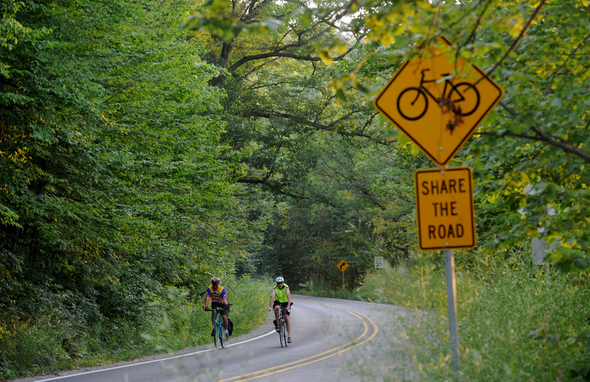
Share the road: Bicyclists ride along Huron River Drive in Ann Arbor.
Melanie Maxwell | AnnArbor.com
Editor's note: Although the city of Ann Arbor has not adopted the Michigan Uniform Traffic Code, as stated in this guest column, the City Council in February adopted its own ordinance defining and regulating bicycle lanes, according to Lisa Wondrash, communications unit manager for the city. You can view the city code here.
What is a bike lane, anyway?
Over the years, as Ann Arbor has added many miles of bike lanes, I’ve occasionally heard some really strange ideas about them. It might help to go over what they are supposed to be and how they’re supposed to be used.
Ken Clark is chair of the Ann Arbor Bicycle Coordinating Committee.
There’s no law in Michigan that says that a bicyclist has to use a bike lane if it’s provided, in part because if the bike lane isn’t safe to use, a bicyclist shouldn’t use it.
There are also lots of exceptions to the keep right law (MCL 257.660a), that apply to bike lanes as well. For example a bicyclist making a left turn should never do it from the bike lane. And by law, they aren’t required to stay in a bike lane or to the right-hand side if they’re preparing to make a left turn. The best thing for a cyclist to do is pretend the bike lane isn't there and keep to the right as they normally would.
Next, in most of Michigan, it is illegal for a motorist to drive in a bike lane.
This isn’t the case in Ann Arbor, where motorists drive in bike lanes all the time, but it is true in Chelsea, Ypsilanti, Dexter, Ann Arbor Township, Scio Township, Ypsilanti Township, and many other cities and townships in Michigan. That’s because there is a set of ordinances recommended by the Michigan State Police, called the Michigan Uniform Traffic Code (UTC), which makes it illegal to drive in a bike lane, and makes a violation a misdemeanor.
It’s technically illegal to drive in a bike lane even if a community hasn’t adopted UTC, since all road users are required to obey traffic control devices, and bike lane markings are traffic control devices. But it’s funny that the Michigan city with the most bike lanes does nothing to keep motorists out of them.
This gets at the point of bike lanes, which is to encourage bicycling. The idea of a bike lane is to set aside extra space on the roadway that motorists aren’t allowed to use, but bicyclists are allowed to use.
They are a lot like HOV lanes; people in carpools can drive in them, but don’t have to, and motorists by themselves risk tickets if they use them. In fact, bike lanes used to use the diamond “restricted” symbol just like HOV lanes do, until the authorities realized that too many bicyclists took that to mean they were two-way lanes. At that point, the authorities switched to arrows in the direction of traffic to make it clear that people using the bike lanes still have to keep to the right.
Finally, a word on what isn’t a bike lane. In Michigan, bicyclists are required to keep to the right of the “roadway” (MCL 257.55). The term “roadway” is specific; shoulders are not, by definition, part of the roadway (MCL 257.59a). So bicyclists are not supposed to use shoulders, even paved shoulders, any more than motorists are. The only real exception to that is when a paved shoulder is designated as a bike facility, with signs and pavement markings.
The reason bicyclists aren’t supposed to use paved shoulders is that if there is a problem with the shoulder, like a gaping pothole, and the cyclist gets hurt from that pothole, the cyclist is out of luck. The local government isn’t responsible for maintaining shoulders in a drivable condition.
That’s why bicyclists are supposed to be to the left of foglines on roadways, since the fogline - the thick white stripe on the edge of the roadway - means the edge of the usable roadway. So every place you see a wide paved shoulder, but with no markings that say it’s a bicycle facility, you shouldn’t expect to see bicyclists using it.
They’re not supposed to use it, since it isn’t part of the roadway, and certainly isn’t a bike lane.
Ken Clark is a former regional director for the League of Michigan Bicyclists, chair of the Ann Arbor Bicycle Coordinating Committee, and chair of the Ann Arbor Environmental Commission Transportation Committee. He's certified to teach the League of American Bicyclists Road 1 bicycle safety course. He's a year-round bicycle commuter on the Northeast side of Ann Arbor, and has commuted by bike for most of his 24 years as a resident of Ann Arbor. He can be reached at kenclark@ameritech.net.
Comments
jcj
Thu, Aug 5, 2010 : 1:48 p.m.
After thought. I happened again last night. cyclist riding out Dexter past maple after dark in dark clothing with NO lights! Any of you care to defend this action?
jcj
Thu, Aug 5, 2010 : 1:47 p.m.
Maybe the cyclist could add a minute so they could show some courtesy also!
Hemenway
Thu, Aug 5, 2010 : 8:20 a.m.
I do ride in a park, Kensington and Island Lake, and I get road raged there as much as on the road. Motorists need to add a few seconds to their commute and give cyclists a break. BTW, I run too and don't get any breaks when I'm in track shoes either. Its not just cyclists that are victimized. So, I ride cause I love it, it is worth the risk! Cycling is a great sport that I will do as long as I can. Was The BP oil spill a wake call for anyone?
jcj
Tue, Aug 3, 2010 : 10:05 p.m.
Bikers beware! Miller road was just top coated. Tar and gravel. Lots of loose gravel. If I were a biker I would stay off of that road for a while.
PA60
Tue, Aug 3, 2010 : 8:06 p.m.
@jcj "I suspect that even my 10 year old grandson could figure out that if there were the same amount of cyclist on the road as motorist there would be an astounding amount of car bike accidents." Actualy no. There are studies that show that the bigger the biker population (percent of bikers commuting to work usually) on the street, the smaller the proportion of bike crashes in the mix. Ann Arbor is the second safest community in Michian (after East Lansing) when bike crash RATE is considered, because of a relatively high proportion of bikers in the traffic mix.
nonyo
Tue, Aug 3, 2010 : 7:17 p.m.
I am willing to pay a license fee based on the value of my bike if I am allowed every other road in the county as a bikes only road. Isn't that what the vehicle license is based on? If the cars have Scio Church, then the bikes have Pleasant Lake. Cars have Dexter-Ann arbor, bikes Huron River Drive, and so on. I would guess most cyclists would agree with me, and maybe then we'd have smooth roads to ride on. As an aside, I'm guessing that the debris in the road is not discarded there by cyclists, for the most part.
jcj
Tue, Aug 3, 2010 : 4:52 p.m.
I have no problem with cyclist riding 2 abreast or even 3 abreast when it is obvious there are no autos in site. To argue that is dangerous dilutes the argument that they need to be more careful and courteous when motorist are approaching them. If anyone is going to hear the other side of any argument both side need to be honest.
John Q
Tue, Aug 3, 2010 : 4:12 p.m.
"When you one is riding a bicycle one must assume there are cars in the vicinity....When you are on a bicycle you are vulnerable. Period." In that case, I'll crawl back into bed and never go out of my home. Life is dangerous. The idea that two people riding their bikes side-by-side on a road with no cars in sight is a sign of danger is crazy.
jcj
Tue, Aug 3, 2010 : 3:40 p.m.
@ERMG Another simplistic twisting of the facts! I suspect that even my 10 year old grandson could figure out that if there were the same amount of cyclist on the road as motorist there would be an astounding amount of car bike accidents. And the fault of most of those accidents would probably be the motorist. But most of the posters on this site are even more savvy than my grandson and they are able to see that there are some that would not admit the truth if they were choking on it!
GreenEggsandHam
Tue, Aug 3, 2010 : 12:14 p.m.
I ride my bike on the sidewalk, don't trust the people driving cars.
Barb
Tue, Aug 3, 2010 : 9:02 a.m.
Wow - what a ton of anger toward bicyclists. I really don't get this. If you're in a car, you have the clear advantage. Isn't that enough power for you?
jcj
Tue, Aug 3, 2010 : 8:42 a.m.
@MI-expatriat "Even if a particular aspect of bicycling is not the law, it is common decency and courtesy to give way" I agree wholeheartedly if you mean BOTH parties should be willing to give way. But I suspect you would only require the motorist to be courteous. I cannot defend the actions of a large number of motorist in A2 when it comes to obeying the law. About 30% of motorist will even think about coming to a stop when a yellow light appears. And if you sat and watched it would take about 2 light cycles to see some idiot run a red light! But that does not excuse the 90% of cyclist that display the attitude that the universe revolves around them!
snapshot
Mon, Aug 2, 2010 : 10:06 p.m.
I believe Ann Arbor drivers are a very frustrated lot. couldit be all the political correctness required in the workplaces? Or maybe it's all sexual in nature. For a city population that takes a formal moral stand on things like the Gaza Strip, Immigration laws in other states, and has all those handicap parking spaces identified by the handicap blue parking meters, you guys are sure lacking in consideration and reason when it comes to some poor guy who can't afford a car riding a bicycle. What a great reflection on the city of Ann Arbor you are. Would you feel better if you could actually hit a biker with your car?
Pat
Mon, Aug 2, 2010 : 8:10 p.m.
Hey Ken, don't preach to us about the rules for cars and bikes until more bicyclists accept that traffic laws apply to them as well as cars. I might be more inclined to look favorably on opinion pieces from the bicycling lobby if they were also writing opinion pieces about how bicyclists need to obey traffic laws. Bicyclists seldom stop at trafiic lights, and if thy do they frequently proceed before the light turns green. And they don't feel the need to stop at stop signs. Plus they endanger themselves by passing vehicles stopped at a traffic light. Are there different laws for bicyclists? Yesterday there were three cyclists blocking a full lane of Ford Rd. Gee, can we drive cars three abreast?
deb
Mon, Aug 2, 2010 : 5:04 p.m.
Daniel, I was responding to the poster on every bike article that says cars should stay off hrd. Do you notice there is a name at the start of my post. I guess not. Bababooey, how about this, although it is not in ann arbor, it isnt very far from hrd or mast rd, so not too much farther and a path that has no cars. Lakelands Trail State Park: Stretching 26 miles through central Michigan, this rail-trail has two personalities: rural and suburban. Twenty miles of soft limestone surface from Stockbridge to Pinckney offer a pastoral backdrop and 6 miles of smooth asphalt carry you through rapidly growing Hamburg Township. The trail is an easy drive from the major population centers of Detroit, Lansing, Jackson and Ann Arbor, which contributes to its popularity. Heading east from the Stockbridge Trailhead amid working farms, wide open fields, and woods, you will understand why equestrians feel right at home on this trail. A diverse collection of wildflowers and butterflies flourish here. The small town of Gregory, followed by the equally quaint Pinckney, add charm to this quiet agricultural area and are good stopping points to enjoy lunch or ice cream or to stock up on supplies. Mountain bikers and walkers have a seamless transition to the trail's recently paved 6-mile section, where they join skinny tires and strollers to continue through the swiftly developing suburb of Hamburg Township. The woods grow thicker and frequently arch into a canopy as the trail meanders to Zukey Lake, a popular destination for swimming, boating and fishing. Trail traffic increases as you head east, but the corridor remains a peaceful getaway. Just before reaching Pettysville Road at mile 15.5, there is a tunnel under State Route 36, transporting you safely under the road. At that point there is a large trailhead. A little farther along, the trail skirts along behind shops, restaurants and snack stops in Hamburg Township. Locals are looking to expansion plans that would take the Lakelands Trail another 16 miles to Jackson, where it would link into Jackson's urban pathway system and provide a journey from sweeping rural vistas to urban conveniences. I happen to know at least 5 miles of it is paved. heres a link http://www.traillink.com/trail/lakelands-trail-state-park.aspx
julieswhimsies
Mon, Aug 2, 2010 : 3:33 p.m.
@John No car in sight in the photograph...When you one is riding a bicycle one must assume there are cars in the vicinity. To assume there ARE nor cars in the vicinity could be deadly for the cyclist. In the long run "manners" and "rights" do not matter. When you are on a bicycle you are vulnerable. Period.
John Q
Mon, Aug 2, 2010 : 3:04 p.m.
"The photograph speaks volumes. Cyclists riding double...putting themselves and everyone on the road in danger." And not a car in sight.
julieswhimsies
Mon, Aug 2, 2010 : 1:49 p.m.
The photograph speaks volumes. Cyclists riding double...putting themselves and everyone on the road in danger. Most roads do not have bicycle lanes. There is a portion of the cycling public who ignore common sense and safety. Cyclists, as well as motorists need to learn to share the road.
Roaring_Chicken
Mon, Aug 2, 2010 : 1:07 p.m.
It's not just a matter of "selfish" motorists vs. "ninnyhammer" cyclists, either. It is also about the major transformation of our area landscape into subdivisions, developments, and urban-fringe sprawl. There are simply a lot more cars on the road around A2 now than 20 years ago, and I'll wager a lot more cyclists on those same roads. A case in point is Mast, once upon a time a nice cycling connector from HRD to Hamburg, Old Whitmore Lake Rd, etc. When I road Mast in April on a Sunday morning about 10am, it was a squeeze of non-stop car traffic in both directions going to speed limit, which is at least 50 if not 55. I was aware of broken side pavement and non-existent shoulders. I commend every vehicle who shared the road with me that morning, because I put us all at risk, fighting a head wind and barely making 13 m.p.h. up a few of the hills. Cars slowed down behind me, waiting to pass, on steep hills... not knowing if in their courtesy someone was going to rear-end them at 50. If that was a spring Sunday morning, I can only imagine what 2pm on a saturday afternoon must be like. [To stunhsif: sorry, in-joke: my brother drove OTR with JB for several years. If you want to throw-down on motorists, ask a trucker about his/her war stories. Oddly analogous to what motorists have to say about naughty cyclists.]
Barb
Mon, Aug 2, 2010 : 12:17 p.m.
@ERM Ghost, good point! And these folks who are so angry about the existence of bicyclists are probably also anti-roundabout. Don't slow me down!
MI-expatriate
Mon, Aug 2, 2010 : 12:11 p.m.
While living in England several years ago, and taking a UK driving test, I learned that EVERYONE in a roadway has the right of way before an automobile - that means pedestrians, bicyclists, my elderly disabled neighbor on his scooter - and you know what, there wasn't any outrage about it! US automobile drivers have some growing up to do; they don't own the road. Even if a particular aspect of bicycling is not the law, it is common decency and courtesy to give way. Absolutely ticket the bicyclists who are breaking the law, but the authorities should do that right after they finish ticketing the automobile drivers who don't use turn signals when turning. Don't THEY know the law?
tracyann
Mon, Aug 2, 2010 : 11:18 a.m.
I agree with Tru2Blu76. This topic of discussion always turns into a p*ssing match between drivers and cyclists. I don't bike on highly traveled roads only because I value my life too much. However, when I see a cyclist on the road, I give them room and if I can't safely pass, I wait until I can. On the other hand, I encounter a man who regularly rides Wagner Rd. between Scio Church and Jackson Rds., which is the same way I take to work. This man rides up alongside the cars at intersections and might slow down as he crosses, but not always. I almost witnessed his demise as a driver was turning right at Scio Church when he was riding up alongside the cars. Had the driver not seen him when s/he did it wouldn't have been pretty. Fortunately, the cyclist wasn't that shaken up for he merely swerved around the front of the car and kept going through the stop sign.
Carolyn
Mon, Aug 2, 2010 : 9:40 a.m.
@eyeheartA2 They are riding next to those "bike lanes" because they are not maintained. There is gravel that gets swept into them by the passing traffic, there are potholes in them, or - if you are talking about the sidewalk/bike lanes - they are incredibly unsafe. And yes, you should ask why you are paying your taxes for unmaintained bike lanes that become useless.
Carolyn
Mon, Aug 2, 2010 : 9:33 a.m.
@ Peter Baker I love your comment. I came from Boulder where bicycles are an expected and accepted form of transportation and those on bikes are approached with care and respect. Let's face it, we live in the middle of car country (no public transportation between cities to speak of as of yet and we are way into the 21st century) and biking is not a respected form of transportation. After being hit by a car, the driver was a bit impatient to take that left turn and tailgated through the intersection on another car, I choose to be very careful where and how I ride these days).
Carolyn
Mon, Aug 2, 2010 : 9:24 a.m.
Just purusing the comments........ @ Basic Bob "I suspect that when they get off their bicycles, they are equally rude as drivers. I would guess a Prius or Camry." LOL LOL LOL
Carolyn
Mon, Aug 2, 2010 : 9:15 a.m.
YAY!!! Ken Clark. ".....Theres no law in Michigan that says that a bicyclist has to use a bike lane if its provided, in part because if the bike lane isnt safe to use, a bicyclist shouldnt use it." I recently saw that Ann Arbor was listed around in the "top 100 cities for bike riding" or (something like that). When I informed my husband of this rating, his only comment was that the rest of the cities on the list must be pretty bad. LOL I NEVER use the combination sidewalk/bike trails. They are sooooooo dangerous - first for the pedestrians that are "in the way" and second because every 'frickin" driveway and intersection is a potential accident (people have not trained themselves to be looking for bikes crossing at crosswalks - even I have had near accidents, and I am a bike rider). And where are the new, safe on-the-road bike lanes that could be going in with all the road construction going on right now. Ann Arbor doesn't really support bike riders. They talk a good talk, though.
Bababooey
Mon, Aug 2, 2010 : 7:07 a.m.
@macncheese....Please let me know where there is a park in Ann Arbor where I can safely ride 15-25mph for 20-50 miles. I would never clog your roads again if you can point one out to me.
Daniel Soebbing
Sun, Aug 1, 2010 : 10:20 p.m.
deb, I think you missed the point of the article. Bicyclists have no legal obligation to use bike lanes or shoulders, nor are they obligated to seek roads that contain such features. We all have to share the road, cars and bicycles alike.
deb
Sun, Aug 1, 2010 : 9:42 p.m.
Roaring chicken, hrd is a great road to get to everywhere. Why dont bikers pick a route with a bike lane. or larger shoulder. I use hrd to go from my house on maple to strawberry lake road. Quickest way. quickest way to loch alpine golf course or to visit friends there. Sorry you are wrong.
futuremi
Sun, Aug 1, 2010 : 9:34 p.m.
Agree there are both bad drivers and bad bikers out there....the only problem is that its bad, attention-deficit drivers who can kill someone, either in a car or on a bike. (I don't recall any cases where a bike hit a car and the driver has injured or killed) When biking, I always stay on the shoulder or as far to the right as possible, as both a courtesy and a safety measure. While on my bike, I often scan the cars and am amazed at the high percentage of drivers (often 40% or more) that I see holder a cell phone to their face or checking messages in between stops. While they might be "inconvenienced" by having to wait a few seconds for a safe time to pass a bike, I doubt they count the count the inconvenience they cause others as they sit after a light has changed because they are checking their emails. Driving commands full attention whether on a bike or a motor vehicle. I doubt that the often 10 second delay or less it causes a driver to wait until a safe time to pass a cyclist has a major impact on their life....I know if doesn't on mine when I wait to pass a cyclist.
stunhsif
Sun, Aug 1, 2010 : 8:32 p.m.
@Roaring_Chicken, JB Hunt rigs don't run 75-80 mph. They all have governors to limit their top speed at 64 mph. This saves the company millions of dollars a year in fuel costs. Anyone caught tampering with the trucks is terminated immediately. But I do agree with you, common sense must prevail. My common sense after seeing three people I know die in bike/car collisions is to not ride a bike or motorcycle on roads, period! I've had enough close encounters when I did ride motorcycles back in the 1980's. Gave em up when my first son was born in 1987 and don't regret it for a second.
Larry Works
Sun, Aug 1, 2010 : 8:06 p.m.
Interesting piece. I'd like to see an article on the subject of 2-wheeled vehicles that includes input from local law enforcement. Particularly as it relates to the increase in mopeds, motorized bicycles and electric scooters. This year particular there's a definite increase but I've seen some real inconsideration on the road from folks in 4-wheeled vehicles who think they have no right to the roadway. How an in-depth article annarbor.com? Show us your journalistic chops.
jcj
Sun, Aug 1, 2010 : 5:31 p.m.
@ Bababooey I have to say you certainly sound like a cyclist I would be happy to share the road with. When I am driving and see cyclist coming at me I get over as far to the right as I can safely so as to give traffic traveling the same direction as the cyclist room to give the cyclist room. I give room every time I encounter a cyclist! I can tell you I am not given the same courtesy by 1 out of a hundred cyclist! While it is annoying to see so many cyclist that seem to dare a motorist to come close to them I bite my tongue and stay off the horn and go on my way. As far as calling the police when seeing the cyclist without lights. That would be the preferred thing to do. What do you think the chances are that a car would be sent to investigate?
Bababooey
Sun, Aug 1, 2010 : 4:46 p.m.
My 2 cents: I'm an avid cyclist and I've seen my fair share of bad cyclists and drivers. Many more bad drivers because simply, there are more of them. Now, as a cyclist I love bike lanes and I love big shoulders. I hug the far right of any road I ride mainly due to reactions I read on sites just like this. It is not safe out there, but when you have a passion for cycling and/or staying fit, or don't want to contribute to big oil anymore, you weigh the risks and proceed cautiously. As has been mentioned, the picture accompanying this article is a perfect example of what not to do when riding. Do not ride double file unless you have to make a quick communication. Always maintain a single pace line, unless you are rotating leads. I don't need laws to tell me how to be safe, it's common sense...and it's frustrating to read an article that seems to be encouraging bad behavior by cyclists. Ride the shoulder, ride bike lanes when available, ride single file, be aware of your surroundings.
Steve Bean
Sun, Aug 1, 2010 : 4:09 p.m.
Thanks for the great column, Ken. The photo caption is inaccurate. As Ken would no doubt have us know, the "former" in his bio applies to his serving as chair of the two committees noted, not only to his LMB position. Anya Dale is the current chair of the Environmental Commission's transportation committee, and my understanding is that the AABCC was dissolved years ago. jcj, I suspect that Mr. Clark would advise you, as I do, to call the police when you observe illegal behavior. Debating it here isn't likely to get anyone to move to the right for you.
Daniel Soebbing
Sun, Aug 1, 2010 : 3:49 p.m.
Pedestrians do have the right to walk at the edge of the roadway, as long as they are walking in the opposite direction of traffic. Who said cyclists should be able to form rolling roadblocks? The law requires cyclists to ride as close to the edge of the roadway as is practicable. What this means in practice is that when road conditions are good there should be sufficient space for cars to pass bicyclists safely with only a minor impedance in speed or, in most cases, no slowing at all. If bicyclists are riding in such a way as to block the road for no good reason they are violating the law. In bad road conditions cyclists need to take the lane for their own safety (if they deem it to be "practicable" to do so), as well as the safety of motorists. Thus any blockage of traffic that is caused by cyclists is either the result of bicyclists breaking the law, or poor road conditions, which are no fault of the bicyclists. There is no constitutional right to bicycle on the road, just as there is no constitutional right to drive on the road. The burden of road construction and upkeep is borne by all people that pay taxes in this country (every time you buy goods at the store you are contributing to gas taxes in some way, so I don't want to hear the argument that only people who are actively driving in cars at any given moment are paying for road upkeep because it is patently false), and therefore the use of roads is extended to all law abiding citizens. No one is granted special rights to travel in an unimpeded fashion at the expense of others, though the use of freeways does grant motorists special rights in states in which bicycles are not allowed to travel on freeways. The progress of cars is inhibited by the presence of other cars just as much as it is inhibited by bicycles. Should bicycles ride on the shoulder or bike lane in most situations, yes! But just as a car can't be expected to travel in a lane that is unsafe, due to blockage or debris, bicyclists shouldn't be forced to travel on the shoulder or in bike lanes if conditions are unsafe for them to do so, which they quite often are. Could bicycles potentially be banned from roadways due to a lack of constitutional right to ride a bicycle on the road? Yes. But it is legal to bike on the road under current law. There is no reason that couldn't change in the future, but there aren't any laws on the books that protect a driver's right to travel quickly or efficiently at the expense of other people that share the roadway, with the exception of freeways. So the arguments that people are making about bicycles impeding traffic on streets have no legal basis. I can understand the frustration of drivers that can't get from point a to point b as fast as they want to because of presence of bicycles on the road. But they rights are not being infringed upon in any way by bicyclists using the road, even if their speed is.
Roaring_Chicken
Sun, Aug 1, 2010 : 3:17 p.m.
My dear old Dad, peace to memory, used to teach Drivers' Ed in a war-torn section of fairly urbanized Michigan not far to the north of Ann Arbor. He had a saying: Many a poor so-and-so has died defending his right-of-way. There's an implied law of road-sharing that includes bicycles and pedestrians, actually, but is mentioned specifically in Michigan's "What Every Driver Must Know": Driving with conditions. This is meant to enhance the common sense that should prevail when sharing the road with machinery that is going much faster and weighs much more than you do. No one would put their Cooper up against the Mayor of Truckville. Similarly, while you may have a RIGHT to bicycle on Scio Church Rd., it may not be WISE to do so, given the speeds other motorized vehicles are traveling, and the types of motor vehicles with which you are sharing the road. You may have a legal right to challenge a convoy of gravel trains to a lane on Parker Rd., but it would be foolhardy to do so, especially if you're rolling on high-pressure tires that won't hold up to going into the gravel at 18 m.p.h. On the other hand, the "customary law" of Huron River Drive is that it is a scenic, winding, low-volume road with a speed limit of 35 m.p.h., much more suited to relatively slower-moving traffic like bicycles than the quarry-routes of Parker Rd. and Scio Church. Motorized traffic needing to get to Dexter above 35 m.p.h. would be well-advised to choose a better route more suited to direct travel, ie, Miller or Dexter/Ann Arbor Rd., rather than be "stuck" behind the Tuesday Night Fat Tire Ride on its way to the Dexter Dairy Queen. But yes, it's always a matter of CHOICE. (Btw, it *is* Michigan Law that cyclists operating "on a roadway between 1/2 hour after sunset and 1/2 hour before sunrise shall be equipped with a lamp on the front... and with a red reflector on the rear..." (What Every MI Bicyclist Must Know, 2nd ed., p.26, quoting MVC 257.662).) As for driving on freeway shoulders: I know this is legal in South Dakota, but when I was there just a few years ago, there was a 20-30 m.p.h. crosswind on I-90, where the speed limit is 75 m.p.h. One small gust puts your Bianchi accidentally in the path of JB Hunt at 75/78/80 m.p.h. and the driver half-asleep. Not a risk I'm willing to take, no matter how much right I have to it.
think
Sun, Aug 1, 2010 : 3:07 p.m.
Bicycles + Automobles = Trouble I wish there was a way that bikes and autos each had their own specific road to travel on. I don't ride a bike. I do drive cars and trucks. I don't want to infringe on either group. Some people ride their bike to work to save money on gas. I think that's great! On some roads there are large amounts of bikers and autos using the road simultaneously. Many times there is a back log of autos behind the gas saving bikers. I wonder if the start/stop/accelerations gas outputs are equal to or greater than if the bikers had just driven in the first place. As fearless as I think I am, there is no way I would ride a bike on the same road as an auto. And in response to: "when is unimpeded traffic flow the only consideration for rules of the road" I bet the considerations in design go as follows: 1. Safety 2. Efficient traffic flow 3. Cost 4. Everything else 5. How bikes affect the primary reason for the road being built in the first place.
jcj
Sun, Aug 1, 2010 : 2:49 p.m.
@Daniel Soebbing "One might argue that it is self centered to believe that a specific group of people should be able to use the roadway in a specific way to the exclusion of other groups of people who would like to use the roadway in a different way." If you are going to use that argument why don't pedestrians have the same right to the road? I will tell you why! Safety! That is the same reason motorist AND cyclist should follow not only the rules but some "suggestions"! "I haven't seen the section of the constitution that guarantees speedy transit to individuals or groups of individuals on public roadways. Can anyone quote that section for me?" Can you quote the section that gives cyclist the right to use rolling roadblocks?
nonyo
Sun, Aug 1, 2010 : 2:26 p.m.
@EyeHeartA2, sometimes we don't ride in the bike lane because they often resemble a debris field, rather than a lane devoted to bicycles.
Daniel Soebbing
Sun, Aug 1, 2010 : 1:11 p.m.
Another section of the pamphlet, "What Every Michigan Bicyclist Must Know," includes this: "Must a cyclist ride in a bike lane? The MVC does not require bicyclists to use bike lanes."
jameslucas
Sun, Aug 1, 2010 : 12:40 p.m.
jcj "how many times have a cyclist ridden 3-4 abreast while snickering under their breath about how the line of cars behind them has to yield to keep from killing the law breakers." Wow does that sound paranoid to anyone else?
Daniel Soebbing
Sun, Aug 1, 2010 : 12:39 p.m.
There is no law that says bicycles must ride in bike lanes or on the shoulder. Although the pamphlet, "What Every Michigan Bicyclist Must Know," which is quoted by clara does specifically quote and give legal interpretations of Michigan State Motor Vehicle laws in several areas, the section that suggests that bicycles ride on shoulders or bike lanes when traveling on roadways that have posted speed limits of 45 mph or greater is merely a SUGGESTION. Bicycles are permitted to ride on every single roadway in the state and in every other state in the country, regardless of the posted speed limit, unless otherwise indicated, such as on limited access freeways. Bicycles are even allowed to ride on freeways in many states, though not in Michigan. A great many of the roads in Michigan have no usable shoulder, so the suggestion in the pamphlet is somewhat misleading. I have biked in every corner of the state of Michigan, going from one side to the other, top to bottom and along every coastline on several occasions. I always use shoulders when they are available, and often specifically seek out roads that have broad, usable shoulders whenever possible. I try to treat motorists with greater courtesy than they treat me with, and to avoid holding up traffic whenever possible. When cycling at night I use lights, and I do my best to obey traffic laws, though sometimes the rude and illegal driving habits of motorists makes it difficult to follow the rules of the road without endangering myself. I also own a car, as do the majority of cyclists in Michigan, so I pay my gas taxes just like most other people. I also tend to drive at or below the posted speed limit when in my car, which seems to anger other motorists almost as much as me being on the road on my bicycle. I am legally entitled to drive at whatever speed I want (above posted minimum speeds, where applicable) and to bicycle on the road whenever I want. If it is self centered to exercise my legal right to use public roadways in any way that I see fit, so be it. One might argue that it is self centered to believe that a specific group of people should be able to use the roadway in a specific way to the exclusion of other groups of people who would like to use the roadway in a different way. I haven't seen the section of the constitution that guarantees speedy transit to individuals or groups of individuals on public roadways. Can anyone quote that section for me? As to who is more rude, bicyclists or motorists, I think there are bad apples in both bunches. Maybe we should keep in mind here that despite the fact that the dominant use of roads is currently for motor vehicle transit, the very idea of paved roadways in America was first popularized by bicycle advocacy groups during the bicycling boom of the late 19th century, when bicyclists outnumbered motorists by a huge margin. Bicycles have been ALLOWING motorists to share their roads for over a century. How about a little reciprocation from motorists?
Peter Baker
Sun, Aug 1, 2010 : 11:52 a.m.
Is it really that bad to be delayed 30-40 seconds when you have an acceleration capacity of 0-60 in less than 10s? And since when is unimpeded traffic flow the only consideration for rules of the road?
stunhsif
Sun, Aug 1, 2010 : 11:33 a.m.
I for one, won't be caught dead riding my bicycle on busy paved roads. I've known three people that got killed riding their bikes, not going to join then by riding a bike or motorcyle. Been there, done that!
jameslucas
Sun, Aug 1, 2010 : 11:18 a.m.
Or local, should we just let cars use up the whole road slowing down and backing up traffic all over Ann Arbor and othe local roads? I completely understand sharing the roads, but I think people get in a car and think they own the road and can do whatever they want because they are in a car. I can't believe how often I have gotten behind cars driving 3 and 4 across, is that legal as well? Unfortunately, our society is based on traveling to get to most places, clearly there are more cars on the road then bikes. I don't know where the middle ground is here, but I often feel cars on the road can be hazard. Does that sound arrogant with a sense of entitlement?
deb
Sun, Aug 1, 2010 : 11:13 a.m.
Loved this line: "This isnt the case in Ann Arbor, where motorists drive in bike lanes all the time, but it is true in Chelsea, Ypsilanti, Dexter, Ann Arbor Township, Scio Township, Ypsilanti Township, and many other cities and townships in Michigan." Really? And how did you come to this conclusion? I must also say the massive amount of HOV lanes around the area make them great to compare bike lanes too. Wait, I do not know of a single HOV lane in Ann Arbor or the surrounding area. Additionally, maybe the picture should show a road with a bike lane, not huron river drive.
Basic Bob
Sun, Aug 1, 2010 : 11:04 a.m.
The last time I drove on Huron River Drive, I was stuck behind two cyclists who refused to ride single-file. I did not intimidate them, I simply waited until I had a clear spot to pass. This is not the way I was taught to ride on the road. I suspect that when they get off their bicycles, they are equally rude as drivers. I would guess a Prius or Camry.
jcj
Sun, Aug 1, 2010 : 10:51 a.m.
@Scott Hadley There are no stats on how many accidents were avoided by motorist yielding to law breaking cyclist. How many times have cyclist ridden 3-4 abreast while snickering under their breath about how the line of cars behind them has to yield to keep from killing the law breakers? So what your saying is that even though cyclist routinely ride after dark with no lights or inadequate lights,(I see it all the time on Dexter ave) or veer into traffic it is always the motorist at fault! Your argument rings hollow! Rudest group on the planet!
amlive
Sun, Aug 1, 2010 : 10:32 a.m.
Clara's and SillyTree's comments are quite valuable addendums to this opinion piece. I have to say that I'm a bit disappointed this article seemed to focus solely on the rights of cyclists, without spending equal time on the rules and responsibilities they are supposed to abide by. There are just as many bad cyclists as there are bad drivers on the roads (and sidewalks) in Ann Arbor. Both contribute to angst and problems between the two, and make things hard for those who do follow the rules and practice common courtesy. So perhaps this can just be part one - lessons for drivers. I think it remains quite incomplete though, without spending equal time trying to get the message through to the other side about their responsibilities as well. Impeding traffic riding abreast, speeding down sidewalks, lights and reflectors, yielding to right of way and traffic signals, shooting up from behind on the right at intersections where cars may be making turns - lots of things cyclists need to be reminded, and rules they should be held to just the same a drivers.
5c0++ H4d13y
Sun, Aug 1, 2010 : 10:31 a.m.
I'm sure a car driver was ever killed when a cyclist ran into them. On the other hand many cyclist are killed when car drivers change the radio or pass illegally. And the courts give them a free pass.
jcj
Sun, Aug 1, 2010 : 9:56 a.m.
Thanks Clara! When riding two abreast, you may not impede normal and reasonable movement by other roadway users. You may never ride more than two abreast. Too bad Mr Clark didn't feel it necessary to point out to his cyclist friends some of the things cyclist are required to do by law! Cyclist as a whole are the most self centered group of individuals I have ever encountered.
clara
Sun, Aug 1, 2010 : 8:51 a.m.
From "What every Michigan Bicyclist Must Know": When riding two abreast, you may not impede normal and reasonable movement by other roadway users. You may never ride more than two abreast. Never ride against the direction of traffic (on the left side of the road). Ride in the right lane except when avoiding road hazards, passing another vehicle, or preparing to make a left turn. Where motor-vehicle speeds exceed 45 MPH, ride in bike lanes or on paved shoulders, (contrary to this opinion paper) Like Road Cycling: Always wear an approved helmet and use safety gear. Ride to the right. Ride single-file.
Laura Meisler
Sun, Aug 1, 2010 : 8:51 a.m.
I agree with SillyTree that bikes on sidewalks can be hazardous, and that cyclists should use lights. And helmets, please!
Ignatz
Sun, Aug 1, 2010 : 8:47 a.m.
I rarely see bicyclists stop at stop signs or even some red lights. I also see them fly down sideWALKS with little disregard for pedestrians. I see bicycles locked to handicapped railings, as well. As for a sense of entitlement, I do feel entitled to drive my car on the roads my fuel taxes pay for.
clara
Sun, Aug 1, 2010 : 8:20 a.m.
This is not an article or news it is an opinion piece.
MyOpinion
Sun, Aug 1, 2010 : 8:08 a.m.
What about the "bike lane" on Packard, east of Carpenter? It is marked, but can't be more than 2 feet wide - encompassing part of the curbing concrete. What is the liability to Washtenaw County if a biker actually tried to use that? Glad to have Complete Streets legislation passed. Eventually that lane will be widened.
SillyTree
Sun, Aug 1, 2010 : 8:05 a.m.
I ride a bicycle and I drive. I have found that both bikers and drivers can behave very badly at times. This does not mean that all bikers or all drivers are bad. When I bicycyle it is important to me to do so in a way that does not endanger me. I keep to the right. I use bike lines when they are available. I won't ride without a rearview mirror. I don't run stop signs or traffic lights and I take routes that are less traveled by cars. For instance I will take Washington into town instead of Huron because it is much safer. It is foolish to ride down W. Huron when it is so narrow. When I drive, I wait until it is safe to pass a bicyclist. I keep a safe distance on their left side. I do not try to put fear into them to teach them a lesson as I've heard some people do. If a bicycle transgresses and cuts me off or runs a light, I give the right of way to that bike because I do not want to hurt anyone. I would ask bicyclists not to ride on sidewalks and especially not to ride across intersections form sidewalk to sidewalk (in the crosswalk.) You approach much more quickly than a pedestrian and are often coming from behind a car making a right turn. I always check my mirror before making a right just in case somebody is zipping down the sidewalk, but I still get surprised. This is true especially at night when many people ride without any lights in the campus area. Please go to a bike shop and buy some lights. I have a nice set of LED lights with rechargable batteries that rival car headlights. My taillight is LED as well and quite bright.
dillymay101
Sun, Aug 1, 2010 : 7:53 a.m.
I learned something from this article - thank you! I think it would be valuable to have an article that sorts out the rules of the road for the bicyclist. I truly believe many don't know their responsibilities while they're on the road.
silverwings
Sun, Aug 1, 2010 : 7:09 a.m.
Boy, that picture really tells the story of the total lack of consideration shown by the majority of bicyclists in Ann Arbor. So what if it's a curve? I want to ride next to my friend, and since I'm a bicyclist I'm proud of my arrogant sense of entitlement, so instead of keeping to the right I'll block off the roadway and slow down traffic or worse.
local
Sun, Aug 1, 2010 : 6:51 a.m.
Or Ken, should we just let bikes use up the whole road (like the picture attached to article) slowing down and backing up traffic all over Ann Arbor and other local roads? I completely understand sharing the roads, but I think people get on a bike and think they own the road and can do whatever they want because they are on a bike. I can't believe how often I have gotten behind bikers riding 3 and 4 across, is that legal as well? Unfortunately, our society is based on driving automobiles to get to most places, clearly there are more cars on the road then bikes. I don't know where the middle ground is here, but I often feel bikes on the roads can be a hazard.
mferg56
Sun, Aug 1, 2010 : 6:29 a.m.
Question: I know it's illegal to drive a car in a bike lane, but, when driving a car next to a bike lane, when one comes to an intersection and one wants to turn right, should one stay in the car lane, or should one get over to the right as much as possible, even if that means one will be blocking the bike lane? I ask this because I worry that if I don't, an unseen bike approaching from behind might collide with my car as I'm making the right turn.