

Three ways to kill improvements in public transit in Washtenaw County
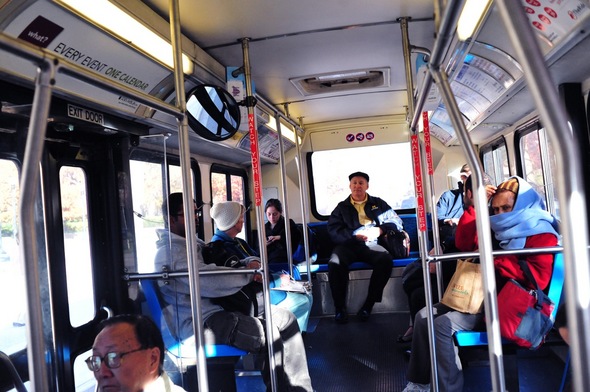
Comprehensive public transit is good for the community because it means that seniors, youth, people with disabilities, and people unable to afford a car can still get to work, to the store, and to school.
Ryan Stanton | AnnArbor.com
Even though I’m on the other side of the issue from you, I’d like to offer some advice.
Yes, I am a transit supporter. I believe that strong public transit is good for the environment as it takes cars off the roads and decreases global warming pollution. And I believe that comprehensive public transit is good for the community because it means that seniors, youth, people with disabilities, and people unable to afford a car can still get to work, to the store, and to school.

Chuck Warpehoski is the director of the Interfaith Council for Peace and Justice.
But if you don’t want our transit system to get any better, here are three ways to kill any improvements.
1. Death by Delay: It looks like you’ve already figured this one out. People have seen the need for improved transit for decades, so you must be doing something right to keep the status quo.
Right now, though, there is momentum for transit. The Ann Arbor Transit Authority has held more than seventy public events over two years to gather public input and develop a transit master plan. Support is growing, and your best way to stop it may be to stall it.
So look for any excuse to say, “not so fast.” If they present a complete plan, denounce it as not having enough public participation. If they present a draft for public comment, denounce it for being incomplete. Latch on to any glimmer of a policy change in Lansing or Washington as a reason to wait “until things get sorted out.” You can be sure that will slow the process to a crawl!
Your goal here is to keep the process running around in circles until it stalls out. Even if public support for transit remains strong, if you delay long enough you can say that the 2 years of public engagement the AATA has just completed is stale and demand they start that process all over again.
Don’t rely on delay for your entire strategy, though. Once gas prices climb above $4.00 a gallon again, your job will get a lot harder. And when $5.00 a gallon hits, look out!
2. Demand that Ann Arbor have complete control of the process: How do you move from delaying transit improvements to defeating them? Convince the other cities and townships that the game is rigged against them by demanding that Ann Arbor have majority control over the countywide authority.
People like democracy, so it will be a hard sell to get Ann Arbor a majority of the seats with only a third of the population. So instead of arguing “one person, one vote,” you should argue, “one dollar, one vote.” Insist that Ann Arbor should have a majority of the board seats because it would pay more into a countywide system. It’s great political judo. You’ll sow mistrust in the townships and turn Ann Arbor’s support for public transit against improved public transit.
The proposed board setup, in which Ann Arbor has 47% of the seats, balances Ann Arbor’s greater economic contribution with the need for a governance structure that is responsive to the entire county. Eliminate that balance and you’ve destroyed the system.
3. Transit to nowhere: One way to deal with calls for improved transit is to redirect them. Dismiss all calls for county transit by demanding improvements within Ann Arbor first. With this approach you play to Ann Arbor’s sense of pride to distract voters from the fact that the transit plan would actually improve service within Ann Arbor.
Just be careful, you don’t want people to realize that their lives don’t stop at the border. If people realize that Ann Arbor-only transit won’t get them to their job at Meijer or their doctor's appointment at Domino Farms or human service centers in Ypsilanti, this tactic could backfire. Likewise, this tactic falls apart if people realize that the transit plan calls for improved service within Ann Arbor and that you can only improve service within the city so far without opening the system to more riders.
There’s my advice if you want to stop transit improvements.
As a transit supporter, I hope that City Council ignores this advice completely when it take up the issue on March 5. I hope council members will keep the process moving forward to create a countywide system that is fair to all participating jurisdictions and that improves service both within Ann Arbor and throughout the county.
Chuck Warpehoski is the director of the Interfaith Council for Peace and Justice. His wife, Nancy Shore, is director of the AATA’s getDowntown program.
Comments
jcj
Sat, Mar 3, 2012 : 1:55 p.m.
Mr Warpehoski You have done irreparable harm to your credibility when you chose not to mention your wife works for the AATA! Everyone knows polls can be manipulated (and usually are) to come up with the desired result. Go peddle your false statements to those that will believe.
B2Pilot
Fri, Mar 2, 2012 : 2:04 p.m.
Conan Smith if you really love political discourse then put it to a vote!
Vivienne Armentrout
Fri, Mar 2, 2012 : 1:50 p.m.
There are many reasons to debate the specifics of the proposed program but underlying it all is our sense of fairness. This post begins an examination of fairness as it relates to the countywide transit plan <a href="http://localannarbor.wordpress.com/2012/03/01/fairness-and-transit-where-aata-is-moving-us/" rel='nofollow'>http://localannarbor.wordpress.com/2012/03/01/fairness-and-transit-where-aata-is-moving-us/</a>
motorcycleminer
Fri, Mar 2, 2012 : 12:58 p.m.
This is not a " comment " it's a sales pitch by people who have their hand in the pot...
Kronoberger
Fri, Mar 2, 2012 : 12:13 p.m.
Of course we need to expand public transportation. There is inadequate parking downtown so everyone benefits from public transportation. In addition, people who work in AA but who can't afford to live in AA need alternatives to the automobile. The same people who balk at pay increases for municipal and service workers are the one's complaining about helping these folks get to work.
dotdash
Fri, Mar 2, 2012 : 5:31 a.m.
In general, I'm a transit supporter and I agree that you need good public transport to have a strong community. I'm just not sure that my community extends outside AA to communities who don't want and won't pay for the service. Why should we create a system that will encourage sprawl around AA and make it easier for those who don't want to live in AA to work here? That's my problem with this. We should have really great services within AA so that people want to live and work here. The implicit model for this countywide service is a central AA where people work but do not live. Let's do better.
Conan Smith
Thu, Mar 1, 2012 : 11:09 p.m.
Chuck, I enjoyed the piece! I'm a transit supporter, of course, but even more as a reader I think taking the time to construct a commentary that uses language as the powerful tool it can be makes political discourse that much more enjoyable. The fact that you take a swipe a mentality -- not an individual -- is just fine. While I hardly ever agree with P.J. O'Rourke, I eat up his essays for the same reason. Thanks for tackling tough issues with a aplomb and a delightful bit of cynicism. Swift and Lewis would be proud!
Steve Hendel
Fri, Mar 2, 2012 : 9:09 p.m.
So, Mr Smith, clever use of language (without, I might note, any FACT-BASED discussion of the actual issues) is the really important thing?
Tom Whitaker
Thu, Mar 1, 2012 : 6 p.m.
The dripping sarcasm of this op ed does nothing to promote healthy public discussion of the public transportation issue. The countywide proposal has little to do with "improving" existing transit and a LOT to do with expanding transit for township commuters. As the chair of the AATA board has written, this expansion is about providing the opportunity for more and larger "transit-oriented-developments" out in the townships. It is all about creating a massive transit system for commuters, which is the antithesis of other City programs like the downtown rezoning (to encourage more residential development and increase downtown population density) and the Greenbelt millage (to buy up property and development rights in the townships to preserve natural areas, open space, the watershed, and more recently, farms). Why should we put millions into preserving land, while at the same time, paying millions more to make it easier to develop in the boonies? The fact is that this county-wide plan does little to improve the mobility of the disabled, elderly, and lower-income people who may currently live in isolated areas. It is all about commuters being brought in from the outlying areas to their jobs in Ann Arbor and back again, along linear routes. A more sustainable idea would be to complement the Greenbelt and downtown zoning efforts to provide for the best urban living experience possible, including excellent intra-city transit, quality roads and bike lanes, well-maintained parks, top-performing schools, a variety of living options--from traditional historic neighborhoods to trendy high-rises, and last but not least, well-funded public safety services that give rural residents the confidence to move inside the City limits. I think it is our local government's responsibility to make our City as attractive to newcomers as possible, not make it easier to live elsewhere.
Vivienne Armentrout
Thu, Mar 1, 2012 : 5:19 p.m.
I know that this opinion is written from a sincere public-spirited conviction, but I regret its negative tone. Mr. Warpehoski should acknowledge that many of us who have raised concerns about the current plan to institute a new regional authority (under Act 196) and transfer AATA's assets to it are, in fact, transit supporters, not transit opponents. At the public hearing on January 23, a majority (by my estimation) of the nearly 40 speakers were people who use our current bus system and were concerned that it might be compromised by this new direction. While I think everyone there supported "improvement in public transit", the details do matter. One question is, how broad is the support for expansion of our city bus system and transit outside of Ann Arbor? When the question asked is "would you like to see this service", the answer is usually very positive. But when it is "would you help pay for it", often communities outside of Ann Arbor demur. As I have explained at length in my post <a href="http://localannarbor.wordpress.com/2012/01/27/how-much-county-in-washtenaw-county-wide-transit/" rel='nofollow'>http://localannarbor.wordpress.com/2012/01/27/how-much-county-in-washtenaw-county-wide-transit/</a> , 5 of the 20 townships have already refused to participate in the county-wide plan development. In the recently completed survey, only Ypsilanti and Pittsfield had a majority of positive responses to a millage vote, while all other areas had a majority of negative responses. A basic rule of providing services is that you can't get something for nothing. Another basic rule of governance is that even if costs and benefits are distributed unevenly, we should perceive that the arrangement is fair. If we are to have "improved public transit", we must also agree on how to pay for it. If those improvements in some areas result in a loss of service to those who are paying for the current service, that is a legitimate concern and I do not believe that an attempt to shame those who fear that loss of service is fair.
Alan Goldsmith
Thu, Mar 1, 2012 : 4:47 p.m.
"Chuck Warpehoski is the director of the Interfaith Council for Peace and Justice. His wife, Nancy Shore, is director of the AATA's getDowntown program." Uh huh.
Mick52
Thu, Mar 1, 2012 : 4:44 p.m.
I think it is fine for anyone to write an opinion piece in support of or against any public proposal. I am in favor of expanded public transit for people who choose to use it, especially since I see evidence gasoline prices are going to increase and not fall. But you cannot criticize people for being wary of large cost expansion of public services and transportation projects are expensive and sometimes unpredictable in the real costs. Here is an example: <a href="http://www.theatlantic.com/business/archive/2011/08/california-high-speed-rail-project-to-cost-more-than-expected/243481/" rel='nofollow'>http://www.theatlantic.com/business/archive/2011/08/california-high-speed-rail-project-to-cost-more-than-expected/243481/</a> I realize that the CA project is much bigger, the point is that cost estimates that may sway voters as reasonable can reach levels that may not be and once a large amount is spent on a project, you have to spend more to finish it otherwise you have thrown money away. There is ample reason for people to be cautious in decision making.
Interfaith Council for Peace and Justice
Thu, Mar 1, 2012 : 4:19 p.m.
Just last Friday I spoke to a woman who had lost her job in the recession. Without an income, she no longer owns a car. She's had four job offers, but has had to turn them all down as they all start early or end late and there isn't bus service in her neighborhood at those hours. The transit service we have is a good start, but we need to do better.
mtlaurel
Thu, Mar 1, 2012 : 5:28 p.m.
what type of car did she own: did she have a loan and expensive insurance? Did she look into a used older car and cut the insurance coverage somewhat thereby reducing the cost for car ownership? We live 50min or less to Detroit and the availibility of lower cost/used vehicles from private individuals or dealers is infinite. This anecdote is irrelevant. Every working person in every neighborhood will not get service that meets all their needs for all hours of the day/nite. No one is saying that improvements aren't needed, but there is no pity for one who declines a job for illogical reasons. Maybe she didn't really like the jobs.
Craig Lounsbury
Thu, Mar 1, 2012 : 4:51 p.m.
anecdotal stories are of little real use. How much did the jobs pay? How much would a cab cost to the nearest job? Subtract cab fare from her take home pay and would she be better off with the job or without the job ? Whats her alternative? keep turning down jobs till a bus runs by her house? Keep hoping for a day job offer? I don't mean to sound callous but they are fair questions. The author of the story who coincidentally works for the same place your alias describes doesn't seem to like questions.
B2Pilot
Thu, Mar 1, 2012 : 4:18 p.m.
I really have no problem with public transportation as long as it can be self-sufficient or close to it with a little help. What we have now is nowhere near that. The county wide plan is a convienant avenue to get more tax revenue to plug some of the holes. Heres an idea; the DDA is filling in gaps in Ann Arbor's budget why not have the DDA finance the bus system? they can spend 50 million on a hole in 5th avenue and still supplement A2's budget so they have deep pockets for this. Oh wait that is already a beuracracy that has its own agenda; sorry I forgot - You say there is overwhelming support; I say put it to a vote!! AATA has decided NOT to put on the election ballot, at least not this year because IT IS A PRESIDENTIAL ELECTION AND TURN-OUT WILL BE HIGHER! They will put it on a not so popular April ballot on an off election year to get it through when few voters have an interest - watch for it! Regional transportation is one thing and there is a need. But it should be intelligently thought out, not a rush by a couple of beuracrats looking for a money grab, which is all this is. The environment is being hurt now by the near empty buses circiling the city and you want more? seriously
Craig Lounsbury
Thu, Mar 1, 2012 : 4:39 p.m.
"I really have no problem with public transportation as long as it can be self-sufficient or close to it with a little help. What we have now is nowhere near that. " The thing is no forms of transportation are self sufficient as in paid for strictly by users directly. Trains aren't airports all have some level of subsidy from those who never fly and the biggie, roads no longer get built and maintained strictly from gas taxes either .
David Cahill
Thu, Mar 1, 2012 : 3:52 p.m.
Yesterday the AATA's financial advisory group decided not to make a final recommendations on financing because of possible Lansing legislation. And press coverage of the meeting indicates that a November, 2012 millage request is no longer likely. So - is the AATA itself adopting the "delay" strategy?
st.julian
Thu, Mar 1, 2012 : 3:49 p.m.
I like to see the detail of the survey results. How many responses were received and where they from. Concluding you have county wide support if 90 percent of the respondents are in Ann Arbor Is not supportable.
Vivienne Armentrout
Thu, Mar 1, 2012 : 4:55 p.m.
There were a couple of good reports on the survey. Here is one: <a href="http://annarborchronicle.com/2012/02/18/aata-oks-airride-survey-results-positive/" rel='nofollow'>http://annarborchronicle.com/2012/02/18/aata-oks-airride-survey-results-positive/</a> This one <a href="http://www.annarbor.com/news/new-survey-shows-washtenaw-county-voters-support-countywide-expansion-of-transit-services/">http://www.annarbor.com/news/new-survey-shows-washtenaw-county-voters-support-countywide-expansion-of-transit-services/</a> does not show the graphical results but does include a reader poll. I have been trying to obtain a copy of the actual report with sampling techniques and numbers but it has not yet been made available. Note that the positive response outside Ann Arbor was much lower than within Ann Arbor.
Enso
Thu, Mar 1, 2012 : 2:44 p.m.
Just pay your taxes and quit whining. All you anti-tax people do is complain like little school kids who aren't getting their way. You benefit so much from tax dollars yourself, so 'man-up,' and be an adult about things. The economy isn't in the shape it's in because your tax dollars are helping the disabled, elderly, and children get to work and school. The economy is in the shape it's in because your last Republican administration took the largest surplus in the history of the country and turned it into the largest deficit in the history of this country. AND borrowed more money than any other president in history which he gave as tax breaks to millionaires and billionaires. What if a Democratic president did that? Would you defend him like you do Bush? And don't give me the 'largest deficit ever.. blah blah.. Obama... blah blah...' The current administration is tasked with the ugly job of having to reap what was sown by the Republicans. Like it or not, all those tax breaks and wars you guys wanted have to be paid for somehow. I'm just mad you dragged the rest of the country down with you.
B2Pilot
Thu, Mar 1, 2012 : 4:21 p.m.
is this an article about transportation or political parties?? what about Clinton's housing policies which encouraged banks to lend with no collatoral? what about Clinton push of NAFTA how did just these 2 pieces effect the current economy? Just askin? now back to the transportation thing...
Redleg
Thu, Mar 1, 2012 : 3:46 p.m.
Gotta agree with you bud: Fox news and the republicans keep trotting out that the deficit has grown by more than 4 trillion dollars under Obama-- For those that need things broken down in a simple fashion, that's a true statement. Alas, things like budgets and deficits are rarely simple. Despite Mitt Romney's silly deficit clock, most of this 4 trillion+ deficit is definitely held over from the Bush administration. I f anybody wants to bother and exercise their mind a bit see Ezra Klein's column from just this past February in the Washington Post. He breaks down the numbers and provides a nice colorful chart to show just where to hang the blame on the current numbers. C'mon people use yer noodle: Did you really think we could fund two wars over ten years+ with their associated costs for nothing extra on the deficit side of the fence?
JSA
Thu, Mar 1, 2012 : 3:16 p.m.
Enso, Get off your high horse. This transit program benefits virtually no one outside Ann Arbor. It is a sham designed to rip off everyone to solve Ann Arbor's parking problems. The economy is in the shape it is in largely because of both parties playing with the housing housing markets by lowering credit standards for Fannie and Freddy and getting rid of the prohibition prohibiting investemnt banks to enter the field of commercial banking. You can thank Chris Dodd and Barney Frank for a lot of it as well as Clinton and Gore. Yes, the republicans jumped on the band wagon too but remember Mr. Obama raised more money from Wall Street than anyone else so stop playing party politics. The transit plan is nothing more than a rip off.
Brad
Thu, Mar 1, 2012 : 1:48 p.m.
4. Publish opinion pieces dismissing the legitimate concerns of the taxpayers. It's preferable if these are written by spouses of AATA employees.
Craig Lounsbury
Thu, Mar 1, 2012 : 1:41 p.m.
"Man up" Mr. Warpehoski , tell us how much you pay in taxes now for the AATA and how much more your willing to pay.
JSA
Thu, Mar 1, 2012 : 1:31 p.m.
The survey was rigged. I know, I took it. The questions were posed in such a manner to give the desired response. The majority of the residents are not in favor of this so stop trying to sell it. The last thing we want to do is send our tax dollars to AATA. They couldn't run any system in a cost effective manner if they had to. This is just about Ann Arbor politicians and bureaucrats trying to scam money from the rest of the residents of the county and really rip off the residents of Ann Arbor because of Ann Arbor's parking problems. Don't try to say otherwise.