

U.S.-China relations -- how they are managed will impact all of humanity
“All warfare is based on deception.” — Sun Tzu, The Art of War
Michigan Gov. Rick Snyder will soon leave for a trip to Asia with stops in South Korea, Japan and China.
Our prior governor played "Peking Duck," never traveling to the fastest growing large economy in the world to seek trade, investments and ways to out Michigan back to work. This was a mistake.

 Moving forward with globalization and technology, all roads will intersect in China.
Gov. Snyder will not address all the challenges between the U.S. and China, but he can begin to develop the guanxi/relationships necessary to assure China's rise does not come at Michigan's demise.
It may be a good time to read Sun Tzu’s 6th century Chinese military treatise, “The Art of War.” This book is considered one of the gems on military strategy to this day.

Tom Watkins
The economic rise of China is well documented. The Economist magazine recently predicted China’s economy will surpass the U.S.’s by 2019 if this ‘see-saw’ (China rises as the U.S. declines) effect continues.
China’s educational wave, making vast improvements to their system of education, is another reminder of China’s desire to regain its prominence as the “Middle Kingdom.”

 A third wave, that of military expansion, has the potential for a build-up that may ultimately swamp America, but perhaps not in the way some expect. The threat may come from within.
According to Pentagon officials, China is not yet capable of competing militarily with the U.S. and are at least a generation or more behind the United States in military technology.
Perhaps the real threat is what President Dwight D. Eisenhower, a WW II hero and Army general, warned about in his farewell presidential speech. It was 50 years ago that Eisenhower warned the nation to beware of the “Military Industrial Complex” -- an “iron triangle” of intertwined relationships between government, the Armed Forces and the industrial sector that manufactures arms and profits from them.
Americans must be careful that we do not allow recent China saber rattling, an expansion of their military prowess, evidenced by a testing of their first stealth jet and the construction of their first aircraft carrier, to draw us into an extended arms race that we can ill afford.
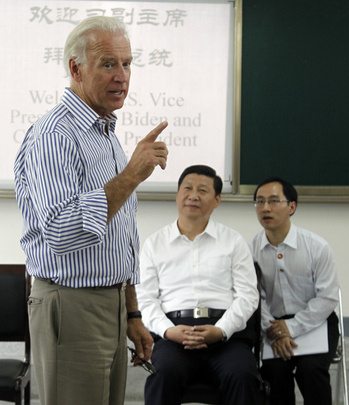
U.S. Vice President Joe Biden, left, speaks near Chinese Vice President Xi Jinping, center, during their visit to a high school in southwestern China's Sichuan province on Aug. 21. Xi is expected to begin taking over the top leadership next year.
AP Photo | Ng Han Guan, POOL
Our military budget, like all aspects of U.S. spending, has recently come under fire in this new era of budget austerity.
China has used its evolving economic strength to gain enormous strategic geopolitical advantage in a number of areas, spending the better part of its stellar economic rise to build its country: Roads, bridges, air and seaports, bullet trains, schools, and universities. All have benefited the Chinese people and kept the Communist Party in power.
All the while, the U.S. has disinvested in our people and domestic priorities, allowed our infrastructure to decay and building up our military only to police the world, spending trillions overseas. It shows, too, as we struggle economically -- we are also crumbling, literally, from within.
Clearly, China is also spending militarily as well as on domestic needs. If we try to keep pace with an arms race with China could we, like the USSR, go broke? Or will the American people become fed up with high unemployment, declining wages, aging infrastructure and a concentration of wealth in the hands of a few to demand changes in spending priorities?
The Soviet Union spent its focus and economy on an arms race with the West (primarily the U.S.). Economically, communism was part of the problem but the spending on arms ultimately bought down the former USSR.
Watch out for the MIC and it trilogy of political hardliners, U.S. military, and defense contractors bringing America down -- without a shot being fired.
As China grows militarily, there will be a continued cry from our military and congressional and defense contractors to reverse the beginning of reductions or at least slowing the increases in military expenditures here at home. Just as the old USSR bankrupted themselves in an escalating arms race, China could do the same to us.
Many in Washington with a Potomac view see China’s growing military might as a strategic threat to the Pacific region if not our homeland. There have already been hot words over the South China Sea, with the Pentagon claiming that China has an “operational” ballistic missile able to sink aircraft carriers at long range.


Adm. Mike Mullen, chairman of the U.S. Joint Chiefs of Staff, said he was not surprised by China’s recent Stealth fighter test. In the New York Times, Mullen pointed to China’s development of anti-satellite and anti-ship technologies saying, “Many of these capabilities seem to be focused very specifically on the United States.”
There is also fear in some circles that China’s current civilian leadership may not have the absolute control over China’s military it once commanded. What might a rogue People’s Liberation Army (PLA) be capable of?
China is intent on catching up and surpassing the U.S. in space and high tech superiority, communications systems and cyberspace weaponry. The PLA has successfully demonstrated advanced anti-satellite weapons systems, blowing one of its satellites out of the sky for the world to see.
During his visit to the U.S., Chinese President Hu signed business deals totaling over $45 billion worth of American exports to China, supporting 235,000 American jobs in 12 states.
One major agreement is a joint-venture in commercial aviation with G.E. This joint agreement/partnership with a state-owned Chinese company calls for the sharing of America’s most sophisticated airplane electronics. While creating jobs at home today, this deal and could result in the technology being used by our Chinese counterparts to out-compete G.E. and other U.S. companies in the future by producing better and certainly cheaper consumer aviation products.
The greater fear is these same technologies could help China fast forward militarily.
Despite billions of dollars in proposed Pentagon budget cuts, outgoing Defense Secretary Robert Gates recently announced that Chinese development of its first radar-evading fighter jet, as well as an anti-ship ballistic missile that could hit American aircraft carriers, had persuaded him “to make improvements in American weaponry a priority.”
So before we even have begun the slowing of military expenditures, we have a rationale for expanding the industry.
Christina D. Romer, an economics professor at the University of California-Berkley and former chairwoman of Obama’s Council of Economic Advisors, pointed out in a New York Times story that the bi-partisan National Commission of Fiscal Responsibility and Reform “recommended that military spending, which has risen more than 50 percent in real terms since 2001, grow much more slowly in the future.”
Timothy Geithner, U.S. Treasury secretary, in a speech to Johns Hopkins University School for Advanced International Studies, his alma mater, recently pointed out: “It is imperative for the U.S. government to invest more in education, infrastructure and research and development, and to improve the incentives for business investment and to restore fiscal responsibility.”
In his State of the Union address, President Obama called for investments in rebuilding America to help get our country working again.
The future will belong to the nation that invests in its people. Investing in research and development, innovation, knowledge, creativity with a can-do spirit will propel us forward. The president has repeatedly said, “A nation that out educates us today, will out compete us tomorrow.”
The question remains, will our expenditures match our rhetoric?
Can we afford both “bread and arms” when we have a deficit in excess of $14 trillion, borrowing 40 cent for every dollar spent and owing China over $900 billion?

 When it comes to the U.S. spending wishbone, domestic vs. military spending going forward, who will be the ultimate winner?
“If you know both yourself and your enemy, you can win a hundred battles without a single loss.” — Sun Tzu, The Art of War
A new nationwide poll by the Pew Research Center shows a major shift in how Americans perceive China. Americans now see Asia, not Europe, as the region of the world most important to U.S. interests. Yet by a margin of 60 percent to 27 percent, Americans think China’s economic strength is more of a problem than its military might.
China has a rich, 5,000-year history of its being the ruler of the universe, aka the “Middle Kingdom.” China was the preeminent world power during most of this time with the exception of the 19th and the beginning of the 20th. Recent flexing of China’s economic, educational and military now represent to China’s nationalistic masses, a historical norm not an abnormality. Today, Chinese Netzens are abuzz with China reclaiming its historical mantle.
China watchers believe China is simply biding its time until it once again regains its “rightful place” as the “Middle Kingdom” of the world. They believe that China will not be as satisfied as when Chou En-lai, Deng Xiaoping or President Hu Jinato claim to deal with the West “on a basis of equality and reciprocity.”
With a population now in excess of 1.3 billion, China’s nationalism will be the glue that will bind the country together as the 21st century unfolds. Riding high historically, China has seen no limit to its power and influence and, some claim, its arrogance.
Just as President’s Obama and Hu begin a relationship, in 2012 we will see President Hu begin to phase out of power from the Chinese Communist leadership scene passing the baton to his expected successor, a former provincial leader and descendant of high ranking revolutionary officials -- Xi Jinping, now China’s vice president. Xi has been known to show impatience with foreigners wary of China’s new power in the world. Yet he has extensive experience with the West and his daughter is a student at Harvard.
Could China’s military build up be a Chinese Trojan fortune cookie? Will China drag the U.S. into greater military spending, borrowing money from China to do so, enabling them to stoke both their domestic and military spending thus accelerating the economic see-saw, with America occupying the declining position?
Our leaders and the American public need to watch this building storm, protect our national interests, and be careful that our own preparation for the coming waves do not become our undoing.
Sun Tzu, reminds us: “The victorious strategist only seeks battle after the victory has been won, whereas he who is destined to defeat first fights and afterwards looks for victory.”
The ancient Chinese Philosopher, Lao-tsu captured the essence of the recent Chinese state visit to the U.S. with this statement, “A journey of a thousand miles begins with a single step.”
The Chinese and U.S. leaders vowed to build “a cooperative partnership based on mutual respect and mutual benefit.” Time will tell how this will play out.
As we continue this journey with a rising China, we will need leaders of great wisdom to make sure it is “harmonious” for us both. How our mutual leaders manage and lead in the 21st century will impact all of humanity.
Tom Watkins has a life long interest in China and has traveled extensively and worked there for more than two decades. He serves on the University of Michigan’s Confucius Institute, and the Detroit Chinese Business Association advisory board and is honorary professor and educational consultant to K-12 schools and a university in China. He served as Michigan’s state superintendent of schools, 2001-05, and president and CEO of the economic council of Palm Beach County, Fla., 1996-2001. He can be reached at: tdwatkins88@gmail.com.
Comments
BhavanaJagat
Sat, Sep 10, 2011 : 1:10 a.m.
A LESSON FROM THE VIETNAM WAR : I would be surprised if United States is unwilling to learn a lesson from its Vietnam War experience. Rick Snyder is not the first famous American to visit Communist China. How could we forget the historical visits to Peking(Beijing) made by Dr. Henry Kissinger and President Richard Nixon who moved the United States to normalize trade with China. Did it hep the War in Vietnam? The diplomatic initiatives of Dr. Kissinger had failed the U.S. Policy both on the diplomatic front and the War front. U.S. could not get any meaningful concession from these Communists. China continued to provide military assistance to Hanoi. North Vietnam launched a major conventional invasion of South Vietnam during March 1972 and this attack is described as 'The Easter Offensive'. America had reduced its fighting troops present in South Vietnam and the Viet Cong forces remained stay put causing an enormous disadvantage to American military initiatives. President Nixon responded with intensified bombing campaign and it did not help us. Communist China continues to pose a military threat to all nations in Southeast Asia. Having sacrificed the lives of over 58,000 American Citizens, United States must confront and resist this Communist Power on the ground. <a href="http://bhavanajagat.wordpress.com/2011/09/09/operation-eagle-1971-and-vietnam-war/" rel='nofollow'>http://bhavanajagat.wordpress.com/2011/09/09/operation-eagle-1971-and-vietnam-war/</a>
braggslaw
Mon, Aug 29, 2011 : 2:59 p.m.
I have worked with Chinese companies (living in and out of China) for a decade. Those who hold China up as an example of doing things the right way are idiots. China and the Chinese people were robbed of their moral centers during the cultural revoluation and the great leap forward. They are driven purely by money and care nothing for the damage created by their drive for $$$. I am a fundamentally a free market guy, but putting melamime in baby formula, omitting steel rod in construction, pouring dioxin in drinking water etc. is more normal then not in China. The Chines govt. is like any other despotic regime, they are interested in keeping power. The nmove to a capitalistic economy is creating great wealth but it lacks democratic feedback and controls. The communist party is faced with the real danger of their country fracturing based upon regional interests. While most of China is Han, regionalism is the biggest issue. Beijing versus Shanghai, West versus Coast etc. China is much like a warm pile of steaming ... covered with glitter and sprayed with air freshener. I like to characterize
Not from around here
Mon, Aug 29, 2011 : 7:12 p.m.
I agree. I have worked for two chinese companies and been there on business trips. I have scene with my own eyes how deplorable the conditions there and the uter contempt the goverment and the upper managment have for the world ecology, the world ecomomy and their own people, as well as for america and americans.
David Briegel
Mon, Aug 29, 2011 : 1:47 p.m.
What a contrast. A nation on the way up and a nation in decline. A nation that values education and a nation the is gutting education and cutting educators. Eisenhower could never have imagined what we would become. Our true value seems to be Perpetual War Profiteering! What will America do when China Spring arrives? Will the combination of a corrupt govt in China and the wealth and power of the Wall St Banksters continue to deny the Chinese people their rightful democratic freedoms? How will that set with American values? Trade with China was to bring freedom and democracy. Does it bring more than exploitation? American Exceptionalism. Just another myth?
David Briegel
Tue, Aug 30, 2011 : 1:41 a.m.
Well Don, you hit the nail on the head. All those wonderful "benefits" of the Chinese system that we are competing with are precisely what our patriotic American corporations (patriotic people) find attractive in China! Central planning. Compliant workforce. No gubbermint regulations. No taxes. Free plundering of natural resources and polluting the environment! You know Don, all the characteristics of a civilized society! That is the same vision those conservative leaders desire right here in America. Aren't you proud? And Bedrog, it is the complainers who love those Chinese scoundrels!
DonBee
Tue, Aug 30, 2011 : 1:22 a.m.
Mr Briegel - I will pay you like a Chinese Teacher....how does that sound? Most teachers stay a year or two before moving on to a job with a real salary. Many of the teachers are in the Army, assigned because they have a subject they have mastered. Most of the text books are heavily censored. Going "off script" in a class will get you not just fired, but potentially in prison. Sure they value education, but not the educators. And they value the education they want obedient students to have. So many high performing, upper class Chinese students come to the US for College and find they are like fish out of water, there is so much they have to relearn and so much they did not know exists. China values the US education system, but they only want to use it for students who have proven they are aligned with the future of China and its government. OBTW - don't believe me, spend as much time in China as I have in the last decade.
bedrog
Mon, Aug 29, 2011 : 8:58 p.m.
moderators: how can a comment be voted one of the 'most popular' ( with 3 votes!!) when all of the 7 responses to it are against it, albeit for different reasons?? ( and i assume the 4 deleted replies , only one of which was mine, were against the dreary , endlessly repeated one-note, " blame the u.s while glorifying scoundrels elsewhere-ism" of the original poster!). Feel free to go ahead and delete this now, even though it raises a fair point!
Not from around here
Mon, Aug 29, 2011 : 7:52 p.m.
and if your concerned about all of this war profiteering, then that must mean your helping vote oue Obama next term. He has continued the two wars he had coming into office, after saying he would end them, and added a third military action. and if you concerned about china's influence on US goverment, I'm sure that you worked to ouster Clinton re-election. After all, he was deep with them and even recieved champaign contributions from The Chinese Communist Goverment conections. Or you can just blame everything on Bush and those slippery Wall street Bankers, or Rick Snyder, or tea-Publican, or Nixon. Your choice.
braggslaw
Mon, Aug 29, 2011 : 7:14 p.m.
Incredibyly wrong on every level....
Not from around here
Mon, Aug 29, 2011 : 7:09 p.m.
What a pile! How about a nation that allows there people the freedom to study whatever they want verse one that forces vales forcing people to become educated in what the state values, forces them in to positions were it serves the state, forces people to limit them sselves to one child and rolls over them with tanks whne they try and question the goverment. America is an exceptional place and you should thank those of us who have fought to protect it and the right for you to insult it!
Mr. Ed
Mon, Aug 29, 2011 : 1:34 p.m.
Maybe while the Governor is in China he can buy back Gateway and bring the jobs back to Michigan.
Basic Bob
Mon, Aug 29, 2011 : 3:49 p.m.
These jobs were never in Michigan. For a while they were in Iowa and South Dakota until it became difficult to attract engineers, then they tried California. Buying Gateway would be the easy part. But it would be like starting over. Finding experienced electronic hardware engineers and low cost assembly workers in this state would not be so easy.