

Very little 'connecting' taking place with William Street project
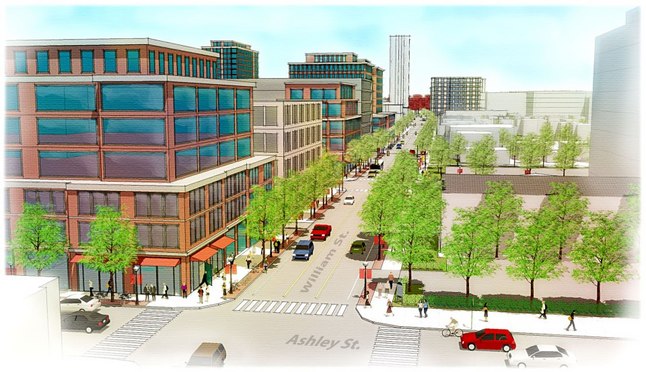
A sketch showing what future redevelopment could look like along William Street in downtown Ann Arbor, looking east and slightly north from the intersection of Ashley and William.
SmithGroupJJR
I have read information online about the project and I have talked to several people.
I agree that the City and DDA should be proactive in defining opportunities that are compatible with the Central Area Plan, that are aesthetically desirable for our downtown, and that promote a higher quality of downtown living.
I support the concept of a greenway streetscape connection through downtown from the west side all the way to campus, dead-ending at State Street.
I appreciate the engagement of local design professionals to interpret and illustrate many of the great ideas and opportunities that are coming out of this project, and I respect their work.
However, I do NOT see any actual “connecting” going on, especially along the William Street route. To encourage, and ultimately require developers to follow through in their responses to requests for proposals, the plan needs to be more articulate in this aspect.
Add elements to the streetscape that are actual nodes, or oases, along the route. These are essential to break up the linear street that is currently only shown as a straight and narrow “chute” with a little bit of green cover along the street edge. Include benches, changes in paving material, additional greenery, and other features of interest.
Add weight to this requirement by including the graphic interpretation now, so that developers can see visual options of expected improvements, and NOT defer to zoning, which in D1 requires NO setback. This makes absolutely no sense. The variability must be demanded by example, and then reinforced by holding developers to this requirement when reviewing their proposals.
We are running into this problem on the northern side of downtown, where the developer for the 413 E. Huron project shows NO setbacks along Huron or Division Streets. So far, the planning staff has supported the developers’ proposal and ignored our request and concern about adequate setbacks for the public right-of-way. In fighting this narrow interpretation of the zoning ordinance, our committee very much wants to point to the Connecting William project as an example of a positive force from the city to do the right thing. Lawyers and developers are too quick to use precedents as their sole argument against being made to provide better design, so it is important to improve any and all guidelines they will be using to comply with expectations and to apply for approval for their projects.
While not a public park, the pedestrian right-of-way along William Street must clearly show how it will link the edges of downtown together and, at the same time, provide a green buffer at the southern edge of downtown. Making it a place for people means telling developers, and reminding staff, that nodes for dialogue and oases for respite will be crucial to the successful design for the entire length of the street. Make sure this aspect of good urban design is represented in your final documents.
Comments
ionic
Tue, Jan 15, 2013 : 5:13 p.m.
Thanks for commenting on my "opinion" piece. Next stop for me is Planning Commission tonight, when we as citizens will speak up about the over-sized, over-bearing, misguided student warehouse proposed for the northeast corner of E. Huron and N. Division. The East Huron overlay zoning district was intended to mitigate aggressive proposals so they complement adjacent small-scale residential neighborhoods. I am all for density downtown, but I am not for the loss of near-downtown residential use by a diverse group people, to the exclusivity of student occupancy. I look forward to the engagement tonight, and hope to see both familiar and new faces stepping up to the microphone to speak against the 413 E. Huron proposal.
Jamie Pitts
Mon, Jan 14, 2013 : 4:15 p.m.
Well-said. We have the power to influence what is developed and can make our downtown more pleasant and productive for the people who will live and work there. These elevated building set-backs and "nodes" along the sidewalk can be opportunities for developers, too. Imagine if there are Palio-style places above the street all along Williams. Imagine if there are places to sip coffee from a sidewalk stand and chat with friends you run into.
motorcycleminer
Mon, Jan 14, 2013 : 1:12 p.m.
The DDA will get its way regardless of the public say.... Just like prince john and his merry band.... They rule dear OZ with an iron hand.... Your wallet is their true desire ... To fuel their massive egos fire.....
Veracity
Tue, Jan 15, 2013 : 4:49 p.m.
Not true! Write and call your City Council member and express your disdain at the DDA's plan to rape Ann Arbor, taking away her joyful character and attractive settings by useless infill building. We have jewel in our downtown that must not be stolen away and replaced with raw concrete and glass in an attempt to balance the DDA's deficit budgets.
Veracity
Sun, Jan 13, 2013 : 9:26 p.m.
FURTHER CONSTRUCTION UNNEEDED AND UNWANTED The DDA wants to fill four public properties downtown with big buildings that will generate much needed TIF payments in hopes to stave off insolvency as the DDA depletes it reserve fund year after year. But maybe not as the DDA wants to encourage development by "gifting" TIF payments back to the developers. How does gifting make any financial sense? It doesn't. When I ask myself what does Ann Arbor need downtown that warrants building seven-to-fifteen story buildings I conclude: not a hotel, nor an apartment building, or even an office building. When I queried our City Council members about their wishes for building downtown I only heard back from a few who either had no specific desires or were interested in small businesses, like a grocery store or another CVS or Walgreens or even another book store. So apparently no urgency exists for building large buildings with lots of square footage to add to the existing percentage of unoccupied commercial space. Then there is the question of how large buildings on the four public lots will effect the appearance of downtown. Of all the drawings that the DDA has offered depicting the skyline downtown none have shown how the west side of Main Street will appear when seven story buildings are built behind the three story historic buildings that extend between Williams and Liberty. Instead of seeing sky above the three story roofs one will see walls and windows. The sun that bathes the east side of Main Street until late in a summer's afternoon will be in the shadows of the new buildings after 2 pm. The crowded appearance will not add to the aesthetic so key to making Main Street a destination for many Ann Arborites.
Veracity
Tue, Jan 15, 2013 : 4:39 p.m.
If you believe that my assessment is correct, then you need to post your own critical comments and write or call your City Council member. The DDA is committed to building on all the sites and only a unified effort by many Ann Arbor citizens may prevent it from happening.
Peter Eckstein
Mon, Jan 14, 2013 : 4:46 p.m.
Veracity, here as most other times, makes a lot of sense. I'm in the phonebook and you are not--at least not by that name. We should talk.
cindy1
Sun, Jan 13, 2013 : 11:42 p.m.
Excellent comment. (I'm sorry to hear we have city councilors who want more national corporate chain stores, rather than locally-owned.)
kittybkahn
Sun, Jan 13, 2013 : 10:42 p.m.
Thanks, Veracity, for this post and for reminding people how the skyline will look to the West and how the sun will be blocked. In their haste to build build build to get money money money, the DDA doesn't pay any attention to this very important aspect of the results of their plans.
nowayjose
Sun, Jan 13, 2013 : 8:24 p.m.
Rich city problems. Wonder if Flint and Pontiac has these developement problems?
say it plain
Sun, Jan 13, 2013 : 5:11 p.m.
Well, it fits with the DDA's purpose of fitting together as many revenue-enhancing projects as possible along that street. Connecting the parcels into a long dull unfriendly line of money-makers; why should they care about anything but that, given their organizational identity?! Beholden to nobody? I really can't believe we allow it to exist anymore, and why we keep on electing the current crew who appoint these folks.
Rita Mitchell
Sun, Jan 13, 2013 : 4:31 p.m.
Thank you, Ms. Tyler. Your suggestions more accurately reflect the connections that are implied with the project title of "Connecting William Street." Results of the process so far are as described by Arboriginal: "Filling in William Street," and careful ignoring of the public input requesting green, open park space as part of the expectation and set of amenities that come with more dense development.
pb
Sun, Jan 13, 2013 : 4:04 p.m.
The other major disconnect is with the public input that regularly contradicts the preordained development plans of the DDA. I wonder what it will take to actually force this autonomous, self-driven and self-validating entity to listen to the persons who ought to be its real constituents.
DonBee
Sun, Jan 13, 2013 : 3:49 p.m.
Ms. Tyler - Thank you for the article. I only have one quibble with it. The use of different paving materials along the routes, with the number of people with disabilities in the community and the tendency for ice to build up in any uneven surface, the more regular the paving material (not smooth mind you) the better for many people to get a round. Try a wheelchair on cobblestones or bricks that have moved over the winter. The tests should be lay the paving, do zero maintenance for 5 years and then take a arm powered (not electric) wheelchair over the paving and put on a blindfold and be lead without anyone speaking across the pavement and see if you stumble. Those should be the tests for paving in Ann Arbor if we want a pedestrian friendly downtown.
Sparty
Sun, Jan 13, 2013 : 10:27 p.m.
AMEN !!!!!
Dog Guy
Sun, Jan 13, 2013 : 2:46 p.m.
As my wife and I age, rough pavement and sidewalks cluttered with trees and bike racks increasingly trammel our connecting along the pedestrian right-of-way. We therefore avoid downtown, thus contributing by our absence to its youthful vibrancy and aesthetics. Even our fifteen-year-old cars are succumbing to Ann Arbor's traffic-calming humps and potholes, further contributing to the city's image. With the aid of property tax foreclosures, Ann Arbor thus will achieve a young and wealthy population. May this plan be fully implemented before our Great Leader reaches the age of natural expulsion and is not around to see the results.
LXIX
Sun, Jan 13, 2013 : 2:45 p.m.
Very eloquent. Perhaps those responsible for zoning should be advised of their dis-connection. It might be easier just to dis-connect the DDA and return managed parking to the city. City property should accommodate those who reside here first and foremost. Not support endless "sprawl" for those who don't. Until the City and DDA can address a population growth endpoint and sustainable business economy thereafter, then their vision has no merit and should be flat out rejected as wasted energy.
Arboriginal
Sun, Jan 13, 2013 : 2:26 p.m.
Well put. The current plan is more like "filling in William Street". A commenter on a previous article suggested closing all of the surface parking lots for a month to see how our current parking structures handle the traffic. It would be a fine place to start!