

Panhandling on freeway ramps: State trooper tries to make a difference one person at a time
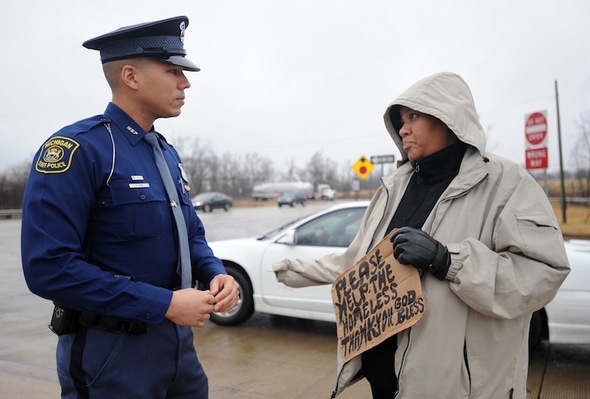
Michigan State Police Trooper Duane Zook talks with Linda Edwards on the Rawsonville Road ramp from Interstate 94, where Edwards had been panhandling.
Angela Cesere | AnnArbor.com
Like everyone who drives around Ann Arbor, Zook had seen people standing at the end of highway exit ramps. They hold signs bearing messages like “Will work for food” or “Homeless vet. Please help.”
But after 41-year-old Timothy Rogers froze to death in December 2007 near the Ann Arbor-Saline Road exit from Interstate 94, Zook decided it was time to do something. Zook had seen Rogers panhandling on the ramp during the summer and fall of that year, but he had never stopped to talk to him.
He wondered, “Who are these people?”
To give or not?
- Drivers who give money to highway ramp panhandlers should be aware that the money donated often goes to feed a drug or alcohol habit, experts say.
- Instead, Zook suggests calling an agency like Project Outreach, which helps homeless people with mental health and substance abuse problems find needed services.
- To reach Project Outreach, call (734) 222-3750
“They will not seek help on their own,” he says.
So, Zook began trying to force the issue. His goal is twofold: To stop, or at least cut down on, the panhandling at the ramps, and to get those who need help access to services. He began the effort in earnest a year ago.
The first time he sees someone panhandling on a highway ramp, he’ll write a warning. He’ll explain that panhandling is against state law, and people aren’t allowed to do it on freeway ramps. Panhandling is considered disorderly conduct under Michigan law and is a misdemeanor punishable by up to 90 days in jail or a fine of up to $500.
Zook tries to get to know the people he encounters on the ramps. He writes down their names and the basic details of each person’s story in a notebook he keeps. He usually pairs the information with a picture.
The notebook helps him keep track of people so he knows who they are if he runs into them again, and Zook makes the information available to other officers who may encounter them. Zook will include details about their history, such as whether the person is HIV positive.
If he sees the same person a second time, he’ll generally issue a citation. That gets the person into the court system, where a judge can order treatment for drug or alcohol abuse if it’s warranted.
But problems of drug and alcohol addiction and poverty are so intractable that it’s difficult to really have an impact. Zook knows this and it weighs on him. Sometimes he has contact with people a few times and then never sees them again.
Zook was saddened to learn about a man who recently died. He was among the panhandlers on whom Zook had been keeping tabs. An acquaintance of the man told Zook he had died of a heroin overdose.
Zook says the majority of people he encounters on the ramps have some kind of substance abuse problem.
“I wonder about all of them,” he says. “I like to keep tabs on them to make sure that they’re still doing ok. It’s almost like you have a bond with them.”
Heart-wrenching stories
Zook has heard lots of stories, and he’s generally wary of a hard-luck tale. People will frequently carry signs proclaiming they’re homeless, but Zook says that’s often not the case. The signs are designed to elicit sympathy and money, often to feed a drug or alcohol problem.
And they work. While some drivers are fearful or scornful of people asking for money, others are generous. Zook has heard panhandlers working the Ann Arbor-Saline Road ramp from I-94 can make $200 a day.
But some stories are so sad they would melt the heart of the even the most skeptical trooper.
There was the young woman Zook saw panhandling last January at Interstate 94 and Rawsonville Road. Zook suspected she was using heroin, but she denied it. She gave him a false name.
The second time Zook saw her on the ramp, a couple of weeks later, he arrested her. She gave him her real name and admitted her heroin addiction. She said she was from Jackson but had come to the Ann Arbor area for the services available here.
She also told him her mother had died of a heroin overdose and her sister was addicted to crack and was in rehab. She said her best friend in Jackson introduced her to heroin at a party when she was 15 or 16. Zook said a kindly couple in Ypsilanti agreed to let her stay with them. She would now be about 20, but Zook hasn’t heard from her in months, even though he gave her his phone number so she could contact him.
“I had phone contact with her and was trying to get her into a treatment program.” Money to pay for it was a problem though. He did see her waiting for the bus outside court a month or two after his last phone contact with her. “She said she hadn’t used.” A hopeful tone creeps into his voice. “She did look better.” He hopes no news is good news.
A mother's struggle
And then there’s Linda Edwards. Zook picked her up on a Friday in early January begging for money on the Rawsonville Road exit ramp from Interstate 94, her 6-year-old daughter in tow. She lives with her daughter at a Belleville motel, she told Zook, and begs for money on the ramp in order to have enough to pay the weekly rent for the room.
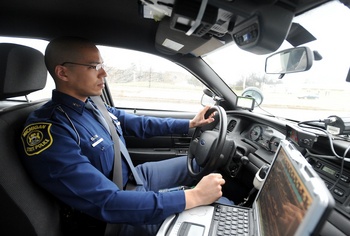
Duane Zook in his State Police patrol car.
Angela Cesere | AnnArbor.com
Zook told her she couldn’t be on the ramp, especially not with her daughter. Edwards said she had to bring her daughter with her that day because there wasn’t any school. She has to pay the rent on Friday so she needed the money.
A couple of weeks later, Zook saw her out on the ramp again. holding her sign of brown cardboard with the words “Please help the homeless. Thank you. God bless.” He stopped his patrol car and got out. When he walked up to her, she hugged him.
“I asked him if he was going to arrest me, and he said, ‘no,’” Edwards said. She was grateful for his lenience. “I was scared because I don’t want to lose my child.”
He told her again she shouldn’t be on the ramp. “I truly believe she has good intent behind what she’s doing,” he said. Edwards is unusual, Zook says, in that the money she was collecting was going for housing, not drugs or alcohol.
Edwards said she had no choice but to work the ramp. She gets food assistance from the state and used to get $200 twice a month from the Family Independence Program, but says that was cut off because without transportation she couldn’t participate in the Work First program. She didn’t have a car and says the motel isn’t near a bus line.
She said she had no other way to earn money and no family able or willing to help her. She said she got anywhere from $25 to $60 a day from panhandling on the ramp. She was walking several miles to the ramp and back each day.
“I can’t stop because I have to keep this roof over me and my baby’s head. … I don’t want nobody trying to take my daughter away from me, cause that’s all I got.”
But Edwards’ story has taken a dramatic turn for the better in recent weeks. Detroit television station WXYZ got wind of Edwards’ plight and did a story about her. Calls from people who wanted to help started pouring in. Zook worked with Billy Salamey, the owner of Budget Towing in Ypsilanti, to get a fund set up for Edwards. Donors have contributed more than $7,000 to the fund. One person even gave Edwards a van.
“I’m overwhelmed with all the support,” Edwards said.
A childhood dream
Zook, 31, has been a state trooper for more than seven years, but he started thinking about it long before that.
It was the shoes that got his attention. Zook was a little boy, only 7 or 8 years old. He was at a car wash at a gas station with a friend of the family. The car wash required an attendant, and Zook had gotten out of the car while they waited for the wash.
“As I’m walking around, I see these shiny shoes,” Zook recalls. “I looked up and there was a state trooper in his dress blouse.” The sight so impressed Zook that he never forgot.
In 2004, he got to wear the outfit himself at the 120th Michigan Trooper Recruit School graduation. He’s been working as a trooper in Washtenaw County since then.
Since January of 2011, Zook has been serving as a community service trooper. His job is to get to know the community, work with schools and other organizations and try to identify and solve problems, like the problem of panhandling on freeway ramps.
That particular assignment is one he gave himself. Zook often thought about Rogers after he died in 2007, but it wasn’t until he took on the community service trooper role that he had time to devote to finding out who was working the freeway ramps.
On average, Zook estimates he finds about one person a week panhandling on the ramps, and he’s arrested about 12 to 14 over the past year.
Zook is respectful of the people he meets on the ramps even if he’s arresting them. They’re generally respectful of him too. Rarely does anyone try to resist arrest, though recently a man he found panhandling for the second time tried to run from him. Zook used his patrol car to cut him off and quickly caught him.
Other local experts back up Zook's assertion that most people working the ramps are addicted to drugs or alcohol and not necessarily homeless.
"Almost all of the people panhandling are not homeless," said James Balmer, president of Dawn Farm, the drug and alcohol treatment facility in Ypsilanti. He said an addicted panhandler once told him he could make $150 a day working the ramp from Interstate 94 to Ann Arbor-Saline Road. He carried a sign reading "Broke and homeless. Please help," but Balmer said the man had his own apartment.
Balmer said people have to make their own decisions about whether it's a good idea to give money to freeway ramp panhandlers but should be aware that the money will likely go to feed an addiction.
Ellen Schulmeister, executive director of the Shelter Association of Washtenaw County agrees: "If you’re going to do it, do it with your eyes open."
Making a difference?
So are Zook's efforts having a positive impact on the panhandlers and the thousands of motorists who exit the highways each day? It’s a hard question to answer.
For a while, the number of people begging on the ramps was greatly reduced, Zook says, though he’s noticed it creeping back up this winter. But he says most of the people working the ramps now are people he’s never seen before rather than repeat offenders.
Still, he knows that doesn’t necessarily mean they’ve kicked their drug habits or otherwise gone on to productive lives. “They’ve essentially just been displaced. Sometimes it’s frustrating because some of them don’t want help at all.”
But Zook refuses to give up. “I’m optimistic something will change with them,” he said. “Time will tell.”
It’s that optimism that keeps him at it. That and the hope that his efforts will keep anyone else from freezing to death on a cold winter night.
For information about donating to help Linda Edwards, contact Budget Towing at (734) 485-2055.
Contact Cindy Heflin at 734-623-2572, or cindyheflin@annarbor.com or follow her on Twitter.
Comments
15crown00
Tue, Feb 21, 2012 : 8:41 p.m.
a PC cop how wonderful.
snapshot
Tue, Feb 21, 2012 : 3:28 a.m.
More treatment and less enforcement is needed. Some should not have to be "forced" into the court system to get help. The justice system will eat them alive with fees, stipulations, and penalties. The Edward's story is both heartbreaking and heartwarming.but she avoided the court system which would have resulted in losing her child. The judicial system does more harm than good for these folks....they need help not prosecution for which they get charged.
Skylar Woodman
Mon, Feb 20, 2012 : 7:20 p.m.
It's tough to tell who's real and not. For example, when I was walking to the North American International Auto Show in Detroit with my father and brother, a man who often walks downtown Ann Arbor with an army hat on selling those toothpick flags under the auspices of being a war vet tried to sell me one. I gave it back and told him to go back to Ann Arbor. He laughed and said he was going to the Superbowl in a week to sell them, and when I tossed it back at him he said I'd "Get my neck broke". That guy's a hustler of a different stripe, but I knew of a man who held a sign at 94/Ann Arbor Saline who lived in an unregistered car with broken windows, 365 days a year. Yesterday I witnessed a man in a black Sheriff's Chevy truck on the 94W Jackson road exit put his window down and talk to a man holding a "Cold and hungry" sign. The light went green and he let the man be, and he looked relieved. I know Grand Rapids has arrested 399 since 2008, 38% of them holding signs and not approaching people or cars. The ACLU is actually challenging the state law as a result of the numbers I just mentioned. I think you can give to the people when you feel you should, and if their stories are untrue, let karma sort it out.
Woman in Ypsilanti
Mon, Feb 20, 2012 : 6:50 p.m.
One of the big problems here as far as I can tell, is that we don't really have many services available for people who may be homeless but who are also drug users or drinkers. The shelter and even Camp Take Notice have strict rules about using. But there are people who are addicts and who are not ready to address their addiction. Shouldn't we provide some kind of option for such folks so they can at least have a roof over their heads and food in their bellies? I don't give money to panhandlers unless I know them personally. But I would feel better about that if I knew that even those with addiction problems could have a place to go even if they aren't ready to address those addiction problems. Do we have to let people die in the cold because we are so worried about enabling? Shouldn't *everyone* in our country be entitled to a warm bed and food to eat?
David Muzzatti
Mon, Feb 20, 2012 : 6:48 p.m.
I'll never forget a revelation a few years back when I came off the Ambassador Bridge on the U.S side. I was approaching Clark Street & I saw a dozen 'homeless people' get out of white van with their cardboard signs. I recognized many of the faces. From that day forward I don't hand out a dime to anyone near the bridge.
Harry
Mon, Feb 20, 2012 : 6:19 p.m.
Wouldn't it be easier/warmer/safer to go to McDonalds and get a job. PLEASE dont tell me there are no jobs. My 17 year old found a job at a fast food restaraunt in 2 weeks. He only went to one place to put an application in too.
jns131
Tue, Feb 21, 2012 : 2:04 a.m.
The woman had a job at Wal Mart. Which stuns me because they consider themselves a family business and this business fired her because she had issues with child care. So, I use to love Wal Mart. Now I am not so sure anymore. Sucks.
Woman in Ypsilanti
Mon, Feb 20, 2012 : 7:12 p.m.
It isn't that there are no jobs, it is that some people are unemployable. Think of the last person who saw panhandling by the site of the road. Now ask yourself. IF you were the manager of a McDonalds, would *you* hire the person? Would you hire them if you had a hard working go getting 17 year old who also wanted the job?
gofigure
Mon, Feb 20, 2012 : 1:55 p.m.
Time for a little Tough Love. Send them to Camp Take Notice. IF they're truly homeless they'll appreciate a place to stay. If not, maybe they'll think twice about taking advantage of the good-hearted folks who felt sorry for them.
donderop
Mon, Feb 20, 2012 : 12:12 p.m.
It's worth noting that the American Civil Liberties Union of Michigan last week challenged the state's panhandling law as unconstitutional under the First Amendment. The group says peaceful begging -- such as merely holding a sign -- is not illegal. It also says Grand Rapids spent more than $60,000 since 2008 to jail peaceful beggars.
genetracy
Mon, Feb 20, 2012 : 3:49 a.m.
Kudos to the hardworking and compassionate State Trooper. As far as Ms Warren, did the crack writer of the article try to verify her story? Did she really work at Walmart and was she really fired? (or in her words, "lost her job")? Is she really living in a motel? With the child involved, has social services been notified? Who is the father? Why is he not paying child support? Does she have other children, if so where are they? Why is her family unwilling or unable to help her? Could it be for reasons she will not mention? Will there be a follow up to see what she does with the 7K? She is 41, did she become destitute overnight or has this been her lifestyle for the last 20 yeears? The questions could go on and on, but as usual, AA.com takes a controversial topic and turned it into a puff piece. Just like last week's update on the homeless camp in Scio Twp.
Julie Woods
Mon, Feb 20, 2012 : 11:36 p.m.
Officer Zook
Julie Woods
Mon, Feb 20, 2012 : 11:35 p.m.
Some people lie. I believe the writer took Officer Soil at his word. This is a local blog, nor the New York Times. This kind of cynicism is bad for your heart.
Mick52
Mon, Feb 20, 2012 : 2 a.m.
"He'll explain that panhandling is against state law..." I thought the courts struck down this law other than if the person is being aggressive. I have no issue with the Trooper's statement that they can't be on freeway ramps, but the ones I have seen are always at the end, near the stop light or stop sign and to issue a ticket for that is kind of hard handed. I have always been suspicious of these folks and figured their entrepreneurial efforts must be quite profitable, otherwise they would not re-appear so often. Here is an interesting documentary that takes a look at this in part: <a href="http://www.youtube.com/watch?v=0OQjlzh279E" rel='nofollow'>http://www.youtube.com/watch?v=0OQjlzh279E</a>
melissa
Mon, Feb 20, 2012 : 12:31 a.m.
I applaud the work he is doing but I despise these people sitting there, doing NOTHING... with their hand out. Expecting someone to give them something for doing absolutely nothing. With their sad little sign you can't even read from 2 feet away, surrounded by garbage thrown from passing litterers. "People who weren't willing or able to solve their own problems. "They will not seek help on their own," he says." " Zook has heard panhandlers working the Ann Arbor-Saline Road ramp from I-94 can make $200 a day." Why should I bother with unemployment when I can sit there and make more money than I ever did working my full-time job in my career? Because it's wrong. It's pathetic to sit there and beg. Don't enable these people who aren't willing to help themselves. There's better ways to spend your money. They can all take a lesson from the homeless guy in Toronto who picked up trash for "donations." <a href="http://forums.anandtech.com/archive/index.php/t-60286.html" rel='nofollow'>http://forums.anandtech.com/archive/index.php/t-60286.html</a> Furthermore they are liars. You're feeding a drug habit, alcoholism, while they wander off to their car or home. It's a farce and it's disgusting.
julieswhimsies
Sun, Feb 19, 2012 : 11:35 p.m.
Thank you, Ms. Heflin for this uplifting story. I get so weary of reading about greedy, angry, and selfish individuals. Now you've introduced us to Officer Zook....A fine young man with a big heart....a man who wants to make the world a better place for a group of people often scorned by the majority. I am speechless.
rosy12
Sun, Feb 19, 2012 : 11:17 p.m.
So her 6 year old daughter is in a motel while she panhandles. She doesn't want her daughter taken away because her daugher is all she has. Well, I must ask, what does her daughter have?? Any hope of any kind of future????? If your motel is not near a busline, then go to another motel. My God, cheap motels are everywhere. Get on the busline, get a job. Show your daughter to be a strong independent woman not a street beggar. Sorry, I know this sounds mean, but come on! Who is looking out for the best interest of this child?
jns131
Mon, Feb 20, 2012 : 1:54 p.m.
Exactly why I posted what I posted above. The social work system will take the child for abandonment if they find neglect. The lady needs to find other sources.
Diane
Sun, Feb 19, 2012 : 11:10 p.m.
Way to go ZOOK.
Ming Bucibei
Sun, Feb 19, 2012 : 10:55 p.m.
Remove the bums from the city & remove the bums for the hghwy ramps Do not give the bums money it only encourages them it does not help them!! Ming Bucibei
RJA
Sun, Feb 19, 2012 : 10:52 p.m.
In the last couple weeks, I have see the same man in Pittsfield Twp. (sign read, homeless, need money for propane) I'm sure many have seen this same man. Hopefully Zook is making a difference, but if one is not being honest with him....shame on them. Great story Zook, wishing you the best of luck in what you are trying to accomplish.
quetzalcoatl
Sun, Feb 19, 2012 : 8:47 p.m.
Seems to me panhandling in February on a Michigan highway offramp is hard earned money, however much you take in and whatever you do with it.
Jack
Sun, Feb 19, 2012 : 10:39 p.m.
There are a number of panhandlers, particularly around the Washtenaw-23 area who use that money for meth. You are not helping anyone by giving these people money. Yes, they do harm others!
genetracy
Sun, Feb 19, 2012 : 8:24 p.m.
Last week, we get a story on the squatters camp, oh sorry, I meant homelless camp in Scio Twp. Now we get an update on ramp panhandlers. What is next? An interview with the guy who was evicted from the Occupy camp at Liberty Plaza and how the event traumatized him? How about AA.com just declare February "Homeless Month"?
JustMyOpinion
Sun, Feb 19, 2012 : 7:32 p.m.
I used to be in the "donate to a charity instead" camp, but not anymore. I think that if you mean to help, you can give directly. It respects the essential humanity of the person in that they can choose what they do with it. I understand that they may decide to buy drugs or alcohol with it, but they also may not. It is their choice to make, not mine to dictate. In as much as health - spiritual and physical - is in part a choice, it is good to have the chance to choose ones path. I do donate to charities as well, but I never pass by someone with their hand out without giving something. I do it in memory of a friend who needed help and none would give it.
genetracy
Mon, Feb 20, 2012 : 6:15 p.m.
Well Mr Opinion, generous people who give these panhandlers money have turned it into lucrative pastime for them and a way to feed their addictions. If a person can go to bed at night and fall asleep knowing this, then more power to them.
JustMyOpinion
Sun, Feb 19, 2012 : 11:09 p.m.
Respectfully, its their choice.
Jack
Sun, Feb 19, 2012 : 10:38 p.m.
Actually, you are not helping. You are enabling an addiction and thereby endangering the community.
Goofus
Sun, Feb 19, 2012 : 6:45 p.m.
I never give money to "Crutches" , who is not homeless.
ranger007
Mon, Feb 20, 2012 : 1:34 a.m.
Heck no...I've seen him dining at fancy restaurants downtown.
jns131
Sun, Feb 19, 2012 : 6:03 p.m.
20/20 years ago did an investigative assignment into the world of pan handling and found that yes, not all are homeless. They found this one man had a well to do house and family. The wife said it was an addiction for him to do this. As for ramp pan handlers? There are places for these people and our taxes pay for these people to get back on their feet. Great job for trooper, but hate to say it, a lost cause. She wants to be arrested so that she does not have to worry about where her next meal will come from and as for her child? There are foster programs that help these children. And no, you don't automatically loose custody unless you are a really bad parent. Time to give up the child, I would, get a good job and then fight to get her back. Good luck.
Jack
Sun, Feb 19, 2012 : 10:37 p.m.
She said she did not want to be arrested out of concern for her child. Going into foster care is not necessarily a good experience. She has now received some assistance. You are correct in that very, very, very few panhandlers are homeless. A recent article in the annarbor.com intervewed another police officer and that officer said she had never met a homeless panhandler, and she had met a lot of them.
zeeba
Sun, Feb 19, 2012 : 7:07 p.m.
Give up your child? Yow - why don't you just say "Are there no prisons?" There is absolutely no reason a single parent should have to give up custody of her children in order to work. People like you are what's wrong with America these days.
RUKiddingMe
Sun, Feb 19, 2012 : 4:41 p.m.
Thank you officer. I hope your optimism isn't crushed. I hope someone's at least checking every once in a while to make sure Edwards is using the help to achieve self reliance.
Chase Ingersoll
Sun, Feb 19, 2012 : 4:38 p.m.
The comments on this article are interesting, because not one (yet) is of the nature, "...but for the grace of God go I..." and in support of the panhandlers. If you go back and look at previous articles about the homeless and panhandling in downtown Ann Arbor, there were always these sort of comments, in support of the panhandlers. I am wondering if there is a difference, simply because this article is not about downtown Ann Arbor where the articles tend to juxtapose the poverty of panhandler vs the wealth of others in downtown Ann Arbor, or if it because the article is approaches the issue from the perspective of the State Trooper who is sympathetic. This is just my observation and I am interested in hearing from other readers and Ryan, as to whether they have observed the same as far as the articles on homelessness and the reader comments. Chase Ingersoll
JustMyOpinion
Sun, Feb 19, 2012 : 8:51 p.m.
I think not seeing things in that way helps people feel safe. The truth is, the vast majority of people are one series of accidents, illnesses and misfortune from these same circumstances. Its easier to blame poor people for being poor. It is also a sign of our times, where a segment of society now adheres theologically to the concept of financial reward being a sign of favor from God. (pardon me while I vomit) They believe that their fortune is because they are good and deserving, ergo the opposite must also be true.
Doug
Sun, Feb 19, 2012 : 7:25 p.m.
"But for the grace of God, go I." Indeed, but God, one assumes, wouldn't advocate the lying, the misrepresentation, and the scams used by the vast majority of these people.
justcurious
Sun, Feb 19, 2012 : 5:58 p.m.
Chase, I always find that I can appreciate your perspective on things. I truly feel "but for the grace of God, go I." We should all feel that way.
Chase Ingersoll
Sun, Feb 19, 2012 : 4:33 p.m.
Officer Duane Zook, just made my list of "People I would most like to hug." Chase Ingersoll
Mike D.
Sun, Feb 19, 2012 : 3:35 p.m.
Any time you think of donating money to a highway exit panhandler, instead go home and donate to a local charity where your dollars really will make a difference. <a href="http://ozonehouse.org/" rel='nofollow'>http://ozonehouse.org/</a>
SonnyDog09
Sun, Feb 19, 2012 : 3:17 p.m.
Every time that I see a beggar I am reminded of the Sherlock Holmes story "The Man With the Twisted Lip." They get no money from me.
genetracy
Sun, Feb 19, 2012 : 3:16 p.m.
"The signs are designed to elicit sympathy, often to feed a drug or alcohol problem". So you heard it here first folks. This is an observation by the trooper. These people are not "down on their luck" who were tossed to the curb by the Republicans. We can build another 10 homeless shelters and create more drug treatment progams in A2 and these folks will still be on the ramps panhandling. If giving them money makes you feel good, then realize you may as hand them a bottle of cheap wine or a rock of crack cocaine because that is where the money is going.
Sallyxyz
Mon, Feb 20, 2012 : 2:27 a.m.
Maybe ms edwards should have thought about how to support a child before she had one. Sorry, but some of these people make bad decisions and then expect others to bail them out. AA is a magnet for these down and out types who need to stay in their own communities. I've seen lots of these people standing on ramps panhandling, creating a bad situation for drivers. Some stand at stoplights and then walk in the roadway, with cars zooming by. It's illegal and an innocent driver can hit one of them accidently. Go to the homeless shelter in AA and get off the ramps.
genetracy
Sun, Feb 19, 2012 : 8:11 p.m.
If everything Ms Edwards says is true, then she is the perfect candidate for all of the state programs designed to help people get back on their feet. Job training, child care, GED, welfare, Section 8 housing, etc. It is there to take advantage of. If she once held a job, she is surely employable. I just hope she finds good use for the 7K gift she received. And really Zeeba, aren't you a little mature to engage in name calling?
zeeba
Sun, Feb 19, 2012 : 5:32 p.m.
Hmmm... you didn't read the part about Linda Edwards? The 41-year-old-mother who lost her job at Wal-Mart because she didn't have anyone to look after her daughter while she was working, then had her car repossessed? Sounds pretty down on her luck to me, regardless of the addicts that are out there. Go on just seeing what you want to see, Nowhere Man.
golfer
Sun, Feb 19, 2012 : 1:45 p.m.
I also stopped giving money to them. It is hard to tell the difference between the homeless and the drugs. Example not all are like this I know. I saw one guy on stadium ext 172. Beg for money. One guy came up to him and started a screaming match. I saw the guy (begging) pull out a cell phone and said here talk to the police. He had to pay for the phone. He had to pay for minutes he used. Then later I saw him walk over to Westgate parking across from rite aid and get into a Pontiac van ( nice condition) and drive off.) I also saw him park a truck at the saline road drive and park take a bike from the back from the bed and ride acdross to the exit. then the street and beg. I once saw someone give a person a bag of MacDonald's. When that person drover off he wadded it up and threw it away on the ground. So how can you tell the difference between the sick and the homeless? You can't now if they make $200 a day that means they could make $6200 a month or $74,000 a year. Now this is the max I know they do not make $200 each day. They do not pay tax on the money. People come from of around Michigan to Ann Arbor to beg. If this sound mean I am sorry but a scam is a scam. I apology to those whom are in need like the lady doing it for her housing. This has bothered me for a long long time. When I drive by them I have two feelings. How do I know what they will do with the money? It is a scam. A no win situation for us.
Sciomanone1
Sun, Feb 19, 2012 : 3:26 p.m.
Wow you wrote that so well, you are so right, if they needed help the police should take to a shelter and get them off the busy streets before a real working person hits them by accident.
zanzerbar
Sun, Feb 19, 2012 : 1:32 p.m.
Wasn't this same story featured a couple of weeks ago?
a2citizen
Sun, Feb 19, 2012 : 9:34 p.m.
no
Sciomanone1
Sun, Feb 19, 2012 : 1:31 p.m.
Also, if they are Vet. erans, they can go to the va hospital and get free food, money and a place to live. Oh, and free medication, so do no sorry for a scam.
xmo
Sun, Feb 19, 2012 : 1:30 p.m.
It is dangerous for the "Homeless" person and their "Victims (drivers). We need to get these so called "Homeless" people off the ramps and back in the "Occupy Movement" where they can make some real money!
Sciomanone1
Sun, Feb 19, 2012 : 1:25 p.m.
This is a nice story, but there is a shelter in Ann Arbor that cost a few Millions of $$$ for real homeless people, it would be much better for the police would drop them off there at the shelter. If they are not really homeless and have a nice car, they should be arrested and put into jail, after a few visits in jail with a few fines, they Will stay home or get a job. It is real bad with how many are out there and they are fake if you give a coupon for free food, they throw it at you and if you give them change they Will do the same.
Carole
Sun, Feb 19, 2012 : 1:23 p.m.
God bless Duane Zook for his caring way. This is a great story about how one individual can make a difference. If we all helped, what a world this would be. Thank you for providing the story. Mr. Zook be safe and have a long career with the Michigan State Police.
average joe
Sun, Feb 19, 2012 : 1:06 p.m.
Officer Zook has just been added to my "people I would like to meet" list.
Dirtgrain
Sun, Feb 19, 2012 : 1:03 p.m.
Good on Officer Zook for taking initiative like that. Don't give these panhandlers money; give money to organizations that help people, like The Salvation Army.
Dirtgrain
Mon, Feb 20, 2012 : 5:50 p.m.
I did not know all that about the Salvation Army. Thanks for the information--I'll look into it.
Chaz H
Sun, Feb 19, 2012 : 8:01 p.m.
That's great that they helped you @justcurious, but they do not help without discrimination, and there are many other charities that do not care about the sexual orientation of those they help. As for it being real or imagined, it is very real: <a href="http://abcnews.go.com/Politics/story?id=121498" rel='nofollow'>http://abcnews.go.com/Politics/story?id=121498</a>
JustMyOpinion
Sun, Feb 19, 2012 : 7:27 p.m.
The problem with the Salvation Army and a lot of other places is that they demand people sit through some sort of religious meeting as a condition of being helped. I find that revolting - Christ didn't say bargain with poor people when you help them.
justcurious
Sun, Feb 19, 2012 : 5:55 p.m.
The Salvation Army is truly the best place to donate to help people, too bad they are hurt by the people who chose to bring politics, real or imagined into everything. I know they helped me as a teenager.
BHanson
Sun, Feb 19, 2012 : 12:53 p.m.
Great article. Wish we could clone this man; he is a hero in my eyes.
Linda Peck
Sun, Feb 19, 2012 : 12:28 p.m.
Good for Duane Zook! He has a tender heart. We as a community must find a way to provide a home for everyone so that no one is homeless.
Harry
Mon, Feb 20, 2012 : 6:14 p.m.
As a community service trooper, isnt that his job?
Get over it
Sun, Feb 19, 2012 : 11:57 p.m.
A home Food Insurance A car Collage Why not just give them a job
ChelseaBob
Sun, Feb 19, 2012 : 11:54 a.m.
Good story. I stopped giving money to panhandlers when I watched one "homeless" man walk back to his range rover, but it's nice to know someone is trying to help those who need it.
djacks24
Mon, Feb 20, 2012 : 5:58 p.m.
"That guy may have been living in his car. He still may be homeless." That may be true, but if I drove a range rover I very well may be homeless too trying to afford it. Sacrificing a roof over your head for more vehicle than you can afford is not dictate someone in need of charity. More like very bad choices.
Enso
Mon, Feb 20, 2012 : 2:13 p.m.
That guy may have been living in his car. He still may be homeless. A lot of homeless people, especially the ones that have recently lost their job and home may still have a car they sleep in.
golfer
Sun, Feb 19, 2012 : 8:37 p.m.
i read an article that one guy in new york was begging on a corner. then went into a rest room. put on a suite and went to wall street to work. true or not do not know. but in was in the new york paper some time ago.
Joe_Citizen
Sun, Feb 19, 2012 : 7:30 p.m.
The car is not a safe tell tale of someone's position, although I have heard of career panhandlers, I actually know a guy down town who was collecting SSI, and had a nice house, who was on State Street, every day. and had told me he made an average of $17 an hour collecting spare change. This was back 20 years ago, and i was going to Community then, but we had nick named him "Spare Change", because that's all he said to everyone, so yeah you never know. I say that poverty stricken people be given a badge or card around there neck, that give them pass to panhandle, like the do in Florida.
jns131
Sun, Feb 19, 2012 : 5:48 p.m.
I don't either. There are homeless shelters and womens shelters that help people like her get the help they need. I am surprised that she didn't find help in where she lived.