

Powerful new breed of U-M Survival Flight helicopters takes to the skies

More Galleries
 The Lunch Room does vegan food in a way that even non-vegans can enjoy
 Images from Dawn Farm's 40th Anniversary Jamboree
 See photos from Kerrytown BookFest
 Images from Michigan's 41-30 win over Notre Dame under the lights
A new University of Michigan Health System Survival Flight helicopter flies above Ann Arbor Friday afternoon on a test run to C.S. Mott Children's Hospital. Jeffrey Smith | AnnArbor.com
-
 A new University of Michigan Health System Survival Flight helicopter flies above Ann Arbor Friday afternoon on a test run to C.S. Mott Children's Hospital.
Jeffrey Smith | AnnArbor.com
/calendar/photologue/photos/081012_NEWS_SURVIVALFLIGHT_JMS/cache/081012_NEWS_SURVIVALFLIGHT_JMS01_fullsize.JPG
A new University of Michigan Health System Survival Flight helicopter flies above Ann Arbor Friday afternoon on a test run to C.S. Mott Children's Hospital.
Jeffrey Smith | AnnArbor.com
/calendar/photologue/photos/081012_NEWS_SURVIVALFLIGHT_JMS/cache/081012_NEWS_SURVIVALFLIGHT_JMS01_fullsize.JPG
-
 U-M Survival Flight crews prepare a new helicopter for flight Friday afternoon at the Ann Arbor Municipal Airport.
Jeffrey Smith | AnnArbor.com
/calendar/photologue/photos/081012_NEWS_SURVIVALFLIGHT_JMS/cache/081012_NEWS_SURVIVALFLIGHT_JMS02_fullsize.JPG
U-M Survival Flight crews prepare a new helicopter for flight Friday afternoon at the Ann Arbor Municipal Airport.
Jeffrey Smith | AnnArbor.com
/calendar/photologue/photos/081012_NEWS_SURVIVALFLIGHT_JMS/cache/081012_NEWS_SURVIVALFLIGHT_JMS02_fullsize.JPG
-
 U-M Survival Flight registered nurse Morgan Cornell of Ann Arbor prepares a new helicopter for flight.
Jeffrey Smith | AnnArbor.com
/calendar/photologue/photos/081012_NEWS_SURVIVALFLIGHT_JMS/cache/081012_NEWS_SURVIVALFLIGHT_JMS06_fullsize.JPG
U-M Survival Flight registered nurse Morgan Cornell of Ann Arbor prepares a new helicopter for flight.
Jeffrey Smith | AnnArbor.com
/calendar/photologue/photos/081012_NEWS_SURVIVALFLIGHT_JMS/cache/081012_NEWS_SURVIVALFLIGHT_JMS06_fullsize.JPG
-
 U-M Survival Flight Pilot Tom Sherony inspects oil levels on a new helicopter Friday afternoon at the Ann Arbor Municipal Airport.
Jeffrey Smith | AnnArbor.com
/calendar/photologue/photos/081012_NEWS_SURVIVALFLIGHT_JMS/cache/081012_NEWS_SURVIVALFLIGHT_JMS07_fullsize.JPG
U-M Survival Flight Pilot Tom Sherony inspects oil levels on a new helicopter Friday afternoon at the Ann Arbor Municipal Airport.
Jeffrey Smith | AnnArbor.com
/calendar/photologue/photos/081012_NEWS_SURVIVALFLIGHT_JMS/cache/081012_NEWS_SURVIVALFLIGHT_JMS07_fullsize.JPG
-
 U-M Survival Flight crews prepare one of three new helicopters for flight. One will be stationed at the pad outside UMHS, one will be in the hangar at the Ann Arbor airport and one will be at the Livingston County Airport.
Jeffrey Smith | AnnArbor.com
/calendar/photologue/photos/081012_NEWS_SURVIVALFLIGHT_JMS/cache/081012_NEWS_SURVIVALFLIGHT_JMS03_fullsize.JPG
U-M Survival Flight crews prepare one of three new helicopters for flight. One will be stationed at the pad outside UMHS, one will be in the hangar at the Ann Arbor airport and one will be at the Livingston County Airport.
Jeffrey Smith | AnnArbor.com
/calendar/photologue/photos/081012_NEWS_SURVIVALFLIGHT_JMS/cache/081012_NEWS_SURVIVALFLIGHT_JMS03_fullsize.JPG
-
 U-M Survival Flight Pilot Tom Sherony of Ann Arbor takes a fuel sample from a new helicopter as he prepares it for flight.
Jeffrey Smith | AnnArbor.com
/calendar/photologue/photos/081012_NEWS_SURVIVALFLIGHT_JMS/cache/081012_NEWS_SURVIVALFLIGHT_JMS04_fullsize.JPG
U-M Survival Flight Pilot Tom Sherony of Ann Arbor takes a fuel sample from a new helicopter as he prepares it for flight.
Jeffrey Smith | AnnArbor.com
/calendar/photologue/photos/081012_NEWS_SURVIVALFLIGHT_JMS/cache/081012_NEWS_SURVIVALFLIGHT_JMS04_fullsize.JPG
-
 U-M Survival Flight Registered Nurse John Bullen of Ann Arbor smiles while preparing a new helicopter for flight with other crew members.
Jeffrey Smith | AnnArbor.com
/calendar/photologue/photos/081012_NEWS_SURVIVALFLIGHT_JMS/cache/081012_NEWS_SURVIVALFLIGHT_JMS05_fullsize.JPG
U-M Survival Flight Registered Nurse John Bullen of Ann Arbor smiles while preparing a new helicopter for flight with other crew members.
Jeffrey Smith | AnnArbor.com
/calendar/photologue/photos/081012_NEWS_SURVIVALFLIGHT_JMS/cache/081012_NEWS_SURVIVALFLIGHT_JMS05_fullsize.JPG
-
 Two new U-M Survival Flight helicopters pull out of a hangar Friday as they prepare to go on test runs at the Ann Arbor Municipal Airport.
Jeffrey Smith | AnnArbor.com
/calendar/photologue/photos/081012_NEWS_SURVIVALFLIGHT_JMS/cache/081012_NEWS_SURVIVALFLIGHT_JMS08_fullsize.JPG
Two new U-M Survival Flight helicopters pull out of a hangar Friday as they prepare to go on test runs at the Ann Arbor Municipal Airport.
Jeffrey Smith | AnnArbor.com
/calendar/photologue/photos/081012_NEWS_SURVIVALFLIGHT_JMS/cache/081012_NEWS_SURVIVALFLIGHT_JMS08_fullsize.JPG
-
 U-M Survival Flight Lead Pilot Jeff Dowdall fuels a new helicopter.
Jeffrey Smith | AnnArbor.com
/calendar/photologue/photos/081012_NEWS_SURVIVALFLIGHT_JMS/cache/081012_NEWS_SURVIVALFLIGHT_JMS10_fullsize.JPG
U-M Survival Flight Lead Pilot Jeff Dowdall fuels a new helicopter.
Jeffrey Smith | AnnArbor.com
/calendar/photologue/photos/081012_NEWS_SURVIVALFLIGHT_JMS/cache/081012_NEWS_SURVIVALFLIGHT_JMS10_fullsize.JPG
-
 U-M Survival Flight Pilot Tom Sherony inspects a new helicopter before flight.
Jeffrey Smith | AnnArbor.com
/calendar/photologue/photos/081012_NEWS_SURVIVALFLIGHT_JMS/cache/081012_NEWS_SURVIVALFLIGHT_JMS11_fullsize.JPG
U-M Survival Flight Pilot Tom Sherony inspects a new helicopter before flight.
Jeffrey Smith | AnnArbor.com
/calendar/photologue/photos/081012_NEWS_SURVIVALFLIGHT_JMS/cache/081012_NEWS_SURVIVALFLIGHT_JMS11_fullsize.JPG
-
 U-M Associate Professor of Emergency Medicine Mark Lowell laughs while talking with Survival Flight Registered Nurse John Bullen outside the hangar at the Ann Arbor Municipal Airport.
Jeffrey Smith | AnnArbor.com
/calendar/photologue/photos/081012_NEWS_SURVIVALFLIGHT_JMS/cache/081012_NEWS_SURVIVALFLIGHT_JMS09_fullsize.JPG
U-M Associate Professor of Emergency Medicine Mark Lowell laughs while talking with Survival Flight Registered Nurse John Bullen outside the hangar at the Ann Arbor Municipal Airport.
Jeffrey Smith | AnnArbor.com
/calendar/photologue/photos/081012_NEWS_SURVIVALFLIGHT_JMS/cache/081012_NEWS_SURVIVALFLIGHT_JMS09_fullsize.JPG
-
 U-M Survival Flight Registered Nurse Morgan Cornell of Ann Arbor prepares a new helicopter for flight alongside Pilot Tom Sherony.
Jeffrey Smith | AnnArbor.com
/calendar/photologue/photos/081012_NEWS_SURVIVALFLIGHT_JMS/cache/081012_NEWS_SURVIVALFLIGHT_JMS12_fullsize.JPG
U-M Survival Flight Registered Nurse Morgan Cornell of Ann Arbor prepares a new helicopter for flight alongside Pilot Tom Sherony.
Jeffrey Smith | AnnArbor.com
/calendar/photologue/photos/081012_NEWS_SURVIVALFLIGHT_JMS/cache/081012_NEWS_SURVIVALFLIGHT_JMS12_fullsize.JPG
-
 A new U-M Survival Flight helicopter takes off as it is prepares to go into service.
Jeffrey Smith | AnnArbor.com
/calendar/photologue/photos/081012_NEWS_SURVIVALFLIGHT_JMS/cache/081012_NEWS_SURVIVALFLIGHT_JMS13_fullsize.JPG
A new U-M Survival Flight helicopter takes off as it is prepares to go into service.
Jeffrey Smith | AnnArbor.com
/calendar/photologue/photos/081012_NEWS_SURVIVALFLIGHT_JMS/cache/081012_NEWS_SURVIVALFLIGHT_JMS13_fullsize.JPG
-
 U-M public relations employee Justin Harris looks out the window of a new U-M Survival Flight helicopter during a flight over Ann Arbor.
Jeffrey Smith | AnnArbor.com
/calendar/photologue/photos/081012_NEWS_SURVIVALFLIGHT_JMS/cache/081012_NEWS_SURVIVALFLIGHT_JMS14_fullsize.JPG
U-M public relations employee Justin Harris looks out the window of a new U-M Survival Flight helicopter during a flight over Ann Arbor.
Jeffrey Smith | AnnArbor.com
/calendar/photologue/photos/081012_NEWS_SURVIVALFLIGHT_JMS/cache/081012_NEWS_SURVIVALFLIGHT_JMS14_fullsize.JPG
-
 A new U-M Survival Flight helicopter flies on a test run to C.S. Mott Children's Hospital.
Jeffrey Smith | AnnArbor.com
/calendar/photologue/photos/081012_NEWS_SURVIVALFLIGHT_JMS/cache/081012_NEWS_SURVIVALFLIGHT_JMS15_fullsize.JPG
A new U-M Survival Flight helicopter flies on a test run to C.S. Mott Children's Hospital.
Jeffrey Smith | AnnArbor.com
/calendar/photologue/photos/081012_NEWS_SURVIVALFLIGHT_JMS/cache/081012_NEWS_SURVIVALFLIGHT_JMS15_fullsize.JPG
-
 A new U-M Survival Flight helicopter prepares to land on a test run to C.S. Mott Children's Hospital.
Jeffrey Smith | AnnArbor.com
/calendar/photologue/photos/081012_NEWS_SURVIVALFLIGHT_JMS/cache/081012_NEWS_SURVIVALFLIGHT_JMS16_fullsize.JPG
A new U-M Survival Flight helicopter prepares to land on a test run to C.S. Mott Children's Hospital.
Jeffrey Smith | AnnArbor.com
/calendar/photologue/photos/081012_NEWS_SURVIVALFLIGHT_JMS/cache/081012_NEWS_SURVIVALFLIGHT_JMS16_fullsize.JPG
-
 A view of Ann Arbor Friday afternoon as seen from a U-M Survival Flight helicopter.
Jeffrey Smith | AnnArbor.com
/calendar/photologue/photos/081012_NEWS_SURVIVALFLIGHT_JMS/cache/081012_NEWS_SURVIVALFLIGHT_JMS18_fullsize.JPG
A view of Ann Arbor Friday afternoon as seen from a U-M Survival Flight helicopter.
Jeffrey Smith | AnnArbor.com
/calendar/photologue/photos/081012_NEWS_SURVIVALFLIGHT_JMS/cache/081012_NEWS_SURVIVALFLIGHT_JMS18_fullsize.JPG
-
 A view of Ann Arbor Friday afternoon as seen from a U-M Survival Flight helicopter.
Jeffrey Smith | AnnArbor.com
/calendar/photologue/photos/081012_NEWS_SURVIVALFLIGHT_JMS/cache/081012_NEWS_SURVIVALFLIGHT_JMS17_fullsize.JPG
A view of Ann Arbor Friday afternoon as seen from a U-M Survival Flight helicopter.
Jeffrey Smith | AnnArbor.com
/calendar/photologue/photos/081012_NEWS_SURVIVALFLIGHT_JMS/cache/081012_NEWS_SURVIVALFLIGHT_JMS17_fullsize.JPG


Editor's note: The location of the University of Michigan Health System's jet has been corrected in this article.
Survival Flight nurse John Bullen of Ann Arbor has been a part of the University of Michigan Health System's program since its inception with a single aircraft in 1983 to a fleet of state-of-the-art helicopters.
Friday, Bullen watched as the latest metamorphosis of helicopter-turned-ambulance took to the skies from the Ann Arbor Municipal Airport in Pittsfield Township - and his focus was still the same: the patients.
"Every time you think you've transported the sickest patient you could ever imagine, you come back in a week and there's a patient who's even sicker, or a new device that improves your ability to care for those patients," Bullen said. "Some of our patients actually do quite well. It's pretty gratifying to see someone who benefits from our care and from the care provided at the university, and goes home and leads a productive life."
With wolverine nose caps and glossy maize-and-blue paint, three new helicopters are readying to enter service for U-M’s Survival Flight.
As happens now, one will be stationed at the pad outside UMHS, one will be in the hangar at the airport in Ann Arbor and one will be at the Livingston County Airport -- where crews are set to break ground this week on a new hangar for U-M's helicopter and plane.
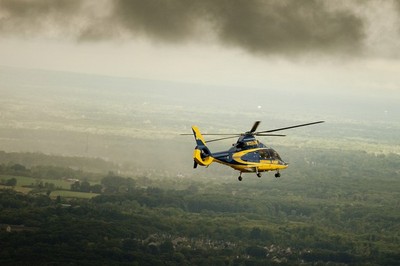
A new U-M Survival Flight helicopter flies above Ann Arbor Friday afternoon on a test run to C.S. Mott Children's Hospital.
Jeffrey Smith | AnnArbor.com
U-M has used three Bell 430 helicopters since 1998.
The Eurocopter can carry about 1,500 more pounds than the Bell 430, and has a 50 percent increase of cubic feet in cabin volume. The new chopper can also go about 90 miles further than the previous range of 406 miles.
Crew capacity will be expanded from four pilots and nurses to six. The choppers will have the ability to carry two patients if necessary, which Bullen said was a rare occurrence.
Compared with the new models, the Bell 430 helicopters feel much smaller inside - especially in terms of headroom - and only give nurses access to the patient from one side, as the gurney is placed on the left side of the aircraft right next to the door.
The layout of the interior of the helicopter was designed by the Survival Flight staff -- an effort coordinated by Ben Tung, flight nurse of 25 years.
The cabins of the new helicopters are about two feet wider than the current models in use. The arrangements of the three seats around the gurney, which is in the middle of the cabin, will give nurses 360-degree access to the patient at all times.
The most important new feature was the amount of space for the crew and patients, Bullen said.
“Inches rather than feet is a lot in the aircraft,” Tung said.
About 10 percent to 12 percent of the calls the Survival Flight is dispatched on are scene calls to pick up patients injured in accidents, said Dr. Mark J. Lowell, medical director of the program.
The majority of the flights transport critically ill patients from area hospitals to the U-M hospitals in Ann Arbor - meaning many patients must be moved with a slew of support devices keeping them alive.
“Everybody is fascinated by the hardware, but it’s really about the nurses and doctors,” Lowell said.
A staff of 21 flight nurses rotates on 12-hour shifts for three or four days a week. Each has extensive training as both registered nurses and paramedics, as well as a multitude of certifications necessary to care for a spectrum of patients.
If a call comes in at 10 minutes to the end of a shift, the crew has to take off again.
“You never know when you’re going to get off,” said Morgan Cornell, flight nurse.
The ride is smoother than an ambulance, as “there are no potholes in the air,” he said. A separate, contracted staff of pilots and mechanics keep the helicopters in tip-top shape.
Cornell is one of the newest additions to the Survival Flight staff, and has been with the program for about a year.
It’s a long process to become a part of the team, as nurses must work at least five years as a nurse in the intensive care unit.
"I've worked as a paramedic as well, so I've always loved the critical care transport environment, because it's not only so dynamic, but also you have to be very resourceful. Your equipment might break, or you might not have the specific equipment -- whereas in the hospital, you have every resource at your fingertips," Cornell said.
The new helicopters, leased by UMHS, still have that new-car smell. As of Friday, the first of the three new helicopters was cycled into active duty.
“It’s your new home,” Tung said as he made final adjustments to the crew's equipment inside the chopper Friday.
Tung explained it will take some time for the new locations of all the equipment on board the aircraft to become familiar to the crews members.
There are some quirky surprises required to be inside the helicopter - like a lighted “no smoking” sign like you’d find on a commercial airplane, and a small first-aid kit in addition to the fully-stocked mobile emergency room.
Night vision goggles are also included in the cabin of the helicopter so nurses can see their instruments and the patient while flying at night, as using bright lights inside the cabin would distract the pilots.
The cabin is fully stocked with as many materials as an advanced life support ambulance.
The new helicopter is able to start up quicker, meaning the crew can hit its target of a five-minute liftoff more readily.
The flight crew is dispatched at the request of a doctor in a hospital’s emergency room, or by first responder staff at a scene where patients are critically injured.
The helicopters don’t fly during icy weather or thunderstorms. U-M uses a fixed-wing Cessna jet, kept at the Oakland County International Airport, or an ambulance during inclement weather periods.
As technology has progressed and more support devices have evolved, Survival Flight has had to accommodate more of them in their transports.
Most times, the patients transported by the Survival Flight crews are the sickest of the sick, and the excitement of flying in a helicopter is lost to them.
Patient Robert Doyen didn't remember the faces of the nurses that were sitting in the helicopter when he was flown from the emergency room in Bay City to Ann Arbor with excruciating pain due to a spinal cord injury.
The significance of the helicopter ride hit home, however - so much that Doyen got a Survival Flight helicopter tattooed on his left arm with the words “Thank you all” inscribed below it.
For the patients that are cognizant when being loaded into the chopper, the crew keeps things positive.
Tung said he tries to keep things lighthearted and fun, even though extenuating circumstances often make flights stressful.
“Some (patients) are reluctant to go at first but then you see them smiling,” Bullen said.
Below, watch some of the Survival Flight nurses share their experiences on helicopter rides:
Amy Biolchini covers Washtenaw County, health and environmental issues for AnnArbor.com. Reach her at (734) 623-2552, amybiolchini@annarbor.com or on Twitter.
Comments
survivalflightsurvivor
Tue, Jul 16, 2013 : 2:22 p.m.
John Bullen was my attending flight nurse, along side him was Chris Wagner flight nurse and my pilot was John Dickensheets! They came to get me from Botsford Hospital on 07-20-03 while I was suffering from a Sub-arachnoid hemorrhage (ruptured brain aneurysm). I remembered coming to and seeing their jump suits and was excited to be flying in a helicopter! They got me to UofM Hospital alive! I can never thank them enough for helping to save my life. And now they are celebrating a New Choper and who cares where it was made. YOU CAN NOT PUT A PRICE ON LIFE! GO SURVIVAL FLIGHT!
Kevin H.
Sun, Oct 21, 2012 : 2:17 p.m.
I would like to Thank the staff of Survival Flight. My brother was transported from Saint Mary's Hospital in Livonia on Wednesday October 17, 2012 to Saint Joseph Mercy Hospital in Ann Arbor with a torn aorta. After seven hours of surgery, my brother sitting up and talking to family members. Thanks to the quick response of Surival Flight and the Medical Staffat Saint Joseph Mercy Hospital. (Yes U of M Surival Flight flys to Saint Joseph Mercy Hospital)
15crown00
Sat, Aug 18, 2012 : 1:02 a.m.
Don't care where they are made.They perform a great service and that's all that really matters.
ToddAustin
Thu, Aug 16, 2012 : 12:59 a.m.
This is great for the patients and I'm glad U-M has these at their disposal now. We live in Dexter and see the U-M choppers flying over frequently, I'm guessing on runs to Chelsea Hospital. I do have to say that the new choppers are substantially more noisy (powerful low-frequency sound) than the old ones and appear to be flying lower, too. If it's necessary for the safety of the patient, then that's fine. If it's reasonable for them to move to a higher altitude as they come out of Chelsea, then it would be appreciated by those on the ground. Go Blue!
Phil
Mon, Aug 13, 2012 : 8:19 p.m.
These are beautiful machines! I used to fly some with a air ambulance service on the east coast. They limited themselves to smaller aircraft that were more economical (lower hourly operating cost). I would guess to buy these outright you would be looking to spend around 10-11 mil. U of M leases these ones which keeps down their capital investment and should be able to get newer aircraft more often. Operating cost is probably around 1100/hr or so (probably more) for this size of aircraft. I can appreciate the need for more space. With 3 flight crew in the back + patient, we were always cramped. The smaller aircraft are also usually weight critical once you load them up with passengers and equipment leaving a smaller margin. Hence going with the EC155 with nicely sized engines. On the comments about "Buy American"...American Eurocopter has facilities in Texas and Mississippi to build these. They actually employ about 900 people. So the US economy does benefit some from the sale of these aircraft. Eurocopter practically owns the rotary air ambulance business. They have the biggest and most versatile selection of aircraft for this type of work.
seldon
Mon, Aug 13, 2012 : 8:28 p.m.
Wait, what? Someone with ACTUAL DIRECT KNOWLEDGE about the topic came and posted in here?
Haran Rashes
Mon, Aug 13, 2012 : 2:49 p.m.
I saw and heard one of the new helicopters over the Plymouth and Green area last night. It sounded more like a small jet than a helicopter. The choppiness of the noise is greatly reduced. Hopefully, neither I nor anyone in my family will ever need a "ride" in these helicopters. But it is nice to know that U of M has them available if we ever do need them.
Ron Granger
Mon, Aug 13, 2012 : 1 p.m.
What is the cost of these? What does Umich charge patients? How much profit do they generate? Anyone who has paid a bill at a Umich hospital knows that it isn't priced out of the kindness of their heart. Regardless of the good intentions of the first responders and medical staff, the administrators are in this game to generate Big dollars.
15crown00
Sat, Aug 18, 2012 : 1:08 a.m.
$$$$ are the name of the game when u come right down to it.look at the price of inpatient care for instance for medications.you can get a whole script filled for the price of 3-4 pills.they have u captive and they know it so they can charge what they want and they do.sort of like buying refreshments at a sports event or a concert.
AACity12
Mon, Aug 13, 2012 : 10:03 a.m.
If you look a few articles down it says AAFD buys new $1M ariel truck. Why doesn't this article say UM buys 2 new $??M helicopters??? I am glad they got cool new toys and I am sure they needed them but where is the transparency in the government spending here? Is it only our fire department that gets scrutinized?
a2xarob
Mon, Aug 13, 2012 : 5:01 a.m.
My family is very grateful for the pilots that fly these flights too, their long years of training and service, often flying in the Mid East as members of our armed forces before leaving military service to start a civilian career in survival flight. They transport the medical team and their patients safely throughout the day and night all year long.We're very lucky to have these brave and exceptionally well trained helicopter pilots working on our survival flights. A big thank you to them as well as to the medical team.
Pete
Sun, Aug 12, 2012 : 8:14 p.m.
I hope they are quieter than the old ones.
Townie
Sun, Aug 12, 2012 : 9:29 p.m.
They are; I live near the airport and my cat can tell you that there's a difference. That said, this is 'swoop and scoop' business and expensive for all of us. Yes, it saves lives in critical situations but the cost forces cuts elsewhere. Look some time into the economics and think about it. Part of the medical 'arms race'. Bigger is not always better or the most intelligent path for better healthcare for all of us. http://www.bizjournals.com/dayton/print-edition/2012/04/27/study-hospital-helicopters-provide.html?page=all
Ron Granger
Sun, Aug 12, 2012 : 7:09 p.m.
"Powerful new breed of U-M Survival Flight helicopters" How does one breed helicopters? Does it require special stem cell lines? I think I've heard about those at Michigan. Could I just borrow a pair and keep them in the same hanger, for the breeding? I do hear that whoof-whoof-whoof sound at night. Is it a natural process, or is there some sort of heli-husbandry involved? And the delivery! That must be something! Is it painful? Does it take long? If I could breed me up some of these choppers, I could be rich!
David Paris
Mon, Aug 13, 2012 : 1:23 a.m.
Ron, it's real easy now that science has developed cells from metal, c'mon man, where you been! http://www.mnn.com/green-tech/research-innovations/stories/scientist-creates-lifelike-cells-out-of-metal
a2citizen
Sun, Aug 12, 2012 : 8:23 p.m.
by the way, that would be a male Cessna and a female Lear (or vice versa).
a2citizen
Sun, Aug 12, 2012 : 8:22 p.m.
"...How does one breed helicopters?..." Ron, your persistent, naive, left-wing rants continue to amaze me. Everybody knows you that to breed helicopters you park a Cessna and a Lear Jet in a hangar and close the doors.
GoNavy
Sun, Aug 12, 2012 : 8:12 p.m.
Ron- Look up what "similes" and "metaphors" are.
Phil K.
Sun, Aug 12, 2012 : 6:06 p.m.
Here's the original announcement regarding the purchase, which covers some of the details people keep asking about: http://www.annarbor.com/news/new-survival-flight-helicopter-fleet-on-the-way-to-the-university-of-michigan-health-system/#.UCfsiUQQLRw Bell/Boeing and Sikorsky (even Robinson) don't make a helicopter that fits Umich's needs, hence the Eurocopter purchase. Bell stopped production on the 430 (the existing line), and Sikorsy's aircraft lack the range & capacity of the current Bell aircraft. Both of those stats are key, since Umich's service extends quite far. I'd have loved to see the U buy an American brand, but they just aren't available. Umich's current Bell's were leased which is standard practice amongst many aircraft operators (even major airlines don't buy many aircraft outright anymore, they lease). Leasing decreases cost, administrative overheard (I'm shocked that the U would engage in such practices!), and generally makes life easier from a paperwork standpoint for companies whose primary goal isn't operating helicopters or airplanes.
Tesla
Sun, Aug 12, 2012 : 6:58 p.m.
I understand what you are saying when you say "primary goal" but lets not be mistaken. That fleet of aircraft (albeit leased) is worth in the 30 million dollar range. At what point does it become the primary goal?
Joe Hood
Sun, Aug 12, 2012 : 6:01 p.m.
Why don't they keep the jet in Ann Arbor as well? Seems expensive to have staff in a second location.
Joe Hood
Mon, Aug 13, 2012 : 1 p.m.
Logically, we need 5000 foot runway for the well being of the populace as well as commerce.
PWJT8D
Sun, Aug 12, 2012 : 6:35 p.m.
Eep, you are correct. The runway at ARB can take a civilian Citation 560 just barely. The problem that Survival Flight's Citation 560 faces is the medevac upgrades add weight to the aircraft. Also, with a team of pilots and nurses, patient and full fuel, the Citation would be pushing the limitations of the runway and it would not be safe. Now if the hippies on the west side of the airport would quit complaining about the airport that was there before they were, ARB could go along with their planned airport expansion to allow medium size business jets into the airport. Thus alleviating the problem of having to hangar N911UM at another airport.
Eep
Sun, Aug 12, 2012 : 6:17 p.m.
The AA runway is only 3500 feet. Livingston County is 5000 feet. I don't think the AA runway is long enough for the Survival Flight jet.
average joe
Sun, Aug 12, 2012 : 5:37 p.m.
"Night vision goggles are also included in the cabin of the helicopter so nurses can see their instruments and the patient while flying at night, as using bright lights inside the cabin would distract the pilots." I'm no expert on these things, but instead of night vision googles, couldn't there be some sort of a wall/curtain between the pilot and the patient area, so that the medical staff could work in proper light without distracting the pilot?
fltrn
Tue, Aug 14, 2012 : 7:19 p.m.
I'm guessing that was a error made in writing the article. Typically NVG's are utilized for safety while looking outside for obstacles / hazards before landing at an accident scene. A blackout curtain, as you mentioned, is standard equipment for an aircraft like this.
Rudra N Rebbapragada
Sun, Aug 12, 2012 : 5:14 p.m.
Survival Flights: Having used military helicopters in emergency situations for transportation of pateints, I can easily appreciate these helicopters. The helicopters that I had used were simply intended for the conduct of military operation and not for use as air transportation of patients. Ultimately, the survival is always defined by a guiding, and controlling principle called the Divine Providence. If not pot holes, air transportation has its own inherent risks.
Brad
Sun, Aug 12, 2012 : 4:53 p.m.
Now since the U is a quasi-governmental agency are the people in Livinston County really OK with accepting their assistance? Wouldn't want the government interfering in their lives now would we?
LXIX
Sun, Aug 12, 2012 : 4:41 p.m.
As an aerospace enthusiast I really like! Even if it is eurospace technology. I moreso admire the pilots and nurses who have the courage to speed forth into any type of weather. At any time. Just to help others.
Tesla
Sun, Aug 12, 2012 : 3:31 p.m.
I am all for the copters when absolutely needed but it occurs to me that they are used a lot more frequently these days. Now they do serve a great purpose but they used to be for people in outlying areas far from hospitals, and or people who could not be moved any other way. You and I both know that the powers that be would never let those expensive to own operate maintain and staff machines sit idle for too long and common sense tells us that they would be used in "less than critical" situations to maintain affordability. I'm not even saying thats wrong necessarily because thats the times we live in. Just sayin......
julieswhimsies
Sun, Aug 12, 2012 : 10:16 p.m.
Do some research and find some stats to back up your comment, tesla
Tesla
Sun, Aug 12, 2012 : 3:33 p.m.
"The flight crew is dispatched at the request of a doctor in a hospital's emergency room, or by first responder staff at a scene where patients are critically injured." What are the criteria?
Sparty
Sun, Aug 12, 2012 : 3:30 p.m.
What happens to the old helicopters? Were they also leased?
bobd
Sun, Aug 12, 2012 : 3:22 p.m.
Nice stroy, but why buy foreign when Bell is a U.S. company. I get real tired of big organizations exporting U.S. jobs!!
seldon
Mon, Aug 13, 2012 : 1:35 p.m.
There's a long response under MichaelinA2's comment explaining why Bell and Sikorsky weren't chosen. You should read it. The short version is that Bell has discontinued the model that was used in medical flights in favor of defense helicopters, and Sikorsky doesn't have anything with the range and performance.
Eric
Sun, Aug 12, 2012 : 5:12 p.m.
If you read the article, it says the helicopter is an "American Eurocopter." Follow the link provided--the helicopter was built in the US.
seldon
Sun, Aug 12, 2012 : 3:39 p.m.
Because, apparently, Bell does not make a model that can do what this helicopter does. They specialize in other stuff. annarbor.com, was that discussion on this site when the purchase was initially announced? Maybe you can link to it?
tdw
Sun, Aug 12, 2012 : 1:51 p.m.
Just a little question.Do they go to St Joe's as well ( I have no doubt they would if needed ) ? I live close to St Joe's and I hear copters all the time
Ron
Sun, Aug 12, 2012 : 2:34 p.m.
St. Joe's had their own service until about a year ago when St Joe's and U of M contracted with each other to transport patients. U of M will service St. Joe's If St. Joe's gets a call requesting a patient be picked up and transported there. St. Joe's will call U of M and have them do the transport.
xmo
Sun, Aug 12, 2012 : 1:45 p.m.
I guess U of M Hospital does believe in "Buy American". Will the Major Unions (AFL-CIO, IBEW & UAW) allow their members to be transported in this Non-American Eurocopter?
Middle America
Mon, Aug 13, 2012 : 2:49 p.m.
I am sure that they will be considerably smarter than you and not care. By the way, nice job on googling "abbreviations for unions" and pasting the results here.
Julie
Sun, Aug 12, 2012 : 1:38 p.m.
Why are only male nurses represented in this article? i know for a fact that UM has some very excellent female RN on Survival Flight roster.
julieswhimsies
Mon, Aug 13, 2012 : 8:49 p.m.
Boo. Read Amy's remarks. Amy. My point was that I know there are indeed female flight attendants. Morgan just happened to be there at the time and I am not sure which Julie to whom you are referring, Amy. I see no sexism in this article, Julie. If there was, I would be the first person to cry foul to A2.com
Amy Biolchini
Mon, Aug 13, 2012 : 2:25 p.m.
@ Julie and @ Boo Radley -- There are female flight nurses on the Survival Flight staff, but there were male flight nurses were at the hangar when I was there Friday for the interview. Morgan Cornell is a man.
julieswhimsies
Sun, Aug 12, 2012 : 10:12 p.m.
Of COURSE there are female RNs on the roster. This guy just probably happened to be there. Oh. I'm an old-time feminist...This is a stupid point to take a feminist stand upon.
Boo Radley
Sun, Aug 12, 2012 : 7:41 p.m.
Julie, you should re-read the article. From what I read, Flight Nurse Morgan Cornell was featured and quoted in the article and a photo of her in the aircraft accompanies the article also. I guess Morgan is perhaps not a typical female name, but she doesn't look like a male nurse to me.
Modern_Atheist
Sun, Aug 12, 2012 : 2:33 p.m.
all the nurses at UM expect everyone else to do their job... female or not, they're all awful.
Michigan Man
Sun, Aug 12, 2012 : 2:03 p.m.
Eagle - Like the way you think! I think you covered the matter at hand so I will save my comments for a future day which will come all to soon.
eagleman
Sun, Aug 12, 2012 : 2 p.m.
Why do you care Julie? As far as we know these nurses may have been the only ones on duty when AnnArbor.com cam to interview them. The your post gives off an odor of sexism, Julie. It really should not matter the sex of who is being interviewed. I know for a fact that an Asian man is a flight nurse. Why wasn't HE interviewed? After all, he represents to groups that are underrepresented in nursing--males and Asians. Where is your outrage over that, Julie? Oh, wait, you only care about women. Nevermind.
Kai Petainen
Sun, Aug 12, 2012 : 1:25 p.m.
that's pretty cool. each day i see these go by.... and it's nice that UofM has this level of service. a new helicopter -- cool stuff. go blue!
AACity12
Sun, Aug 12, 2012 : 1:16 p.m.
So, what's the sticker price on one of these thing?
Modern_Atheist
Mon, Aug 13, 2012 : 3:02 p.m.
whatever it was, I can assure I was not kidding.
tdw
Sun, Aug 12, 2012 : 4:36 p.m.
Mr/Ms Atheist.....I really hope you are kidding
tdw
Sun, Aug 12, 2012 : 1:43 p.m.
Not quite sure where you are going with your comment......But I'll say the price is a hell of a lot less than a human ( most anyway ) life.If it saves ONE kids life I say it paid for itself in full
MichaelinA2
Sun, Aug 12, 2012 : 1 p.m.
Were these aircraft designed, developed and "Made in the USA," using world renowned American skilled labor? If not, why not? ...OOPS! http://www.eurocopter.com/site/en/ref/Shareholders_23-2.html
Paul Taylor
Sun, Aug 12, 2012 : 6:53 p.m.
Interesting that Bell and company are tied up in defense contracts. Does this mean that defense spending is now impacting homeland public safety? Preparing for flaming in three... Two... One...
Phil K.
Sun, Aug 12, 2012 : 5:56 p.m.
MichaelinA2, This came up when the purchase was first announced. Bell/Boeing and Sikorsky are almost completely wrapped up in defense contracts right now, and have essentially stepped out of the medflight market. Bell has stopped making anything the 430 line (the helicopter that umich was using before) and did not replace them with anything close to comparable. The closest Sikorsky helicopter (S-76) is slower and doesn't have either the range or capacity that the Eurocopter has. In this case, it's about buying the right tool for the job. It's not that the existing US manufacturers are getting undercut, it's that they're not making the product for the market, mostly because they're having trouble keeping up with their existing defense contracts. Put another way; if you wanted to buy a replacement for your F-350 pickup truck, Kia or Hyundai aren't going to be your manufacturers of choice. They don't make what you need. Right now, the US builders simply don't make what Umich needs. (as an aside, there's not much money to be made in the medflight market right now. Many hospitals are dropping the service as the leases on equipment run out. St. Joe's is a prime example.)
seldon
Sun, Aug 12, 2012 : 1:47 p.m.
I remember this coming up before, and there not being any completely American-made helicopters which can actually do this job. American helicopter companies apparently don't play in this market.
Dan Perlman
Sun, Aug 12, 2012 : 1:17 p.m.
Not that that's really important, but, if you'd have bothered to actually read the article it says "American Eurocopter" - http://www.eurocopterusa.com/index/index.asp - happy now? Acceptable that we can actually rescue people with a better quality vehicle but only because it's made in the US? Wouldn't want to save someone's life using something made by a foreigner after all.... oh wait, maybe we better start replacing all that equipment in the hospital that's not American made... and probably half of everything in your home.
PWJT8D
Sun, Aug 12, 2012 : 1:12 p.m.
Eurocopter makes a damn good aircraft, and that is most important. However, before you complain about it being made outside the USA, much like your "American" car was built in Canada or Mexico... Survival Flights EC155's were purchased as shells, and the entire cabin, medevac upgrades, additional avionics and paint were all done in the USA by a company in Florida.
lefty48197
Sun, Aug 12, 2012 : 12:02 p.m.
Thank GOD that we have people like the helicopter rescue crews and ALL the health care workers who take care of us when we need help!!!
seldon
Mon, Aug 13, 2012 : 1:30 p.m.
Nobody said anything about alone. Human beings, working together, accomplish miraculous things. If you want to attribute that to some benevolent higher power, go ahead, but don't take away from human accomplishments due to intelligence, ingenuity, and hard work. (None of which are required for producing babies, but all of which are required for Survival Flight.)
jcj
Sun, Aug 12, 2012 : 4:56 p.m.
seldon They use what GOD gave them! Try making a baby without the tools God gave you.
jcj
Sun, Aug 12, 2012 : 4:53 p.m.
seldon Wrong!
a2citizen
Sun, Aug 12, 2012 : 3:46 p.m.
gonavy, God may not provide the trained medical personnel,... But the founding fathers of the U-M, a Roman Catholic priest, a Presbyterian minister and a Freemason may disagree with you.
seldon
Sun, Aug 12, 2012 : 1:44 p.m.
Human beings create other human beings from scratch all the time, jcj. Even when they aren't trying to.
Brad
Sun, Aug 12, 2012 : 1:33 p.m.
If I had that much power I'd just prevent people from being in accidents in the first place.
jcj
Sun, Aug 12, 2012 : 1:28 p.m.
GoNavy Your mother must be so proud. If you are so gifted. Go create a human being from scratch! Or you make the wind blow strong enough to bring down one of these choppers!
GoNavy
Sun, Aug 12, 2012 : 12:11 p.m.
God isn't providing the trained medical personnel, and he certainly didn't endow us with the mechanics behind the operation of the helicopter. Thank you, University of Michigan Medical System.
Paul Taylor
Sun, Aug 12, 2012 : 11:47 a.m.
I wonder if that was the copter that circled five or so times over the south side last night from 11pm to 11:20ish pm. It sounded like a powerful engine. Wish it had landed on the first go, however.
John of Saline
Mon, Aug 13, 2012 : 2:32 p.m.
The fuel's at the airport, I'm guessing.
Modern_Atheist
Mon, Aug 13, 2012 : 2:32 p.m.
ummm... a church bell serves no purpose... the helicopter is transporting someone to save their life. There's also many less hospitals in the US than there are churches, it would be much easier to live far away from a hospital than it would be a church. Please don't call me out and say i "hate religion" because I'm an atheist... do whatever you want to and waste your time reading a silly old book, I don't care... just don't shove it in my face.
Paul Taylor
Sun, Aug 12, 2012 : 6:57 p.m.
If any of you can identify a hospital on the South side, I would be appreciative. Otherwise, keep flaming an honest, non-inflammatory comment like good members of the 22nd Keyboard Brigade!
Paul Taylor
Sun, Aug 12, 2012 : 6:34 p.m.
If the copter was carrying someone I loved, I would want them to circle and land at the hospital, not the A2 airport.
Sparty
Sun, Aug 12, 2012 : 3:38 p.m.
Just like those church bells .... what did you expect living so close to them, right? If you don't like the church bells ringing, then move if they're such a problem. LoL.
Modern_Atheist
Sun, Aug 12, 2012 : 2:29 p.m.
move if it's such a problem... what did you expect living so close to such a huge hospital??
KatiGal
Sun, Aug 12, 2012 : 12:16 p.m.
If the copter were carrying someone you love, you wouldn't care how loud or how many times it circled. Thank you Survival Flight crew for all that you do.