

President Barack Obama's higher education agenda: Good for America or government takeover?
Health-care reform captured most of the attention, but President Barack Obama highlighted another domestic priority in his State of the Union address Wednesday -Â getting more Americans to graduate college and making the endeavor more affordable.
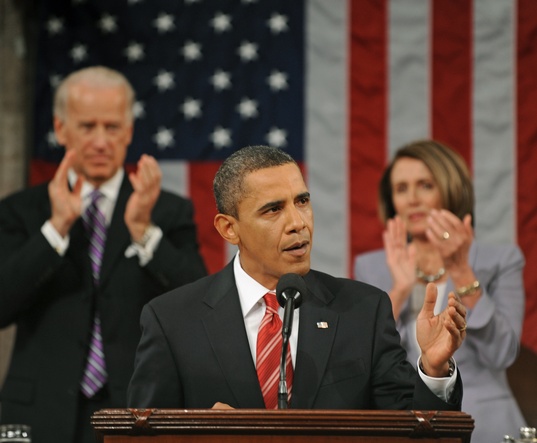
President Barack Obama delivers his State of the Union address on Capitol Hill in Washington, Wednesday, Jan. 27, 2010. Vice President Joe Biden, left, and House Speaker Nancy Pelosi listen from the background.
AP Photo | Tim Sloan
Big changes to the student loan system are in the works as part of his agenda to have the highest proportion of college graduates in the world by 2020.
"And let's tell another 1 million students that when they graduate, they will be required to pay only 10 percent of their income on student loans, and all of their debt will be forgiven after 20 years - and forgiven after 10 years if they choose a career in public service," Obama said. "Because in the United States of America, no one should go broke because they chose to go to college.
"To make college more affordable, this bill will finally end the unwarranted taxpayer-subsidies that go to banks for student loans," he said. "Instead, let's take that money and give families a $10,000 tax credit for four years of college and increase Pell Grants."
But what does it all mean?
According to officials from the Education Sector, an independent, non-partisan think tank based in Washington D.C., the $10,000 tax credit referenced by Obama came into being with the American Investment and Recovery Act of 2009. The American Opportunity Tax Credit provides recipients up to $2,500 a year over the course of four years for college. It's set to end after 2011, but Obama's announcement would likely entail making it permanent, the think tank reported.
In September, the U.S. House of Representatives passed the student aid bill, which would eliminate all lending from the bank-based Family Federal Education Loan program and re-direct all new federal student loans through the government-run Direct Loan program. The measure now awaits Senate approval.
Critics characterize the Student Aid and Fiscal Responsibility Act as a government takeover that would eliminate jobs, as well as choice, competition and innovation from student lending by eliminating the FFEL program, a public-private partnership in place since 1965.
Democratic proponents from the House Committee on Education and Labor said in a September 2009 press release that $90 billion could be saved by lending more cheaply via the government-run Direct Loan program. That savings could be allocated for a wide array of purposes, including the federal Pell Grant program, which Obama referenced Wednesday.
The savings would also be directed to non-higher education initiatives, including billions of dollars to schools for construction and modernization, and early learning programs.
Republicans from the same committee called the projected savings "fuzzy math." In their September press release, they warned of cost overruns and said taxpayers would pay $50 billion over the next decade for the program.
Among other things, student aid legislation would:
- Provide $40 billion to increase annual Pell Grant scholarships to $5,500 in 2010 and $6,900 by 2019.
- Provide $3 billion to be used for completion-support and college-access programs.
- Simplify the Free Application For Student Aid (FAFSA) form.
- Expand and change the Perkins Loan program, which provides low-cost federal loans to students.
- Provide loan forgiveness for military members called to duty in the middle of the academic year.
- Provide $2.55 billion to colleges and institutions that primarily serve minorities to invest in retention efforts.
- Provide $10 billion to improve community college systems for job training and adult education programs.
- Make interest rates variable beginning in 2012.
- Eliminate restrictions that prevent individuals convicted of drug possession from receiving taxpayer-funded financial aid.
What do you think? Should the government manage all student loans? What would having more citizens with college degrees or certificates do for America? Take our poll and comment below.
Juliana Keeping covers higher education for AnnArbor.com. Reach her at julianakeeping@annarbor.com or 734-623-2528. Follow Juliana Keeping on Twitter
Comments
Matt
Tue, Feb 9, 2010 : 4:12 p.m.
It cracks my how many of you are firing off comments without having done any research. The Direct Lending Program and the FFEL Program all had their time to flourish and here is what happened: Schools flocked to FFEL because the terms for students were a little better and the banks offered perks to schools. Then the feds stepped in and made the terms for all the students loans very similar. Here is what happens now at a FFEL school: The bank originates the loan and sells it to the Direct Loan program. FFEL originates 1/2 of all the student loans in the US yet the Direct Lending program owns over 90% of the loans. Banks are selling the loans and passing the risk on to the taxpayers. Go to NSFAA.org if you want to find the studies done on the FFEL to DL transition. If there are other specific points you want me to address, let me know.
Pam
Mon, Feb 1, 2010 : 12:17 p.m.
The government does such a great job of running businesses why shouldn't they take over the student loan business? Ask a vet how long it took them to get their tuition from a government run agency. You might find that some are still waiting. Ask a student trying to consolidate their defaulted loans how long it takes to get this done and you will find this too takes months from a government run agency. Ask students who have direct loans how long it takes to get IBR (income based repayment) and you will find out the government doesn't even have an approved form for a program that started months ago. So if service doesn't matter and the national debt doesn't matter, absolutely let the government take over the student loan program. NO THANK YOU!
Denise
Mon, Feb 1, 2010 : 10:07 a.m.
Subsidies from the government to the banks ended 2 years ago. Schools have had the opportunity to process directly through the federal government for almost 20 years. Seventy percent of schools chose to go through banks due to the services the banks provide and believed the competition was good for the students. The federal government is planning to make direct lending mandatory eliminating student choice and school choice. The government has not managed large-scale finances properly in the past and I do not believe they will do it in the future. The feds have their eye on the money they will get off the backs of students through interest on loans. The math is incorrect and based on many if this and if thats. Havent we had enough of this! Mandatory direct lending is a bad idea. Choice! Choice! Choice!
Angelika Poe
Mon, Feb 1, 2010 : 10:01 a.m.
Why start at the backend? We should concentrate on keeping these universities from charging outragous amount to attend. Their tuition should be capped and they shall only be allowed to raise it a small percentage, not 30%. That alone will help keep people's student loan debt down, because they won't have to take out $50,000 a year to attend their college of choice.
David Briegel
Fri, Jan 29, 2010 : 9:19 p.m.
Hey Mike, I have been consistent. 20 budgets. Not one balanced! Fiscal conservatives never, ever submitted one single, solitary balanced budget. NOT ONE!!! Only Clinton did it!!!! I have always said 12 trillion, the real number. How could that be? Oh, I get it. It is a whip to beat on those evil Dems. Except when reality sets in. The only thing you have to show for your foolishness is billionaire tax cuts and perpetual war profiteefing! Name ONE other thing. You can't! Chris, you are so wrong! I was consistent and it IS the Ronnie Reagan, Bush Crime Family that rang up that debt. Fact!
brad
Fri, Jan 29, 2010 : 6:21 p.m.
Park service; museums; libraries; The two you cited either provide services not performed by private companies (regular mail and rural deliveries), or they are enforcement agencies and shouldn't have customer service as their top priority.
Leslie
Fri, Jan 29, 2010 : 6:13 p.m.
What bothers me the most is no one has even mentioned the COST of college education. Tuition increases every year, the Gov. doesn't cap the cost of tuition. But they do SET the interest rates on student loans in the ffel program. The cost of education is what we should really focus on, cost increases cause the students to have to borrow more money. I think that the schools will just increase the cost of tuition to absorb the extra money that was added to the pell grants. Lower the cost of education so students will have to borrow less
Jeff
Fri, Jan 29, 2010 : 4 p.m.
Private Lenders and Providers of student loans ARE NOT THE ENEMY. Allowing the private sector to originate student loans promotes competition among lenders, allowing rates to drop and students to have VALUABLE OPTIONS in where they obtain their money to go to school. I would like everyone to think for one moment about the level of CUSTOMER SERVICE they recieve when they have to go to a government run agency to obtain a service. Your placed on a conveyor belt and treated like a anything you say or do, does not matter. They aren't there to offer outstanding customer service or earn your loyalty and shower you with benefits and VIP treatment. No. They are there because they have to be, and you HAVE to go them for that service because there IS NO OTHER CHOICE. What happened to freedom? What happened to choice? Aren't these the some of the most VITAL things our country was built on? The Private Sector ALSO WANTS CHANGE. The private sector would like to save their customers money and provide the best in outstanding customer service to the millions of americans that are trying to achieve thier dreams. The private sector did not choose how much it costs to attend colleges and universities. However, they are here to help students and families to not only PAY for college, but also to SAVE and INVEST WISELY in their educations, by helping students borrow, save, and pay for college the RIGHT way. Unemployment is at an ALL TIME HIGH. The private sector creates THOUSANDS upon THOUSANDS of jobs all over this country. Jobs that families rely on every day. Yes, I myself work for a company in the "private sector" and I see everyday just how many people come to work with smiles on their faces knowing that they are here to make education affordable and possible for americans everyday. We work EXTREMELY hard to ensure that not only are our customers able to obtain the resources they need to finance their education, (With an OUTSTANDING level of customer service) but also that we help them do it wisely, by making the right choices and providing students products and services that suit their needs. Hopefully, we can all get some "change". I myself am a supporter of our president, I believe he's absolutely right that things DO need to change. Things CAN be better when we all work together.
Kim
Fri, Jan 29, 2010 : 3:32 p.m.
BAD IDEA.
cb83
Fri, Jan 29, 2010 : 1:50 p.m.
Brad, The point of the public private partnership was risk share to lower the rate and not burden the taxpayer with funding the loan or the administration. How good is government at building infrasture, streamlining processes and customer service. Give me ONE successful example. The IRS, the postal service? Even in the Senate building if they want a package delivered quickly that go to UPS or FedEx. Not their own postal service.
mike from saline
Fri, Jan 29, 2010 : 12:07 p.m.
correct me if I'm wrong, but it seems to me that Briegle claimed that Reagan, and the "Bush crime family" was responsible for 19 trillion dollars worth of U.S. debt. A few days later, it was 14 trillion, and now it's down to 12. I can't wait until tommorow!
brad
Fri, Jan 29, 2010 : 11:37 a.m.
@cb83: I havent done the math or the research, but Ill bet you cant get a non-guaranteed, unsecured loan for 3.8% from a private lender. @ luke: If youre still making $20k after 5 years, youre doing something wrong with your degree. For those who claim subsidized loans drives up the tuition rate, do you know by how much? If it is a couple percent, then I think it is good public policy to get more people into college who couldnt afford it without the subsidy.
cb83
Fri, Jan 29, 2010 : 10:57 a.m.
Does anyone actually do the MATH? Now the government wants to do ALL the loans. The government wants to increase Pell Grants by $200. Lots of students have both loans and Pell Grants. Right now the government earns around 4% on every student loan and over 6% on every Parent loans that are made in FFEL. But students pay 6.8%. And parent's pay 8.5% for Parent PLUS loans. The average student borrows $20,000 and the government gets MOST of the interest. Student's are paying HIGHER interest rates than ever before just to pay for their OWN Pell Grant increases. Keep government out of the loan business and lower interest rates for students by 3%. Students deserve good customer service and a good loan rate. The Obama Administration isn't interested anything except robbing Peter to pay Paul and hoping that know one looks closely at the money trail. The student's are the pack mules here NOT the banks. Banks aren't getting any actual subsidies. READ the legislation that cut lender subsidies in 2006 and 2007. I wish reporters would actually do some thorough investigative reporting. Does anyone question the government anymore? The American newsmedia have become simpleton's. They take the "If it sounds good it must be good" approach to reporting. That is a horrible way to report and a worse way to govern.
Freemind42
Fri, Jan 29, 2010 : 10:42 a.m.
What's with the title of this story? This question is a false choice. It seems as if Annarbor.com is becoming more and more CNNesque every day.
luke
Fri, Jan 29, 2010 : 9:43 a.m.
So what happens to the money that the students don't have to pay back? If you wanted to pay of a 40,000 student loan with 6.8% interest over twenty years you would need to make about 40,000 a year to pay it back in time. so like many people you finish college you don't get a job pertaining to your college education right away, and you make 20,000 a year for the first 5 years. If you do the math here the government either makes no money or loses money. and if the fed gov loses money that translates to we the people lose money. my taxes, your taxes pay for someone else's education. pell grants will increase by 1400 dollars in ten years. how much will tuition increase in ten years?
Bob
Fri, Jan 29, 2010 : 9:13 a.m.
Allowing loans to be funded solely by the federal government will simply turn this funding program into the same kind of mess than Social Security, Medicare/Medicaid, FHA home lending, and SBA lending are in. Further, it distorts the cost of education and allows schools to simply raise tuition and costs even without any market consequences because students will have their repayment terms capped at 10% of net income. These proposals play to the populist groups but just don't make any sense when you begin to consider the adverse consequences.
Bruce Amrine
Fri, Jan 29, 2010 : 7:29 a.m.
Anything that brings down the cost of getting an education is a help. I think that young people should not need to start out their adult lives with a crushing student loan debt.
Chris
Thu, Jan 28, 2010 : 11:31 p.m.
Mr. David Briegel I think you can thank the democrats for a majority of that 12 trillion dollar debt. Just sayin'
Cash
Thu, Jan 28, 2010 : 4:34 p.m.
Well, remember that for eternity (almost) the feds have guaranteed student loans made by private lenders to students! That means the banks have for years loaned money, made a huge profit and it is impossible for them to lose because the feds (we) will pay the bad loans back to them. What a killing for banks! So it is smarter for the feds to lend it and get the interest and origination fees for us instead of the banks. The people opposed are: banking industry private loan servicers some in financial aid higher ed who have been reaping some nice benefits from the banks and servicers for many many years. That said, some schools made the wise decision several years ago to go with direct lending and have bypassed the greedy banks. Good for them. The banks and servicers are going to fight this as hard as BCBS fights health care reform.
cinnabar7071
Thu, Jan 28, 2010 : 3:24 p.m.
How about fixing the public schools first, detroit has a 50%+ dropout rate, and Obama wants to get into the college biz. Just great!
David Briegel
Thu, Jan 28, 2010 : 2:25 p.m.
Jesus said, "blessed are the bankers"? Who is paying off the 12 trillion debt charged to us by Ronnie Reagan and the Bush Crime Family? Just askin'.
deetdeedee
Thu, Jan 28, 2010 : 1:52 p.m.
How much more debt is the US going to take on? Who gets to pay this off? BO will be long gone and we'll still be paying this debt off.
uawisok
Thu, Jan 28, 2010 : 1:49 p.m.
Why should I or my kids pay additional fee's (profit for money changers) when we could by-pass the private sector all together?