

Promise Scholarship program cut; 6,096 University of Michigan students impacted
More than 8,000 Washtenaw County college students are losing out on tuition cash they banked on after a popular statewide scholarship program met its demise today.
Gov. Jennifer Granholm signed a higher education bill today that doesn't include $140 million for the Michigan Promise, a merit-based scholarship program that offered 96,000 in-state students up to $4,000 for college.
At the University of Michigan, 6,096 students will lose Promise money; at Eastern Michigan University, 1,662 students; at Washtenaw Community College, 660 students; and at Concordia University Ann Arbor, 75 students.
Of the students at U-M, only 1,662 of those who lost the scholarship qualify for other financial aid.
U-M officials expressed disappointment in the program's end, but said the university anticipated it. U-M set aside an additional $2 million in its budget this year to make up for lost Promise aid for those 1,662 students, spokesman Rick Fitzgerald said. The rest of the students will have to come up with money themselves.
"We remain concerned about the status of the Michigan Promise scholarships, and are disappointed that students who expected this support this year are left vulnerable," Cynthia Wilbanks, U-M's vice president for government, said in a written statement. "Every economically successful state finds a way to keep investing in higher education, and if we are to turn around our state's economy, Michigan must do the same."
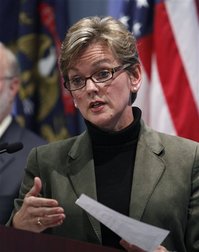
Michigan Gov. Jennifer Granholm talks about school funding cuts during a press conference last week in Lansing.
Al Goldis | Associated Press
Last year, WCC, EMU and U-M fronted money for Promise grant recipients and were later reimbursed by the state. This semester, students had to pay what the scholarships provided or apply for more aid if they didn't have the money. If the program came through, they would have been reimbursed.
Beginning in 2007, students who met or exceeded state standards on the Michigan Merit exams could earn $1,000 during their freshman year and $1,000 in their sophomore year from Promise grants. Students have to maintain a 2.5 grade point average by the end of their sophomore year to receive the remaining $2,000.
But the program had a previous incarnation, one that had been in place since 2000.
The Promise Scholarship replaced former Gov. John Engler's Michigan Merit Award program that provided up to $3,000 for college if students did well on Michigan Educational Assessment Program tests taken in junior high and high school.
Both programs were funded in full by a giant settlement reached in 1998 between five tobacco companies and 46 states, the District of Columbia and several U.S. territories. The companies agreed to pay $206 billion by 2025 to settle lawsuits related to the financial toll of treating smoking-related illnesses.
Michigan has received $2.9 billion in settlement payments since 1999, said Terry Stanton, a spokesperson for the Michigan Department of Treasury.
This year, the Legislature had to fill a $2.8 billion shortfall to pass a balanced budget, though $1.4 billion of that hole was filled with stimulus money.
Granholm said she vetoed $127 million in spending for the 2010 fiscal year. She began signing 15 budget bills earlier this month, but signed the last six today to avoid a government shutdown. The state has been operating on an interim budget since Sept. 30; it would have expired late Saturday. Today, she also signed community health; energy, labor and economic growth; human services; police and general government budgets.
Granholm called cuts made in the bills by the Senate "too deep and too painful" for the most vulnerable of Michigan's residents in a phone-in press conference this morning.
Suggesting her hands were tied by a Republican-controlled Senate leadership, she said, "Had I been able to veto money in or special interest tax loop holes out, I would have."
Did you or your children receive Promise money? If so, Juliana Keeping would like to speak to you; reach her at the contact information below.
Juliana Keeping covers higher education for AnnArbor.com. Reach her at julianakeeping@annarbor.com or 734-623-2528. Follow Juliana Keeping on Twitter
Comments
larry
Mon, Nov 2, 2009 : 6:29 p.m.
Ok, 1bit, I was wrong in pegging you about raising taxes. But, as I've pointed out in my earlier post, there are plenty of ways for the school system to produce the promised scholarship money for hardworking young folks like EG if they really desire to keep their promise.
larry
Sun, Nov 1, 2009 : 9:43 a.m.
1 bit -- The money could come from many sources. Cuts in employee pension contributions? Cuts in wages (a 2 percent cut is not earth shattering). Cuts in administrative staff? I work in corporate Michigan, and we have had a reduction of 90 PERCENT in our workforce since 2001. We have had to take a pay cut of 2.5 percent this year. Plus we might lose our pension and retiree benefits. And you really think increasing our taxes further is the answer to support an increasingly costly government system? No wonder this country is going down the tubes. I wonder why the rest of the world is talking about an alternative to the US dollar?
Engineer
Sun, Nov 1, 2009 : 12:04 a.m.
Jennifer Granholm continues to run this state into the ground. Now she has a friend in washington we can go under even quicker. Keep voting for the Dems Ann Arbor and soon the entire country will be like Michigan. We lead the pack. Time to look back at what Reagan accomplished and look for some smart conservatives and quit listening to the liberal press.
larry
Sat, Oct 31, 2009 : 5:15 p.m.
Responding to some posts here about Reagan: I love Ronald Reagan. Before he (and Margaret Thatcher) cut taxes (cutting the maximum tax rate from a staggering 78% down to about 35%), the global distribution of wealth had remained virtually unchanged for over 300 years, with about 27% of the population below the poverty level. Since 1980, after his tax cuts, which were pretty much incorporated by a majority of countries around the world (including India & China), hundreds of millions of people have been lifted out of poverty. Things are booming in cities like Mumbai, India, where people are now starting to buy cars, TV's and pretty much everything else. This is clearly because of a change in India's policies from being socialist to becoming free-market oriented with low taxes and less government intervention and bureaucracy. ANYONE who disputes this should really think again and reexamine the facts. As a result, for the first time, global poverty rates have dropped from 27% to 5%. Thank you, Ronald Reagan.
larry
Sat, Oct 31, 2009 : 5:01 p.m.
Main Entry: 1promise Pronunciation: \pr-ms\ Function: noun Etymology: Middle English promis, from Latin promissum, from neuter of promissus, past participle of promittere to send forth, promise, from pro- forth + mittere to send Date: 15th century 1 a : a declaration that one will do or refrain from doing something specified b : a legally binding declaration that gives the person to whom it is made a right to expect or to claim the performance or forbearance of a specified act 2 : reason to expect something; especially : ground for expectation of success, improvement, or excellence 3 : something that is promised Perhaps they should have called it something different? Ah, but politicians and keeping promises? Talk about an oxymoron...
johnnya2
Sat, Oct 31, 2009 : 2:24 p.m.
Seems to me, the State and student entered into a contract. There was consideration for specific performance. The student held up their part of the contract and the state is breaching that contract by not providing the funds.
st.julian
Sat, Oct 31, 2009 : 11:38 a.m.
A brazen attmept to catch Louisiana and Mississippi in two competitions: 1) the education isn't important to our state, and 2) how many smart young people can we send out of state for jobs.
A2Dave
Sat, Oct 31, 2009 : 8:34 a.m.
Welcome to the Mississippi of the North.
David Briegel
Fri, Oct 30, 2009 : 6:49 p.m.
Hey Top Coot, How was it the Chairman of the Billionaire Boys Club leaves Goldman Sachs to become Treas Secy? To preside over the looting of our Treas! Why did the let Lehman Bros fail? Then bail out AIG? Bacause Goldman got 16 of the 160 billion! And he is still free! Bernie Madoff was chump change compared to what your "free enterprise" boys did to us! Obamanomics works and Reaganomics is a complete fraud and failure! Proof is all around us! Remember when the lottery would save education? Remember when the tobacco money would save education? The Liars in BOTH parties squandered both windfalls and continue to stick it to the middle class while letting the fat cats off easy! Anyone who thinks college students don't work is wrong! Unless your name is Bush or McCain! Affirmative action for the semi-literate offspring of rich white guys! Republican Approved1
Dan
Fri, Oct 30, 2009 : 4:46 p.m.
Granholms been spinning the state economy down the drain for six years. Now that term limits are forcing her out of office she takes the opportunity to blame the Republicans for the mess the state budget is in. It doesnt matter which programs get cut she is going to blame it on the Republicans. And the Demarcates in the state predictably lap it up. Politicians empower themselves by spending our money, Republicans and Demarcates. They always need more because they always spend what we give them and how can they do more for us without us giving them more? Voting for tax increases is like saying yes Politician you can do a better job spending my money than I can, please take it! Vote No on any tax increase, keep you money in your pocket and send you own kids to college! I have four kids in college this year and a senior in high school whos hoping to go to college next year, yes I was hoping for the MEP not to turn into MELie but Im not surprised, well figure something out.
An
Fri, Oct 30, 2009 : 4:42 p.m.
It's pretty hard to work your way through college when college grads are the ones working at fast food restaurants, Meijer, WalMart, etc.
pyrooce
Fri, Oct 30, 2009 : 4:06 p.m.
Hey, only 2 more years until were blown away by the Guv's campaign promise made during her reelection, hey everybody how's that HOPE and CHANGE working for you?
TXteacher
Fri, Oct 30, 2009 : 3:44 p.m.
There is nothing wrong with college students working their way through college. The boomer generation did it, and so can today's kids. Michigan needs a more "can do" attitude. I see their commercials down here in Texas pitched at business returning to Michigan. It's encouraging to see this, now get to the business of cutting taxes and providing incentives for business to return. It's BUSINESS that provides incomes, not government. And it is true that Unions must see the writing on the wall if this state is to return to its former stature as a national leader.
81wolverine
Fri, Oct 30, 2009 : 3:13 p.m.
I understand the state is broke and must cut expenses. My daughter will lose her Promise money, but we'll find the money elsewhere. Unfortunately, other families won't be so lucky. This wouldn't have been necessary if the politicians in Lansing (both Democrats and Republicans) hadn't run our state economy into the ground for the last 20 years. By failing to work together to create a business environment that attracts new industries and diversifies Michigan's historically auto-centered economy, everyone must now pay the price. I agree with everyone who plans to show their displeasure with the state government at the polls. Let them know that partisan-based finger pointing isn't acceptable any more by voting them out of office. My feeling is that if they're going to cut the $140 million Promise money, only do it if they then put the money into attracting and nurturing new business growth in the State.
TXteacher
Fri, Oct 30, 2009 : 2:50 p.m.
This is the same short-sighted thinking that has gotten Michigan into the mess it is in. People and businesses have been exiting for 30 years and NO ONE has figured out why. Finally the legislature has figured out that we can't provide money for everything. Lower taxes and business will come back to a competitive environment. Until then, the exodus and death of a state will sadly continue.
Janelle Baranowski
Fri, Oct 30, 2009 : 2:47 p.m.
Thanks EyeheartA2 :) I just posted a bit more about this on my blog www.some-other-viewpoint.blogspot.com Feel free to check it out.
voiceofreason
Fri, Oct 30, 2009 : 2:39 p.m.
This is truly disappointing if it does prevent some people from going to college. That being said, this cut is absolutely necessary for the time being. The top priority of state government right now should be to improve the tax/business climate. Without a robust job market in Michigan, the Promise Scholarship acts as a subsidy to other states. People need to prepare themselves for more cuts in the future. Without the addition of over $1B in "stimulus" funds that were applied to the deficit this year, it is very safe to say cuts to the budget in 2010 will be much deeper and more painful. People such as Mr. Briegel like to frame this as a "haves vs. have-nots" issue, but unless business is attracted to this state, we will all soon be in the "have-nots" catergory.
David Briegel
Fri, Oct 30, 2009 : 2:37 p.m.
EyeHeartA2, Surely you must know that the philosophy of cutting taxes for billionaires was the driving force behind Reagan's entry into politics. It was referred to as "Reagonomics". Voodoo econonmics! (It's Halloween!) The reasoning was that if we would let the billionaires have more money it would "trickle down" resulting in an economic boom. So America was hoodwinked into letting the affable fool, Ronnie have his way. Billionaires got the tax cuts and you and I are standing in the results of that warped, failed philosophy! We learned that all that trickles down is bodily excrement! Blame on a dead man. What are you smoking? Do you really wish to plead ignorance of these simple facts? Ike was only half right when he aptly named the "military industrial complex". The Dept of Perpetual War Profiteering is more accurate! Luis Vazquez is right on target with his comments! The name is Briegel!
Janelle Baranowski
Fri, Oct 30, 2009 : 2:24 p.m.
This article doesn't mention that the whole situation came down to two choices: cut the program or raise taxes. Here's a timeline of the Michigan Promise history: Since 2000, Michigan has received approximately $300 million per year as part of the tobacco Master Settlement Agreement (MSA). Through legislation, Michigan committed tobacco settlement revenue to two trust funds: the Michigan Merit Award Trust Fund and the Tobacco Settlement Trust Fund (TSTF abolished in 2005. From 2001-2007 the Michigan Merit Award Trust Fund received 75% of the States revenue from the settlement with the tobacco industry. In 2007, however, a portion of the MSA payments were securitized and the lump sum payment was used to address a state budget deficit. In addition, legislation allocated $75 million of tobacco settlement revenues (that had not already been securitized), annually 2008 through 2015, to the 21st Century Jobs Trust Fund. The Michigan Merit Award Trust Fund supports a variety of health and education programs, including the Michigan Promise scholarship. ----------------- The money exists, it is just being used to shore up other parts of the state budget. This means that to restore the funds there are two options: 1) Raise taxes 2) Cut other programs Anyone who wants to keep the program should probably mention which they would choose.
E. Manuel Goldstein
Fri, Oct 30, 2009 : 2:13 p.m.
Thanks republicans, for nothing. My children and I will be there at the voting booth to thank you in person. In fact I may run as a Republican in the future to reclaim the party and put some sense back into it.
Dan
Fri, Oct 30, 2009 : 2:12 p.m.
"She urged Michigan residents to "fire" their senators for breaking the promise." Who broke the promise? she signed the bill!
Macabre Sunset
Fri, Oct 30, 2009 : 12:58 p.m.
Jenny has promised too many entitlements to her voters. Something had to give. She is unwilling to cap lifetime welfare benefits, which means we have a huge influx of people not paying taxes who we have to support. This means we can't consider a college education an entitlement. It's all about priorities for Jenny. Maybe if college kids voted 99% for the Democrats, this would change. Increasing taxes on higher earners does not necessarily raise revenue, by the way. If taxes are high enough, it can actually decrease revenue.
11GOBLUE11
Fri, Oct 30, 2009 : 12:53 p.m.
When Granholm made this promise, it was supposed to be funded by money from the tobacco settlements. If she failed to set this money aside, and spent it on another one of her fixes, well then who broke the promise? Hmmmmm...
Eric78
Fri, Oct 30, 2009 : 12:51 p.m.
It is not tax-payer's responsibility to provide money to college students.
whatchathinkin
Fri, Oct 30, 2009 : 12:48 p.m.
@d...um, if it's that expensive, will UP TO $4000 really make that much of a difference and enable someone who can't afford it otherwise to go to college? My guess is that a $4000 student loan wouldn't end up being that absurd. I'd be even more impressed with a driven and capable young person who works, gets a loan, earns other scholarships, etc. Creating a general sense of entitlement in our young adults would be detrimental to our country's future.
David Briegel
Fri, Oct 30, 2009 : 12:44 p.m.
This is the "Promise" of Reaganomics! Another oxymoron! Like "Compassionate Conservative". The largest upward flow of wealth in history has occured the last 30 years and all they want to do is continue to cut the taxes for billionaires and "starve the beast"! In this case, the "beast" is our very own children! Hooray for us! We are civilized and Christian!
larry
Fri, Oct 30, 2009 : 12:39 p.m.
With very few jobs available within the state for today's college grads, all those tax-payer subsidized college grads are leaving the state anyway. Where's the long term payoff in that strategy - providing employees for Chicago and New York? Don't get me wrong - I will personally lose thousands putting my own kids through college, but where is the money supposed to come from? More taxes for my neighbors to help put my kids through college? The program doesnt make sense given the current circumstances. This is not the first promise the government can not keep and it definately will not be the last.
A2Realilty
Fri, Oct 30, 2009 : 12:39 p.m.
I think that these cuts make sense... After all, our state government has instituted a terrible business tax plan that encourages businesses to leave the state of Michigan. Since our state government has already successfully helped to drive down business within the state and drive up unemployment, there won't be jobs for these students anyway. Lansing is wonderful. They should all be fired. Or, as Al Pacino's character in Scent of a Woman said: "If I were half the man I used to be, I'd take a flamethrower to this place." PATHETIC!!!
bruceae
Fri, Oct 30, 2009 : 12:31 p.m.
Think of this as an education. All these "little darlings" held rally, make calls, got out the vote for Obama and his Michigan GF Granholm. Politicians made "promises" but once they got into office it's the same old crap.
Thinkin' it Over
Fri, Oct 30, 2009 : 12:31 p.m.
This is a terrible thing for Michigan students and families. Shame on our short-sighted Senate. It is impossible to forgive the breaking of this promise. Our kids have worked hard and done well in school thinking that after 4 years of high test scores, they would earn a small portion of their college tuition. The Republican Senate seems bound determined to make Michigan as undesirable as possible so that our young people won't want to live and learn in Michigan. Shame on you! You have done serious damage to our state and we won't forget it in the voting booth.
whatchathinkin
Fri, Oct 30, 2009 : 12:02 p.m.
I don't understand how or why it became the tax-payer's responsibility to provide money to college students. Sorry, but these are unprecendented times and the Promise Scholarship is definitely a "nice to have". Others have paid their way through college without any financial aid, and still others will figure out a way to afford it into the future. That being said, I'm appalled by Governor Granholm's "leadership" and can't wait until she's no longer in office.
uawisok
Fri, Oct 30, 2009 : 11:35 a.m.
Thank the Michigan republican senators.....they got what they wanted but didn't have the guts to do it so they thru the it to Granholm..."No more taxes" is their mantra and guess what "No more students getting funding they were promised"
MichU
Fri, Oct 30, 2009 : 11:28 a.m.
This is so sad. Again, those that have will get access to our "public" university, while those who believed/planned for this promise to pay are getting taught a real lesson. And what is that? I hope some philanthropist will step forward and help these people...or give them loans to finish their education.
Jeff S
Fri, Oct 30, 2009 : 11:15 a.m.
I am a student at CMU. Yesterday, I overheard someone talking about how their parents can no longer provide money and they can't afford to take out any more loans and they are relying on this scholarship for help. Now they wont be getting the help they deserve. And neither will I. Thankfully I should be able to find the money elsewhere, but this is not the case for many other students.. I wonder how many more students that were relying on this are going to have to pack up and go home. Thanks for breaking the promise.
An
Fri, Oct 30, 2009 : 11:14 a.m.
Sounds like "Broken Promise" scholarship to me.