

Advocates tell residents to lobby for better rail service, stress economic benefits
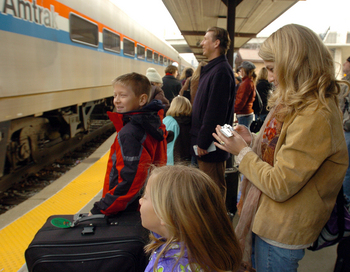
AMTRAK already provides passenger rail service in Michigan but rail enthusiasts say Michigan needs more and better lines.
File photo
“The first goes here,” he said referring to what he and many others see as the first priority for an improved rail line in Michigan.
Area residents at the Michigan By Rail public forum Thursday night at Washtenaw Community College were instructed to put stickers on large maps representing important places in Michigan, then draw lines where they would like to see rail service developed. Cooper chose Detroit to Ann Arbor, and one of his group members quickly picked up a marker and drew the next line from Ann Arbor to Chicago.
A pattern quickly emerged as the roughly 10 groups of about 10 people filled in their maps. They connected the cities of southern Michigan’s urbanized network to Chicago and some lines went north to the state’s tourist destinations.
The groups then discussed how to make the vision for a successful rail network a reality. The bottom line, organizers from the Michigan Association of Rail Passengers and Michigan Environmental Council said, is lawmakers must be educated on the potential economic benefits of rail.
John Langdon, a representative from MARP, pointed to 53rd district State Representative-elect and Washtenaw County Commissioner Jeff Irwin.
“We can talk to Amtrak all we want but we’re talking to the wrong people. The gentleman in the back of the room will be in Lansing in January … Everybody here needs to get on the phone tomorrow and tell your elected officials what you want.”
The forum was the 16th and final one held statewide since June. MEC Director Tim Fischer said about 25 state lawmakers — more Republicans than Democrats — attended the events, as did countless local representatives.
The Michigan Department of Transportation is in the process of developing a long-term statewide rail plan, and the forums were an opportunity to gather residents' input.
A final report will be distributed to Governor-elect Rick Snyder’s administration, state house and senate leaders and MDOT. That report will be available at www.michiganbyrail.org.
Fischer said organizers found more support then they anticipated, adding "people are actually clamoring for more passenger rail options”. Residents at nearly every meeting expressed a desire to see the same five different rail lines developed, Fischer said. Those are:
- Grand Rapids and Ann Arbor to Traverse City.
- Detroit to Grand Rapids and points between.
- A commuter rail stop at Detroit Metro Airport, which Fischer said even residents in Flint, Bay City and Traverse City asked for.
- A Detroit to Toledo line.
- A line somehow connecting universities and colleges together in some manner.
Amtrak, which was created by Congress in 1970 to provide a nationwide rail system, currently offers service throughout Michigan.
Langdon said it’s possible to buy an Amtrak ticket from the Upper peninsula to Toledo, which connects to all major points east. Though some legs of the trip would be by motor coach, a customer would purchase the ticket through Amtrak.
Derrick James, Amtrak’s senior director of government affairs for the Midwest, fielded questions about the company’s service. Amtrak offers three direct rail lines from Chicago to Grand Rapids, Chicago to Lansing and Chicago to Detroit. Ann Arbor is the busiest Michigan station, and ridership statewide increased 8 percent to more than 800,000 passengers last year, James said.
That reflects a national growth in rail ridership. Amtrak saw its best annual figures in fiscal year 2010 with 28 million riders. James said Amtrak still receives a government subsidy, but the company covered 72 percent of its operational costs last year, which is better than any previous year.
He highlighted that was accomplished with trains topping out at 79 miles per hour and limited route options.
“No, it’s not where anyone would want us to be, but in terms of a national railroad, we’re doing pretty well with the resources we have,” he said.
One audience member asked about a train service that would allow residents to take cars up north with them, allowing residents to bypass construction and congestion without giving up their car. James said there is a service that allows passengers from Virginia to Orlando to take their cars, so it is a possibility.
In response to a question from Cooper, James said Amtrak is also exploring purchasing equipment that would allow passengers to bring their bikes aboard.
Several audience members asked why Amtrak couldn’t make improvements to its schedules locally, stop in Ypsilanti or better coordinate interstate schedules.
James said the federal government has pushed for Amtrak to become more of a contract operator, meaning states decide how much or how little they use their service. Schedule improvements and adding more routes is, in part, up to legislators.
“We are only looking at expansions to the extent that states are asking for expansions,” he said. Like other speakers, James said residents need to push the “role trains can play in making our economy hum”.
Irwin will play a larger role in making that happen when he starts his term in the state house in several weeks. He has long advocated for rail projects locally, and said he will continue doing so in Lansing.
“It’s something we’ll certainly be working on, especially in this environment where we’re bleeding jobs, there’s high unemployment, and we’re struggling to get by, because transit is one of the investments government can make to make a tangible and relatively quick impact on the economy,” he said.
One of the obstacles is a Michigan tax structure making it difficult to raise money at a local level without avenues like a local sales taxes, Irwin said. He said it makes sense for southeast Michigan to have a rapid transit system, but it doesn’t make sense for residents in Marquette to pay for it.
But he believes there is a solid case to be made for the economic benefits of rail and rapid transit that could make sense to Republicans and Democrats.
“When you dig down deep into the numbers and look at what transit has accomplished for communities that have invested in it, I think there’s a real strong argument that conservatives will listen to,” he said. “Investing in transit pays big dividends and, in the terminology of our incoming governor, it produces a big outcome and has high ROI (return on investment).”
Comments
Elizabeth
Sun, Dec 12, 2010 : 11 a.m.
I beleive a reliable rail system in Michigan is long over due. It would bring new buisness opportunity to our region as a whole. I personally have lived in Japan and Portland, Or. with wonderful rail systems. In the long run it would benfit the state tremendously. Conecting cities, buisnesses and people.
Larry S
Sun, Dec 12, 2010 : 5:37 a.m.
Only fools bet on a future where gasoline and oil continues to be so cheap and plentiful. All indicators point towards less oil production combined with increased worldwide consumption in the next few years. Do you really want to be stuck with only the option of paying $9 a gallon of gasoline or $1000 to fly to Chicago in coach seats? If you even have a job after the oil prices skyrocket again... The talk about cost by some commentators here is baloney. No airport or highway has ever made a profit. Show me the ledger. I-94 and Metro Airport are money losers for the government. The truth is that they COST the taxpayers billions while only returning around 50% in user taxes and fees. Amtrak covered 72% of its costs with ticket revenue last year. That seems to be pretty good compared to highways and airports. The big government talk is baloney too. The majority of our tax dollars go towards the military-industrial complex, social security and medicare. Amtrak is peanuts compared to those programs. You're being played as a chump by the lobbyists for those industries, especially when they convince you through your favorite radio talk show or cable news network that considerably smaller programs such as unemployment insurance and Amtrak are bleeding the country dry. Suckers.
dogpaddle
Sat, Dec 11, 2010 : 12:43 p.m.
To USRepublic: If taking a canoe all over the country were a viable form of transportation, I would. As we shifted in this country to an automobile mentality, passenger rail became less and less the way to go. If you want to continue with the automobile mentality ONLY (I'm not against it - it is convenient for taking me where I want to go when I want to - sometimes - and automobiles built this region as rails have built this country -but how is that working for us now?) while the rest of the world passes us by and roads crumble and clog and gas goes up and up or disappears, go ahead. And when I do drive, I can't get up and go to the bathroom when I want, talk on my cell when I want (not legally), text, watch movies, drink a beer, walk around, etc. And if you don't want to subsidize my polar express fantasy as you put it, that's fine as soon as I don't have to pay for two wars I don't want to be in (that has cost us how much over these last 7 years?) or support other things our government does that I don't believe in. Last time I checked, we don't get to pick and choose how our tax dollars are actually spent, we only get the American right to complain about it (thank goodness). And for the record, I am happy to pay a little more for what I think is the convenience and COMFORT of rail travel. You travel how you like - again, this is America - we all have a choice and would like to keep them and hopefully expand them. I am not suggesting we try to become Chicago - I think that ship sailed and we missed it. Am I supporting something like a subway or EL here? Not necessarily only because I don' think our Motor City mentality (and, yes, I'm part of that, too) would support it. But whether private or public (and I'm not against a private enterprise building a high speed rail system), I do think it's time to join the rest of the world and have high speed rail as a viable means of travel which would be more efficient in the medium runs over air travel (let alone faster in total wait time and more comfortable - such as St Louis and other places up to 500-700 miles away). And to A2.com, while I don't feel personally attacked by USRepublic's comment, I'm curious why it wasn't removed as a personal attack. I've had comments removed before that to me seemed less "attacking" and wasn't about anyone on here (was about a public figure - just sayin). And, no, this is not an attack on a2.com - just trying to figure out the boundary system.
glacialerratic
Sat, Dec 11, 2010 : 12:41 p.m.
No substantial interurban rail system anywhere in the world has ever been built without government funding in entirety or major participation in securing right of way, etc. Infrastructure is costly and a public good.
bedrog
Sat, Dec 11, 2010 : 12:16 p.m.
rail is great and needs to be revived since the infrastructure is arleady in place...as does a once viable train/fly program in which, for the price of a roundtrip plane ticket, you got a private train sleeper one-way and an economy plane seat the other.... At least 1/2 of the trip was a positive, if leisurely, pleasure, with an old-time graciousness feel.; the other 1/2 was merely convenient. as i recall it was all bookable thru amtrak.
KJMClark
Sat, Dec 11, 2010 : 10:47 a.m.
I look at it this way. The people of the US are willing to give us $161 million to put in better passenger rail service. They aren't willing to give us that $161 million for roads. We can whine that they won't subsidize our roads like we want, but the rest of the country wants to subsidize rail instead. If we aren't willing to put up the $37 million they expect, they'll just send the money somewhere else. They won't, ever, give us that money for our roads. This is part of the reason Michigan is a donor state. The rest of the country keeps trying to bring us into the modern world - with more trains, transit, and non-motorized transportation - and we keep telling them to get stuffed. Then they send the money somewhere else, and we whine that we don't get our share.
margo
Sat, Dec 11, 2010 : 10:02 a.m.
TO HAMMER..there, was a big country with no trains, no cars, no airplanes, in the 1800 -1900- century........ So no poeple..then came the horse and carriage,etc etc.Right now china the comunist country is building the trains from Bejeng to the baltic sea Poland,Russia,Germany, France, Spain.....so just sit back and relax so there price on gasoline is ONLY going UP for USA. Sucker
margo
Sat, Dec 11, 2010 : 9:54 a.m.
REP.John Dingell gave $ 150 million for the TRAIN senator Carl Levin EARMARK $ 3,500 000 for the TRAIN Depot Town rag report: Michigan HB 6484 67 voting for 31 voting nay. So contact your Senator NOW to vote for HB 6484 We need the train and the jobs IT bring to michigan SenL-Brater@senate.michigan.gov MiRAIN www.semcog.org/AADD.aspx reported that the TRAI would take you to the thankgiving parade in 2010.Ha.ha,they wasted money on Flyer!1 so much for Semcog MDot effienciet! And then there is the GOLDEN SPIKE from AnnArbor to brighton 30 years in the making. can you think IT Europe Waited=Wasted==30 years..they wouldnot be first in line.Wake UP michigan and get the JOBS that are there and the money is here also, just some stupid....i....that have there...?????
bigbluebus
Sat, Dec 11, 2010 : 9:30 a.m.
I work in Lansing, would love to take a train, would also like a pony. I was also un- or underemployed for 21 months before this job, but am completely against spending on additional rail transit if it would need significant subsidies. Here's what I think the plan should be: 1. Develop the business case. 2. Revise due to fantastic projections for rail use & additional economic benefits. 3. Revise due to ridiculous projections for rail use & additional economic benefits. 4. Revise due to completely unrealistic projections. 5. Review realistic business case, check it again in 5 years.
Hammer
Sat, Dec 11, 2010 : 9:27 a.m.
high speed rail in Michigan would be a colossal failure. If we had a dense urban area like Chicago then it would make sense. Even then, I lived in the Chicago suburbs and rarely used the train because it didn't fit my needs. Most of those cars on I94 aren't going to/from Chicago, they are travelling a few exits then moving laterally away from the freeway.
Cash
Sat, Dec 11, 2010 : 6:36 a.m.
As we sit on our hands becoming more and more disconnected from the future America....the Chicago to St Louis high speed rail is moving forward. http://www.thetelegraph.com/news/illinois-48131-durbin-chicago.html Michigan snoozes And once again loses.
Cash
Sat, Dec 11, 2010 : 6:26 a.m.
Steve Hendel, It has worked for years for Chicago metro area - rail gets them where they need to go. Companies settle where urban mass trasit can move their people. Just travel there and open your eyes. We are 4 hours away from one of the wealthiest metro areas in the world. Yet we have made no commitment to move masses to and from that area. We pay to subsidize the education of thousands of U of M students only to see them move to Chicago, a city that has recognized the value to moving masses for employment, entertainment, shopping etc. Go to Chicago and observe the thriving Union Station and throngs of mostly 20-50 yr olds moving through it. You can almost touch the vibrancy. If Ann Arbor doesn't move forward, we will continue the backslide of the past twenty years. We are light years behind. Time to wake up.
stunhsif
Sat, Dec 11, 2010 : 1:52 a.m.
Derrick James, Amtrak's senior director for government affairs said: "Ann Arbor is the busiest Michigan station, and ridership statewide increased 8 percent to more than 800,000 passengers last year, James said." Wow, very impressive---NOT. That averages out to less than 2000 paid trips per day. Compare that to the number of passenger vehicles that go down I-94 every day to and from Detoit and your Amtrak number are less than 1/10th of 1%. You want to make this trip worth the while, raise the ticket prices for the folks that want to ride the train. I go from A2 to points all over southeast MI every day. Not in my lifetime will it ever be cost effective to put in rail in this dying metro area to make it worth my while and more importantly time to take a lousy train.
DonBee
Fri, Dec 10, 2010 : 11:36 p.m.
@bhall - I would love it if the government got out of the road business and dropped taxes. You are absolutely right, we don't need big government. Get them out of the road business. I would love to be a shareholder in a private toll paid I-94, I-75 or even US-23. Toll roads the world over make money for their shareholders and they tend to be in better shape than the non-toll roads. I could even think of a way to use current sensor technology to get paid for your local streets and even your drive way. Come on government - get out of the way, let free enterprise run all the roads. Great idea bhall! Great idea!
Ann English
Fri, Dec 10, 2010 : 8:25 p.m.
If these passenger rail lines were desired by enough consumers and we were free enough from burdensome government regulations, the private sector could build and maintain the lines WITHOUT subsidies. Subsidies prop up services that free enterprise does not. Tax money is used for subsidies. For private business to keep operating, it has to please the consumer. For a governmental service like Amtrak to keep operating, it does not need to do a good job, or even make a profit from what it does. It was free enterprise that gave us the invention of the train. Martin Van Buren, our eighth President, did not support this new mode of transportation, thinking it couldn't successfully replace the stagecoach.
Steve
Fri, Dec 10, 2010 : 6:54 p.m.
Hey, @cash: well I guess that's a good reason for spending zillions of dollars on rail-you're tired of hearing what your Chicago friends are saying about THEIR rail service. Seriously, though, I think what the proponents of expanded passenger rail are lacking is: 1. Hard documentation for the claims of economic benefits which would accrue from the huge investment which would be required. 2. Good cost estimates for the expansion, along with how they would be funded. "Build it and they will come" may work in the movies, but not for this particular field of dreams.
Cash
Fri, Dec 10, 2010 : 6:19 p.m.
Michigan had better get past the anti-mass transit thinking or we will continue to fall further behind Chicago area and the northeast. Chicago laughs at Michigan and it's inability to move large groups of people. I get so tired of hearing from friends about hopping a train to the city for a weekend of shopping or shows etc. Chicago folks have the freedom to travel without cars, parking problems, bad roads etc. Someone here suggested buses. Buses pollute as badly as cars and do not carry large numbers of people. Roads must be maintained for buses. And our roads are falling apart. We have not planned ahead for a future of higher employment, easy non-polluting movement of our populace,etc...and yet we think it is going to magically happen. We are getting exactly what we have planned for.....high unemployment, loss of our educated young people, decaying highways and bridges.
USRepublic
Fri, Dec 10, 2010 : 6:12 p.m.
@dog...paddle your own canoe!! Don't ask the rest of us to subsidize your occasional Polar Express fantasies! Look at the link I provided and notice that the "Wolverine" is losing $55/passenger ride....as it is...without the $500M improvements being proposed! I like someone's idea from yesterday's post....put a choo choo train around the base of your "holiday" tree and live the dream......
DonBee
Fri, Dec 10, 2010 : 5:33 p.m.
How many of the rail fans were "Rails to Trails" fans 10 or 15 years ago. We took apart much of the rail system in Michigan. Getting new right of way is not cheap. If they were going to do rail right and offer real high speed (200 Kilometers per hour or better) then I would be "on board" but the 10 percent plan they have is a waste of time and money. Good bus service is way better and does not need government subsidies. I like the Megabuses after using one to get from New York to Washington DC recently. Simple, very cheap and a great drop off and pick up setup. Real High Speed Rail - Yes. This boon doggle - no!
st.julian
Fri, Dec 10, 2010 : 5:29 p.m.
It be nice to see some evidence from exist ting low density light rail systems that 1) light rail investment would have an roi in a limited time, 2) has ridership that meets or excedds forecasts, 3) can gnerate fare revenues to cover operatin costs without local, state or federal subsidies.
sbbuilder
Fri, Dec 10, 2010 : 5:21 p.m.
Oh, goody, goody. It's all so easy. All you have to do is draw wishfull thinking lines on a map, and poof! there's your new RR. When we have the new flashy rail line that has zero budget allocated, can we have a spaceport too? And when that's up and running, can we have a teleporter as well?
Steve
Fri, Dec 10, 2010 : 4:29 p.m.
@dogpaddle: I have taken the AA-CHI train a number of times, and I agree with you; it IS, as you put it, "cheap and convenient." Let me point out, though, that by all accounts it is a money-loser for Amtrak. So it's only cheap because you and I are paying a discounted (subsidized) fare, and the difference is being made up by (presumably) federal and/or state taxes. Whether or not expanding rail, and especially passenger rail, makes economic sense is open to discussion; what is CERTAIN, though, is that it would surely cost millions or even billions of dollars to implement the fantasy train routes of all these people at the session. I'd give more credence to their efforts if, at the same time, they had the discipline of also thinking about how to pay for them.
sellers
Fri, Dec 10, 2010 : 3:47 p.m.
pbehjatnia, can you elaborate how drugs and rail are correlated? I agree the existing system has major problems on reliability due to freight and speed, but I think that is what this whole talk is about - to remove some of those governors.
sellers
Fri, Dec 10, 2010 : 3:42 p.m.
I like the ideas shared - I think AA to Toledo is more strategic/central, versus going east to come back west and south. Plus, it's the busiest station (probably due to the U) Amtrak has/had plans for AA-Toledo already on some proposed maps (in the Toledo station) I wonder if there was an AA and East Lansing to Pontiac line if Metro Detroit students would use it to get home for the holidays or weekends. We already pickup Kzoo, AA, Detroit, but the northern detroit burbs are a large source of enrollment at the U's. Interconnecting the Mac and bigTen schools would be good.
dogpaddle
Fri, Dec 10, 2010 : 3:39 p.m.
If you don't believe in rail service, don't use it. I do use it and wish it offered more options than our 3 runs a day to and fro Chicago. Never say never, but I don't think I will ever drive, bus or fly to Chicago again. I've had very few delays on Amtrak using that method. It's relatively cheap and convenient as far as accessing it here in Ann Arbor and getting you right to Downtown Chicago only 2 blocks from the nearest El station. If it's on time which over 90% of my experiences have been, it's only slightly longer than the stress of driving (presuming you don't hit construction or an accident on 94 as I did between here and Jackson recently adding 45 minutes to what should've been my one hour trip from Lansing). Yes, I've had a few delays beyond Amtrak's control because as a country, we gave up embracing passenger rail in the 50s/60s and Amtrak doesn't own the tracks in Indiana as they do here and have to yield to CSX or Burlington or whomever. I would love to see expanded rail service where if you choose to travel that way because you hate driving and flying (and sorry, Megabus, but that still counts as driving and unlike our friendly Amtrak station, you can't park and leave your car where Megabus picks up). Again, if you don't believe in rail service, don't do it. Don't ruin it for the rest of us who would use it more and more if there were more and more available. PS - if you have never tried taking Amtrak to Chicago if Chi is your destination - try it.
Cash
Fri, Dec 10, 2010 : 3:33 p.m.
As it is right now, we really have NO mass transit in Michigan. It is a watered down service that gets good ridership, even though it is dependent on the freight rails and never gets improvements like the trains in Chicago and out east do. Go out east or to Chicago to see a society that has moved forward and the businesses and educated workforce have followed....a lot of that workforce was educated with the help of our tax dollars. Wake up.
pbehjatnia
Fri, Dec 10, 2010 : 3:21 p.m.
I used to think this would be a good idea. Then I took the train to Chicago again last week. First class with no heat in either direction as well an extra two hours because of the freight tracks in Indiana. It got me thinking. The Amtrak system is worse than Eastern Germany used to be. Hell, it makes Iran look advanced. Also, noticed a big spike in recent months of violent crimes in the Ann Arbor area. Too many of h suspect are coming from the Detroit area. Forget my vote. I don't want it.
Top Cat
Fri, Dec 10, 2010 : 3:08 p.m.
Rail is the most energy efficient way of moving certain types of freight such as bulk commodities. That does not translate to every scheme that the public transportation lobby conjures up.
Ignatz
Fri, Dec 10, 2010 : 2:28 p.m.
Traveling by rail is the most efficient way to travel fuel-wise. This will help reduce our use of oil and so we will not have to send our folks overseas to fight for it so much. Or is that something we want to do?
bhall
Fri, Dec 10, 2010 : 2:16 p.m.
Whatever happened to personal responsibility? Why do we need a nanny state to get us to work for us. That's just stupid. I'm sick of the people on this site clamoring for more big government! People, figure out how to get to work and keep the government out of our lives!
USRepublic
Fri, Dec 10, 2010 : 1:32 p.m.
Railaholics never give up....do they? They have no clue as to the economic calamity rail service is in Michigan.....here are the numbers straight from Amtrak.... http://subsidyscope.org/transportation/amtrak/table/ Throw in the added bonus of all those people who live in Detroit and make their living in Ann Arbor selling drugs, stealing cars, and burglarizing homes and you have a real winner....
golfer
Fri, Dec 10, 2010 : 1:31 p.m.
have a cheaper idea make more bike paths. the ones in ann arbor are a waste of time. less room for the cars that travel more than bikes.