

Ranks of Merrill's Marauders thins: Ted McLogan, war hero and public servant, dies at 92
Edward A. “Ted” McLogan never considered himself a war hero.
That’s despite strong proof to the contrary: A Bronze Star, a Purple Heart, membership in the fabled World War II Merrill’s Marauders and the fact that a hill he helped secure in battle against the Japanese in Burma was named after him.
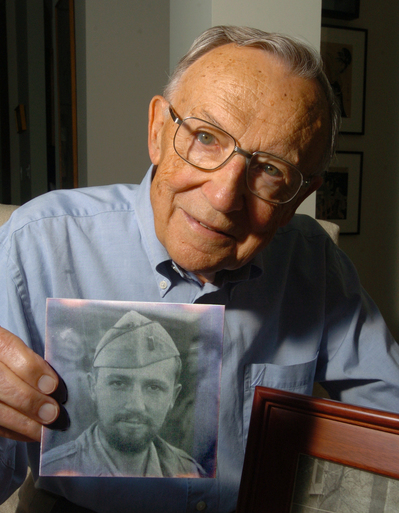
Ted McLogan, in his home in Ann Arbor in 2008, holds a photograph of himself when he as a volunteer soldier in Merrill's Marauders during World War II in Burma.
Ann Arbor News file photo
“He didn’t think of himself as a hero, but he surely was,” said his son, Matthew McLogan.
Ted McLogan, who graduated from the University of Michigan in 1942 and returned to the town of his alma mater a decade ago, died Jan. 25 at his Ann Arbor home at the age of 92. Services are scheduled for 11 a.m. Feb. 2 at St. Mary Student Parish, where McLogan married his college sweetheart, Beatrice Bouchard, 67 years ago.
A Flint native, Ted McLogan was a young and handsome ROTC graduate from U-M when he joined the 25th Division in Guadalcanal and the Solomon Islands as a second lieutenant. He soon volunteered to join a campaign behind enemy lines in Burma, known today as Myanmar, to wage guerilla warfare against the occupying Japanese forces in the mountainous jungle. This group of soldiers became known as Merrill’s Marauders after Brigadier General Frank Merrill, who led them. More than 70 years after the campaign, only a handful of Marauders remain.
“The campaign was edifying. They were dropped behind enemy lines to frustrate the Japanese supply line. But their own supply lines were not good. There was massive starvation and terrible illness. The deprivation of the campaign was legendary,” Matthew McLogan said.
Of the nearly 3,000 soldiers in the unit, roughly 200 survived to the end. Many were wounded or fell ill and were evacuated. Many died of malaria, typhus and dysentery, while others were killed in battle. “The enemy was only part of the problem,” said Robert E. Passanisi, historian for the Merrill’s Marauders Association who was 19 years old when he fought in Burma.
“There was near-constant fever, skin conditions, gastric problems. There was a rule: You had to run a fever of 103 degrees for three days straight to be considered sick,” he said.
He added the 2,000-calorie K-rations — when supply lines were able to deliver — weren’t nearly enough for troops marching 12-hour days carrying 90-pound packs, he said.
Every soldier who survived was awarded the Bronze Star. Near the end of the five-month campaign, Ted McLogan was wounded by shrapnel.
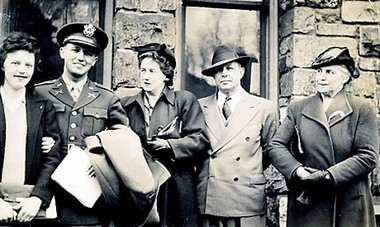
Ted McLogan (second from left) leaves for war from the train station in Ann Arbor in October, 1942. Seeing him off are (from left) Beatrice Bouchard, then his girlfriend and now his wife of 63 years; his mother, Helen A. McLogan; his father, Edwin C. McLogan; and Bouchard's mother, Vernona H. Bouchard.
Courtesy photo via MLive
The story of the Marauders was told in a book, which details how Ted McLogan secured a hill, and later in a 1962 movie "Merrill's Marauders."Matthew McLogan remembers his father taking him to see the movie when he was a youth. “When we left the theater, I asked him if it was really that bad. He said, ‘No — It was worse.’”
Ted McLogan, a platoon leader, and interpreter Roy Matsumoto became heroes for defending a hill against a Japanese attack, Passanisi said.
Ted McLogan’s battalion spent 12 days trapped on the side of a hill, surrounded by the Japanese. Matsumoto, who visited Ted McLogan last year in Ann Arbor, eavesdropped as the enemy discussed their next move, allowing them to devise a plan where his soldiers booby-trapped their abandoned foxholes with explosives, luring the enemy into the trap. After fierce hand-to-hand combat, the Japanese retreated, and the Marauders nicknamed the hill McLogan’s Hill in his honor.
It was a sense of duty that moved his father to enlist in the Army, volunteer to fight in Burma and become a public servant when he returned home, Matthew McLogan said. “He volunteered for the Marauders because he was asked. That was true his entire life: Service before self.”
There's is a family with deep roots in Michigan public service, McLogan said. Ted McLogan’s great grandfather helped found the Republican Party in Jackson in the 1850s, and his father served as mayor of Flint. McLogan was elected to the Michigan Constitutional Convention in 1961 and also served on the Genesee County Board of Commissioners.
McLogan was inducted into the U.S. Army Ranger Hall of Fame in 2001, the year after former Secretary of State Colin Powell won the honor. He raised seven children (one son and six daughters) in Flint where he managed the family’s department store, McLogan and Austin. After the sale of the store, he spent the next 30 years in brokerage and financial services.
McLogan was a true war hero, Passanisi said. “I think every Marauder was a hero, just to have survived. But McLogan was also a great military officer who took care of his men. His strategy and intelligence were important to their survival.”
McLogan is survived by his wife, seven children, 21 grandchildren and four great-grandchildren.
Comments
Hemenway
Sat, Feb 2, 2013 : 5:39 a.m.
My father served in Burma as part of the CBI Theater, ChinaBurmaIndia, in the Army Air Corp, now the Air Force. I wish I got a chance to meet Mr. McLogan.
Jonnie M. Clasen
Thu, Jan 31, 2013 : 5:13 p.m.
This story is a beautiful tribute to Ted McLogan, his family and Merrill's Marauders ... except for one glaring error. The Marauders were not "dropped" into Burma -- they were a long-range penetration unit. These brave men "walked" almost 1,000 miles behind enemy lines -- farther than any other WW II fighting force -- through dense jungle and the foothills of the Himalayas with only what they could carry on their backs or pack on mules to achieve their mission -- capturing the only all-weather airstrip at Myitkyina, Burma, from the Japanese and opening up supply lines into Asia. They had no mechanized vehicles. Jonnie Melillo Clasen, Merrill's Marauder Proud Descendant liaison officer and daughter of Merrill's Marauder Vincent Melillo, 94
HB11
Thu, Jan 31, 2013 : 12:50 p.m.
Amazing story. Unfortunately another one of the "greatest generation" has passed. It is great that his story seems well documented and that he shared his oral history with his children. My father, now deceased, had a less-storied hitch in the Navy in WWII and I regret not making more of a record of some of his stories.
PK
Wed, Jan 30, 2013 : 10:50 p.m.
Amazing story. Thank you for sharing it with us. I think I will call my dad tonight and tell him how much I love him.
Janet Miller
Wed, Jan 30, 2013 : 8:51 p.m.
Peter. Yes, as a member of the Public Service Commission, Matt marks the fifth generation of public service. An added note that didn't make it into the story but serves as a testament to Ted McLogan: All 21 of his grandchildren will attend his funeral services Saturday, some coming in from as far away as Australia and France.
Peter Eckstein
Wed, Jan 30, 2013 : 8:36 p.m.
As for "deep roots in Michigan public service," I am sure this is the same Matt McLogan who, among other things, served on the Michigan Public Service Commission (utility regulator) under appointment by Governor Milliken. Condelences to Matt and the family, and thanks to all for retelling a great story.
Dave K
Wed, Jan 30, 2013 : 7:47 p.m.
Ted was the best of the best. A treaure, and a well-kept secret (by his own choosing) in our town. Rest well. You've earned it.
Mike
Wed, Jan 30, 2013 : 7:46 p.m.
We need more men like him today. May God bless him and his family. Thank you and farewell Ted McLogan..........
Simon Green
Wed, Jan 30, 2013 : 7:15 p.m.
Another unassuming hero lost, in today's era when there are far too few "real" heroes. God Bless.
Geoff Larcom
Wed, Jan 30, 2013 : 7:03 p.m.
Thanks for writing this piece on Ted. He told his story at the Downtown Ann Arbor Rotary Club some time ago, and it was fascinating. A true hero.
Wolf's Bane
Wed, Jan 30, 2013 : 5:53 p.m.
Thank you so much for posting Ted McLogan's biography. What a great man.