

It's time to re-learn winter driving
All but the newest drivers in Michigan know how to drive in the snow. Why is it that we all have to re-learn each year?
Patrol officers everywhere in the state dread the first snowfalls because of all the crashes the downy flakes or “wintery mix” cause. The first snowfalls of the season cause an inordinate number of crashes.
For our own safety, the safety of our neighbors and emergency responders, let’s resolve to drive more safely this winter. Being prepared for the drive and driving slower is key.
Preparing for the upcoming perilous journeys on Michigan roads starts with making sure your vehicle is ready to go.
- Check your tires. Do they have enough tread to get you through the snow?
- Do you have a snow/ice scraper in your car?
- Are your defrosters, windshield wipers and windshield washer fluid pumps and reservoirs operational and full?
- Do you have sunglasses for the added glare from the snow and salt spray on your windshield?
- Do you have warm clothes or blankets in your car in case the road you are on is shut down and you are low on fuel? (Remember it is best to keep your gas tank at least one half full during the winter to avoid condensation in the tank and so you have enough gas in case you are stranded).
- Do you have a cell phone in the unlikely event you land in the ditch and must call for a wrecker or help?
If you answered yes to all these queries, you have the right equipment.
Next we must be mentally prepared for the journey through Michigan’s winter wonderland. Check the local weather report. Bad weather, snow and slippery conditions mean you need more time for your commute. You must also factor in the time to properly clear your windshield of snow, ice and frost. Therefore, you will have to set your alarm a little earlier in the morning.
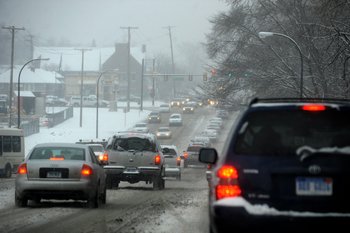
Cars sit in traffic along South Main street near East Stadium as the snow piled up in January.
Melanie Maxwell | AnnArbor.com
The absolute key to safer winter driving is to SLOW DOWN. During the first snows, that means slow down a lot and reacquaint yourself with slippery conditions. Even if you own a four-wheel drive vehicle, bad conditions might mean you must actually drive below the posted speed limit.
Once the temperatures get down into the 30s, wet roads can “flash” and become icy with little or no warning — especially on bridges and overpasses. Remember black ice just looks like wet roadway until you try to maneuver on it and find your tires have no grip on the road.
Increase the distance between your vehicle and the car ahead because stopping distances are greatly increased on slippery roads. Avoid using cruise control in slippery conditions. Winter driving takes much more finesse. Try to avoid making sharp movements while steering, accelerating and braking.
Learn how to correct the invariable loss of traction and skidding that's part of winter driving. Find an empty and open parking lot and practice correcting skids. (This does not mean just doing continual “doughnuts”). Remember in general terms that if you go into a skid, take your foot off the accelerator and turn in the direction of the skid to correct your course.
When braking, if your car is equipped with antilock brakes, engage them and steer as needed. If your car doesn't have antilock brakes, you must “threshold” brake (which involves braking just up to the point of skidding and backing off on the brakes when you start to skid) or pump your brakes so you can continue to steer.
Remember, once you “lock” your brakes, you will lose your ability to steer and your car will head in whatever straight line it was heading when the skid started.
Let’s all slow down this winter so we can enjoy the splendor of our winter wonderland and keep each other safe.
Lock it up, don’t leave it unattended, be aware and watch out for your neighbors.
Rich Kinsey is a retired Ann Arbor police detective sergeant who now blogs about crime and safety for AnnArbor.com.
Comments
PittsfieldTwp
Fri, Dec 3, 2010 : 9:24 a.m.
@atnaap Really? If you keep you foot on the gas and you have no traction, you tires will spin. Once the car moves on to ground where their is traction, those spinning tires will grab the ground lunge the car forward quickly in an undesirable direction and speed. Something I learned long ago and never forgot.
jcj
Thu, Dec 2, 2010 : 10:47 p.m.
@atnaap With all due respect you sound like someone that has never driven in the snow. To start by simply taking your foot off the accelerator in a skid is exactly what you should do! And the most important tip for winter driving is not snow tires! They will be of NO help to the numbskulls that drive like they do in the summer! Slow down and give yourself more room from the car in front of you.
Fat Bill
Thu, Dec 2, 2010 : 8:25 p.m.
I second what bunnyabbot says. With fewer officers on the road, dispatchers are sending wreckers to cars in the ditch without waiting for police response. Watch for the amber or red beacons; wreckers sometimes cannot get all the way off the road to recover a vehicle back to the shoulder. Remember, the Michigan move-over law applies to tow trucks as well as fire/ems/police. By the way, that extra bit of room in front of a tow truck is not an invitation to fill the space, that's the extra room required to stop a 6 ton vehicle towing another 2-to-3 ton unbraked trailer...
pegret
Thu, Dec 2, 2010 : 3 p.m.
I log a lot of miles, and even in adverse weather, the main problem I've had is with other drivers...and it seems like the more traffic there is, the worse they are. Folks who drive aggressively in good weather, usually drive the same way when it's bad...making the roads even more dangerous then the snow & ice. If weather conditions necessitate slowing down on the freeway, I stick to the right lane, and on a 2-lane road I'm more than happy to pull off to the side when possible to allow a faster vehicle to pass easily. However, most of these impatient fools can't get it through their heads that tailgating someone does NOT make them go faster! Also, some of these drivers need to realize that not everyone on the road has 4-wheel-drive or anti-lock brakes, and even if YOU do, they're not necessarily going to help you on ice.
theodynus
Thu, Dec 2, 2010 : 2:45 p.m.
Fine advice except that simply taking your foot off the accelerator in a skid is exactly what you shouldn't do, since that'll upset the car even more. The good officer would know this if he'd spent enough time messing around in parking lots! The article also misses the most important safety for winter driving: snow tires.
bunnyabbot
Thu, Dec 2, 2010 : 2:11 p.m.
Although it is a state law in Michigan and in many other states (and common sense, which we know how well that works) I wish people would begin to slow down and move over AS SOON AS they see the flashing lights on the shoulder of a road, be it a cop car or a wreaker or even a semi that had to pull over. I get sick of those people that want to cruise up as close as they can get and then merge and then slow down quickly than the rest of the pack did. A firefighter was killed a couple years ago when a car slid on the ice and hit her as she was at a traffic scene. A cop can just as easily slip on ice and fall on his butt walking between cars and end up in a weaker position.
robyn
Thu, Dec 2, 2010 : 10:13 a.m.
Thank You Rich! Very good advice that everyone should read and heed. Especially the advice to give yourself some room. There is no reason people need to 'tailgate' in ANY weather - but it's even more dangerous to do so in wet, snowy or icy conditions. It's not only dangerous to you - but to the persons in front of and behind you.
jcj
Thu, Dec 2, 2010 : 9:13 a.m.
"Increase the distance between your vehicle and the car ahead" It seems most drivers think if they can't read the numbers on the phone the driver ahead of them is using they are too far back!
Jim Clarkson
Thu, Dec 2, 2010 : 8:59 a.m.
Six accidents on I-94 and the M-14 / US 23 exchange yesterday. Come on people I saw more snow in Northern Iraq than we got yesterday.
Hmm
Thu, Dec 2, 2010 : 8:45 a.m.
When the temperature is hovering in the lower 30's and there's ANY precipitation in the air, I always slow down whether it's visible or not. It's better to just slow down, nothing is worth losing your life over cause you are too careless to slow down
PittsfieldTwp
Thu, Dec 2, 2010 : 8:29 a.m.
The overpass issue mentioned is real. This time of year, much of the ground is not yet frozen and does not feel frozen when driving. However, the overpasses with air underneath are the first to freeze so a driver goes from wet ground to ice in a split second. Later in the winter the transition from ground to overpass is minimal. Most of us probably do not need to "re-learn", its just tricky figuring out when to apply the winter driving skills. The change over is quite often unexpected.