

Recycling in Ann Arbor? Your questions answered
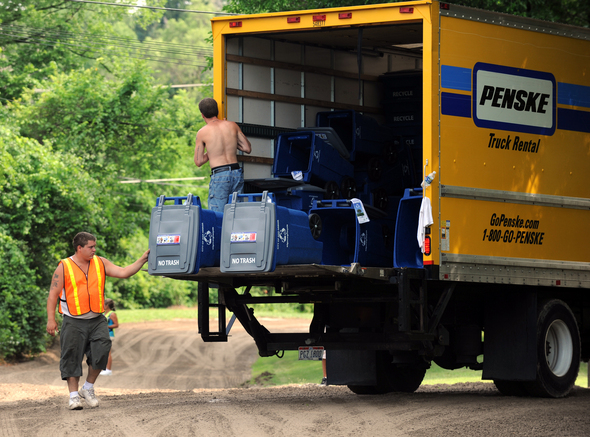
Workers pull new recycle bins off a truck as they distribute them along Ironwood Drive in Ann Arbor last week.
Lon Horwedel | AnnArbor.com
Fans tailgating in Ann Arbor before University of Michigan football games should think twice before throwing out all their used plastic Solo cups this year. For the first season ever, those items are among those that can be recycled since Ann Arbor began its new single-stream recycling program.
Didn't know that's among the additions to recyclables made in Ann Arbor? You're not alone.
The city upgraded its Materials Recovery Facility, or MRF, this summer to accept single-stream recycling - rather than sorted paper recyclables vs. materials like glass or aluminum.
The city has been launching full-scale information campaigns to get the word out about the changes to its curbside recycling, which began July 5.
We caught up with some folks deeply involved with the program to answer some of the most commonly asked questions about how it all works. Here's what they said:
Q: Why single-stream?
A: “Single-stream recycling is a more cost-effective, more convenient way to collect and process recyclables, and it allows us to take more types of materials that our former plant couldn’t accept,” said Nancy Stone, spokeswoman for the city's public services area.
Q: So when do I start putting all recyclables into a single container?
A: Now. The program officially started July 5, and although carts are still being distributed in some neighborhoods, everyone should be participating, Stone said. “As far as I know, tonnages are up," Stone said. "But it’s hard to get the message out that even though folks haven’t gotten their carts yet, they don’t need to separate their recyclables anymore. People are reluctant to mix.”
Q: So I haven’t gotten my cart yet. What’s the deal?
A: If you’ve heard from friends who have received their carts and live in other neighborhoods, you just might be living in an area that is scheduled to get carts at a different time. To see details about when folks are scheduled to get their carts (which has been a few days off schedule) visit http://www.a2gov.org/government/publicservices/fieldoperations/solidwasteunit/Pages/RecyclingCartDeliveryAreas.aspx. If your neighbors on the same block have gotten their carts but you never did, you might want to call Recycle Ann Arbor at 734-662-6288.
Q: What was added as a result of single-stream recycling?
A: "We officially added freezer boxes, things like Lean Cuisine, those boxes," Stone said.
• "For scrap metal, in the past we were less eager for things like toasters but now - even with the cords attached - we can accept things like that," she said.
• Plastic bottles now include numbers 4, 5, 6 and 7. "A lot of them look like shampoo bottles, vitamin bottles, prescription vials," Stone said.
• "We’ve added the tub shape like a margarine tub shape and a cup shape like an iced tea cup from a café. But with these things, we’re still not interested in those lids. Just the tub shape," Stone said.
• "Yogurt and butter tubs really have been the big request. There isn't a single (recycling center) tour that goes by where someone didn't ask about why we wouldn't recycle those. It's great now we're able to respond to that request."
• "The last piece is bulky plastics. Really they're called bulky rigid and it can get confusing … the idea is, it's a tub or cup shape, anything goes," Stone said. Bulky plastics usually include things like old broken plastic lawn furniture or laundry baskets.
• See an official list of recyclable materials here.
A: "What we really don't want are plastics #3 - and there are really few in the market," Stone said. "We don't want biodegradable plastics or things that are labeled 'Compostable' or 'Made with corn starch.' The reason for that is those plastics is a mixture that is designed to rot and we're interested in finding plastics that can be melted down for reuse."
"Plastic bags and styrofoam (like packaging material) can't be recycled. They are materials that get into the gears of the machinery at the recycling center and can contaminate. But with plastic bags, all the local grocery stores accept them, so it's easy to find a place to take them back," Stone said.
The recycling center had been accepting Pyrex and ceramic containers and batteries in the past but no longer does. It also can't recycle light bulbs, electronics or hard cover books.
Q: What about folks who drive into Ann Arbor to bring their recyclables into the drop-off station? Should they continue to sort?
A: Yes they should continue to sort, said Recycle Ann Arbor spokeswoman Jean Brown. It's a different recycling program from the city's and the destination of the recycled items is often not the Ann Arbor MRF.
Q: Ok, I’ve got an item I know is recyclable. Do I really have to wash it that well?
A: Short answer: Yes. “If you don’t, it creates odors and the potential to attract bugs,” Stone said. “And because there is optical scanning that helps sort, if there are contents in the bottle, it throws off this step … A clean container is what we’re looking for.”
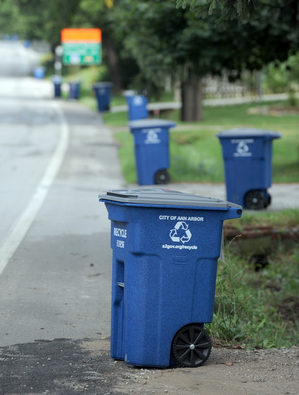
Freshly distributed recycle bins line Dexter Road in Ann Arbor.
Lon Horwedel | AnnArbor.com
Q: Why can I only recycle bottle and tub shaped items? And why can’t you take lids if you can accept the containers they come on?
A: Imagine a conveyor belt with hundreds of items, which largely resemble items of spread out trash, chugging along on it. A mixture of different scanning technology, mechanized hands and human hands work together to grab items and sort them.
“We just can’t effectively sort things that don’t have a good shape and weight to them because it can be easy for them to fall flat on the belt or fall into the paper waste,” Stone said.
And for those who think they’ll just pop those yogurt lids back on the container for recycling, think again. It’s not a very helpful solution because the weight of other recycled items usually pops the lid off anyway. And for those lids that remain on … well, there’s always the concern about what sort of items could be hidden inside that could be hazardous or just plain gross for the human hands that have to sort them. They’ll probably get tossed into the trash rather than be recycled, Stone said.
Q: The new RecycleBank program is supposed to reward participants with incentives. How does that work?
A: RecycleBank is a company that runs a program to reward individuals along a particular trash route who recycle. On pickup day, each individual cart - with its RFID tag - gets a credit for contributing to the weight of recyclables along the route in which it's collected, said Tom McMurtrie, the city's solid waste coordinator. That weight is converted into RecycleBank points that are distributed to houses on that particular route.
• See the city's explanation of RecycleBank here.
Q: Ok, but wouldn't that system be pretty easy for folks to scam? For instance, couldn't someone increase the weight of their recycling by throwing bricks into their bucket?
A: "We have cameras in the trucks. If something tipped like that, they will be noticed and tracked back to the RFID," McMurtrie said. The city also has hanging door tags it can use to alert the resident to recurring recycling mistakes, he said.
Q: I want a different sized recycling cart. Is it OK if I just trade mine with someone else?
Q: What are these rewards from RecycleBank and how do I get them?
A: From the city: "First you will have to set up your account. You will be mailed instructions on setting up your RecycleBank account after the recycling carts are delivered and before Sept. 1. Once set up, you will be able to access your RecycleBank account online or via phone to check your points and shop for rewards."
According to RecycleBank spokesman Jeff Harse, a household can earn enough points to redeem a reward after a week or two of recycling. To give an example, a member on a route that averages 2 pounds of recycling per participating household can earn five RecycleBank points. Two pounds of recycling is equivalent to 36 plastic bottles, 64 soda cans, four glass bottles or two cardboard boxes.
The points can be redeemed for rewards from national retailers and brands like Nature Made, Coca-Cola, CVS Pharmacy and Bed Bath & Beyond. They can also be redeemed at local businesses, including 16 Hands Gallery, Amer's Mediterranean Deli, Ann Arbor Bivouac, Ann Arbor Brewing Co., Arbor Farms Market, Banditos, Downtown Home & Garden and more for between 20 and 50 points. An example of a local reward is a $10 coupon off a purchase of $50 or more at 16 Hands or a $5 coupon for a purchase of $25 or more at Amer's.
RecycleBank members can also track online how many gallons of oil and how many trees their household saved because of their recycling efforts.
Q: So couldn't my neighbor freeload from my recycling efforts by only recycling a little bit to reap the rewards?
A: Theoretically, yes. But the rewards themselves are not meant to be the reason folks recycle - just an incentive to join a community-wide effort, Harse said. "Let's be honest about what this program is doing. It's creating an great incentive for recycling, to make someone think twice before throwing something away … That's the greater goal."
Do you have more questions about recycling in Ann Arbor? Send them our way and we'll be sure to update with all the answers we can get.
Tina Reed covers health and the environment for AnnArbor.com. You can reach her at tinareed@annarbor.com, call her at 734-623-2535 or find her on Twitter @TreedinAA.
Comments
Andrea
Mon, Aug 23, 2010 : 12:27 p.m.
@SonnyDog09: So I saw that Cleveland is actually monitoring its citizens for not recycling the expected amount (10%) and thought of you! Source: http://news.cnet.com/8301-17852_3-20014348-71.html
Julie Martin
Wed, Aug 4, 2010 : 4:31 p.m.
Well, everyone in our neighborhood got one, except us. I called, lets see how fast this issue is resolved.
bunnyabbot
Mon, Aug 2, 2010 : 12:42 p.m.
ok, so it seems a few of us will be likely to remove the tracking devices, now maybe the trucks will sit idle at the end of the driveway with that arm going up and down in confusion and saying "cannot compute" over and over.
Snarf Oscar Boondoggle
Mon, Aug 2, 2010 : 10:34 a.m.
@tina "I spoke with Tom McMurtrie, the city's solid waste coordinator, and he said all new recycling carts have the RFID's embedded in them so it is really not possible to have a cart without. It is also not supposed to be possible to dismantle or remove the RFID tag from the new recycling carts." as i noted earlier.... gimme a coupla 12 yr olds and about 18 seconds and we;ll see just how accurate taht statement is. if they can jailbreak their i-phone, they can jailbreak my treashcan, likkedly-split. j l b r k u r t r s h c n!!!
Roaring_Chicken
Mon, Aug 2, 2010 : 9:32 a.m.
Here's the carrot & the stick: "Incentive-Based Recycling: A handful of forward-thinking municipalities are already using RFID tags for incentive-based recycling. One recent example is the city of Philadelphias partnership with Recycle Bank. Philadelphia residents receive a bin fitted with a low frequency (LF) RFID tag that identifies each household. Recycling trucks are outfitted with a scale and a RFID reader. On recycling pick up day, a residents bin is placed on a scale, identified by the RFID tag and reader, and then weighed. The Recycle Bank system tracks how many pounds of recycling each household produces per month, and the households then receive Recycle Bank Rewards Dollars. Residents can redeem rewards dollars with more than 300 retailers." The stick (ie, stick-it-to-you): "Bill by Volume: Depending on the city or town, trash collection pricing structures vary from flat fee, pay-as-you-throw and pay-by-weight. As recycling efforts become more mainstream, municipalities may turn away from flat fee-based systems and charge customers according to the amount of waste they generate. RFID technology improves the accuracy and efficiency of bill-by-volume waste collection. As the fully automated truck lifts the RFID-tagged bin to empty it, the tags ID number is read and eventually processed into individual customer invoices. Trucks fitted with scales can add weight data for pay-by-weight billing as well." Slick! "Individual customer invoices."
Val Losse
Sun, Aug 1, 2010 : 8:59 p.m.
Interesting that I will be able to use my rewards points to get into the recycle station to drop-off batteries and motor oil. Yet this was a free service before. Since the batteries are not the rechargeable type can I just toss them into the trash? Why can't they pick-up the oil as before? Hey folks remember those fluorescent energy saving bulbs. It will cost to dispose of them not like the incandescent light bulbs. They do contain mercury though in tiny amounts.
Joe Hood
Sun, Aug 1, 2010 : 4:21 p.m.
@deb Information on the wholesale market pays about 1/10 of a cent per user. There is a great article in yesterday's Wall Street Journal detailing the entire process of collecting the data and selling (alas on the web, not on our recycling bins).
jameslucas
Sun, Aug 1, 2010 : 2:38 p.m.
Great two of the most dangerous household items oil and batteries are more difficult to recycle than these mostly harmless items.
deb
Sun, Aug 1, 2010 : 11:28 a.m.
Information is not free. If the contractor gets the information from my recycling, they should have to pay some sort of compensation for it. Carts and/or services by the contractor should come at a lower cost to the city. They can have the info, it just needs to be paid for. Additonally, they found places for cameras and other neat things, how could they not look for a place for used oil? Oil and batteries are very toxic, much more than used bottles, why would we make it harder to recycle them? This seems like a step in the wrong direction.
Speechless
Sun, Aug 1, 2010 : 10:28 a.m.
Was going to comment much earlier, but became sidetracked by a new home project. Especially after reading through the later comments here, a new motivation has arisen in my life. Thank you for the inspiration! Instead of recycling used aluminum foil, I've now taken to scrubbing it clean and carefully fashioning the pieces into oversized headgear. After applying a little heat, the resulting 'weldment' creates a shiny and surprisingly elegant tin hat to display across the top of our new blue recycling cart. It should not have to spend time outdoors without functional, appropriate haberdashery. By the way, should aluminum foil not deflect the city's sinister recycling rays as well as I would prefer, does anyone think that an alternate soft alloy might do better? Please mail me your response by card or by letter, care of Mayberry, RFID.
Joe Hood
Sun, Aug 1, 2010 : 9:17 a.m.
If they were enterprising (whoever "they" is). They could run images of your recyclables through the Google image database, sell the information to a marketer. At least the coupons you get at the counter would be for things you buy. There is money to be made in this endeavor. Am I a conspiracy theorist, no, I left the RFID tag in the can.
Roaring_Chicken
Sun, Aug 1, 2010 : 8:45 a.m.
I'm very much NOT a conspiracy theorist... but I deeply distrust "reward programs" which compel your participation. It's like the funny money my credit card issuer tells me I've earned in order to get me to buy cheap silly stuff I don't want... ON MY CREDIT CARD, of course. Maybe a reader/commenter here could research how "chipped" trash carts are being used in other municipalities. "Just" for rewards? I thought recycling was its own reward. Be well, San Arborites!
Craig Lounsbury
Sun, Aug 1, 2010 : 7:39 a.m.
"How exactly do you remove that piece Joe?" deb, on my cart there is a black vinyl threaded "plug" on the right hand side by the hinge. This threaded plug can be unscrewed with channel locks or an adjustable wrench. The device is visible inside and appears to be removable with a pair of needle nose pliers or maybe even tweezers.
deb
Sun, Aug 1, 2010 : midnight
How exactly do you remove that piece Joe? Additionally, I would like to know the parameters of the contract between the city and the contractor. Information, even what is in peoples trash, is worth money. At the very least, those chips installed in those carts should not have cost the taxpayers a penny. I believe privacy laws cover trash, and once you put it out to the curb it is no longer considered private. Once on the curb, people can go through it. Although, it is legal, it also immediately raises the questions: 1) How close we are to the police force or anyone else doing a virtual "trash pull" every time we throw anything out?; (2) What additional personal information can be gleaned from the collected information?; (3) How the information is being used?; and (4) How the data is being stored and what security measures have been to prevent exposure of the information? Just to raise a few. I know it seems nit picky, but this type of thing does not sit well with me. Again, I would like to know more about the parameters of the contract before I completely chastise this.
Craig Lounsbury
Sat, Jul 31, 2010 : 7:12 p.m.
Thanks for the picture Joe. (hopefully they won't delete this version.)
Snarf Oscar Boondoggle
Sat, Jul 31, 2010 : 5:58 p.m.
@tina reed, "I spoke with Tom McMurtrie, the city's solid waste coordinator, and he said all new recycling carts have the RFID's embedded in them so it is really not possible to have a cart without. It is also not supposed to be possible to dismantle or remove the RFID tag from the new recycling carts."..... ummmmm, ms reed, mr mcmurtrie, excuser me if you must but, uhhhh, has either of the two of youevern encountered a copuple of 12 yr olds 'on a mission from pod' (people)? if i can jalil break my iphn, someone is gonna figger out how to jaiolbreak their trash can, ok?... j a i l b r e a k... u r... t r a s h c a n!!!... h t t p : // (fill-blank.kp)
Joe Hood
Sat, Jul 31, 2010 : 5:52 p.m.
After a quick look, I've answered my own question on the location of the RFID tag. The tag is located in the hinge area. Here is a picture: http://bit.ly/A2RFID
Snarf Oscar Boondoggle
Sat, Jul 31, 2010 : 5:43 p.m.
@joe... only the shadow knows....
Joe Hood
Sat, Jul 31, 2010 : 5:27 p.m.
Where is the RFID tag located on the can?
Craig Lounsbury
Sat, Jul 31, 2010 : 3:39 p.m.
I have drilled 4 holes 1/2" each in the bottom of my cart. I put 4 inch long bolts through the bottom in to the cart itself and tightened them with nuts and fender washers. Next I poured 3 1/2 inches of ready mix concrete in the bottom of my cart. Once the concrete set I put another fender washer and another nut on the 1/2" of each bolt protruding through the concrete to be sure it stays in place. My cart now weighs in at 79.6 pounds empty before I put anything in it. As soon as I get my neighbors squared away we'll all be vacationing in the Bahamas this winter. I never realized recycling could be so profitable.
Snarf Oscar Boondoggle
Sat, Jul 31, 2010 : 1:49 p.m.
Low-frequency (LF: 125134.2 kHz and 140148.5 kHz) (LowFID) tags and high-frequency (HF: 13.56 MHz) (HighFID) tags can be used globally without a license. Ultra-high-frequency (UHF: 868928 MHz) (Ultra-HighFID or UHFID) tags cannot be used globally as there is no single global standard. In North America, UHF can be used unlicensed for 902928& MHz (13 MHz from the 915 MHz center frequency), see wiki article for more. what i NEED to know, is, did mayor & council KNOW (what did they... wehnd did they...) that electronic & video snooping into our trash was involved in this single-screaming recycle (boondoggle)? it -is- possoible that this info was concealled from them. then this stoyr is a whodunit.
AstroJetson
Fri, Jul 30, 2010 : 7:53 p.m.
>>> Arieswoman: Use the clear plastic bags from dry cleaning for your shredded paper.
bunnyabbot
Fri, Jul 30, 2010 : 7:27 p.m.
tina, now find out how I can turn the cart back in, thereby not being charged for it, I don't wish to participate in recycling
pbehjatnia
Fri, Jul 30, 2010 : 4:39 p.m.
great. so now i need to go buy the brown paper leaf bags that the city began to refuse a couple years ago because now there is no leaf pick-up. ok. check. oh! and don't forget to go buy clear plastic contractor bags for the new recycling system. ok. check. hm. guess i need to add extra gas for my car to go personally drop off e.g., oil at a central facility. ok. check. and find some other way to dispose of glass bottles? okaayyyy. check. ah. wait a minute. on second thought: uncheck all of that and anything i missed - i'm just going to dump it ALL in the trash. check.
Beth Wilensky
Fri, Jul 30, 2010 : 3:50 p.m.
What about household (non-rechargeable) batteries? Just about everything I've seen from the city has been confusing on this point. I think that both the WasteWatcher and the city's website say that they are no longer recyclable because most aren't toxic and therefore the original rationale for collecting them no longer applies. But there is also information on recycling them at the Recycle Center. It seems like the city doesn't want to just come out and say we can now put batteries in our trash, but that is the implication. Is that correct?
nemo
Fri, Jul 30, 2010 : 2:49 p.m.
For those who want to disable the tag, here's a solution truckers use to KO black box trackers: Figure out where the tag is, put a block of dry ice on top of it and let it sit until it's almost gone, then give the thing a whack with a rubber mallet. The ice freezes the tiny circuits so they become brittle, then wham, they're broken.
Mike Hulsebus
Fri, Jul 30, 2010 : 2:44 p.m.
Anyone who wants to see what reward will be offered should check out http://www.recyclebank.com/, (spotted: Amazon gift cards!) though of course at this point it's hard to know how many points you earn per recycling action. I already signed myself up even before we got the sign-up mailing and I'm curious to see if I begin earning points: my recycling pick up day is today. Yeah sure, it would be nice to pay less in property taxes, but come on. In many places you have to pay to recycle. Not here. And not only that, but they're gonna give you something to recycle? And it encourages people to recycle more? Sounds good to me. I look forward to recycling my old recycling bins and earning points for their weight. And one final thing: the recycle bank site suggests that you don't earn individually but per route, so you can't just steal stuff from neighbor's bins to grab points. Even if you did put a brink in there, you wouldn't see a marked uptick in points since the weight of that brick would be divided among all your neighbors. To quote the city site: "Residents on each recycling route earn points based on how much material is recycled on the entire route."
uresgoddess
Fri, Jul 30, 2010 : 2:13 p.m.
This is great news for all of the ann arborites, but I live in ypsi township in a condo. Our condo assoc. years ago decided that it was just too bothersome to deal with recycling so just have our big garbage gondolas collected once or twice a week. I was taking my bottles and cans to the fire station at Hewit and Congress, but due to the budget cuts that is no longer an option. I took a carload down to the recycle center on Ellsworth and was asked to make a $3 donation. I'm out of work, so no income is coming in, and I am STILL a huge can, glass, and cardboard producer -- I know that $3 isn't much, but it's enough to make me want to just throw the recycles away. Any suggestions?!
Tina Reed
Fri, Jul 30, 2010 : 1:23 p.m.
A number of you have mentioned concerns about the city tracking your recycling because of the radio frequency identification technology embedded into the carts. I spoke with Tom McMurtrie, the city's solid waste coordinator, and he said all new recycling carts have the RFID's embedded in them so it is really not possible to have a cart without. It is also not supposed to be possible to dismantle or remove the RFID tag from the new recycling carts. He did say the city does not have access to the recycling data from the RFID's, but that the RecycleBank company is the only entity that receives that information.
Craig Lounsbury
Fri, Jul 30, 2010 : 1:21 p.m.
bhall@ "To disable the RFID tag, you have to place your hand over the bar code, then strike it with a hammer as hard as you can. You have to distribute the force equally over the bar code in order to fully disable it." That seems like it would hurt. If I use this option can I make my medical claim with the city, or am I on my own? Maybe I'll wait for universal medical care to kick in.
M-Fan
Fri, Jul 30, 2010 : 1 p.m.
Who's great idea was this? Who is making money from it? Was it another of the usual 'no-bid' deals to the usual group of the Powers that Be, and how much have they (the no-bid winners) contributed to the present Powers that Be.
Tina Reed
Fri, Jul 30, 2010 : 12:50 p.m.
Yes, shredded paper does have to be in a clear plastic bag since it isn't processed in exactly the same way as usual paper and workers actually grab the bags at a different point in the line. (That's why the bags need to be see-through for them to spot the shredded paper.) A quick online search showed clear contractors trash bags for sale at places like Sears and Lowes. Everything needs to fit inside the cart and the lid of the cart cannot be secured in order for recyclables to be picked up. Yes, cardboard should be recycled, but it needs to be broken down and recycled in amounts that can fit into the cart. Oil is no longer collected curbside, Jean Brown told me. This is due in part because the new trucks just don't have a place to store them as they haul recyclable materials. The Ann Arbor Drop-Off Station, 2950 East Ellsworth Road, the Washtenaw County Home Toxics Reduction Program at 705 N. Zeeb Road and different oil change places accept used motor oil. As for your golf game, the Re-Use Center does have used sets of golf clubs for less than $20 and is always willing to accept more sets, Brown suggested. Perhaps that may help?
bhall
Fri, Jul 30, 2010 : 12:38 p.m.
To disable the RFID tag, you have to place your hand over the bar code, then strike it with a hammer as hard as you can. You have to distribute the force equally over the bar code in order to fully disable it. Hope this helps.
Marvin Face
Fri, Jul 30, 2010 : 12:29 p.m.
Good Lord, bunnyabbot. Get ahold of yourself. Is this really worth the hyperbole?
bunnyabbot
Fri, Jul 30, 2010 : 12:06 p.m.
if we wish to not participate in the reward program, and since the cart is being added to a water bill?, and that means the homeowner then OWNS it, can I remove the tracking info from it? that is cover the number or such? and if not then I don't want the cart and my money back and I will not recycle anymore, because afterall it is a free country and I have a right to not recycle if recycling is being policed.
uawisok
Fri, Jul 30, 2010 : 11:17 a.m.
I doubt the "recycle bonus points" will work for us too well, we won't set our current carts/containers curbside until they are full. We may go 3 weeks before filling our small wheeled cart. We figure why waste the drivers time and un-nessesary wear and tear on the equipment. I agree with the guy that posted this bonus program encourages putting waste into the system rather than reducing waste stream!!
Roaring_Chicken
Fri, Jul 30, 2010 : 11:16 a.m.
Starting to look more and more like "Demolition Man" around here all the time. The City can measure sump pump outflow, determine your property's groundwater runoff tariff, and now evaluate your recycling output. RFID tags? Cameras in garbage/recycling trucks? I expect to see three litle shells in every lavatory stall in the new City building. :)
Trepang674
Fri, Jul 30, 2010 : 10:42 a.m.
Now if we can get Canada on this program - we won't have to take in their rubbish and clog roads...thankfully it has improved - so we take their trash and they spill thier oil...Dang they are trashing our state...we are only sending polluted air.
suswhit
Fri, Jul 30, 2010 : 9:46 a.m.
Shredded paper in clear a plastic bag??? We've always put ours in a paper grocery bag and taped it shut. Is that no longer ok?
5c0++ H4d13y
Fri, Jul 30, 2010 : 9:45 a.m.
No more oil curb site too. Right?
Tina
Fri, Jul 30, 2010 : 9:36 a.m.
"Everyone should be using single-stream recycling at this point." My apartment complex has no curbside recycling, neither does my friend's condo complex. Those of us who do recycle in those units have to use the drop-off station, which, as stated in the article, doesn't use single stream. Personally, while the points would be nice, I'd like access to single stream so more of my waste could be recycled versus going into the landfill. I have some broken #2 plastic laundry baskets which I was told by a drop-off station attendant would be recyclable once single stream went into effect. Not so much, apparently.
bunnyabbot
Fri, Jul 30, 2010 : 9:32 a.m.
1. what about cardboard? I mean big boxes that won't fit into the container, I might get several shipments in a week. 2. sorry but coupons that amount to 10-20% off are not incentives. You can find those deals on the internet without having to recycle. Small businesses often will give you 10-20% off your purchase if you just ask if they can do better. So for these businesses its participating is a form of advertising while still get the amount of money out of you that they would during one of their normal sales. 3. if ANYTHING is being tracked I am less likely to want to recycle, so with me they just got themselves more garbage. 4. the carts they are delivering now, please stop putting them in the street, please stop putting them in the driveway, and stop putting them on the sidewalk! They are blocking the walking paths. Some of those left downtown have been in the same spot for 3 days b/c no one is living in an apartment, but their cart is still smack dab in the middle of the sidewalk.
LAEL
Fri, Jul 30, 2010 : 9:32 a.m.
@SonnyDog09 That's an interesting point. Is the city set up to evaluate whether a low or drop in recyclable materials means laziness on the part of the consumer or reflects a change in consumption habits that has lead to less disposable, recyclable materials being used?
SonnyDog09
Fri, Jul 30, 2010 : 9:21 a.m.
I like how the recycle bank points just encourage further consumption. The irony just knocks me out. I am sure that the inability to use recycle bank points to pay your property tax or fund bridge repair has something to do with buckets. The scene is Ann Arbor, 2015. City official speaking to Citizen: It has been brought to my attention, comrade citizen, that your recycling amount has been below your weekly quota for four of the past five weeks. Please take appropriate measures to kindly meet your recycling quota or you will be required to attend a re-education session to remind you of your duties as a citizen of the People's Democratic Republic of Ann Arbor. Have a nice day.
Hmm
Fri, Jul 30, 2010 : 8:46 a.m.
Yes this was a very good and informative article thanks A2.com!
Tina Reed
Fri, Jul 30, 2010 : 8:41 a.m.
You're right. The better number to call with questions about your cart is 734-662-6288. The other phone number listed would've directed you to the recycling drop-off station. That has been changed.
Tom Joad
Fri, Jul 30, 2010 : 8:37 a.m.
Now it's time to do something about the excessive fees charged at the Recycle Center. The City should be encouraging the disposal of hazardous and household wastes. The website fee schedule is posted online. It's $3 just to enter the center. If you are throwing out a used propane gas cylinder (the type used with camping stoves) it's $5 each. The disposal fee is twice the cost of a new one in the store. The fee structure only leads to illegal and improper dumping and disposal.
Tina Reed
Fri, Jul 30, 2010 : 8:36 a.m.
Got an email about someone wanting information out about multi-family units: Everyone should be doing single stream recycling at this point. But as for RecycleBank points, a proposal will be brought to city council next year to continue expanding RecycleBank to people in multi-family. So those incentives won't be available to people in complexes or cooperatives for quite some time.
Kerry
Fri, Jul 30, 2010 : 8:33 a.m.
Ms. Reed, If you have not received your cart yet the correct number to call is 662-6288 NOT 971-7400.
Tina Reed
Fri, Jul 30, 2010 : 8:31 a.m.
Glad to hear some of your comments! Here are some answers to your additional questions. As for the wine bottles, it is preferred they be recycled without corks or tops on them. Those bottles have probably still been recycled all along, but it does add an extra step to get the tops off at the plant. You can choose to reuse your old recycling container, you can use it as a credit to recycle it at the drop-off station or just toss it into your new recycling cart to dispose of it. As for using RecycleBank rewards toward bridge repairs, water bills and property taxes? Well it's a nice thought. but city officials said it isn't going to happen. You can use your RecycleBank points to get into the drop-off station without paying the $3 charge. And the radio frequency ID tags are supposed to be used for the RecycleBank points only - not to penalize or monitor those who are not recycling. The cameras in the trucks are used if a driver thinks something funky got dumped into the truck, but surveillance of the contents of each and every cart being tipped is not part of the plan.
Otto
Fri, Jul 30, 2010 : 8:13 a.m.
I seriously doubt that the contents of each container can be tracked back to a specific rfid. Is someone going to sit and review the tapes of each truck picking up each bin each day? Or will needless money be spent on sometype of technology to scan contents on each load. Doubtful. Will the camera lens always be clean enough to get a clear picture? What happens when it rains or snows? My guess is that the market for recycleables is so variable and weak that a sigle stream makes it easier to select what is valuable at that time and landfill the rest.
Craig Lounsbury
Fri, Jul 30, 2010 : 8:01 a.m.
I'm not normally a conspiracy/big brother kind of guy but what if my neighbor who doesn't like me sneaks some bricks in to my recycling container? Will the video cameras hidden in the street lights catch him?
Craig Lounsbury
Fri, Jul 30, 2010 : 7:47 a.m.
"Recycling in Ann Arbor? Your questions answered" "On pickup day, each individual cart - with its RFID tag..." ""We have cameras in the trucks. If something tipped like that, they will be noticed and tracked back to the RFID," Questions: 1. An 'RFID tag" is a radio frequency device attached to my bin? 2. When the truck lifts my bin the RFID tag "speaks to the city" that the truck is lifting Craig Lounsbury's bin? 3. A camera "films" my recycling?
Brad
Fri, Jul 30, 2010 : 7:47 a.m.
A: "We have cameras in the trucks. If something tipped like that, they will be noticed and tracked back to the RFID," McMurtrie said. Really? They're watching the recyclables with cameras and can trace items back to an individual RFID? That's sort of creepy (if true). And they told us the RFID was all about the incentive program.
a2grateful
Fri, Jul 30, 2010 : 7:31 a.m.
My family would like to apply our "reward discounts" to our Ca2 property tax or water bill...
SonnyDog09
Fri, Jul 30, 2010 : 7:09 a.m.
Will we be able to recycle the old recycle containers? Can I donate my recycle bank points towards replacing the Stadium bridge?
BobbyJohn
Fri, Jul 30, 2010 : 6:19 a.m.
I have noticed people recycling wine bottles, but putting the corks back in the bottles or rescrewing the metal caps back on. I take it these are both no-nos. Are they?
Angela Smith
Fri, Jul 30, 2010 : 5:42 a.m.
The mention of Ann Arbor Brewing and others giving incentives for recycling has my husband washing yogurt cups allready. Genius!
Brian Bundesen
Fri, Jul 30, 2010 : 5:22 a.m.
Thanks for this article. Very informative. I learned several things I've been doing wrong for years.