

Report: Ann Arbor schools reduced administrators by 11.9 percent in past 5 years
A five-year snapshot of staffing adjustments at the Ann Arbor Public Schools revealed an 11.9 percent reduction in administrators and a 5.6 percent reduction in teachers.
Deputy Superintendent of Human Resources David Comsa and his team delivered a report on the department to the Board of Education Wednesday night.
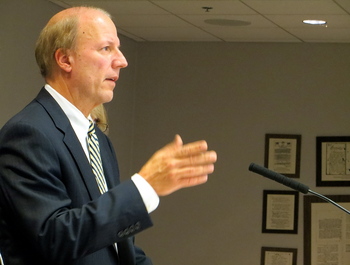
David Comsa
The presentation drew praise from board members, who were pleased to see Ann Arbor’s faculty numbers brought before the public. But the report also launched a discussion on how AAPS can improve its recruitment/hiring process to attract more minority teachers.
FTE stands for full-time equivalent and for the 2012-13 academic year, AAPS is employing a total of 59 FTE in administration, 165 in custodial and maintenance staff, 262 in paraprofessionals and 1,137.54 in professional certified staff, which includes teachers, counselors, school nurses, social workers, psychologists, speech pathologists and occupational and physical therapists.
This is virtually the same size staff the district employed in 2011-12. It has one fewer professional certified staff than last year, according to the report.
From 2005-06 to 2011-12, the number of teacher FTEs was reduced 5.6 percent from 1,206.14 to 1,138.54, for a difference of 67.6 FTEs.
The district compared its current staff ratios to other surrounding districts of similar size (Farmington, Dearborn and Plymouth-Canton) and found its student-to-principal ratio to be about equal to Dearborn’s, slightly greater than Farmington’s and much less than Plymouth-Canton’s.
The same trends were true of Ann Arbor’s student-to-certified staff ratio when measured against these neighboring districts.
From 2005-06 to the previous school year, Wednesday’s report showed AAPS had reduced its central administration staff from 11 FTE to 8 FTE and its principals and directors from 56 FTE to 51 FTE — for a total reduction of 11.9 percent.
Board Secretary Andy Thomas pointed out that in this five-year timeframe, the district opened Skyline High School and increased the responsibilities of principals and administrators, especially in the areas of evaluations, data collection and data desegregation, he said.
Thomas also said occasionally, AAPS is criticized by the public for the number of administrators it employs.
“So Mr. Comsa, is there any reason why a rational, knowledgeable person would reasonably reach the conclusion … that administrators have somehow been held harmless in all of (these recent budget cuts)?” Thomas asked facetiously after the administrator totals were revealed to the board.
“I couldn’t comment on why a person would hold a particular opinion,” Comsa said. “But I would say the data speaks for itself.”
President Deb Mexicotte said in addition to administrators’ responsibilities increasing and their “span of control,” or the number of employees they are supervising increasing, student achievement also has improved in the past five years.
Currently, 51 percent of Ann Arbor’s total professional certified staff has obtained a master’s degree. Two percent of employees have their doctorates, while 11 percent have a bachelor’s degree and a master’s degree with some additional credits. Ten percent of the district’s staff has solely a bachelor’s degree.
According to the report, AAPS hired 65.45 FTEs at the start of the 2012-13 academic year to fill vacancies left by retirements and resignations. Of those new hires, 29 percent had a bachelor’s degree, 50 percent had a master’s degree and 13 percent had a master’s degree plus 30 extra credits.
“So we have a highly, highly educated staff,” Mexicotte said.
Ann Arbor Public Schools employs 1,074 Caucasian teachers, 167 African American teachers, 28 Hispanic teachers, 23 Asian teachers and two American Indian teachers. Twenty-five teachers identified themselves as “other” on the district’s demographic sheet, Comsa said.
Trustees Glenn Nelson and Susan Baskett both expressed concerns about the number of teachers in each minority demographic. Nelson said it's important for children to see “people like them” be successful in the world and to have mentors of similar backgrounds to look up to.
Baskett asked about the district’s minority teacher recruitment process.
Human Resources Director Cynthia Ryan said there is an Ann Arbor Education Association Minority Affairs Committee that assists in recruiting “applicants of color,” as Baskett referred to potential minority teachers.
Ryan said in April, the district attends job fairs at the University of Michigan, Eastern Michigan and Michigan State.
“The lines are long and some of these kids wait in line for a few hours,” she said. “We see a lot of people. However, we don’t see a lot of minorities, so we usually try to reach out to the historic black and minority colleges and universities.”
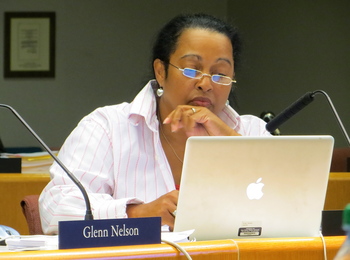
Susan Baskett
“I’m a little troubled by this,” Baskett said. “Why don’t we expand at least to like Wayne State University? … Why have we limited ourselves to this? … At one time, I remember a conversation about Ann Arbor hosting its own recruiting fair. … I would have hoped we’d have done something a little more creative by now. These are the same schools we’ve been seeing for years.”
Ryan said the department tries to recruit close to home for traveling purposes, but it has reached out in the past to other universities in Michigan via phone and email.
“It is very difficult to get kids (potential teachers) to come to our district from the other side of the state — let alone out of state,” Ryan said.
Baskett asked why, when AAPS has proven it is a “wonderful district” through its academics and test scores.
Glenn said he also would like to explore Ann Arbor’s hiring process more thoroughly.
“I’m quite surprised and a little dismayed that we’re having trouble getting people to come from a distance to Ann Arbor,” he said.
The biggest reason new teachers cite is they want to stay close to their families or, if they reside in a warm climate, they don’t want to move to a cold one, Ryan said.
“Personally, I’ve heard that we hire too late in the process,” Baskett said, adding more hiring decisions should be made in June, not August. “A lot of your good applicants of color leave graduation with a number of offers already in hand.”
Ryan said often budget unknowns, late retirements and resignations as well as principals moving staff around to teach different courses or grade levels can make it difficult for human resources to know what the district’s needs are. Comsa said HR can consider establishing some new procedures to deal with that last item.
Mexicotte said district officials also need to explore strategies for relationship building that start before the applicants graduate.
“…How do we maintain a pool of candidates that we can approach and re-approach,” she said. “We know a few years into a teaching profession, most people are looking to move or to change districts. I wonder if there isn’t some strategy there we can look at as well?”
Comsa said one other thing he would like to do is gather data from Ann Arbor’s peer districts on how many minority teachers they are employing and hiring, so AAPS can “benchmark” itself. “It would be good to know where we stand,” he said.
Vice President Christine Stead suggested obtaining data from the local university programs, as well, to see how many minority teaching graduates are out there, so Ann Arbor knows how large the pool is.
Download the powerpoint that accompanied Wednesday's human resources report here.
Danielle Arndt covers K-12 education for AnnArbor.com. Follow her on Twitter @DanielleArndt or email her at daniellearndt@annarbor.com.
Comments
noreaster
Fri, Oct 26, 2012 : 2:28 p.m.
If Balas has an FTE staff of 8 why did they need to recently purchase 30 expensive Apple laptops for the "IT staff". (http://www.annarbor.com/news/education/ann-arbor-school-board-approves-first-purchases-of-458-million-technology-bond/) Perhaps the "IT staff" is being hidden eleswhere in the budget. And where do these 30 "IT staff" have their offices? Makes me wonder...
noreaster
Fri, Oct 26, 2012 : 2:30 p.m.
Sorry, should have said "central administration" instead if "Balas".
Susie Q
Thu, Oct 25, 2012 : 11:52 p.m.
I am quite sure the number 59 FTE in administration for 2012-13 is obscuring the reality of the actual number of administrators. I can count 21 elementary principals, 10 middle school administrators, 4 each at PHS and HHS (1 principal, 3 assistants, including an AD), 3 or 4 at Skyline and 1 each at Community, A2 Tech and Clemente. This is 46 or 47. And I count WAY more than 12 or 13 at Balas. I suspect some of these Balas folks have been "re-classified" as something other than "administration". The Special Ed department alone has about 5-7 directors or assistant directors. These numbers appear to be disingenuous at best.
jns131
Thu, Oct 25, 2012 : 11:46 p.m.
Balias is still spending beyond its means. They still need to reduce the waste. Teacher cuts? Not good. Need Balais cuts.
Angry Moderate
Thu, Oct 25, 2012 : 7:45 p.m.
Where is the report? Not just the PowerPoint--the report that shows the raw data. That's what the public needs to figure out how they are manipulating the statistics. Same thing with the report from a few weeks ago that supposedly proved that the achievement gap has gotten smaller; they posted the slideshow but not the report itself. AA.com should be FOIAing aggressively, not caving to their lame excuses that a report containing anonymous statistics would invade someone's "privacy."
grye
Thu, Oct 25, 2012 : 4:49 p.m.
I am offended by the comment regarding "applicants of color". Last time I went to the hardware store, white was listed as a color. The White House isn't called "The Non-Color House". White is a color. If the concern is the number of non-white applicants, then quit beating around the bush and say what you mean. The issue with not hiring earlier is due to teachers not announcing retirement until just before the school year starts. Open positions are also filled internally and until the dust settles, the final list of needs is not readily apparent.
thecompound
Thu, Oct 25, 2012 : 4:32 p.m.
Is there anything Baskett doesn't drag skin color into?
Angry Moderate
Thu, Oct 25, 2012 : 7:46 p.m.
In a word, "no."
CLX
Thu, Oct 25, 2012 : 3:06 p.m.
Hard to believe that the number of teachers has remained unchanged given the huge classes our kids are in this year. I agree with DonBee that these numbers do not mean a whole lot when we can see with our own eyes that we have lost teachers, which resulted in ridiculously large classes.
ArthGuinness
Thu, Oct 25, 2012 : 2:56 p.m.
"Nelson said it's important for children to see 'people like them' be successful in the world." Sigh. I agree that kids should have people they look up to, but why is skin color the only criteria for a teacher to be "like" a child? Is this what we are teaching the kids to judge by? Stick with your "own kind"? It may not be easy, but perhaps we should focus on other ways to have kids relate to their teachers. I know that good teachers find a way.
J. A. Pieper
Fri, Oct 26, 2012 : 12:42 a.m.
As the parent of two African American children who have completed their tenure with AAPS I can say that it was never the color of a teacher's skin that made a difference to my kids. The biggest influence was if they truly felt cared for by their teachers, and this has absolutely nothing to do with SKIN COLOR!
DAN
Thu, Oct 25, 2012 : 2:18 p.m.
The schools need a greater reduction in administrators and an inrease in teachers.!
arborani
Thu, Oct 25, 2012 : 2:30 p.m.
Sums it up.
brimble
Thu, Oct 25, 2012 : 2:04 p.m.
The discussion of ethnic origin is a red herring here. The real question is one of how we maximize the value of administrative services while reducing the cost. Versus baseline, AAPS has added or subtracted how many total non-classroom people? And versus baseline, the total cost in salary, benefits, etc., of the non-classroom people costs how much more or less? What are the equivalent comparisons for teachers? And what is the equivalent comparison for total budget? At the end of the day, does the structure and cost of administration best use the dollars available to provide the best educational outcomes for students possible?
Nick Danger
Thu, Oct 25, 2012 : 1:07 p.m.
The special education department{SISS} is so top heavy it's criminal.To make matters worse they are entirely disconnected from their staff .One wonders why this trend continues with out scrutiny
DonBee
Thu, Oct 25, 2012 : 6:35 p.m.
SISS "support staff" (cannot call them administration according to AAPS) is paid for out of the WISD millage to a large extent. So I doubt that the AAPS HR people would consider them overhead at all. I find the people in SISS who spend their time working directly with students to be wonderful, caring and giving people. I would support them to the end of the earth. Some of the people they report to - not so much. But this seems true of most of AAPS.
smacks
Thu, Oct 25, 2012 : 1:17 p.m.
One wonders why people have such a problem with punctuation and spelling.
a2mom
Thu, Oct 25, 2012 : 1 p.m.
Ridiculous. Hire the most qualified candidates.
jcj
Thu, Oct 25, 2012 : 12:18 p.m.
Would be a more meaningful story with cost increase/decrease.
doglover
Thu, Oct 25, 2012 : 1:51 p.m.
Also, the total number of admin/staff/teachers to the number of students and how it changes over time, and how the percentage of minorities compares to the population overall.
DonBee
Thu, Oct 25, 2012 : 11:52 a.m.
LOL - Not true. Not true at all. They moved and reclassified people from one account under FID to another. The total real headcount of administration is not down. But as a citizen I will never be able to prove it, because the AAPS will continue to deny any FOIA for anything about personnel on "privacy" grounds. They even deny summary counts, like how many teachers are in classrooms as a primary assignment across the district. I have been around the district long enough to know how this game is played. "Let's see someone is complaining about administration - ok, move those people over here, now they are not administration anymore - they are "support staff". See we reduced administration. And the board will swallow this hook line and sinker. The real question is has the overhead been controlled and AAPS's own numbers filed in FID show a $4 million dollar increase. So while they can claim a reduction of "administration" they have increased the overhead costs - One would expect if the administration numbers were really down - that the amount of money spent would come down too. Let's see administration head count down 11.9% cost of overhead up 16% - which number do you want to believe?
arborani
Thu, Oct 25, 2012 : 2:26 p.m.
Great comment!
YpsiLivin
Thu, Oct 25, 2012 : 11:36 a.m.
See Deb spin. See Andy spin. Spin, spin, spin! Oh, funny School Board! (Must be getting ready for a new millage.)
local
Thu, Oct 25, 2012 : 10:58 a.m.
Whenever I hear hire minorities because we need to increase the percentages of them just irks me to know end. I understand the desire to have them, but shouldn't a district like Ann Arbor be looking for the most qualified, regardless of their skin color. As a society, we continue to push this idea when we should be pushing for hiring the best of the best. Another thing to consider is that the teaching profession as a whole is down. With the hits that teachers are taking, why would anyone want to be in this profession. Teachers are being asked to do more, with less (including pay and more out of pocket cost). Hard to attract the best, when you can't offer that in compensation, etc...
Bulldog
Thu, Oct 25, 2012 : 10:46 a.m.
If the highly qualified candidate is the best choice, they should be the hired employee. If this candidate happens to be a person of color, this is a bonus. We shouldn't just recruit and hire based on skin color. Should we try to recruite all types of minority teacher, absolutely. Children need to see themselves in their teachers. Isn't the ultimate goal hiring the best for the job? Sometimes I feel we lose focus. I also think it's the adults that make a bigger issue out of this, not the children.
A2comments
Thu, Oct 25, 2012 : 10:21 a.m.
"please to see" should be "pleased to see" "it employees" should be "it employs" Compare total admin salaries over the period, but show by year along with admin by year to show recent growth.
Danielle Arndt
Thu, Oct 25, 2012 : 10:31 a.m.
Thanks for the catch! The typos have been fixed. And I like the suggestion. Thanks for throwing it out there.