

Residents voice concerns over University of Michigan's plan to close Main Street on game days
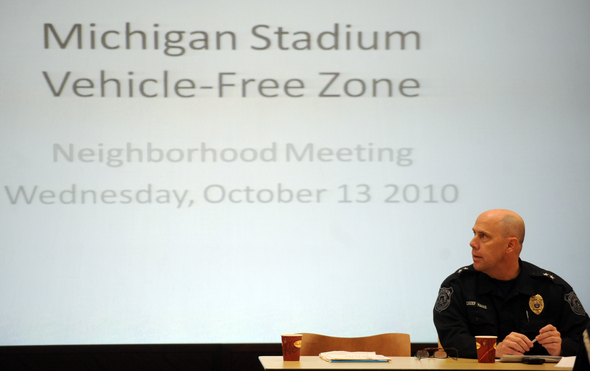
Ken Magee, director of University of Michigan's Department of Public Safety, waits for his turn on Wednesday night to address the audience during a meeting to discuss closing portions of South Main Street on football games days.
Melanie Maxwell I AnnArbor.com
Area residents voiced numerous concerns at Wednesday night's meeting about the University of Michigan's proposed plan to close South Main Street for five blocks near Michigan Stadium during football games and other major events.
The meeting at the Junge Family Champions Center attracted about 110 people. Concerns regarding game day traffic, increased congestion in neighborhoods, game day parking and emergency vehicle response times were among the issues raised by nearby residents and others.
Dalana Moore, Ann Arbor resident, says she owns property at 1300 S. Main St., across from the U-M Stadium, where she has a parking lot that fits 32 vehicles. She says she’s concerned about potential loss of revenue from parking on game days.
“In my case, I don’t sell ad hoc, I have people who have been parking in my lot for 30 plus years,” she said. “If the side streets into the neighborhoods are closed off, how do I get them down (to my parking lot)?”
She said she wants to know, “Are there passes or something I can give to all my renters so they can get through?”
“I’m just concerned, especially for the rest of the season, if they do this by November, what am I going to do?” she said.
Representatives from the university, the U.S. Department of Homeland Security and U-M Police spoke to the crowd about the plan and answered questions.
The plan would:
• Close Main Street to all traffic from Stadium Boulevard to Pauline Boulevard.
• Close Keech Street between Main and Greene streets.
• Limit access to parking permit holders on Green Street from Hoover to Keech streets.
• Close the westbound right-turn lane on Stadium Boulevard onto Main Street.
"The university has not formally submitted an application to the city yet," said university planner Sue Gott. "We want the chance to get this input tonight so we might consider how we would put a proposal forward to the city."
According to the plan, Gott said, barriers would ideally be removed within an hour of the end of a game or event.
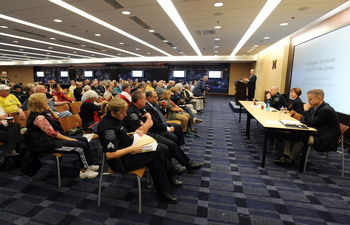
About 110 people attended Wednesday night's meeting to discuss closing portions of Main Street near Michigan Stadium on football games days.
Melanie Maxwell I AnnArbor.com
“This plan is being made to reduce the potential for vehicle-borne bombs or attacks,” she said, adding police believe the moves will work as a deterrent for anyone looking to attack the site.
The plan comes out of a comprehensive vulnerability assessment conducted by U-M police, the U.S. Department of Homeland Security and other local police agencies.
“They had a number of recommendations for us to implement,” Brown said. She said the review also supported recent moves like banning bottles and bags from the stadium.
When asked whether she was concerned about the possibility of a terrorist attack at the stadium, Moore said, “Plausible? Yes. Anything can happen"
"I’ve been going to games since I was an infant, 40 plus years,” she said. “I do understand there are threats for us all the time. Is it really going to happen? I don’t know. I hope not.”
Emad (Al) Shenouda, protective security advisor for the U.S. Department of Homeland Security Detroit district, told the crowd while there is no “specific, credible threat” to the university or the stadium at this time, the department has seen "a very, very disturbing uptake of terroristic activities in the United States” in the last 18 months.
“I do not sacrifice security for convenience,” he said.
Ann Arbor resident Dick Raab says he is concerned about increased congestion in subdivisions and neighborhoods if the plan is put into place.
“I have great concerns over this,” Raab said. “They’re going to close the roads between Pauline Boulevard and Stadium Boulevard ... that dumps all those cars, which is a lot of cars, into the subdivisions.”
Brown said the proposal calls for the parking restrictions to be in place for all home football games, but other events at the stadium would be handled on a case-by-case basis. She said it may be in place for the Big Chill hockey game, but not necessarily for charity runs that end at the stadium. Similar restrictions were in place when President Barack Obama spoke at commencement.
Events at Crisler Arena, which is located next to the stadium, would also be evaluated on a case-by-case basis, including looking at who the featured guest is at an event.
"There's always a chance that someone will do something bad," said George Feldman, of Ann Arbor. "I think that the psychology involved here is that any threat, of any type that we can imagine is worth changing everyone's lives for."
John Simpkins, of Ann Arbor, said he doesn’t understand why this is a priority now, rather than when renovations to the stadium were being planned.
“I want to know why, after the stadium (is renovated), they’re addressing this,” he said. “Yeah, (the possibility of a terrorist attack) concerns me ... but surely after 9-11 there should have been plans (for security) when they were encroaching out on Main Street.”
As for the plan, he says, “How can we protect oursleves from someone that’s a terrorist? I don’t think closing Main Street is the answer,” Simpkins said. “By talking about it, you’re almost giving (a terrorist) more ideas than by just leaving it alone.”
After the meeting ended, Gott said she thought it had offered a "constructive dialogue."
"We came tonight to hear input and the input will help us review how to strengthen the plan and have ongoing discussion with the city," she said.
Gott said it is unclear when the university will give a formal proposal to the city.
Heather Lockwood is a reporter for AnnArbor.com. Reach her at heatherlockwood@annarbor.com or follow her on Twitter.
Comments
Brian Bundesen
Sun, Oct 17, 2010 : 4:37 p.m.
Each new security measure enacted by the U will err on the side of caution. How cautious is too cautious? We'll never know. I simply don't see the big deal. I put the whining about this on a par with all the whining about not being able to bring a water bottle into the stadium. Where are all those dehydrated fans we were so worried about a few months ago? What is so outrageous about not being able to drive down a street that crawls at a snails pace anyway? This is no more ridiculous than taking off your shoes at the airport. It IS ridiculous, but it's a fact of life. Park. Walk. Enjoy the game. Go Blue!
Karen
Sun, Oct 17, 2010 : 5:55 a.m.
They want to close Main Street to prevent terrorist attacks? Are they serious? When has that ever been a realistic concern? This is another example of U of M football running the city every fall; I'm already sick and tired of Main St/Ann Arbor Saline Road being closed after the end of each home game, and having to twist and bend to accommodate football fans. The city needs to recognize that there are plenty of other people who don't attend the games that also matter, too.
Stuart Brown
Sat, Oct 16, 2010 : 9:49 p.m.
Some people are such Good Germans! Does it not concern some people that the billions of dollars wasted on the War on Terror could have been used to solve real problems killing people in this country? Nine years of endless war on terror and we are no safer now than before 911; something is really foul with the policy decisions guiding this lame proposal.
sandy schopbach
Sat, Oct 16, 2010 : 5:18 a.m.
Get a grip! This is over-kill. Terrorists can strike anywhere, in spite of almost any precautions. Thinking the U-M stadium would be a target is just plain silly. On the one hand, it's giving the site too much importance. On the other hand, if it WERE to be a target, there are many ways to succeed. I've been one metro ride away from being blown up twice in Paris and had just left Camden Market in London when the IRA blew that up. So I can tell you first-hand that there's not much that would have changed any of those terrorist plots. It's all a crap shoot. I'm sure the officials are concerned. That's their job. But some modicum of common sense has to prevail also.
Bones
Fri, Oct 15, 2010 : 3:18 p.m.
Thanks for the comment removal Bob. I still say that this is a total joke. Homeland security is taking freedom from people and now wish to impose draconian tactics and nazi dictatorship. Closing the roads over a percieved terror threat? Get real people. This is beyond parnaoid. By doing crap like this. You are letting terrorists win. And at this point I am not sure which is which, with the way freedom and rights have been curtailed by things such as homeland security. Get ready to be the new nazi germany people. They are using the depleted local police as stormtroopers. Just wait, your rights and freedoms have been suspended.
Bob Needham
Fri, Oct 15, 2010 : 3:03 p.m.
(comment removed because it contained masked swearing)
a2cents
Thu, Oct 14, 2010 : 8:39 p.m.
It's odd that Yost Arena on State St. isn't included. That would only close State 10-15 times per year for hockey games. Approach distance there could be only a few feet. Maybe that should be on the agenda?
David Briegel
Thu, Oct 14, 2010 : 7:06 p.m.
AlphaAlpha, You win the prize!! I insist that Mary Sue and her Regents explain the gross negligence that has caused this debate to occur! Your "planning" did not include the handicapped. Now this. Leaders and best. Where?
Ricebrnr
Thu, Oct 14, 2010 : 7:02 p.m.
and this plan would stop one or more guys on foot in suicide vests...how?
AlphaAlpha
Thu, Oct 14, 2010 : 6:34 p.m.
A threat significant enough to close Main Street is a threat significant enough to close the stadium.
Milton Shift
Thu, Oct 14, 2010 : 5:58 p.m.
I don't see how putting up some temporary barricades and declaring the street closed is going to stop some freak from plowing into the crowd at 100mph with a semi full of explosives... The streets that get packed with pedestrian traffic probably should've been closed to through traffic. I don't see any problems with this. The reasons given are just plain insulting to our intelligence, which is what pisses me off about this.
Jon Saalberg
Thu, Oct 14, 2010 : 5:12 p.m.
When asked whether she was concerned about the possibility of a terrorist attack at the stadium, Moore said, Plausible? Yes. Anything can happen" "Ive been going to games since I was an infant, 40 plus years, she said. I do understand there are threats for us all the time. Is it really going to happen? I dont know. I hope not.Really? I feel like the UM is turning Ann Arbor into its personal property, and long-term residents, such as myself, are along for the ride, without any say in what makes sense. There haven't been any attacks at sports venues in the United States, period. We could also institute security at the borders to the city, to ensure no one gets into our fair city with potential incendiary devices. Or institute security at every University facility where hazardous materials are used. Why not secure these areas? When will we realize that these measures are nothing more than reactions to a question that hasn't been asked?
sbbuilder
Thu, Oct 14, 2010 : 4:36 p.m.
Oh, and I still wonder how this will stop a plane from a nearby airport from parking itself on the fifty yard line. Why bother with a truck parked outside the stadium when you can just hit a neat bulls eye inside? I can take a lot of things, but, for some reason, I hate being lied to. Even worse when someone looks you in the eye and tells you it's for your own good.
Stuart Brown
Thu, Oct 14, 2010 : 4:35 p.m.
Brian Bundesen said, 'Ms. Brown of DPS said it very simply on one of the news clips: "It's better to be safe than sorry." That is the mind set of the University, and rightly so.' WRONGLY SO! I am tired of being lied to by so called government "security" experts. The resources wasted on terrorism security could instead be used to fix real problems killing Americans instead of some pie-in-the-sky threats! Let's take a poignant example from just this past week. Five people, including three UofM students were recently killed on US-23 when the Prius the three students were in departed its north bound lane and entered the south bound lane, striking a Blazer and killing five of the nine passengers in the two vehicles. These fatalities could have been prevented if guard rails had been installed along US-23 where the accident occurred but were not due to lack of funding. That's right folks, the "War On Terror" killed these people because it deprived needed funding for something that actually would have saved lives! Feeling safer now folks? Don't worry, the real function of TSA agents in airports checking your bags and making you take off your shoes is not so terrorists are thwarted (the DTW Christmas Crotch Burner showed this); the purpose of the TSA is to scare the hell out of you so you, the mark or knuckle head citizen, will support aggressive, interventionist foreign military campaigns. So if all this is making you feel less safer, MISSION ACCOMPLISHED!
sbbuilder
Thu, Oct 14, 2010 : 4:32 p.m.
DennisP Excellent post, and entirely relevant to this discussion. I would propose turning the tables on the Homeland Security folks, and the UofM security people, and ask them to prove to us how closing this street will materially improve safety. Show us the data. I want to see numbers, here, not fanciful 'perceived threats'. I think they would have a very hard time, if pressed, to prove their case. If is seems silly to the average person, it will seem ridiculous to the average terrorist. Close off Main Street? Just how? Place a rickety little barrier across the street, and man it with one or two security personnel? I can imagine a truck laden with explosives and barreling up Main Street having a real hard time negotiating one of those prohibitively solid barriers. Golly, probably even a tank would have a hard time with one of those. Either these folks think the residents of this City have brains the size of Neaderthals, gullible as all get out, completely disinterested, or maybe they think that we are altogether beneath their lofty domain. Perhaps a combination of all the above.
foxxo
Thu, Oct 14, 2010 : 3:33 p.m.
I wonder: if this plan goes through and Main street south of Pauline is closed, will the city take down its "no street parking on game day" signs in the neighborhoods there? After all, those streets will no longer serve to move people to and from Main street for parking. Residents should be allowed to park on their own streets.
Sunshine26
Thu, Oct 14, 2010 : 3:23 p.m.
Yes, the new football stadium is too small to handle the "pesky fans"! No room for fans to move about inside and no room for fans to move about on the west side of the stadium! So instead of closing Main Street and making it a pedestrian mall, the UofM folks need to close their parking lot on the east side of the stadium and make that their pedestrian mall!!! This way citizens of Ann Arbor will still have their street for cars and UofM will have their mall for all their fans! UofM could even serve food & drinks there!!
MyOpinion
Thu, Oct 14, 2010 : 2:55 p.m.
Did I misunderstand? The story is about a vehicle free zone around the stadium and yet only one of the perimeters is being made vehicle free? What is the plan for shuttling all the folks who used to park in the lots abutting the stadium? What about the traffic on Stadium Blvd? Oh. Never mind. The real issue is that the sidewalk on the east side of Main is way too narrow with the stadium addition and pesky folks are spilling into the street.
talbotsmom
Thu, Oct 14, 2010 : 2:44 p.m.
I was unable to attend the meeting, but I'm curious if anyone knows whether they will close Berkley, Potter, etc on the west side of Main Street. Thanks.
Steve Graves
Thu, Oct 14, 2010 : 2:04 p.m.
The University is being completely disingenuous about this street closing being for security measures. If anything, the west side of the Stadium enclosure is by the far the most safe boundry of all. The dip in Main street along that side of the Stadium produces a natural blast barrier from a car or truck bomb. Unless they close off the east side parking lots and especially Stadium Blvd., the Stadium is completely vulnerable to a car/truck bomb. Think how simple it would be to drive west bound on Stadium and simply pull the car truck into the gate 2 area. Methinks the U really wants to use Main Street for pedestrian overflow and keep the high mucky-mucks in the Press Box as far away from any blast as possible. I left my parking spot on Hoover at Green an hour and half after the MSU game was over, and it still took me an hour to get on the thru-way - and that was with Main Street being open to traffic! If they close down Main Street, Ann Arbor will experience 5 hour traffic jams both before and after a game. Why doesn't The City Council allow UM ONE game day to try out their scheme and see what happens. Don't approve anything permanent at this point.
Killroy
Thu, Oct 14, 2010 : 12:32 p.m.
Closing Main street protects the University of Michigan's interests: The students! Let them close Main street all the way down to Williams on Saturdays and let the students (mooo) run free (with open beers).
A2G
Thu, Oct 14, 2010 : 12:10 p.m.
I think the negative tone in many of the responses is an indication of how poorly the University does and has done in its community relations and its dealings with residents and the City of Ann Arbor. The University seems to have a credibility problem based on its past actions and were in no way helped by the performance last night by the Community Relations Director and his staff. The need for security is real and a way to reduce a know vulnerability is to close Main Street. But there are better means to mitigate the threat and impact on the community besides the plan developed by the University. The best way to get there is to have a meaningful and ongoing dialogue with the residents impacted by this to work through the issues. Something which is not done with a one and done meeting like last night.
jcj
Thu, Oct 14, 2010 : 11:44 a.m.
@Larry J8unck Dan says "U of M has done it again", criticizing UM for building the stadium so close to Main Street. He is criticizing UM for decisions that took place in the years leading up to 1927. Duh.. Well DUH Larry...! Have you looked at an aerial photo of the stadium pre 2008 and a current photo? Any chance the current configuration is much closer to Main St?
Newzdog
Thu, Oct 14, 2010 : 11:42 a.m.
@johnnya2 Well said!
Ricebrnr
Thu, Oct 14, 2010 : 11:30 a.m.
call a pig a pig. Security changes to stadium itself = UofM is both inconvenienced and has to pay the bill Security outside of stadium and on public streets = YOU and I get inconvenienced and pay the bill. Let us eat cake, eh?
Mick52
Thu, Oct 14, 2010 : 11:29 a.m.
I am surprised at the tone of some of the negative comments. I am very glad that football game security planning is being done. This is nothing new, it has been under consideration for quite some time, with added emphasis after 9/11. What they have done here is identify a weakness, this area of Main St. There is a video in this link of an explosion of a car bomb: http://www.liveleak.com/view?i=50f_1285858796 The bomb in the video was a re-creation of the bomb that was placed in NYC on May 1 this year, the one that did not go off because the dude who built it did not follow the directions. Vehicle based bombs are a weapon of choice by terrorists. This could happen on Main St, someone could stop on NB Main and park a car/truck/bus right on the street there, and walk away, or not. In addition to the attempt in May, there was a car bomb set of on Feb 26, 1993 in the World Trade Ctr. I think even if the additions to the stadium were not done, this plan may still have been presented because Main St was always close to the crowd, and as noted in the article, incidents are up in the US. When you are trying to protect 110,000 people and keep the venue safe, there is only so much you can do, other than try to identify these weaknesses and try to come up with a plan to run as much preventative interference as possible. Close the holes so to speak. It is probably not likely that you can stop terrorists if they really want to act, but if something were to happen it is better to be able to say that there was planning, there were things done, rather than not doing anything at all. I think every effort should be made to open routes to the people who live and work in this area so they are not boxed in, but they also should be supportive of this plan, because if something were to happen on Main St, their well being will be in jeopardy too. I for one am glad they are doing this planning and trying to make the stadium safe for these seven out of 365 days. Whether it is implemented or not may depend on how many people promote convenience over security. My compliments to those who are trying to keep us safe.
averagetaxpayer
Thu, Oct 14, 2010 : 11:28 a.m.
Another benefit to closing Main St - possible relief of concourse congestion. When Main St is closed I would hope they limit vendors on the street so that it could be used mostly for pedestrian traffic. I can't speak for other parts of the stadium but if you sit in sections 18-22 you know how crowded the main st concourse area is prior to a game, much a result of people heading to the south gates after entering from the north (and vice-versa). With Main St closed hopefully fans will walk around the stadium instead of using the concourse. As it stands now the area is ripe for an altercation result of the congestion.
5c0++ H4d13y
Thu, Oct 14, 2010 : 11:06 a.m.
@Brian Bundesen Yes better safe than sorry. For the next game are they using bomb sniffing dogs? Will they close the adjacent parking lots. 'cause you know, better safe than sorry. Will they erect truck proof barriers or the flimsy steal and plastic ones that any rental truck could roll right over? No fly zone over the stadium? Better safe than sorry! Close off Stadium Blvd too, better safe than sorry! We should close the stadium, 'cause you know better safe than sorry. Terrorism is the lie they use to justify the solution to their crowd control problem. It may be a good idea but UofM is being completely dishonest on this one.
LarryJ
Thu, Oct 14, 2010 : 10:57 a.m.
The story doesn't state at what time the streets would close. I had the misfortune last Sat., less than 1 hour before game time, of trying to drive near the stadium on Main St., and it was a disaster. The line would advance about 2 car lengths with each cycle of the light. If the closure was limited to ~2 h before kickoff until ~2 h after game, it would meet the security requirement, close the streets only when they don't move traffic well anyway, and limit inconvenience to drivers.
LarryJ
Thu, Oct 14, 2010 : 10:52 a.m.
Dan says "U of M has done it again", criticizing UM for building the stadium so close to Main Street. He is criticizing UM for decisions that took place in the years leading up to 1927. Duh...
Snehal
Thu, Oct 14, 2010 : 10:42 a.m.
The reason does not seem concvincing. A car with a bomb can be parked ahead of time, may be set off by a remote and still the harm may be done. And is living in constant fear from a bomb a good idea in a peace loving city like Ann Arbor? Heck, some body may drop a bomb from a private plane above. Michigan stadium, if I am not incorrect is not in no-flying zone. What is needed is to discourage people from taking their cars all the way up to the stadium and encourage shuttle system. We have good and efficient shuttle system. Like we have during the art fair. Or tickets may include designated parking spots with free shuttle to the stadium. With 100,000 people attending game, this measure of closing Main Street would add to woes not only for attendees but for all the locals of Ann Arbor.
breadman
Thu, Oct 14, 2010 : 10:23 a.m.
AND again U of M is not thinking if us residents that aurround the stadium. As I sit on my front porch on game day I watch the speeders wiz by and not a concern to residents. Smart move!!!
Brian Bundesen
Thu, Oct 14, 2010 : 10:21 a.m.
Ms. Brown of DPS said it very simply on one of the news clips: "It's better to be safe than sorry." That is the mind set of the University, and rightly so. I'd be very curious to see what other recommendations came out of that "Vulnerability Assesment." I bet there are a few doozys. I really don't know why this was not done years ago, simply for convenience. DPS should just come out and say it would make their jobs easier. It does seem like they are playing the "fear" card. I feel bad for those who may lose parking revenue, but other than that, all the fuss over this is pretty ridiculous. Some folks are acting as if this will ruin their lives. It's 8, maybe 10 days per year. Go with the flow, and GO BLUE!
SonnyDog09
Thu, Oct 14, 2010 : 9:55 a.m.
I have an idea. What if the University "rents" Main Street next to the stadium and closes it down for a block party the eight times a year (or whatever it is). Make the rent about $10million/year and use that money to pay to replace the Stadium street bridge. Can you say "quid pro quo?"
Morris
Thu, Oct 14, 2010 : 9:31 a.m.
This is another example of over-reacting to "terrorism" or else using it to cover other motives. We must not live our lives in fear. PLEASE --City Council -- don't turn our streets over to the U of M to run!
DaLast word
Thu, Oct 14, 2010 : 9:20 a.m.
Let's build a Mosque on the corner accross the street. Maybe they'll think twice before bombing so close to the stadium.
townie
Thu, Oct 14, 2010 : 9:18 a.m.
Annarbor.com: you should provide a little more history here. I recall that UM GAVE a strip of property along Main Street to the City so the City could expand Main Street to four lanes (15 years ago maybe?). That's why pedestrian space is squeezed at this point. The new stadium wall (with the brick arches) is no closer to the street than the old yellow chain link fence ever was--in fact, it is perhaps further away. It was the City that pushed for a widening of Main which put the street closer to the stadium.
DaLast word
Thu, Oct 14, 2010 : 9:15 a.m.
Terrorism working!
DennisP
Thu, Oct 14, 2010 : 9:10 a.m.
Here's a description of the impact of the ANFO bombing at Oklahoma City from Wikipedia at http://en.wikipedia.org/wiki/Oklahoma_City_bombing#Bombing : "The blast destroyed or damaged 324 buildings within a sixteen-block radius, and shattered glass in 258 nearby buildings.[3][4] The broken glass alone accounted for 5% of the death total and 69% of the injuries outside the Murrah Federal Building.[4] The blast destroyed or burned 86 cars around the site, causing secondary explosions from the vehicles' gas tanks and tires.[3][64] The destruction of the buildings left several hundred people homeless and shut down multiple offices in downtown Oklahoma City.[65] The explosion was estimated to have caused at least $652 million worth of damage.[5] The effects of the blast were equivalent to over 5,000 pounds (2,300 kg) of TNT,[55][66] and could be heard and felt up to 55 miles (89 km) away.[65] Seismometers at Science Museum Oklahoma in Oklahoma City, 4.3 miles (6.9 km) away, and in Norman, Oklahoma, 16.1 miles (25.9 km) away, recorded the blast as measuring approximately 3.0 on the Richter scale.[67]" ________________ Does anyone really think closing off Main St. from Pauline to Stadium will offer a whole lot of protection from a determined terrorist?
zags
Thu, Oct 14, 2010 : 8:59 a.m.
If you close Main for 'security' purposes then really, you need to close Stadium for the same reason. Oh, but that would mean you couldn't park on the golf course and that would cost the U revenue. Playing the terrorism fear card to further your interests is just criminal. But that seems to be the new reality these days.
DaLast word
Thu, Oct 14, 2010 : 8:59 a.m.
I got it! Move the stadium, say out on Wagner road. Apparently the University has money to burn.
gwncb
Thu, Oct 14, 2010 : 8:44 a.m.
* Is this really a "security" situation? * What can the University do to reduce traffic congestion? $ Can we eliminate games that start after, say 1:00pm? * Who controls drinking on the UM Golf Course?
glacialerratic
Thu, Oct 14, 2010 : 8:26 a.m.
Will U-M want to also close surrounding streets during Commencement or other events in the stadium? The security argument sounds pretty weak--there are plenty of opportunities for a lunatic. It's foolish to get into a defensive crouch (if that's the appropriate metaphor) for every perceived vulnerability. Other security measures would be far less disruptive, including use of CCTV along the streets leading to the stadium. And, yes, this is a consequence of very bad site planning.
Sunshine26
Thu, Oct 14, 2010 : 8:01 a.m.
Thank you Ann Arbor City Council Members Higgins and Teal for being at last night's meeting. Since this issue encompasses all of Ann Arbor, where was the Mayor? I did not see Hieftje, nor Council members Briere, Smith, Rapundalo, Kunselman, Taylor, Anglin or Hohnke at the meeting. The closing of Main Street is a huge issue. All who have the responsibility to vote on whether or not the city allows UofM to close Main Street and redirect traffic need to be involve and up to speed on the pros & cons of a "Vehicle Free Zone".
Craig Lounsbury
Thu, Oct 14, 2010 : 8 a.m.
If the concern is truly a car bomb, which I do NOT believe for an instant, then why don't they also close Main up to Scio Church and Stadium from 7th to South Industrial too. Otherwise they merely closed off one of four possible approaches. Maybe closing Main makes some sense for pedestrian traffic, I don't pretend to know. But don't tell us its about car bombs and not address the other 3 possible approaches.
Brad
Thu, Oct 14, 2010 : 8 a.m.
As soon as they modify their plans to close the ENTIRE PERIMETER around the stadium then I *may* believe it's security-related. Remember when Obama came to the Stadium? They closed the ENTIRE PERIMETER. Why? Because nothing else would make sense in that context. And I guess if the stadium is that much of a terrorism target it should be moved out in the country so as not to endanger the surrounding homes. If not closed outright. It's a convenience-grab, nothing more. Just say no.
justcary
Thu, Oct 14, 2010 : 7:56 a.m.
Thanks for fixing 'borne' I'm with those who think this is a veiled ploy to get free rent of the street surface next to the stadium! The new luxury area has eaten up crowd areas on the west side of the stadium, and now they want the street. Wake up, folks, this is not meant to prevent any terrorist attacks! IF it were, they'd close the airspace, yes? There has never been a terrorist attack on a college football game! Don't be duped! There are still 100,000 people who deserve to get around in their own town on a football Saturday and shouldn't have to bow and scrape to the University.
SonnyDog09
Thu, Oct 14, 2010 : 7:52 a.m.
"We came tonight to hear input and the input will help us review how to strengthen the plan and have ongoing discussion with the city." Translation: we're doing this whether you like it or not. Be thankful we don't put the entire city on lockdown. We're here to protect you, don't you know. So, get used to it.
David Briegel
Thu, Oct 14, 2010 : 7:50 a.m.
A2G, those people are afraid to speak, say the wrong thing. They were only there in an attempt to put lipstick on the pig!
Kai Petainen
Thu, Oct 14, 2010 : 7:45 a.m.
http://www.ur.umich.edu/update/archives/101014/stadium " told the crowd of more than 110 people that 55 terrorism plots have failed or have been foiled on U.S. soil in the past 18 months." "after they conducted a vulnerability assessment last spring." "Several dozen Michigan Stadium neighbors shared concerns and suggestions... Most concerns focused on perceived challenges the neighborhood would face by closing Main Street" the vehicle free zone will be built. security is important even if you disagree with them. but, why did it take them this long to conduct a vulnerability assessment? should that not have been conducted before they built it? was security an afterthought? and is it just the stadium that they look at, or do they investigate/(and solve) other events in the city that may threaten or have threatened us or the environment?
A2G
Thu, Oct 14, 2010 : 7:42 a.m.
I was there last night also. I think what I have found most interesting in all of this, is the University's complete level of incompetence in handling the community engagement and public relations piece of this and most other issues. The non-police/public safety University staff seemed very uncomfortable talking with and engaging the participants at the meeting and were generally unprepared to discuss anything beyond the prepared statements which only eroded any credibility they might have had in this discussion. You would think the community relations people would be better at community realtions. The meeting was only held because the City Council told them they needed to, not because the University wanted to. Their original intent was to ram rod this through without engaging the public. Supposedly, notification cards were sent out to members of the local community, but it appeared that no one in the audience had received one.
David Briegel
Thu, Oct 14, 2010 : 7:39 a.m.
If the city has ANYTHING to say about this (?) they should insist that the UofM expand the perimiter of the stadium to the North and East for a vehicle free zone to include Crisler Arena and the new basketball facility and only allow access to ticketed guests. That would aid in reducing the crowding within the stadium proper, provide additional restroom facilities. The violation of numerous setback regulations along Main St is the main reason for the concerns. The UofM created this situation!
David Briegel
Thu, Oct 14, 2010 : 7:29 a.m.
I suggest the regents call a meeting to investigate why these issues were not addressed during the planning phase of this botched expansion plan. Further, that they hold the "professionals" accountable for rubber stamping those plans creating this humiliating situation. That is, if they have any shame!
johnnya2
Thu, Oct 14, 2010 : 7:24 a.m.
All this complaining is just ridiculous. This should have happened whether they expanded the stadium or not. IT should happen for PUBLIC safety during game days. The people who com,plain about extra traffic in their neighborhoods are really disingenious, because it is already happening with the Stadium Blvd construction, which has nothing to do with the U. As for what other Big Ten schools are doing, most do not have a situation where you can throw a baseball off campus to the surrounding neighborhood. Those that complain about the lots around the stadium need to understand that those lots are NOT open to the public. Getting in requires a pass. The cars do not get close enough to the stadium to cause a problem. There are inconveniences associated with living in a town the doubles in size 8 times a year. There are those that complain that A2?Saline road is turned into a one way after the games. It actually means you have to plan a little, but is it really such a burden? There are many of us who are inconvenienced by the Art Fairs, or every fun run, parade, walkathon, student move in, student move out, construction project etc. Why not worry about issues that really negatively impact the city.
antikvetch
Thu, Oct 14, 2010 : 7:09 a.m.
Let the university rent the space during game day, for an appropriate fee for such a large, premium space. The fee could then be divided and disbursed to city residents at the end of the season. Karma would seem to indicate the fee should be equal to the revenue generated by the new luxury boxes. After all, it's about security, not money, right?
zags
Thu, Oct 14, 2010 : 7:04 a.m.
If you close off Main st then it makes sense to close the Victors Club Big Money Donor parking lot on the east side. I'm sure those people will understand. Security, you know.
TreeTown
Thu, Oct 14, 2010 : 6:12 a.m.
Was the expansion of the Stadium designed before 9-11-2001? Why the security/crow issues were not considered? U of M needs to answer these questions first before they ask us for help (i.e. closes Main). We should do the traffic count on game days and bill that to the U of M each time Main is closed.
trespass
Thu, Oct 14, 2010 : 6:09 a.m.
Look at who is answering your security questions. Ken Magee, the campus police chief who would lose his job if he did not tow the University's line.
trespass
Thu, Oct 14, 2010 : 6:06 a.m.
Did building so close to the street increase the risk of vehicle born bomb attacks? Of course it did but did that stop the UM from building? No! If the UM was concerned about reducing risks they should have thought about that before they built but the building increased revenue so they would rather put the burden on the public.
Sunshine26
Thu, Oct 14, 2010 : 5:59 a.m.
I was at the meeting. I feel this is completely a UofM plan, using security as the fail guy! It seems to me the new, redesigned, football stadium does not handle the crowd situation well. With the new brick buildings within its compound there is not enough space for all the people to mill about. So UofM has decided to have fans spill out onto the street. If the UofM were serious about protecting fans they would close their expensive parking lot on the east side of the stadium, Kipke Drive. They would also restrict buses from using the right west bound lane of Stadium. They would build vehicle proof barricades around the entire perimeter of the stadium. I could go on and on about how UofM could improve their property to handle the crowd, before closing a main artery in town. Please City of Ann Arbor listen to the tax payers of this city!
Steve Hendel
Thu, Oct 14, 2010 : 5:57 a.m.
What about other Big 10 schools? What have they done about these 'threats'?
mm1001
Thu, Oct 14, 2010 : 5:49 a.m.
What I don't get is after putting in place a ban on bringing in bottles to bags they allow the sales of those Fanvision devices which seems to me could easily be used by terrorists to sneak in a few explosive devices.
5c0++ H4d13y
Thu, Oct 14, 2010 : 5:47 a.m.
You for got an option on your poll. You need "The university is lying through their teeth and is using 'security' as an excuse to deal with the crowd control problem they made worse with the stadium expansion" If a vehicle born attack is such a danger why didn't they put security barriers around the stadium when they renovated? Maybe they should cough up an inconvenience fee to everyone living in that area and pay for those that are losing parking revenue.
DAN
Thu, Oct 14, 2010 : 5:34 a.m.
It seems like the U of M has done it again--created a problem by poor stadium planning and then expecting the city to acquiesce to their solution. I would oppose any permanent closing of Main Street and require the University to create a new stadium route on all of their adjacent property. Had they not built the stadium addition so close to Main street, there would not be this trafic problem. djm
Kim Kachadoorian
Thu, Oct 14, 2010 : 5:29 a.m.
I was not able to attend the meeting - but I too have concerns: If they are closing Main then why not Kipke to Main Street? (Their parking would still be open but it would reinforce the line around the stadium) If they are truly trying to make a "vehicle free barrier" around the stadium - they should close the parking lot next to the stadium. I worry more about the helicopters that are allowed to fly over the stadium during the games this year! Why are they there??? I agree with John Simpkins - why wasn't the renovation plan for the stadium to include the reinforcement in the building? Was this that big of hiccup in the plan - who was the project manager that didn't see this issue? If they shut down the streets for other events are neighborhoods going to be notified in advance? How far in advance? Neighborhoods need speed bumps installed if this goes through - they already speed through our neighborhoods on game days - this will multiply the issues significantly. Need parking signs on the emergency streets updated to later times as well! The last game we had Main street backed up for miles until well after 11:15 PM which is when I quit looking but it was still backed up to Madison solid - so you want to make this worse? There should be other alternatives to explore. Seriously - Main street isn't the only side that needs to be closed if you plan to do this! So many other places that need to be secured.