

Where have all the keg sales gone? Ann Arbor sales plummet since tag law took effect last year
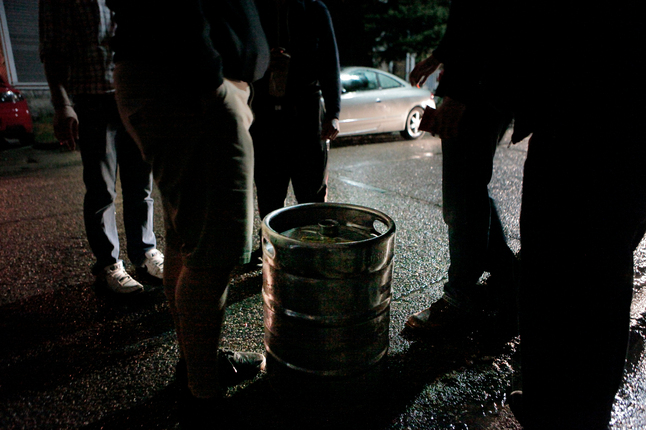
Students and other individuals stand around a keg during an end-of-the-semester party on Greenwood Avenue in Ann Arbor.
Chris Asadian | AnnArbor.com
"People like me and you, we have a few people over," Kesto said in a recent interview. "But these students, they're like 21, 22 or 23, and they used to buy [kegs] and have big, big parties."
Key word: "used to."
"They don't buy them anymore," he said.

Individuals gather during the Greenwood Block Party in April.
Chris Asadian | AnnArbor.com
It's the same story for Vern George, co-owner of Stadium Market at the corner of Packard Road and East Stadium Boulevard. George says "keg sales are way down." Guss Batwo, manager of the Campus Corner Party Store on State Street, says he sold 30 kegs last week, a stark difference from the 70 or 80 kegs he says he would have sold last fall.
Liquor stores throughout Ann Arbor are seeing a dip in keg sales, which owners and managers attribute to a November 2011 law that requires retailers to attach a tag with the buyers name, address, phone number and ID information to each keg they sell.
That way, if police bust a party with underage drinking, they know who bought the keg and, in effect, supplied the alcohol to minors. Authorities also can track buyers who dispose of keg barrels and taps in unauthorized ways.
"That's a big turn off for a lot of students, they don't necessarily want to put their name and address on a tag for everyone to see," George said.
Removing a tag can result in a hefty $500 fine or, worse, jail time.
The goal, according to bill sponsor Michigan Representative Mark Meadows (D- East Lansing), is to stop the out-of-control college parties and blind pigs, where students charge entry for unlimited access to beer.
"In particular the law was designed to... identify who was actually providing the alcohol," said Meadows, who called the charge-for-admission parties a "money maker for a lot of people."
Kesto said that most students "aren't buying kegs for sure" anymore.
According to Dick Schear, owner of the Village Corner Party Store on Plymouth Road, located on South University Avenue before it was displaced by construction of the Landmark high-rise, students are apprehensive about linking their name to a keg purchase.
"People who used to buy kegs aren't buying them anymore. The buyers don't want to have to worry about liability," he said.
Added Kesto:
"With the tailgates and stuff, a lot of minors do drink out of those kegs. But before, whoever bought them, they didn’t care if those younger ones drank or not."
Although keg sales have declined, Kesto says he thinks the law has had little effect on underage drinking.
"Is it safer for the kids? No," he said. "They buy cases, so they're going to drink anyway... If there’s alcohol in the keg, or alcohol in the cans, they’re going to drink anyway."

Trash left on the street after a night of partying on Greenwood Avenue, an area of Ann Arbor largely populated by students.
Angela J. Cesere | AnnArbor.com
This year, police issued 112 citations —mostly for excessive noise, open intoxicants and minors in possession of alcohol— during U-M's welcome weekend, which began Thursday evening and ended Sunday.
During the same period last year, there were 129 citations, although there was also a home football game at Michigan Stadium that weekend.
Meadows said although there likely is "an impact on underage drinking," the keg law is intended to curb the large parties, blind pigs and those who provide large quantities of alcohol to minors, and not necessarily to target underage drinkers.
"There has to be intent involved," says Meadows, explaining that if someone purchases a keg and unwittingly serves a minor, there's no violation of the act.
"It's one thing to get a keg and say 'We're going to watch the MSU v. Michigan game and we're getting a quarter-keg, so come over," Meadows continued. "It's another thing... to charge five bucks a a cup and say come in and drink as much as you want."
Kesto said the expense of the cases, and the fear of liability when buying a keg, has lowered the amount of "massive parties" near campus.
"I don't think they're having those anymore," he said. "They have smaller parties."
Kegs filled with low-end beer cost between $45 and $50 each. Purchasers put a deposit on the keg body, which locally averages between $20 and $35. A keg costs between $150 and $300 to manufacture and is reusable.
Kegs are filled with about nine cases of beer. Two cases of cheap beer cost roughly the same amount as a keg of cheap beer.
The law has effectively made it more expensive for students to throw parties.
However, Margie Teall, an Ann Arbor councilperson representing residents that live near Michigan Stadium and town's heavily-populated student area, said she and fellow residents haven't noticed a dip in large parties since the law went into effect in November.
"They probably won't be drinking out of kegs, but they might be drinking cans instead," she said. "I don't think it's changed a lot of the really rowdy parties."
Jim Kosteva, U-M director of community relations, says the college has no "good information" as to whether or not there has been a decline in illegal keg parties since November.
Batwo, owner of the Campus Corner, says beer and liquor sales have increased slightly since the keg law went into effect. He said although keg sales are low, they've rebounded from plummeting lows originally experienced after the law first went into effect last year.
"Last year, come Nov. 1... the people didn’t understand the law as much as right now," Bawto said, explaining that the tag paperwork, which store owners say takes between five and 10 minutes to fill out, intimidated some purchasers. "Now students understand it more.
"This year is better than last year," he continued.
Kellie Woodhouse covers higher education for AnnArbor.com. Reach her at kelliewoodhouse@annarbor.com or 734-623-4602 and follow her on twitter.
Comments
Harm
Sat, Sep 8, 2012 : 7:34 a.m.
headline: Where have all the keg sales gone? Ann Arbor sales plummet since tag law took effect last year. Good.
MARK
Sat, Sep 8, 2012 : 12:50 a.m.
What a buzz kill UM student are supposed to be "the leaders of the West" they should find a work around
lumberg48108
Fri, Sep 7, 2012 : 7:45 p.m.
typical "feel good" law that does nothing but hurt sale of a product big brother? minority report? nanny society? pick a name - but this is just a start of the Wesley Munch type morons who think these laws are a good idea but the weak minded blindly follow to help protect ADULTS from themselves, even when it does not since its done nothing but damper commerce, why not do the smart thing and repeal the law?
Dutchy734
Fri, Sep 7, 2012 : 7:27 p.m.
I bet the people behind this law are also the ones that were never invited to the parties.. America's noble experiment AKA prohibition proved that if people want to drink they will find ways to drink.
pwilly
Fri, Sep 7, 2012 : 6:31 p.m.
So if the tag is removed by someone how are the police going to know who the keg belongs to? anyone else wonder that
Frustrated in A2
Fri, Sep 7, 2012 : 5:27 p.m.
I think we've had a Margie Teall sighting Lol!
Honest Abe
Fri, Sep 7, 2012 : 11:19 p.m.
Margie Teall sighting?? Could be a Michael Caine sighting! They look just a like!
Steve
Fri, Sep 7, 2012 : 4:50 p.m.
you don't buy cans, as other's have pointed out, you just buy liquor, lots of liquor.
Kellie Woodhouse
Fri, Sep 7, 2012 : 4:35 p.m.
I've received a breakdown of this year's 112 welcome weekend citations from the city: · 13 for Noise · 46 for Minor in Possession · 35 for Open Intoxicants in Public · 4 for Urinating in Public · 14 for Other Ordinance Violations
Honest Abe
Fri, Sep 7, 2012 : 4:33 p.m.
"Give me a keg......of BEER!" - Michael J. Fox in movie Teen Wolf.
Atticus F.
Fri, Sep 7, 2012 : 3:31 p.m.
I have noticed and unuasual amount of students walking around with 30 packs of Hamm's Beer. On an unrelated note, sales of Charmin toilet paper have skyrocketed.
leaguebus
Fri, Sep 7, 2012 : 3:23 p.m.
Looks to me that the state legislature just put more money in the pockets of the large retailers who probably sell beer generally cheaper than local party stores.
Patty Bradley
Fri, Sep 7, 2012 : 3:08 p.m.
The real benefactors of the tag law are the folks that collect returnables and take them back for cash.
Paul
Fri, Sep 7, 2012 : 3:18 p.m.
That makes absolutely NO SENSE!
David Bardallis
Fri, Sep 7, 2012 : 3:04 p.m.
So let me get this straight. This new imposition has crushed keg sales for retailers but, if it's had any effect on the perennial scourge of "student drinking," it's only been to drive 20-somethings to buy cases of beer and bottles of high-octane hooch instead. Meanwhile, the loser who sponsored this legislation seems mainly to have a problem with people charging party guests to drink from a keg. I don't get it. Why is that a "problem" and why is that any of his business? Great job as always by our wise overlords.
Judy
Fri, Sep 7, 2012 : 2:59 p.m.
Why can't AnnArbor.com reports' ever seem to compare apples to apples or oranges to oranges? What is the 129 citation break down?
Mohawk
Fri, Sep 7, 2012 : 2:55 p.m.
The beer distributors should lawyer up and find a way to get their kegs redefined as something else....there must a specific definition for "keg" -- find away around it.
Mohawk
Fri, Sep 7, 2012 : 2:52 p.m.
Brilliant -- I would love to see the stat on increase in sales of the cheapest plastic bottle 1/2 gallons of hard liquor
newsboy
Fri, Sep 7, 2012 : 2:42 p.m.
Youth now find it cheaper and easier to buy molly, weed or half gallons of liquor. Half gallons I'm told; are more mobile than kegs and you don't need a tap or deposit. Why is it we just keep pushing kids underground further and further? Teach your kids at a young age the importance and the dangers of alcohol. Teach them how to brew their own beer, make their own wine, and to drink and think responsibly. Legislating abstinence and discrimination only encourages excessive and rebellious behavior. We are teaching our young adults that the law and law enforcement are not in their best interest. This type of treatment and residual behavior will cost society a great deal more through its unintended consequences. Treated like second class citizen and tried as adults!
Kellie Woodhouse
Fri, Sep 7, 2012 : 2:36 p.m.
I was just given some additional information from Ann Arbor police Lt. Renee Bush. She said that to her knowledge, there have been no citations related to the tag law handed out since November.
Jojo B
Fri, Sep 7, 2012 : 2:06 p.m.
Coincidentally, the sale of red Solo plastic cups has also gone down!
Brad
Fri, Sep 7, 2012 : 2:04 p.m.
So the bottom line then is that the students are probably drinking just as much as before, just not out of kegs now. The alcohol retailers benefit because they get to sell the more profitable non-keg packaging, and the students have to pay a couple of bucks more per party. Wow, what a huge success this law is! How do I know that there are still a lot of parties? Because Margie can still see them from her back porch. You betcha.
Mike
Fri, Sep 7, 2012 : 1:57 p.m.
That's great...............kids steal these kegs form parties and so with the tag law the buyer of the keg will get charged with any crimes commited by the thieves...........beautiful............I can see why they're not buying them. The effect is sales are down at liquor stores, so I guess that's a good benefit, unless you are a government agency who will no longer collect the taxes from the sales or a store owner. Look at the bright side; you don't have to pay income taxes on something you don't sell...............
mohomed
Fri, Sep 7, 2012 : 1:52 p.m.
These students needed to drink more than a Keg to forget after watching UM get destroyed by Alabama like that. We got to get a little revenge on Chair Force, I mean Air Force tomorrow.
Atticus F.
Fri, Sep 7, 2012 : 1:40 p.m.
Simple solution: 'jungle juice party'. I would personally rather my son or daughter drinking from a keg, as apposed to drinking some homemade liquor concoction... But it apears that the busybody lawmakers have left the kids with few other options.
Cossur
Fri, Sep 7, 2012 : 1:29 p.m.
And a matching dip in the sales of red Solo cups?
Ricardo Queso
Fri, Sep 7, 2012 : 1:25 p.m.
This law is essentially a poll tax preventing minorities from purchasing kegs. Since securing a photo ID is an unfair financial burden for the poor and the poor are mostly minorities.
Ricardo Queso
Fri, Sep 7, 2012 : 9:27 p.m.
Thanks SEC. You need an ID for just about all transactions. If you can't figure out how to get an ID then perhaps you should not be living on your own. And if you lack "documentation" you are an illegal. Period.
SEC Fan
Fri, Sep 7, 2012 : 3:32 p.m.
I think he was being humorous. geezz...people on here have no sense of humor.
Atticus F.
Fri, Sep 7, 2012 : 1:45 p.m.
I nominate it for "out of touch analogy of the year". BTW, have you lost your ID recently?,,, it's no wonder we have a growing population of homeless, in the sense that loseing ones I.D. can be a financial/social death sentence for somebody that doesn't have the wherewithal, or proper access to the required documantation to obtain I.D.
SEC Fan
Fri, Sep 7, 2012 : 1:37 p.m.
I nominate this for "Post of the Year"!
rs
Fri, Sep 7, 2012 : 1:18 p.m.
Customers hate the new tag system, as shown by the decrease in sales. Store owners hate it because it increases their paper work and forces them to keep records of all their past kegs sales. Anybody that thinks keg tags will decrease college drinking is a fool. They are just replacing kegs with canned beer. The only difference this law will make is what container the beer comes in.
Tru2Blu76
Fri, Sep 7, 2012 : 1:12 p.m.
U of M can't be blamed for students' consumption of alcohol: so it's a mis-aimed shot to say otherwise. It all boils down to market economics and a tendency on the part of some to find ways to be free of responsibility. Such people consider becoming an adult and acting responsibly (soberly) too much of a burden. But the majority actually find pleasure in education and achieving positive goals while the minority only have the goal of consuming enough alcohol to blunt their minds - sometimes severely. The market for beer kegs is dwindling, but Heineken markets the Heineken DraughtKeg® which I understand holds 5 liters of beer. Such "mini kegs" are free of the tagging requirement, so they're popular with the same minority which formerly constituted the market for traditional keg beer. In this YouTube video, user "ShinerMcbitely" praises the DraughtKeg as "a gift from the gods." www.youtube.com/watch?v=yCUO-oQ2zxA Potheads and booze hounds alike are aggressive in defending their "right" to blunt their brains and and thereby shirk their responsibility. Anyone pointing this out is promptly criticized. Maybe that's because they know their pro-shirker propaganda puts the spotlight on the themselves - the very ones who are behind the market for drugs and alcohol. Research has shown that about 10% of humans are potential addicts - and most of those become habituated to drinking alcoholic beverages. When a way is found to detect and cure this (apparently genetic) predisposition, alcoholic beverages, smoking and recreational drugs will disappear because the market will disappear.
Harm
Sat, Sep 8, 2012 : 7:31 a.m.
TruBlu is correct, despite the number of (apparent) alcohol abusers that take issue with him.
James
Fri, Sep 7, 2012 : 8:39 p.m.
"Pot heads and booze hounds". Spiro Agnew is alive and well.
smokeblwr
Fri, Sep 7, 2012 : 6:10 p.m.
I remember the Coors Light and Killian's party balls. A big 5 gal plastic ball you could carry around campus and drink from. http://www.wisegeek.com/what-is-a-party-ball.htm
Brad
Fri, Sep 7, 2012 : 2 p.m.
You want an alcohol-free society? You'll probably like any number of middle east countries then. Enjoy.
Atticus F.
Fri, Sep 7, 2012 : 1:48 p.m.
Here's a thought... If you cant bear the thought of young people going out and experimenting with alcohol, why don't you simply stay inside your house.
Tru2Blu76
Fri, Sep 7, 2012 : 1:44 p.m.
smokeblwr: you're correct in your facts: some info I've run across says that the "per ounce" price of mini-kegs is often a bit more than "canned" beer. But that ignores the convenience of mass-dispensing from a mini keg. For college age "pro keggers" it's just easier to line up a few mini-kegs (which btw lack the usual pumps and other inconveniences) so their attendees can more easily fill their plastic party cups. My point was that mini kegs get around the tagging requirement - which they do. What I just mentioned about the mass dispensing convenience is in addition to the "no tag required" feature. Besides, mini versus traditional kegs is a side issue. The real issue is the need to detect and "treat" those pre-disposed to consume alcoholic beverages and other drug and drug-like consumables. It's not just a matter of choice: currently people with potential addiction problems become addicted to something because they're unaware they are at risk until it's too late.
Bill
Fri, Sep 7, 2012 : 1:37 p.m.
The mini kegs are priced at the same per ounce as cans or even higher in some cases with a very limited variety being available.
smokeblwr
Fri, Sep 7, 2012 : 1:18 p.m.
The mini kegs are about the same price as the equivalent ounces of beer in bottles or cans. That is why I am anti-mini-keg.
drut_ferguson
Fri, Sep 7, 2012 : 1:01 p.m.
Lower the drinking age to 18. Underage drinking among college students: solved. Unless the students in question are child geniuses. But those kids are all nerds anyway, so nobody's going to invite them to parties.
smokeblwr
Fri, Sep 7, 2012 : 1:07 p.m.
Hey, I was a nerd and plenty smart too! Then I got invited to a party and every thing has been downhill ever since. BTW, I thumbs-downed you to express my displeasure with your opinion.
justcurious
Fri, Sep 7, 2012 : 1 p.m.
"That's a big turn off for a lot of students, they don't necessarily want to put their name and address on a tag for everyone to see," George said. Works for me.
SEC Fan
Fri, Sep 7, 2012 : 12:45 p.m.
I think they should add the buyer's picture and a DNA sample to the tag.
MI Farmer
Fri, Sep 7, 2012 : 12:45 p.m.
Sounds like a Beer run to the old buckeye state! You can by nine 30 packs for less than $150, Plus no deposit!
MI Farmer
Fri, Sep 7, 2012 : 3:32 p.m.
B, double E, double R, U, N!
SEC Fan
Fri, Sep 7, 2012 : 1:35 p.m.
Sounds like moonshine runners will be making a comeback.
rs
Fri, Sep 7, 2012 : 1:06 p.m.
Actually, its illegal to carry more than one 24 pack across state lines. OH has a screwed up system where you can only get kegs from a distributor (and there's only a handful of those in OH). To circumvent this inconvenience, OH people drive to any party store in MI and pick one up and drive it back to OH. Police have been staking out MI stores that sell kegs close to the boarder and busting people as soon as they cross the state line.
drewk
Fri, Sep 7, 2012 : 12:37 p.m.
So now Greenwood is covered in broken glass bottles instead of Solo cups. How wonderful
Thomas Jones
Fri, Sep 7, 2012 : 12:33 p.m.
baaaaaahahahahahahaha I remember those days... poor kids
Homeland Conspiracy
Fri, Sep 7, 2012 : 12:28 p.m.
Do our so called "law makers" even bother to think it out b4 they pass a law? All they do is buy more cases & hard booze... Hey look I have a "Big Brother" in my beer.
HB11
Fri, Sep 7, 2012 : 12:20 p.m.
What kind of kegs will fit my old spline-type tap handle? It used to be Yuengling, Old Milwaukee, and a few others but looks as if everything is a ball tap now.
HB11
Fri, Sep 7, 2012 : 7:12 p.m.
@action, I like my 8-tracks. How else can I listen to Candy-O and Frampton Comes Alive??
actionjackson
Fri, Sep 7, 2012 : 2:21 p.m.
Throw away your spline-type handle! Also dump all of those 8 track tapes while you're at it.
smokeblwr
Fri, Sep 7, 2012 : 12:27 p.m.
Ball tap? Ouch.
smokeblwr
Fri, Sep 7, 2012 : 11:54 a.m.
In looking at that photo...all I can think is that nobody knows how to tap the keg. Tapping the keg is an art form, a crafted skill. Do it wrong and you get soaked and end up wasting beer.
djacks24
Fri, Sep 7, 2012 : 1:25 p.m.
So much for learning how to tap a keg while in college now... Also, no more drinking straight from the tap. There will be a lot more beer bongs and shotgunning from cans. I doubt the beer makers will even notice a dip in sales. They will more than likely make more money with the law limiting desire to buy in bulk. Just like mentioned in the article, it's not going to stop them from getting beer. This is an example of government not getting their cut, so nobody gets anything. I highly doubt it was about curbing underage drinking.
music to my ear
Fri, Sep 7, 2012 : 11:47 a.m.
I have been at Meijers in a2 and have notice alot of young people buying liquor like, alot of bottles. it always makes me think, really, do you all really need that much booze plus alot of girls like mixed drinks ,beer is kinda bloatie I too worked at a store and have notice the keg sales dipping. yes it is the tag law. soon everything we like to do will be tagged, almost everything is already (TAXES)
PSJ
Sat, Sep 8, 2012 : 9:36 a.m.
Maybe they pluralize (or term them possessive but with no apostrophe) cause Dad worked at Fords?
James
Sat, Sep 8, 2012 : 4:14 a.m.
Just out of linguistic curiosity, why do Michiganders pluralize the names of stores?
lugemachine
Fri, Sep 7, 2012 : 12:19 p.m.
Same thing happens at Krogers and Wal-Marts.
Ricardo Queso
Fri, Sep 7, 2012 : 11:27 a.m.
I predict a rebirth of the "trash can". Grain alcohol and plenty of kool-aid.
Lovaduck
Fri, Sep 7, 2012 : 5:36 p.m.
Attacus, I think they were kidding!
Atticus F.
Fri, Sep 7, 2012 : 2:25 p.m.
Smokeblower, Kids are going to be kids. And some, naturally are going to experiment with sex, alcohol, ect.. But can you honestly say that you would want your son, or duaghter to drink grain alcohol, or "huff paint". My answer would be "probably not"... Although, I'm sure you would rather see someone elses son or duaghter "huff paint" as apposed to drink a beer.
towncryer
Fri, Sep 7, 2012 : 1:08 p.m.
You can be extra classy and soak some fruit for a few days in that grain alcohol.
smokeblwr
Fri, Sep 7, 2012 : 11:59 a.m.
Let them huff paint!
M
Fri, Sep 7, 2012 : 11:15 a.m.
That tag law is outrageously pointless, and does nothing, as we've seen, but dampen kid's spirits and hurt small businesses. Thanks, lawmakers! Remember, there hasn't been any arrests or citations from the tag law - all they've done is drive down sales for literally no gain.
Rod Johnson
Fri, Sep 7, 2012 : 1:52 p.m.
Aw, the poor kids, with their spirits all dampened. That's the saddest thing I ever heard.
smacks
Fri, Sep 7, 2012 : 1:13 p.m.
"...dampen kid's spirits... Are you serious? That may be the funniest thing ever posted on this forum.
Paul
Fri, Sep 7, 2012 : 12:43 p.m.
Thank you Billy. keep in mind and I know of many many stores that do so, they sell the kegs at 25 CENTS above cost (A bud Light keg costs $80 for example)...but in reality they are selling you a Natural Light Keg (costs less than $50)...most students cant tell the difference between the two when they drink it...same goes with Keystone Light vs. Coors light and Milw best vs. Miller Light. So this way, stores cant cheat their customers either..again as a liquor store owner myself, I have no problem with that law for this and the above mentioned point re margins (when you do sell the correctly labled keg). Government interference is a different story, but again they could have cracked down on all the cheating that has been taking place but they didnt!
Billy
Fri, Sep 7, 2012 : 12:36 p.m.
Paul could't have said it better. The profit on kegs is nil. The only reason they offer kegs is to bring students in. It brings more traffic to your establishment, and therefore increases sales indirectly.
Paul
Fri, Sep 7, 2012 : 12:18 p.m.
Really not...since sales overall have not been hampered, students now buy cases of beer instead. As a fellow business owner I tell you, and as one of very few business owners that did not cheat students by selling Nat Light kegs as Bud light kegs (for example) - by removing and swapping caps, I prefer to sell cases anytime over kegs, for the margin on kegs are terribly low for the amount of money they cost and the space they take, etc.
Billy
Fri, Sep 7, 2012 : 10:52 a.m.
"Authorities also can track buyers who dispose of keg barrels and taps in unauthorized ways." DERP? Um.....that's not a problem...nor has it EVER been because of the DEPOSIT that is on those items. It's more of a problem with people STEALING your keg to return for the deposit.
Alan Goldsmith
Fri, Sep 7, 2012 : 10:37 a.m.
"However, Margie Teall, an Ann Arbor councilperson representing residents that live near Michigan Stadium and town's heavily-populated student area, said she and fellow residents haven't noticed a dip in large parties since the law went into effect. "They probably won't be drinking out of kegs, but they might be drinking cans instead," she said. "I don't think it's changed a lot of the really rowdy parties." When it comes to Ms. Teall protecting her Burns Park neighbors, she pops her head up to face the issue head on. If John Kennedy were still alive, he could add a chapter to his Profiles in Courage book perhaps? Guess the criticism of her missing in action representation of the 4th Fourth taxpayers is starting to hit home with her? How did she come up with her facts--counting the number of students walking through her neighborhood carrying beer cans?
Bill
Fri, Sep 7, 2012 : 1:31 p.m.
Amazing a Margie Teall sighting, perhaps that should have been the headline!