

Roger Fraser tells Ann Arbor City Council to set aside politics to make budget decisions
City Administrator Roger Fraser didn't mince words Monday night when he told Ann Arbor City Council members it's time to set aside political ambitions and be willing to make bold - and perhaps unpopular - budget decisions.
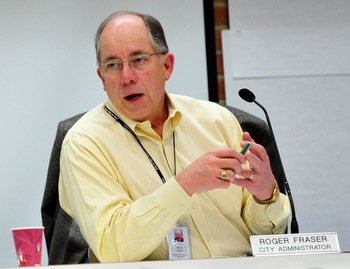
City Administrator Roger Fraser says it's time for City Council members to be willing to make tough choices.
Ryan J. Stanton | AnnArbor.com
"I understand that these are politically difficult things to talk about," Fraser said. "I understand that we have elections every year. I understand that six of you are up for election this year. But I also understand that we've got some major issues that need to be resolved in terms of our budget, and something's got to give."
Fraser spoke candidly as he gave a progress report on the city's budget during Monday's council meeting.
He again reiterated the city budget process is operating on two tracks this year - one where city officials are exploring so-called "big ideas" for changing the way the city does business - such as selling parks - and another more conventional approach where city department leaders have been asked to trim their budgets by 7.5 percent starting in July.
"My fear is that if we continue to do just the kinds of cuts that result in 7.5 percent changes, that we're going to wind up getting so thin in what we attempt to do that we're not going to be able to do them well," Fraser said. "And I don't believe that we want to be an organization that provides services half-baked."
The City Council has an aggressive schedule in the coming months with budget working sessions taking place on several Monday nights - in between weeks the City Council normally meets. Fraser said he hopes to have a clearer picture after the next three meetings on Feb. 8, Feb. 22 and March 8.
"My expectation is that, over the course of those three forthcoming meetings, we're going to talk about each of the background pieces - or the big ideas - and we hope that you will tell us out of those conversations, 'That was really bizarre, and we're not going to go there,' or, 'These are some things that perhaps need additional consideration,'" Fraser said.
Beginning next week, Fraser said, the city will have a report available with more information on those "big ideas," as well as budget impact sheets that reflect the proposed 7.5 percent reductions in each service unit.
The city's budget for the 2010-11 fiscal year starting in July already presumed a 3 percent cut in general fund expenses. The additional 7.5 percent is a response to a growing budget deficit caused by further declines in property taxes and state revenue sharing payments, among other losses.
"Given the fact that, from July of last year to July of 2012, we're looking at somewhere in the neighborhood of a 30 percent reduction in our general fund spending ... it seems as though it's time to talk about services that we might be able to do without," Fraser told council members. "None of that's fun."
Fraser also told council members he expects each of them to bring fresh ideas to the table and not just simply respond to administrators' recommendations.
"We're not asking you to vote on any of this stuff, because it's my recommendation ultimately that will be formulated in March and presented to you in April," he noted.
Mayor John Hieftje gave a detailed report on the budget last week at a community forum at Pioneer High School. At that meeting, he said the city is faced with difficult choices and can either make deep cuts or increase revenues.
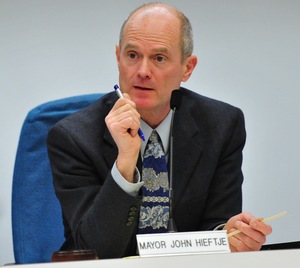
Mayor John Hieftje says the City Council still may consider a city income, but he's not personally in favor of it.
Ryan J. Stanton | AnnArbor.com
Hieftje indicated that he's not keen on the two leading options for increasing revenues - a Headlee Amendment override or a city income tax. But he said those will be a central part of the City Council's deliberations in the coming months.
Hieftje said he'd prefer, as some residents suggest, a tax on University of Michigan football tickets - but the city doesn't have that option under current state laws.
"One of the ones that people say to me all the time is, 'Well, can we tax football tickets?' And we can't," he said. "But, gee, two bucks a ticket, 100,000 people, seven times a year -Â that'd be great. Nobody would even notice."
Hieftje said the city may find itself facing hard times, but so does every other city in Michigan. He said he wouldn't trade the city's economic situation with any other city in the state.
"But we're going to need to make some choices at City Council," he said. "We've been cutting the budget for a while. We can continue to cut the budget, but we can't do it anymore without affecting services. So we need to make a choice. Do we want to continue to cut the city government or do we want to raise revenues?"
Fraser said this year's budget is more complex than ever given the deficit the city is facing. He said the City Council must be willing to "break the mold" on some ideas, because the city's financial position isn't going to turn around anytime soon.
"Even if the economy picks up, typically it's a two- to three-year lag before we start to see increased revenues from our property taxes," he said, adding the city also likely won't see increases in state revenue sharing soon. "And those were the two biggest things that we depend on in the general fund."
Hieftje said the city suffered a huge loss when the former Pfizer property became another part of the swirling mass of tax-exempt property in the city. About 40 percent of the real estate in Ann Arbor is tax-exempt, largely due to the University of Michigan.
"If the U of M had not taken over the Pfizer property, we would actually be in pretty good shape," Hieftje said. "That was 4.75 percent of our property tax revenue, and that bill comes due this year."
Fraser presented a chart at December's city budget retreat showing the city's general fund budget for the current fiscal year totals $83.2 million, about 48 percent of which is spent on police and fire services; 16 percent on general government; 12 percent on public transportation; 5 percent on parks and forestry; 5 percent on district court; 3 percent on social services and 6 percent in other categories.
Ryan J. Stanton covers government for AnnArbor.com. Reach him at ryanstanton@annarbor.com or 734-623-2529.
Comments
irritated
Mon, Feb 15, 2010 : 11:17 p.m.
Bruno_uno has the right idea consolidate the city services, especially fire
Ryan J. Stanton
Sun, Feb 7, 2010 : 1:28 a.m.
I have a correction to make to an earlier comment I posted: The $89.2 million figure for general fund revenues and expenditures in 2008-09 were the figures presented to the City Council in December by administration. It appears upon closer examination those were the figures when the budget was first adopted. It's misleading to use those numbers now, since they changed during the course of the year. I just took a look at the audit for 2008-09 and revenues actually were $79.1 million and expenditures were $83.9 million, a $4.8 million overrun. When you take a look at all city funds, revenues totaled $119.7 million, while expenses totaled $132.3 million, a $12.6 million overrun. The audit also shows the general fund's fund balance dropped from $19.8 million to $11.4 million from July 1, 2008, to June 30, 2009. I haven't heard any real discussion of the fund balance at any council meetings in the last six months, other than certain city officials opining that it's in good shape. That's quite the hit in one year, though.
AlphaAlpha
Thu, Feb 4, 2010 : 9:30 p.m.
Math check please... The 2010 Budget Book, page 117 lines 1 and 2, shows: requested pay at $55,519,965 requested benefits at $59,426,234; these total $114,946,199; when that amount is shared by 766 (per page 72) city employees, it provides $150,060.31 for each employee for 2010. Is $150,060.31 per year average total compensation reasonably accurate? If so, is it reasonable?
townie
Thu, Feb 4, 2010 : 2:07 p.m.
Ryan said: "The major losses of revenue are found in state revenue sharing, income investment, traffic citations, new development review fees, revenues from new parking meters (because the council held off on installing meters in neighborhoods)...." With the exception of state revenue sharing, I challenge the categorizing most of these as being "major losses of revenues," especially the parking meters in neighborhood thing. First, a great number of these meters were indeed installed. Secondly, the DDA and City compromised on other parking revenue streams (like the Y lot and 415 W. Washington) to help offset the "loss" of not installing ALL the meters. Almost everyone who has looked at this "meters in neighborhoods" proposal, including the mayor and most councilmembers, found the revenue projections to be highly dubious anyway. Investment revenue ought to be way up in 2009. The County's was, UM's has recovered somewhat, and even my own IRA bounced back in a big way last year. The real problems are not on the revenue side of things. Tax and fee revenue has increased at a very healthy clip for the past 8 years. The City continues to move basic services from the tax-funded side of things to the fee-based side. As a result, revenue from what the City calls "business" income has increased dramatically. No, the real problem is how they are spending the money. Mack Pool, the Senior Center, Project Grow, parkland sales, etc. are either drops in the "buckets" or are simply used as scare tactics. The only purpose is to distract attention away from the real fat in the budget. Certain departments/categories have seen their costs skyrocket under this administration: Areas like the IT department, the City Attorney's office, layers of highly paid upper management, early retirement buy-outs for cops, debt load from unecessary capital projects, etc., etc.
bobkuehne
Thu, Feb 4, 2010 : 11:13 a.m.
"If the U of M had not taken over the Pfizer property, we would actually be in pretty good shape," Hieftje said. "That was 4.75 percent of our property tax revenue, and that bill comes due this year." but the bills for the new parking structure and new city hall will come due every year for decades. good plan.
Lokalisierung
Wed, Feb 3, 2010 : 6:12 p.m.
"Why is this the moment when it's time to spend money expanding the airport?" Can you show me anything that says the city is going to expand the airport? Can you show me any budgeted monies in the new budget for expanding the airport? Becasue I haven't seen anything thing at all other than the head of the airport wanting to expand and many council members and the mayor saying they were against it. So could you show me please?
SBean
Wed, Feb 3, 2010 : 5:55 p.m.
John Floyd, since we don't have an income tax, the OSC might have located outside the city for property tax reasons, but not income tax reasons -- unless, of course, they don't need to pay property taxes like the rest of the U. TAG, speaking of the U not paying property taxes, that's the reason behind considering an income tax: they don't pay property taxes like other employers.
treetowncartel
Wed, Feb 3, 2010 : 3:36 p.m.
I would think it would be a little chaeper to run a police department in Texas due to the climate differnces. Those cops don't need those furry hats with the ear coverings for 1.Probably have to take into consideration that it is a right to work state too.
Karen Sidney
Wed, Feb 3, 2010 : 2:14 p.m.
According to the FY2007 city audit, the economic development fund was established with a $2.18 million transfer. The audit does not tell you where the transfer came from but if you look at the trial balance report for that year, you see that the account number coding indicates it is from fund 10, which is the general fund. I believe the trial balance reports are available on A2docs. If you want to know what has happened to taxes, I suggest looking at the audit. These are called CAFR on the city website, which stands for comprehensive annual financial report. I always go to the "city of Ann Arbor Statement of Activities" That is page 23 of the hard copy of the FY09 audit. In FY09 the city got taxes of 71,997,079 plus 9,526,085 for a total of 81,523,164. Fraser came to the city a few months before the start of FY03. In FY03 total taxes were 61,284,172 (53,597,747+7,686,425). The taxes appear at the bottom of the reports and do not include the taxes going to the DDA. There was a small decline in taxes between FY08 and FY09 $90,623) The projected 2010 taxes, most of which have already been collected are about the same as FY09 taxes. The budget discussions about cuts can be confusing. The cuts are not from last year's spending. The cuts are from the projected amount needed to keep the status quo and to implement any new initiatives approved by the city administrator. Actual city spending has increased. In FY03, the cost of primary government (excluding DDA, housing commission and LDFA) was 144,172,441. In FY09 it was 184,811,290
Lokalisierung
Wed, Feb 3, 2010 : 1:05 p.m.
"I view that as the easy way out. Lansing could change things to make this work." I totally agree with the idea 1000% but getting Lansing to change a law in any amount of reasonable time is a bit of a pipe dream i would think.
Lokalisierung
Wed, Feb 3, 2010 : 12:56 p.m.
"My property tax bill used to support one court house at Main & Ann. Now, in addition to that one, my property tax bill also supports a new one at Huron & 5th, as well. If times actually are tight, it's hard to see how the County & City could not have found a way to "get along" for a few more years." Problem is this is just a completely made up scenario based in zero reality.
GoblueBeatOSU
Wed, Feb 3, 2010 : 12:54 p.m.
"Pittsburgh proposed a 1% tuition tax on local university and college students. "The "Post Secondary Education Privilege Tax" or "Fair Share Tax" is justified, the city argues, because the students use city services -- roads, police and fire protection -- and should pay for them. Moreover, the city contends that the tuition tax, which would range from $27 for students attending Community College of Allegheny County to $400 for those attending Carnegie Mellon, amounts to a small charge for services." http://online.wsj.com/article/SB125963361940670699.html Since the article in the WSJ was written Pittsburgh has decided not to do this, for now. I believe, based on a prior article, that Ryan J. Stanton asked Tom Crawford about this idea. Crawford said, and correct me if I am wrong, that this wouldn't be legal in Michigan. I view that as the easy way out. Lansing could change things to make this work. About 40%+ of U of M students aren't from the State of Michigan. Factor in the higher tuition cost for out of state students and over 50% of the tax revenue would come from out of state students. The people of Michigan built the U of M. It is time for the people of Michigan to get a return on their investment that would help solve some of our current financial problems. A tuition tax would suggest most of the revenue would come from out of state or out of country. True some of this tax would hit current Michigan residents. Maybe Lansing could do something to fix this issue as well. However, this is a revenue source that would for the most part hit the people that come to the Ann Arbor for four years or so, using an asset owned by the people of Michigan, and then bolt out of State.
Ryan J. Stanton
Wed, Feb 3, 2010 : 11:37 a.m.
The overall budget picture is this: According to data provided by the city, the general fund budget for fiscal year 2008-09 was balanced with revenues and expenditures equal at $89.2 million. Last May, the city projected revenues of $85.2 million for fiscal year 2009-10, which proved to be $3.3 million too optimistic when updated projections were released at the December council retreat. Similarly, the city had projected revenues of $82.9 million for fiscal year 2010-11, which proved to be $6.8 million too optimistic. That brings the city down to a general fund budget of about $76.1 million starting in July, which is a 15 percent drop over two years. As said before, property taxes are only just now starting to go down. The major losses of revenue are found in state revenue sharing, income investment, traffic citations, new development review fees, revenues from new parking meters (because the council held off on installing meters in neighborhoods), bond user fees, and an unresolved lease with the DDA.
Ryan J. Stanton
Wed, Feb 3, 2010 : 10:59 a.m.
Page 79 of the city's budget book shows general fund revenues since 2005. It shows property tax revenues actually increased from $48.2 million in FY 2006-07 to $52.1 million in FY 2008-09. Property tax revenues are just now starting to decline. The city has been challenged from the other sources of revenue declining as well. Tom Crawford, the city's CFO, tells me, "One of the reasons you hear people say local government revenues will be bad for a couple of years is because the impact to property taxes is a little delayed so they're just now showing up." As you read the chart, the line called "prior year surplus" is money the city is pulling from savings, so if you want to see the revenue generated from operations, you should deduct that number from the total. Here's a link to the budget book. Regarding changes in taxes, the city's annual report has a chart on page 133 which gives this history. Here's a link to the annual report. For more budget info, go here.
belboz
Wed, Feb 3, 2010 : 10:27 a.m.
Isn't it the job of the City Admin to develop a plan - and the council to approve? Otherwise, fire him if he can't figure it out... Here is something to look at... Abilene Texas, also with 110,000 people - has a Police budget of $21 million. Ann Arbor has a budget of $26 million. How about benchmarking other cities and developing a plan for the majory services. Quit looking to the public for more taxes and fees...
kmgeb2000
Wed, Feb 3, 2010 : 9:34 a.m.
With regards to someone working in A2 and "not using the services"; well they drink the water and flush the toilets, work in a safe environment - these are not free service. Anyone in the city, visitor, resident, etc. uses these services. You buy a coffee - water from the tap. Eat at a restaurant - water from the Tap for food prep. At some point you have to pay for the type of environment you want to live in. I'm sure you can buy a house for a small fraction of the cost in Detroit or Flint verses Ann Arbor. Let say they didn't have 25-35% unemployment would you choose to work there or A2? I'm all for fiscal responsibility but a safe, clear community cannot be wished into existence. As an example look at the Scandinavian countries, they have very high taxes but they made a choice to have some of the best places to live in the world and created that environment.
TAG
Wed, Feb 3, 2010 : 8:55 a.m.
I think income tax should be considered to replace property taxes because it is tied to one's ability to pay rather than the value of the house they happen to live in. I like the idea, perhaps for selfish reasons, because if I retire, I expect my income to drop significantly but my property taxes wont - but if we had income tax instead, my tax bill would change to reflect the change of my income. Of course, if I made more then I would pay more and that is fine with me. As far as the 1/2% income tax for non-residence, I don't particularly like that idea - I live in Ann Arbor but work in another city and I would not be happy paying taxes to that other city when I don't use any services of that city other than drive on about 1/4 mile of their roads between the x-way and my place of employment. I would expect my employer to pay their fair share of taxes in that city - the same for A2, the employers should perhaps continue to pay a property tax.
John Floyd
Wed, Feb 3, 2010 : 1:08 a.m.
Does any (Karen Sidney?) one know how much has been transferred out of the General Fund to things such as the Economic Development fund in the last few years? My property tax bill used to support one court house at Main & Ann. Now, in addition to that one, my property tax bill also supports a new one at Huron & 5th, as well. If times actually are tight, it's hard to see how the County & City could not have found a way to "get along" for a few more years. The figures that I have seen for repairing the Stadium bridge are in the ballpark for the estimated costs of building the new courthouse. A new courthouse might be fun, and a new police facility might be a good idea, but this bridge is essential. The city was denied federal money to repair it, it's time to bite the bullet & repair it - except that the debt service taken on by the city ties our hands. The city and county should look for even more ways to share resources. Maybe we don't need multiple police/sheriff administrative units in Washtenaw. Exactly what city services are used by a dietician at University Hospital who lives in Whitmore Lake or Milan? Looking at our parks on their way to work? Walking on the grass at lunch? Wearing down the streets on the way to work? People whose employment is tied to the U are an easy tax target, but if they have no voice in how taxes are spent, and receive roughly nothing in services, over time the most highly compensated (those who pay the most tax) will find ways to move their homes and incomes out of the city. Notice that the U's Outpatient Surgery Center is just outside the city limits on Plymouth Rd? If we have no money, why are we spending $$ to build the U a commuter rail station? Why is this the moment when it's time to spend money expanding the airport? Why is the DDA allowed to siphon off city General Fund taxes? Lots of questions, can we get answers?
snapshot
Tue, Feb 2, 2010 : 10:05 p.m.
A2 definitely has a budget problem. Fraser knows the numbers and contrary to BornNraised he isn't lying about the numbers, it's just that many folks don't understand government funding, the sources, and the specific spending criteria involved. These folks may be making poor decisions spending the money but their spending it on what's allowable under the law. Can't use park or "fountain" dollars for firefighter salaries. Property owners need tax relief. Ann Arbor workers use Ann Arbor resources and should pay their.5% income tax. Property owners would save 6 mils on property taxes and at 1% income tax, some would pay more, some less based on their income. Many Ann Arbor residents have state tax exempt pensions, firefighters, police, almost anyone with a pension is state tax exempt. Nice perk if you can get it. That's why these folks are against an income tax, they would have to pay more than their property tax because they have such lucrative salaries and pensions. I like the city filing bancruptcy idea, but in lieu of that there's got to be some layoffs, not buyouts as the firefighter union wants. Taxpayers cannot afford to support these powerful government unions anymore. They need to make salary and benefit consessions. Fortunately a Hedlee override will have to be voted on by the electorate, as would an income tax. The outcome will depend upon the state tax exempt pension holders and whether they will pay more or less under each option. The Hedlee override would open the doors for unlimited property taxes while the income tax would be a maximum of 1%, and could be less. Tough times call for tough decisions but none of those decisions should further burden the average taxpayer while supporting the affluent government workers they support. Not a popular position with the union folks but then it's them or me.
bruno_uno
Tue, Feb 2, 2010 : 10:04 p.m.
Fraser- why dont you put your own politics aside and take a stance against the unions that stranglehold every government organization in Michigan and take action on consolidating services with nearby communities.
AlphaAlpha
Tue, Feb 2, 2010 : 9:41 p.m.
What is the average total annual compensation paid to a city employee?
LoveLife
Tue, Feb 2, 2010 : 8:32 p.m.
Belboz - You should understand that all those firefighters that you are talking about have retired. Yes, they left with huge payouts and believe me the ones that are still there are probably wondering WHY they kept trying to save their precious roll-ins. It's those firefighters that you see today that are really making the sacrifices. They get no roll-ins, comp time is capped, they have taken pay cuts.
brad
Tue, Feb 2, 2010 : 7:58 p.m.
If you have big problems, look at the big items. Budget FY10 Revenues for non-General Funds (in millions): Sewer bond 28; Retirement 28; Risk 28; DDA parking 22; Water 23; Sewage 23; Solid Waste 16; Water bond 13; Stormwater bond 12; Fleet 8; IT 7; Debt 7for reference, the total General Fund revenue is $85m. Governmental accounting is complex, but in your mind, do you separate parking meters from water from property tax? No, it all goes to the city. For a couple of years, the city should lower user rates (water, sewer, solid waste, etc.) by the same amount it will raise property taxes. Some important projects will be deferred, but practically, the General Fund will get money to pay for police and parks without citizens paying more. If you notice, none of these funds are on the chopping block, and it seems like they never have budget issuesjust makes you wonder if they have money to spare.
Lokalisierung
Tue, Feb 2, 2010 : 7:51 p.m.
Re:EyehearA2 How many of the cities you named were crushed by auto factories closing? Detrot & Flint for sure. Highland Park I think. Don't know much about the others.
mmggttnn
Tue, Feb 2, 2010 : 7:26 p.m.
regarding the City Income Tax idea, there would be a 6-mill reduction in our city property taxes. This doesn't appear to be represented in the comments above. So for City property owners, the 6-mill property tax reduction would at least in part offset the 1-percent income tax. The major benefit of this proposal is that the 1/2-mill raised from out-city people who work in the city and use our services would generate enough revenue for the city to provide a reasonable degree of services to city residents.
townie
Tue, Feb 2, 2010 : 6 p.m.
@B.Corman: Pfizer was paying about $4 million per year to the City in taxes (real and personal property). There was a settlement that reduced the total amount for 2008 and 2009 by $2.1 million, which was actually better than projected, but still, those City budget figures already show a good chunk of the Pfizer loss factored in. Therefore, the balance of the Pfizer loss, to hit this year, will not be the full $4 million, when compared to last year's revenue. Maybe another $2.5-$2.8 million? The bigger story is that from 2002 to 2009, total City revenue (taxes and fees) increased 22%, while expenses increased 37% and debt service more than tripled. The Pfizer hit could have been more readily absorbed had these huge cost increases in IT, legal, debt service, and layers of upper management been reigned in. Had the administration and Council not been spending like drunken sailors over the past 8 years, we might be in a better position to weather this storm. Do not buy into Fraser's threats. There is still plenty of fat to be cut before we start selling parks.
BornNRaised
Tue, Feb 2, 2010 : 5:17 p.m.
BTW, how interesting it is that when they wanted the firefighters to take cuts (and they did), they had us all believing that they MADE $100k per year. Factor in benefits, pension, medical/dental/optical, uniform allowances, then ok. But to say a firefighter makes $100k is ridiculous. However, when it comes to Roger Fraser and the bunch taking a pay cut, they only talk about their gross pay, not their TOTAL compensation package. So does it make sense to you that a firefighter makes $100K and Fraser makes $139K? Just like saying Roger hasn't gotten a raise. However he continues to get "vacation banks" allocated to him that he can cash out at any time. People... we're being played for fools.
BornNRaised
Tue, Feb 2, 2010 : 5:11 p.m.
@Corman... I'm saying Fraser has proven time and time again how he can spin numbers to benefit what he's saying and then say something totally different a couple days later and no one calls him out on it. That's the 'lying' part. As for property taxes. I've read countless times, and even saw an interview that claims that this city has actually gotten and increase in property tax revenue since the taxes have gone up. My issue is that both sides are making statements but no one is providing any documentation to back it up. And don't mistake a city's budget with it's fund balance. They are two totally different things. The budget, which the city is willing to share, says what they project to spend. The fund balance sheet is the important one and will answer MANY questions. That shows how much, and where the city actually has the money. This is something the city keeps delaying. BTW, it was due in October. It has actually been FOIA by the unions, but the city has refused to provide it. Why are they hiding this information? If the city is truly cash straped, then prove it and get the residents behind you (Fraser) to rally that all city services need to be cut. Common sense 101... if you aren't able to prove what you're saying, stop saying it. People will no longer trust you.
Lokalisierung
Tue, Feb 2, 2010 : 5:05 p.m.
@ Kate Boyd kate were are you spending 6K in property tax on 40K a year salary outside of the city of Ann Arbor? If you mean living in Ann Arbor than by way of an Income Tax being implimented your proprty tax will go down. I can only speak for myself as a Homeowner in AnnArbor making roughly 40K that $33 a month isn't going to kill me. Of course, my property tax woudl go down so I'd be saving money, don't know about you though.
A2K
Tue, Feb 2, 2010 : 4:58 p.m.
Heh...OK, we'll take the 40K/year salary in A2. Factor in Fed and State Taxes, then benefits + a whoppoing 6K in property taxes, and you're left with, oh 26K take-home...now how does another $400 sound on top of that?
B. Corman
Tue, Feb 2, 2010 : 4:58 p.m.
@bornNraised: How is this lying? It sure seems like simple logic to me. If Pfizer has still been paying their taxes (but will soon stop) the current tax revenue figures that everyone is referencing will not reflect the future decrease in tax revenue that is anticipated and being discussed. The university has just purchased the site recently so I am assuming that Pfizer has been paying there taxes up until that point. Isn't that what Hiefje is referencing when he says "That was 4.75% of our property tax revenue and that bill comes due this year. The effect of the tax revenue decline has not been recognized yet.
belboz
Tue, Feb 2, 2010 : 4:53 p.m.
With Police representing 1/3 of the budget, I'd expect that 33% of any cost cutting excercise comes from that department. Too often, it seems the city is looking at the small potatoes. A fundamental reduction in pay, or reduction in staff seems appropriate. Frankly - not meant to be a smart comment - I'd recommend the city go bankrupt. It can shed some of the pension obligations and renegotiate many of the contracts it has with any union base or salary member - Fraser included. Exactly the same thing done by many businesses. If you truly want to resolve the budget issue, then it should be a serious thought. If not, then budget issues must not be the highest priority. Neil Berlin and the group that retired from A2 years ago are just as responsible for the mess as anyone. Firefighters and Police who took advantage of banking vacation days - sick days as well - so that when they retired, they received huge financial rewards. Sure, it was all part of the contracts. Well, it is time to revise those contracts...
Janelle Baranowski
Tue, Feb 2, 2010 : 4:44 p.m.
Thanks Ryan. This link should be featured on the homepage. @BornNRaised- I don't blame you for not trusting Fraser-math nor the word of a random person online. The documents are pretty extensive, but on www.a2politico.com there's a pretty decent summary. You can find the information here: http://www.a2politico.com/?p=2746
BornNRaised
Tue, Feb 2, 2010 : 4:35 p.m.
That link seems to be to look up individual properties. Looking for a larger picture. Not sure if it exists. @Corman... I know Fraser has said a LOT of things. Unfortunately his credibility is quickly diminishing. Case in point... When he (Fraser) wanted to give the firefighters an early x-mas gift and surprise them with a 6 month early pink slip, he said it would save the city $396,000 to get rid of them 6 months early. So we've all followed that 13 firefighters, 6 months early, equals $396,000. Prior to that he told us all that the 13 firefighters were going to be cut and that would save $1.4 Millon per year. Hmmm... $1.4 Mill per year would also be $700,000 for 6 months wouldn't it? Now, I don't want to call anyone a liar, but it would seem that everytime Mr. Fraser fires up his city calculator, you never get the same answer after pressing the '=' key. So I'm sorry, but any information that comes from him is falling on deaf ears until it can be verified. He's shown his true colors one too many times to be allowed to go unchecked.
Janelle Baranowski
Tue, Feb 2, 2010 : 4:35 p.m.
You can access revenue data here: http://www.a2gov.org/government/financeadminservices/accounting/Pages/Home.aspx
Ryan J. Stanton
Tue, Feb 2, 2010 : 4:30 p.m.
@Janelle Check out the Our Town Budget Web page on the city's Web site. There's a link at the bottom to submit feedback on the city budget.
Mick52
Tue, Feb 2, 2010 : 4:27 p.m.
Ann Arbor's problem are the result of emphasis on social agenda politics. For too long city councils have developed non essential programs based on feel good programs. A2 has extensive housing department, homeless shelter, and social service attitude. Couple that with overly generous benefit packages and no wonder there are budget problems. Perhaps the housing commission is self funded, rents pay for the facilities but we wouldn't know, its never spoken about. How much does the homeless shelter cost/yr? How much did the old YMCA escapade end up costing? Income tax is a dumb idea. Businesses will locate in the townships if an income tax is proposed. I like Mr Fraser's attitude, but good luck to him dealing with this council, some of whom won't do what they are asking employees to do by cutting their pay by a mere 3%. Council pay should be cut far further than that.
Lokalisierung
Tue, Feb 2, 2010 : 4:24 p.m.
"due to Pfizer's departure won't hit until next year." That's fiscal year right? so this year July.
kittybkahn
Tue, Feb 2, 2010 : 4:21 p.m.
I don't know if this is the info you need, but the assessor's site has property tax info: https://is.bsasoftware.com/bsa.is/AssessingServices/ServiceAssessingSearch.aspx?i=1&appid=0&unit=283
B. Corman
Tue, Feb 2, 2010 : 4:21 p.m.
I believe that the reduction in tax revenue due to Pfizer's departure won't hit until next year. So all the numbers that people have been looking at that shows no decline in revenue (current status) does not show the effect of Pfizer leaving; that will happen next year. It appears to me that Fraser is planning ahead for the decline of 4.75% of tax revenue. Ryan please check this and correct me if I am wrong about this.
BornNRaised
Tue, Feb 2, 2010 : 4:18 p.m.
@Janelle... with all do respect, where are the facts to back this up? I can pull a "Fraser Move" and say the city has seen an 80% decrease in property tax revenue. And just as he does... not provide any statistical data to back up the statement. We've heard time and time again that property tax revenue hasn't truly gone down, but as you also claim, gone up. We need proof.
Janelle Baranowski
Tue, Feb 2, 2010 : 4:04 p.m.
@bornandraised Tax revenue and incoming revenue streams (fees, etc) hasn't changed (in fact, I believe it has increased steadily) but spending and debt obligations (bond payments) have spiraled out of control.
Stephen Landes
Tue, Feb 2, 2010 : 4:02 p.m.
Irresistable: "two bucks a ticket...no one would even notice". Spoken like a true Democrat. The problem with the city budget is that the city has no strategic plan, no criteria for establishing priorities, and no willingness to make any priority decisions. The council needs to establish priorities that are supported by our community and the city manager needs to craft a budget that a) does not exceed expected revenue, and b) supports the priorities.
MyOpinion
Tue, Feb 2, 2010 : 3:43 p.m.
In regard to "Stop General Fund Support for golf" the latest report shows that revenues for the golf course equal the operations cost. However, the golf courses are saddled with an overhead expense for the city IT department, community services manager, etc. I don't think the city website helps the golf course any nor has Jayne Miller been much use to the golf courses. In fact, I believe the consultant the city hired to look at the golf operations (why does the city hire so many consultants) said the city overhead was way too high. The golf course management followed most of the other recommendations and has brought in more revenue and more players. If only city operations could be so easily turned around.
BornNRaised
Tue, Feb 2, 2010 : 3:41 p.m.
@Ryan Stanton... or anyone that knows the answer to this question... I've ready numerous comments and other articles in various papers that say revenue from property taxes have NOT changed in the way that Fraser keeps telling the citizens. I have no faith on our city council, and certainly not Fraser. So is there a place, website or other agency, that collects data on property taxes and could be posted so we could see the truth? Fraser is very good at Fraser-Math. We saw it when he talks about cutting the fire service. His numbers to date have never made sense or been consistant. We need factual information from an entity OUTSIDE of this council.
Janelle Baranowski
Tue, Feb 2, 2010 : 3:29 p.m.
The award-winning IT department needs to put a page on the city's website for citizen's to submit ideas for cost savings. Perhaps they can earn some savings to cover their $7 million dollar budget.
treetowncartel
Tue, Feb 2, 2010 : 2:52 p.m.
I worked ion Detroit for a while and paid that city tax, it is infuriating to pay taxes when you have no say at the ballott box on how the money is spent. Not that we have a real say now with respect to state and federal taxes, but there is some feeling of connectivity. How come they don't set aside politics and slash the pay for themselves and the administrators,along with the perks?
Lokalisierung
Tue, Feb 2, 2010 : 2:51 p.m.
Sorry $16.67 a paycheck not month.
John of Saline
Tue, Feb 2, 2010 : 2:50 p.m.
You know, the University could raise football tickets $2 or so and GIVE the money to the city, to get around the state law. I know, crazy talk again.
Lokalisierung
Tue, Feb 2, 2010 : 2:44 p.m.
"Many others professionals will telecommute or otherwise stop working in the city to avoid the tax." These are the threats I 100% do not agree with or believe in (IF I'm doing the matsh correctly). What is the income tax we're talking about here...1% I believe if you live outside the city? (please correct me if I have the wrong number). So how muchg does a "professional" make in a year? let's just say 40K to hit a little but of everyone in the spectrum. 1% of 40K = $400. $400 / 24 (number of paychecks a year) = $16.666 So have I made a silly error here or am I not understanding this correctly? Is this really how much people would "lose" from an income tax? Will a "professional" stop working in Ann Arbor after losing $16.67 a month? Fire dept just gave up 3 times as much right?
John of Saline
Tue, Feb 2, 2010 : 2:32 p.m.
Maybe they should consider enacting a law that sets aside surplus funds when tax receipts are high, rather than spending it all just because it's there. I know, crazy talk, expecting politicians not to spend every cent.
a2grateful
Tue, Feb 2, 2010 : 2:31 p.m.
As the City slashes its services while increasing taxes for more folly fountains, fewer will want to to live here. That's a problem. a2 government has zero credibility as it asks for more fountain money amidst collapsed bridges.
Brian Kuehn
Tue, Feb 2, 2010 : 1:55 p.m.
There was an article some time ago where Roger Fraser had a list of 18 items to consider as part of paring the budget. It would have been more informative if a "price tag" had been placed on each of these items. For example, we know what the cost per deputy is if one contracts with the County. What would be the savings to the City if we contracted out police service? Or would there actually be a cost increase? I am definitely NOT advocating contracting out police services. However, when one makes that suggestion, there ought to be a fairly good estimate of the savings. At the same time, there should be some sort of analysis as to what will happen if one of the items is adopted. For example, what happens if General Fund support of the Parks system is ended? Does that mean everyone working for the Parks system is laid off? No more grass cutting etc..? Here is the list that Mr. Fraser thinks are the tough decisions that need to be reviewed. Require leaves to be bagged by residents. Eliminate general fund support for the parks system. Outsource city legal services. Stop general fund support for golf. Contract with county for emergency management. Eliminate human services funding. Discontinue maintaining some parks. Reduce solid waste millage (eliminate waste collection and maintain recycling). Contract with the county for police services. Sell some parks. Institute street lighting special assessment districts. Rescind parks budget reduction resolution. Reduce or re-purpose general fund support for AATA. Eliminate the Downtown Development Authority. Change the way fire services are delivered. Contract with county for parks services. Defer uncommitted capital improvements. Close recreation facilities. Finally, I somewhat agree with Lokalisierung as to the comments from the Mayor. Time to stop wishing for a painless solution, Mr. Mayor. Why not let the citizens decide on a Headlee over-ride or Income Tax? If we reject both, then we deserve to live with the consequences.
a2grateful
Tue, Feb 2, 2010 : 1:37 p.m.
The City will never tax it's way out of broken thinking and policy making. The Stadium Bridge is our new civic symbol. Six on council need to wake up or move on!
Lokalisierung
Tue, Feb 2, 2010 : 1:28 p.m.
"Hieftje said he'd prefer, as some residents suggest, a tax on University of Michigan football tickets - but the city doesn't have that option under current state laws." Great....hey i'd like that too but since you can't do it let's move on. Income Tax now!