

Saline schools will consider mandating daily 'Pledge of Allegiance'
Saline Area Schools will explore the merits of mandating the daily recitation of the “Pledge of Allegiance” throughout district classrooms.
Trustee David Holden asked the Board of Education to consider the move at Tuesday's meeting, and it drew a mixed reaction from the audience.
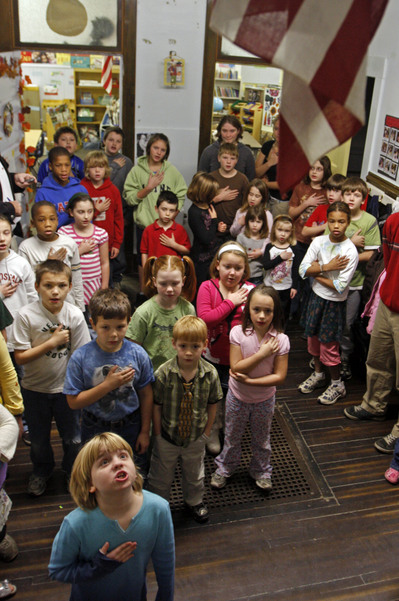
The Michigan Legislature is considering mandating the "Pledge of Allegiance" in public school classrooms statewide.
File photo
“A lot of people focus on ‘one nation, under God,’ but I prefer to focus on the back end of the pledge: ‘with liberty and justice for all,’” Holden said. “I think it works very well with some of the things we are trying to do to discourage bullying.”
In November, the Michigan Senate passed SB 0637, which would require students in districts across the state to have the Pledge of Allegiance at the start of each school day.
The bill has not yet come out of committee, nor has it been read on the House floor. State Rep. Mark Ouimet, R-Scio Township, who attended Tuesday’s board meeting, said he believes a bill of this nature would pass “if not unanimously, then pretty darn close” in the House.
The House of Representatives recites the pledge every day as well as a prayer, Ouimet said. Each representative is required to lead the prayer when their name comes up in the alphabetical rotation. However, he or she or may choose to have a member of their constituency, such as a pastor or a priest, visit to recite the prayer instead.
But Holden said Saline doesn't need to take direction from the state on this issue. He argued reciting the pledge would provide students a “brief lesson in history and patriotism” and serve to unify the student body.
“It was one of the first diversity lessons we had (in America) before anyone talked about diversity,” Holden said.
A number of students disagreed with Holden’s argument, stating the Pledge of Allegiance would entice bullying, not prevent it.
Aaron Mukerjee, a student representative from Saline High School, said students who chose to exercise their rights to not say the pledge would be ostracized.
“Unfortunately, while I think the intentions of say the pledge are excellent … practically applied at the high school … I think it would exacerbate students’ differences,” Mukerjee said. “There would be a lot of peer pressure to say the pledge and the people that didn’t would feel excluded.”
Kelly Hall, a junior at Saline, said she remembers in a boy in her second grade class who was made fun of on a weekly basis for not participating in the pledge.
“It was really awful,” she said.
Kelly added students should study and debate the pledge similarly to how they study the U.S. Constitution. She said in her Advanced Placement Government class, she and her peers have “amazing” discussions about the meaning of the Constitution.“I think that’s what fosters patriotism more than reciting (the pledge) everyday,” she said.
Senior Drew Sieczka said the pledge also would take up valuable class time, when the district already operates on a trimester schedule to squeeze in the all of the curriculum required to graduate.
Superintendent Scot Graden said most of the elementary schools do have the Pledge of Allegiance included in their morning announcements, so a policy change mostly would affect the middle and high school.
A couple of students did speak out during public comment in favor of the mandating the pledge.
“Honestly, I feel there is not enough patriotism in our schools,” said junior Paul Popa. “When I walk in the halls and talk with friends, I never see anyone talking about how happy they are to be an American. … The Pledge of Allegiance really brings together the ideals and morals of what it means to be an American citizen.”
Steven Kiyabu said students that are not willing to say the pledge offend him.
“It (‘under God’) is not a religious statement,” he said. “It is more a historical reference to our Founding Fathers.”
He suggested reciting the pledge during lunch, so those who do not wish participate can remain seated and be more hidden among the crowd.
The Board of Education agreed to have the issue addressed by Saline’s policy committee and then brought back to the board for consideration.
Staff reporter Danielle Arndt covers K-12 education for AnnArbor.com. Follow her on Twitter @DanielleArndt or email her at daniellearndt@annarbor.com.
Comments
Stanley
Sun, Jan 15, 2012 : 6:11 a.m.
Does anyone actually believe that the mere recitation of a single short sentence is a meaningful demonstration of devotion to this country? If so, I submit that you have a most strange and distorted view of the concept. Any act requiring no discipline and no effort should have very little meaning to serious people. Talk is cheap and no talk is cheaper than symbolic speech recited robotically. Funny how often self-proclaimed "patriots" are so eager to declare their love of country verbally rather than through useful activity.
the leprachaun
Sat, Jan 14, 2012 : 2:04 a.m.
people don't realize how lucky we are to live in the greatest county the USA
Sallyxyz
Fri, Jan 13, 2012 : 3:31 p.m.
"In November, the Michigan Senate passed SB 0637, which would require students in districts across the state to have the Pledge of Allegiance at the start of each school day." So, if this passes the House, then every school has to comply? That will be interesting in the AA schools. Get ready for the lawsuits!
arborani
Fri, Jan 13, 2012 : 11:43 p.m.
Last time I looked, neither homosexual life styles nor promiscuous behaviors were prohibited (or mentioned) by the U.S. Constitution.
OLDTIMER3
Fri, Jan 13, 2012 : 9:16 p.m.
Would you rather the schools promote homosexual life styles and promiscuous behaviors?
A2centsworth
Fri, Jan 13, 2012 : 2:48 p.m.
the pledge of allegiance is more than just the word "God" it is about saying to oneself and others that we are proud of our country and that we honor what it stands for and even though sometimes it may not feel like we are getting our personal wants met, there is a bigger picture, we fight for liberty and justice for ALL, an ongoing goal. Saying the pledge is a reminder of our unity as a country, that all of us, no matter where we come from, what color we are, or what our backgrounds are, exist under the banner of our flag. It should not be negated just because someone has a problem with the word "God". Our country is not perfect, but if we all pledge to honor it, and in doing so, make it better, then we have accomplished something far greater than ourselves, and that is what I teach my children and hope that others teach theirs.
Roaring_Chicken
Fri, Jan 13, 2012 : 1:19 p.m.
I suggest we preach Jefferson & him vindicated: "I promised you a letter on Christianity, which I have not forgotten. ... I have a view of the subject which ought to displease neither the rational Christian nor Deists, and would reconcile many to a character they have too hastily rejected. I do not know that it would reconcile the _genus irritabile vatum_ who are all in arms against me. Their hostility is on too interesting ground to be softened. The delusion into which the X. Y. Z. plot shewed it possible to push the people; the successful experiment made under the prevalence of that delusion on the clause of the constitution, which, while it secured the freedom of the press, covered also the freedom of religion, had given to the clergy a very favorite hope of obtaining an establishment of a particular form of Christianity thro' the U. S.; and as every sect believes its own form the true one, every one perhaps hoped for his own, but especially the Episcopalians & Congregationalists. The returning good sense of our country threatens abortion to their hopes, & they believe that any portion of power confided to me, will be exerted in opposition to their schemes. And they believe rightly; for I have sworn upon the altar of god, eternal hostility against every form of tyranny over the mind of man." --Letter to Dr. Benjamin Rush, 1800.
proudtobeme
Fri, Jan 13, 2012 : 5 a.m.
Can you be patriotic and not believe in God? So if you can,then what? I mean,I love my country and I am proud to be an American BUT I don't believe in God,so now what? Didn't people flee to this land for religious freedom? I thought all religions were suppose to be accepted and valued in this country. What if I believe in more than one God? Since the pledge was written in the 50's maybe it's time to rewrite it. Then,and only then would I even consider pledging an allegiance to the flag.
proudtobeme
Fri, Jan 13, 2012 : 10:39 a.m.
Sorry I meant since the "under God "was written in the 50's.
arborani
Fri, Jan 13, 2012 : 12:41 a.m.
I remember well reciting the Pledge in grade school "just because." It was the addition of "under God" that got my attention. I was very young, nominally "Christian", and pretty much apolitical, but it stuck in my craw, and still does. Mandate reciting the Pledge? From "Catch-22", here's Joseph Heller's classic take on loyalty oaths: <a href="http://www.sheilaomalley.com/?p=7225" rel='nofollow'>http://www.sheilaomalley.com/?p=7225</a>
Patriotism ForAll
Thu, Jan 12, 2012 : 10:03 p.m.
A few questions: 1. A daily Pledge? What kind of an oath is it that is only good for 24 hours? 2. How is it a "brief lesson in history and patriotism," the Pledge is never explained? There is zero educational value in it. 3. Why exactly does the government need little kids swear allegiance to it? Oh, wait, unless the goal is indoctrination. The Pledge was intended to promote a strong socialist style central government.. It's done a good job. Everything about the practice in public schools is wrong. Make no mistake that the T-Party would be totally against it, if it wasn't that it was the last foothold for promoting God in the schools.
Roaring_Chicken
Thu, Jan 12, 2012 : 7:12 p.m.
I do believe that I saw a poster around the UM campus advertising a showing of the film, "Fordson: Faith, Fasting, Football, and the American Dream" on the 16th. I'd say maybe we'd better clarify "under God" so we can sort out our Monotheists from our Trinitarians. Wouldn't you hate to have your 8-year-old pledging to Allah? I mean ... that's NOT what we intend here, is it! [sarcasm, sarcasm, sarcasm]
E. Manuel Goldstein
Thu, Jan 12, 2012 : 5:58 p.m.
Hey, I've got an idea: why don't we all go back to using the original straight arm salute to the flag? <a href="http://rexcurry.net/book1a1contents-pledge.html" rel='nofollow'>http://rexcurry.net/book1a1contents-pledge.html</a>
Pixie Belle
Thu, Jan 12, 2012 : 5:44 p.m.
Reciting the preamble to the constitution would be more helpful. It's something you actually do need to know later in life. It has the benefit of not being illegal or offensive. Oh and there"s a really catchy School House Rock version.
Roadman
Thu, Jan 12, 2012 : 5:29 p.m.
Let us just make everyone purchase an American flag and force them to salute it and recite the Pledge of Allegiance while standing every morning. Failure to comply results in a mandatory minimum prison term of five years. Or maybe just limit such a law to welfare recipients as a condition of receipt of benefits. Like children in school they are helpless and will gladly comply rather than being homeless and hungry. Love these ideas that come out of the Saline school board; we need some of these fellows in D.C. to run our country.
Sparty
Thu, Jan 12, 2012 : 2:50 p.m.
Here's a thought: rather than violating the constitution in Saline's schools, how about all of these concerned parents teaching their children the pledge and having them recite it to them before they leave for school each morning? Mission Accomplished. Constitution not violated in public schools.
Greg_G
Thu, Jan 12, 2012 : 2:13 p.m.
Let's teach our kids the principles of democracy (including the right to dissent) and let them become good citizens on their own. Blindly swearing allegiance to anything is never a good idea.
BigSexy76
Thu, Jan 12, 2012 : 2:09 p.m.
We live in a country becoming increasing populated by "Americants'. People who think patriotism and anything american is harmful to them period!
teepartidude
Thu, Jan 12, 2012 : 2:31 p.m.
As a patriot, I'm terribly offended that you didn't capitalize "american."
Wolf's Bane
Thu, Jan 12, 2012 : 1:33 p.m.
Great! The economy tanks so logically let's all get a fresh dose of Jingoism... to inspire the or kids? What's next, teaching creationism?! You fools!
johnnya2
Thu, Jan 12, 2012 : 5:34 a.m.
Think about what this silly poem says: I pledge allegiance to a piece of cloth. Allegiance to these clothes and religions are what causes wars. I do not and would never pledge any allegiance to the United States, or any other country. In fact, why is it conservatives always scream about THE INDIVIDUAL, but then want collectivism when it comes to prayer, and the pledge. Why should anybody pledge an allegiance to a country when they are wrong? I do not believe in blind faith or allegiances. If you think that is good, you have basically joined a cult. If you don't believe me, read the definition of cult and find where this is not cult like behavior.
A2centsworth
Fri, Jan 13, 2012 : 2:57 p.m.
If you are not willing to pledge your allegiance to the country in which you live, why do you live here? It seems very selfish to take take take from a country and not give anything back. The sense of entitlement is overwhelming, and the lack of greatfulness toward a country that offers so much is very sad. It is like being in a marriage where you do not love your partner, but just stay because of the financial benefit. Sad and lonely.
a2citizen
Thu, Jan 12, 2012 : 6:39 p.m.
Oil seems to be causing more wars than flags or religion.
Usual Suspect
Thu, Jan 12, 2012 : 2:07 p.m.
If you want to talk about cults, you can't leave out the climate change alarmist crowd.
Roadman
Thu, Jan 12, 2012 : 5:33 a.m.
The "mandatory" part is what not only runs afoul of the First Amendment but smacks of totalitarianism. In occupied countries such as France, women were filmed crying in terror while being forced to give a Nazi salute to victorious German soldiers entering Paris. Today, it is a criminal offense in Germany to raise one's hand in such a salute and Germans are routinely imprisoned by courts for doing so; one German pensioner was recently jailed for teaching his German shepherd to give the Nazi salute upon the command of "Heil Hitler!". As chronicled in the Gulag Archipelago by Alexander Solzhenitsyn, Soviet citizens could be imprisoned or face a firing squad for disrespecting, voluntarily or involuntarily, Joseph Stalin or his image. Is the district going to discipline or expel a student who refuses to give the Pledge of Allegiance? What if doing so violates their religious or political beliefs? What if they are not citizens of the U.S.? Ripe grounds for not only the ACLU to have a class action federal lawsuit, but also teaching students what the Constitution does not represent - thought control.
nicole
Thu, Jan 12, 2012 : 4:48 a.m.
Do any of you even know the words to the pledge? Get real. We said it in school and I'm better for it.
mavfunn
Thu, Jan 12, 2012 : 6:58 a.m.
It's interesting that you question whether people know the words, yet you yourself do not seem to understand its origin and evolution, as you wrote in another comment: "How do you know where they got their info on the origin. It may be wrong." regarding what has been posted in the comments section. If you knew anything significant about the pledge as a whole concept in context beyond its mere wording, you'd be able to actually point out the inaccuracies--if any. Perhaps you don't want to learn about the pledge beyond your indoctrination because its history is inconvenient to your misinformed preconceptions regarding its origin, meaning, and evolution. Because really, the information others have posted should be common knowledge to anyone who has even done a cursory examination of the issue and you make it sound like these facts are somehow disputable. It speaks volumes.
johnnya2
Thu, Jan 12, 2012 : 5:35 a.m.
How are you better for it? Name ONE thing in your life you ever did different BECAUSE of saying the pledge. If saying the pledge is what was the reason, you are either a bold faced liar, or can easily be manipulated. All you sheep can be.
aareader
Thu, Jan 12, 2012 : 4:33 a.m.
Thanks to all that have posted on this story. I did not know about the origin of "the pledge." Thanks "City Confidential." Also the comments from Stephen Lange Ranzini were especially interesting as "Crony Capitalism" appears to be alive and growing rapidly today. Therefore one can understand why some want to still push this issue.
nicole
Thu, Jan 12, 2012 : 4:49 a.m.
Be careful. How do you know where they got their info on the origin. It may be wrong.
B2Pilot
Thu, Jan 12, 2012 : 4:07 a.m.
Heres a thought how about the school decide what to do in their classrooms & if needed ask parents of current students for their opinion. Everyone else with personal agendas keep it to yourself. And yes you know I pledge my allegiance - the allegiance i pledge allows people to express their unallegiance; talk about irony
eom
Sat, Jan 14, 2012 : 2:56 a.m.
Ask 5-year olds?
stunhsif
Thu, Jan 12, 2012 : 3:52 a.m.
We have your back Mr. H and Mr. Z ! Let's roll and get things fixed after 20 years of ineptness on all fronts. Would have been there last night but my baby sitter fell through. Go Green Go White
snoopdog
Thu, Jan 12, 2012 : 3:44 a.m.
Holden and Zimmer rock, God Bless ! Good Day
Fat Bill
Thu, Jan 12, 2012 : 3:30 a.m.
Way to make a splash Mr. Holden. Let's get everybody riled up about something so trivial and silly, rather than focus on the hard issues, such as the ever-shrinking budget. The purpose of k-12 public schools is to provide a basic education to our young people, to prepare them to become productive citizens by either getting them ready for college or to enter the work force. That is the job your were elected to do, not to perform some political stunt with the pledge of allegience ritual. In Texas, they might accuse you of being "all hat"...
Happy Puppy
Thu, Jan 12, 2012 : 2:18 p.m.
I would expect this from Holden, but I can't believe ZImmer and Slawson will stick with him in the long haul. They are both politically to the left of Obama, I never understood the partnership with a conservative like Holden. He has succeeded in making Saline look like a bunch of idiots on day one as a school board member. Good job Holden and good job people who elected him - he is doing your community proud. Wait until the next board meeting - it will be packed with people from both sides, will last about 3 hours and nothing will be decided - gridlock at it's finest!
stunhsif
Thu, Jan 12, 2012 : 3:49 a.m.
He is going there Fat Billy, where ya been ? Go Green Go White
Mom in Town
Thu, Jan 12, 2012 : 3:19 a.m.
I for one am sick of the people in this country who hide behind their so called patriotism by complaining about others who want to teach the children of this country to be proud citizens. What we end up teaching our kids is "it's a free country, do whatever you want and you can call it patriotism" Freedom comes with a price, and children should be taught that. Period. If that means reciting a pledge, so be it. If that means reciting the Declaration of Independence even better. What we end up teaching them right now, is you can whine about what other people do, not participate, and be disrespectful and still call that patriotism. This country is going to be in serious trouble (as if it isn't already) if we don't get it together and teach children that FREEDOM comes with RESPONSIBILITIES and RESPECT. You can't have diversity or unity without them.
a2citizen
Thu, Jan 12, 2012 : 2:44 p.m.
@Dennis: You said you read the Constitution. The word "personal" is never used in the US Constitution. Which constitution did you read?
mavfunn
Thu, Jan 12, 2012 : 6:52 a.m.
If students "want" to say the pledge of allegiance, they already have the right to do so, but when you start using phrases like how they "should be doing it at school" is when it starts (again) to sound like you're advocating it be a mandatory ritual. And it's the mandate issue that causes so-called "complainers" to use labels that reflect the totalitarian and authoritarian nature of such an implication. The baseball game analogy in particular is not equivalent to the context of students in public schools, and that you seem to think it is indicates that you do not understand the core objection here.
Mom in Town
Thu, Jan 12, 2012 : 6:08 a.m.
those "complainers" are the ones who think that by reciting a pledge of patriotism makes you a fascist or a nazi. This is my country and I think that kids should WANT to say the pledge, and if it is important to say the pledge of allegiance at the beginning of a school board meeting or the national anthem at the beginning of baseball games, kids should be doing it at school.
mavfunn
Thu, Jan 12, 2012 : 5:20 a.m.
Then you are railing against imaginary complainers. Where are these people who are "complaining about others who want to teach the children of this country to be proud citizens"? It's when what is actually "taught" is more of an indoctrination via a mandatory pledge--what this article was about, btw. And when you mention about having something "taught" by writing, "if that means reciting a pledge, so be it" when responding in a subject about a mandatory recitation of the pledge of allegiance, it carries the implication that you agree and somehow see a lot of "complainers" here, yet if you oppose government mandated pledges through the public schools, you should be seeing a lot of allies here, so your initial reaction is perplexing. And frankly, everyone I've known learned, memorized, recited, recapitulated word-for-word in writing, and were taught about the history, meaning, and evolution of both the DoI and Constitution in American History classes, yes, including recently, so it sounds like an invented boogeyman.
Mom in Town
Thu, Jan 12, 2012 : 5:05 a.m.
I am not advocating for MANDATE to say the pledge. I am merely saying that we are not teaching our children about the great country that we live in. You are putting words in my mouth.
mavfunn
Thu, Jan 12, 2012 : 4:58 a.m.
It's funny how respecting our rights defined by the constitution/bill of rights (and it's not like this hasn't been ruled upon by the judiciary) is "complaining" and that for you the only way to truly "respect" the constitution is to just ignore it.
Mom in Town
Thu, Jan 12, 2012 : 4:40 a.m.
So because it's over 1000 words you are saying high schoolers and middle schoolers can't learn it? Come on. I am not saying they need to recite it every day, I am saying that they need to LEARN it and KNOW it! Which means more than learning it in a half an hour class once a year! If that means they need to practice every day so be it. I am saying that all of the complaining about our RIGHTS ends up leaving kids with the idea that they have the right to do nothing and call it patriotism when in fact all it is is laziness. They don't know what that type of patriotism means if they haven't learned the basis behind it. Liberty to not be patriotic... fine (why not allow kids to burn flags in the classroom then), but then how do you suggest we teach them about maintaining the principles this country was founded on? And it may not be in the Constitution, but a little responsibility and respect would go along way in today's world. @mavfunn- Same goes for you. Freedom of Religion does not mean Freedom FROM Religion. If taking the "under God" portion out would help you... fine, than find some other statement of respect for the country we live in or step aside when I use my rights to believe in that God. My point is that kids too easily can say "I don't have to do that" without knowing what it is they are saying.
Dennis
Thu, Jan 12, 2012 : 4:05 a.m.
hahahaha, have you even read the Declaration of Independence? The document is over 1000 words. Last time I read the Constitution (yes I have read it) there was nothing in there about responsibility or respect. Personal liberty is mentioned, such as the liberty to not be patriotic. People like you scare me.
mavfunn
Thu, Jan 12, 2012 : 3:36 a.m.
If the price of freedom is violating the constitution, it's hardly patriotism. You talk about freedom, responsibilities, and respect, but seem to care about none of those things: not the freedom of speech and religion of the students, not our responsibility regarding the maintenance of those rights, and certainly not respect for the constitution if it should be flung aside on the whims of the ignorant.
Caferacer
Thu, Jan 12, 2012 : 3:22 a.m.
Very well said!
Roadman
Thu, Jan 12, 2012 : 3:01 a.m.
United States Supreme Court Justice Jackson, in delivering the opinion of the court during 1943 in the Barnette case, striking down a state school board's mandatory recitation of the Pledge of Allegiance wrote: "If there is any fixed star in our constitutional constellation, it is that no official, high or petty, can prescribe what shall be orthodox in politics, nationalism, religion, or other matters of opinion or force citizens to confess by words or act their faith therein." The mandatory policy being considered by the school board in Saline violates the spirit, if not the letter, of the Barnette holding and their legal counsel would be best advised to address the constitutional implications of their conduct.
aareader
Thu, Jan 12, 2012 : 4:43 a.m.
It appears you are implying some of our legislators do not know Supreme Court Law/opinions regarding this issue let alone some members on the Saline School Board. Maybe they will read your comments and realize they have a way to save money for the State and Saline. That is to forget this and move on to issues that will improve the quality of life for all.
lennyG
Thu, Jan 12, 2012 : 2:45 a.m.
Maybe the students in Saline should praise our "dear leader" everyday also.
Roadman
Thu, Jan 12, 2012 : 3:05 a.m.
Conan Smith, Chair of the Board of Commissioners?
teepartidude
Thu, Jan 12, 2012 : 2:54 a.m.
Rick Snyder?
Dennis
Thu, Jan 12, 2012 : 2:42 a.m.
Not that I am anti-pledge, but I am pretty sure that courts have already ruled in other states that you can't force students to say the pledge. There is no reason to think this wouldn't be immediately challenged and overturned, most likely wasting district money in the process.
Roadman
Thu, Jan 12, 2012 : 2:47 a.m.
The U.S Supreme Court in Barnette already said this almost 70 years ago.
Caferacer
Thu, Jan 12, 2012 : 2:35 a.m.
Why is this such a threat to personal freedom? It is just a short statement that basically says "I am an American and proud of it." Frankly, I think we could all use a little more of that perspective!
Gasmaskted
Thu, Jan 12, 2012 : 4:43 a.m.
Those reciting the pledge: 1) are not necessarily Americans 2) if they are Americans are not necessarily proud of it. Your distillation is also not what the pledge says. It says the speaker pledges allegiance to the flag and the Republic. The pledge does not address if you are patriotic. It is only about submission, to the republic and to the vacant symbol of the republic, potentially divorced from the republic. It also makes several assertions about what the republic is.
Dennis
Thu, Jan 12, 2012 : 4:09 a.m.
They have a name for what you are describing Caferacer. It's called fascism and it always goes hand in hand with forced nationalism. Read a history book once in a while.
Caferacer
Thu, Jan 12, 2012 : 3:26 a.m.
Yes... correct... not sure how many times you would like me to say it. Let's all just disregard our country and just teach our kids about how to futher disassociate themselves from the greatest country in the world... that strategy should work well for our future.
teepartidude
Thu, Jan 12, 2012 : 2:50 a.m.
Let me get this straight: we legally compel citizens to recite an oath from a 19th century children's magazine promotion to prove that they are "American and proud of it"? And you don't see a problem with that? Really?
Caferacer
Thu, Jan 12, 2012 : 2:48 a.m.
Silly man.... just silly!
Dennis
Thu, Jan 12, 2012 : 2:44 a.m.
If you can't see how FORCING students to say the pledge goes against the concept of personal liberty I don't know what to tell you.
Vivienne Armentrout
Thu, Jan 12, 2012 : 2:05 a.m.
Oh, please. Who writes these polls? Couldn't you have separated the issue of having a required pledge of any kind from the "under God" pledge? There are a lot of constitutional and philosophical questions behind the idea of a required pledge, even if it was "Saline is the finest community in the world and I never want to go too far". The religious issue is also complex and has many nuances. You need to have a major editorial discussion and, I hope, resolution on how these polls are constructed. I propose an editorial committee. Let several people respond and kick it around.
Roadman
Thu, Jan 12, 2012 : 2:01 a.m.
The school district cannot "mandate" anything when it comes to speech! The United States Supreme Court in Barnette versus West Virginia Board of Education held that students cannot be forced to recite the Pledge of Allegiance since they are protected by guarantees espoused pursuant to Free Speech Clause rights granted under the First Amendment. The plaintiffs in that case were Jehovah's Witnesses who claimed doing so would violate their religious beliefs. That decision came down in 1943. The court held that freedom of speech entails freedom not to speak and contains memorable language from a justice in an opinion strongly siding with the plaintiffs therein. The Pledge of Allegiance is routinely led by the Mayor at Ann Arbor City Council meetings and there are those present who choose not to stand and join in the recitation of the pledge and they cannot be compelled to do so. I hope the American Civil Liberties Union investigates this situation to ensure the policy enunciated does not abridge the rights of any student.
Lily'sMom
Thu, Jan 12, 2012 : 1:49 a.m.
Uh-Oh. I feel Saline's need to post the Ten Commandments creeping in...
Roadman
Thu, Jan 12, 2012 : 3:04 a.m.
....and maybe a nativity scene at Christmas time, with an approved daily prayer?
Gramma
Thu, Jan 12, 2012 : 1:38 a.m.
Back in the 40's and early 50's, the Pledge of Allegiance was required in my schools. Everyone stood and rotely said it. At the same time, they may have been kicking the kid ahead of them or some such mischief. When I was in 5th or 6th grade, we all fumbled around, adding "under God." None of us understood that this Pledge meant swearing to take up arms whenever ordered to do so. I lived in a rural, all white part of Michigan and none of us had any idea of the hypocrisy of the words "with liberty and justice for all." In the 40's, the armed forces were still segregated, those riding on public transportation had to change their seating arrangements as they crossed from Ohio into Kentucky. Schools were legally segregated. Churches were (and most still are) segregated as a matter of custom. Jim Crow was alive and well in the South and supported by the National government and most Northerners as a State's rights issues. Now it is de facto segregation and demonizing of Muslims and Latino immigrants. In the 40's, there was not liberty and justice for all and there still is not. Teaching this hypocrisy to our children can in no way bring about true patriotism: the righting of wrongs within your own country.
a2citizen
Thu, Jan 12, 2012 : 3:31 a.m.
Agreed. I certainly wouldn't take up arms to defend the rights of some of the people you mentioned.
sh1
Thu, Jan 12, 2012 : 1:23 a.m.
You don't teach patriotism by forcing people to say a pledge they don't even understand.
mun
Thu, Jan 12, 2012 : 1:05 a.m.
If the government is going to require kids to recite the Pledge of Allegiance, they also need to require that the students read about Francis Bellamy, the author. I wonder how the legislators would feel about the fact that Bellamy was a Christian Socialist. <a href="http://oldtimeislands.org/pledge/pledge.htm" rel='nofollow'>http://oldtimeislands.org/pledge/pledge.htm</a>
proudtobeme
Thu, Jan 12, 2012 : 12:52 a.m.
I just asked my 5th grader who attends an Ann Arbor school if he ever recites the pledge in school. "What do you mean?" was his response. My 3rd grade son (who attends a different school than my 5th grader) said he does not recite the pledge in school either. Neither one of them has ever recited the pledge in any of their years in school. 2 different Ann Arbor schools,no pledge. So not ALL Ann Arbor schools do it and I know several in Saline who do not either. Here's a question,Is it ok for teachers to opt out of saying the pledge?
Gramma
Thu, Jan 12, 2012 : 1:39 a.m.
Legally, it has to be.
bobr
Thu, Jan 12, 2012 : 12:40 a.m.
I remember when the "under God" was put in when I was in grade school. Saying the Pledge is a about a 15 second bit out of the day. It's not a big deal. I didn't say the "under God" part and no one compelled it or enforced it. I suppose it would be a problem if a busy body looked around at who said what and tried to compel everyone on every word.
mavfunn
Thu, Jan 12, 2012 : 3:44 a.m.
Mandating that children recite a pledge they barely understand is not a gesture of patriotism; it's clearly the opposite. Apparently what it means to be an American is to desire that others' rights be abridged and that the constitution be ignored, if we followed your lead. Try to stop and really think about the issue and think about it in the context of the country and the design of its governance instead of just being a propagandized reactionary with the knee-jerk form of nationalism.
Caferacer
Thu, Jan 12, 2012 : 3:09 a.m.
It is simply a gesture of patriotism...My gosh we need to teach our kids something about what it is to be an American. Let's be proud and show it rather than stick up for secularism.
Gramma
Thu, Jan 12, 2012 : 1:28 a.m.
bobr, If you believe that "saying the Pledge is about a 15 second bit out of the day. It's not a big deal." then why bother to say it? There is always someone looking around seeing what others are doing. Why force something that is not a big deal?
davecj
Wed, Jan 11, 2012 : 11:34 p.m.
Many schools in Washtenaw County, including Ann Arbor, already recite the Pledge every morning. It doesn't seem to be a problem. What's all the fuss about?
eom
Sat, Jan 14, 2012 : 2:52 a.m.
The fuss is about you (and others) not understanding what the fuss is about.
Roadman
Thu, Jan 12, 2012 : 3:07 a.m.
Mandatory recitation is the problem.
Caferacer
Thu, Jan 12, 2012 : 2:51 a.m.
Totally--we need to be more appreciative of our country... Why people push back on this is beyond me!
aamom
Thu, Jan 12, 2012 : 12:08 a.m.
I agree. I think a lot of old timers are coming out to comment on how they said the pledge every morning because they think it doesn't happen anymore. This is essentially a story about nothing. The pledge gets said in most schools. Not worth making a law because a couple don't.
Dave66
Wed, Jan 11, 2012 : 10:50 p.m.
Hilarious!!! Yes, by all means, have them recite the Pledge. Give them a good lesson in hypocrisy (the state of pretending to have virtues, moral or religious beliefs, principles, etc., that one does not actually have). OK, see if you can follow along. 1. The pledge states "with liberty and justice for all." 2. "Liberty" is to be free of government coercion or control. 3. The government forcing you to say you have liberty is HILARIOUS. I love irony as much as the next guy, but this goes to the next level. I don't know what's more ironic than irony, but if anything could be, this is it. By forcing the children to recite the pledge (and, of course, educating them on what *exactly* they're doing), they will learn several important lessons: 1. It doesn't matter what you do as long as you say the right thing 2. It's easier to be a mindless, conforming drone than it is to think for yourself 3. Politicians and administrators will work VERY hard to accomplish exactly nothing, then congratulate themselves for a job well done.
a2citizen
Thu, Jan 12, 2012 : 12:34 a.m.
They are, and now I mostly worry about the three "S's".
teepartidude
Thu, Jan 12, 2012 : 12:28 a.m.
"the three R's"--that is so awesome!
a2citizen
Thu, Jan 12, 2012 : 12:12 a.m.
There certainly is a Catch-22 in most of these arguments. Another one might be: If you are unwilling to state "...and justice for all", then why would you be expect justice. And going to the next level: This is why I have my child in a private school. The goal there is the three R's.
Red Raider
Wed, Jan 11, 2012 : 10:47 p.m.
It is disappointing how this article was written. I am Steven Kiyabu's father and he did not say that people who are unwilling to say the pledge OFFEND him. He said, based on the history of this country going back to the founding fathers, he was puzzled over the intense debate over this. However, he does understand that each person is entitled to his/her views. That is the beauty of living in this country. It is really unfortunate because Steven did not intend to offend anyone. Yet, how this article was written, his mother and I were offended by what was attributed to him. We are all VERY grieved by this. He went to this meeting and spoke because of a government class assignment, not to come across as some hardnosed, intolerant extremist. Scott Kiyabu
Roadman
Thu, Jan 12, 2012 : 5:44 p.m.
The Johnson case was in 1988, however the federal Flag Protection Act passed in 1989 in response to the Johnson decision was likewise invalidated as conflicting with the First Amendment in the Eichman decision in 1990.
Roadman
Thu, Jan 12, 2012 : 5:41 p.m.
@Sillysally: Gregory Lee Johnson was the flag burner who did it in front of Dallas City Hall to coincide with the Republican National Convention in 1984. He had ben charged nder Texas state law. Burning and spitting on an American flag is protected by the First Amendment, acc ording to the U.S. Supreme Court in the Johnson case.
Silly Sally
Thu, Jan 12, 2012 : 11:55 a.m.
Who "burned and spat on an American flag who successfully invalidated a federal criminal law on First Amendment grounds in 1988 and got his conviction reversed." Wrong decision, but if upheld, then all hate speech laws should be similarly invalidated on first amendment grounds. Even more so with hate speech laws, since these laws are based upon thoughts, not actions. Punish the actions, but not the thoughts.
Roadman
Thu, Jan 12, 2012 : 4:01 a.m.
The landmark case in Barnette in 1943 was brought by Jehovah's Witnesses who found mandatory compliance a religious abridgment, although the Court upheld their right to exclude themselves on Free Speech Clause grounds. There are Puerto Rican residents who are American citizens who refuse to honor the American flag and even have burned it as a symbol of American imperialism imposed on their lives and identities as Puerto Ricans. There was a radical Marxist U.S. citizen that burned and spat on an American flag who successfully invalidated a federal criminal law on First Amendment grounds in 1988 and got his conviction reversed. There are a whole host of reasons why certain Americans do not honor flag etiquette as you or I may. On a certain level, I agree with your son since I proudly stand and recite the Pledge of Allegiance whenever asked to out of deference toward what the flag symbolizes, but I also believe in the rights guaranteed under the First Amendment are also a part of what it symbolizes. Those who choose to ignore or to desecrate the flag are free to do so as American citizens. When James Madison submitted his draft of the Constitution to the delegates fr approval, he was told to go back and insert further limitations on federal government power - hence the Bill of Rights including the First Amendment came part of that package of civil liberties so jealously guarded by the courts today. Do not feel grieved - millions of Americans likely would be offended at those who do not recite the Pledge of Allegiance or disrespect the flag. Our U.S.Congress has been chastised by the Supreme Court for being unconstitutionally overprotective of the American flag in enacting flag protection legislation. I welcome your son's opinion. :)
Widow Wadman
Wed, Jan 11, 2012 : 10:44 p.m.
We recited the Pledge of Allegiance every day in first grade. Everyone knew the words. We sang, "The Star Spangled Banner," "America the Beautiful," "God Bless America," and "My Country 'tis of Thee" throughout elementary school. We attempted the Marines' hymn and Navy hymn. As young children we knew to be quiet when the national anthem was being performed, to take our hats off, and to hold our right hand over our heart if we felt strongly when the anthem was playing. We were taught when and how to hang the flag. Kids these days aren't learning the words or the protocols. It's embarrassing to see them and their parents fumble upon the words or carry on conversations while others perform. It is apparently out of fashion to show any respect. Though I regret the ignorance and lack of manners, I think it's more important that students from different backgrounds feel comfortable in the classroom and that classroom time be spent on other activities. As there are many non-religious people in our country, I think it would be fine if reciting the Pledge were to be considered an assignment for a history class. I don't think that reciting the pledge needs to be done every day. I think it would be helpful if more children were taught the content of the Constitution and the Bill of Rights so that more people might understand principals upon which our nation developed.
Silly Sally
Thu, Jan 12, 2012 : 12:11 p.m.
Doing what this author described in the first paragraph helps children have a common heritage and behavior. It helps avoid embarrassing moments such as one woman at our church. Born to American parents, she was raised in a south American country. During a talk, she had a 3 ft by 5ft American flag as a prop. She kept placing it on the ground and kept being puzzled why she was getting angry looks from some. She was clueless until during a break someone filled her in and she apologized. Learning proper social graces goes a long way, and this is just one of many.
oldguy
Wed, Jan 11, 2012 : 10:37 p.m.
When "god" was added to the pledge it became a prayer and therefore should NOT be mandated by public schools. And no Buster W, this is exacly what the Constitution writers tried to avoid.
Fred Crothers
Wed, Jan 11, 2012 : 10:36 p.m.
When are we christians going to stand up for what the founding fathers of this country built this country ON!! IF a student choses NOT to recite the Pledge with a note from their parents so be it! It is a free country! However those of us who have a sense of patriotism will continue to recite the Pledge of Allegiance and placing our hand over our hearts AND removing our hats. I would suggest for those adults who chose NOT to, then you need to go find a country that is NOT FREE!! Our solders from the civil war on through to the latest Afghanistan war are defending the rest of us!
Cathy
Fri, Jan 13, 2012 : 4 a.m.
Note to Fred Crothers: MANDATE means we have no choice in the matter. How does that make us MORE FREE?
lennyG
Thu, Jan 12, 2012 : 2:52 a.m.
It's countries that aren't free that tend to force their population to mindlessly repeat words praising their country.
Gramma
Thu, Jan 12, 2012 : 1:44 a.m.
We could also have all those who are going to say the Pledge have a note from their parents permitting them to do so. Then they could stand in a separate area and recite it. That way those who do not say it would not be ostracized.
Jake C
Wed, Jan 11, 2012 : 10:41 p.m.
The last war where US soldiers actually "defended" their country was WWII. Everything since then has been meddling in foreign affairs, whether justified or not.
carrier
Wed, Jan 11, 2012 : 10:31 p.m.
We are all Americans, so why would we have a problem pledging allegiance. It's better than pledging allegiance to any other country I can think of
lennyG
Thu, Jan 12, 2012 : 2:51 a.m.
because forcing someone to blindly repeat any set of words daily smells more like North Korea and the Soviet Union and less like a country that stands for individual freedom.
Gramma
Thu, Jan 12, 2012 : 1:45 a.m.
The words "under God" are not the only reason not to say the Pledge. Many faith traditions believe that making a pledge to the flag puts flag and country above God and is therefore blasphemy.
John Q
Wed, Jan 11, 2012 : 10:37 p.m.
Because people have religious beliefs.
Mike
Wed, Jan 11, 2012 : 10:26 p.m.
What difference does it make? We already beat this fantasy into our kids heads from birth. Nothing new.
leaguebus
Wed, Jan 11, 2012 : 10:25 p.m.
What City Conf. says. If its mandated, it loses it meaning. If a class wants to do it daily, good for them. It certainly means more if they want to do it as opposed to having to do it.
Tom Devine
Wed, Jan 11, 2012 : 10:21 p.m.
Why would public schools make children repeat a pledge? It's a PLEDGE- which, incase you don't know, it's a promise, why would we have to repeat a promise? Do they not trust us or something?
Diane
Wed, Jan 11, 2012 : 10:13 p.m.
Give the kids the opportunity to say it. If they don't want to, then let those students sit down. What's the BIG DEAL?
E. Manuel Goldstein
Wed, Jan 11, 2012 : 10:09 p.m.
Ugh. Don't they have anything better to do in Saline? And AnnArbor.com, don't you have any real news to report on? This is breathtakingly inane.
Rod Johnson
Wed, Jan 11, 2012 : 10 p.m.
"Entice" bullying? Entice it to what? Usage issues aside, I look forward to the lawsuits. Down with theocrats (and their idiot children who think "under God" isn't religious... I mean, huh?).
Kent Jocque
Wed, Jan 11, 2012 : 9:54 p.m.
Here's a page of quotations on the subject of patriotism <a href="http://en.wikiquote.org/wiki/Patriotism" rel='nofollow'>http://en.wikiquote.org/wiki/Patriotism</a> It includes this from William Ralph Inge "Patriotism varies, from a noble devotion to a moral lunacy."
Goofus
Wed, Jan 11, 2012 : 9:54 p.m.
Saline...Washtenaw County's most awkwardly Stepfordian community...does it again on the weirdness and unnecessary controversy.
a2citizen
Wed, Jan 11, 2012 : 9:48 p.m.
Or how about having them recite the beginning of The Declaration of Independence: "When in the Course of human events, it becomes necessary for one people to dissolve the political bands which have connected them with another, and to assume among the powers of the earth, the separate and equal station to which the Laws of Nature and of Nature's GOD entitle them, a decent respect to the opinions of mankind requires that they should declare the causes which impel them to the separation. We hold these truths to be self-evident, that all men are created equal, that they are endowed by THEIR CREATOR with certain unalienable Rights, that among these are Life, Liberty and the pursuit of Happiness...blah, blah, blah" Oh, it really doesn't say "blah, blah, blah" I just thought I'd put that in their.
a2citizen
Thu, Jan 12, 2012 : 3:25 a.m.
Hopefully the children aren't wasting a lot time and energy on these silly arguments. That time could actually be spent learning what capital letters are. The children, the children, we must think of the children.
lennyG
Thu, Jan 12, 2012 : 2:49 a.m.
Make sure we make them say GOD and CREATOR in capital letters.
Mike
Wed, Jan 11, 2012 : 9:46 p.m.
yes!
Ron Granger
Wed, Jan 11, 2012 : 9:32 p.m.
Have them recite different parts of the constitution.
Ben
Thu, Jan 12, 2012 : 2:27 a.m.
That'd be great, if most of those kids knew how to read.
alan
Wed, Jan 11, 2012 : 9:31 p.m.
...with liberty and justice for all unless you're black, hispanic, asian, gay, muslim, jewish, mentally ill, your first language is not english, .... How about mandating brown shirts and armbands while we're at it?
alan
Thu, Jan 12, 2012 : 1:42 p.m.
That is one of the Silliest comments I've ever seen Sally. Ad hominen abusive is a logical fallacy. I grew up reciting the pledge and watching my best friends and relatives come home with drug addictions, mental illness, and napalm burns for being 'patriotic'. My friends couldn't sit in a restaurant with me. I saw positive change but in the last 30 years that has gone nowhere but backwards. No, most of the groups mentioned don't receive special treatment. We pass laws denying gays the same rights as everyone else. We argue whether people can build a mosque. If you happen to born black in this country you are ten times more likely to be poor and you only have a 50% chance of even knowing who your father is yet people still recite the ridiculous belief that everyone has the same opportunity. Baloney. If you think that a white kid born to an intact, educated family in Palo Alto has to work just as hard as a black kid born to a poor, unwed, high school dropout in Detroit then I would love to live in your fantasy world. Affirmative action was a somewhat misguided attempt to close the opportunity gap but it should start with birth, not when kids reach college age. You can disagree with the way it was handled but if you can actually think that there is no problem, which inevitably costs us trillions, then you live in a selfish fantasy world.
Silly Sally
Thu, Jan 12, 2012 : 12:14 p.m.
Most of these groups get special affirmative action privileges based on race. If they do not speak English, they almost certainly get better accommodations than I would in their native land. If I were gay, I'd sure hate to be in a Muslim or Hispanic or Asian land. Some sure seem to hate this nation...
djm12652
Wed, Jan 11, 2012 : 9:23 p.m.
Well, if the Pledge of Allegiance was written by a Socialist, one would think it would be mandatory in Ann Arbor Schools...and for those that have no allegiance to the flag of our Great Nation, go to another country...like Somalia or the Sudan where the allegiance to anything is nil.
sh1
Thu, Jan 12, 2012 : 12:30 p.m.
And those people who love forced pledges, go to Iran.
Forever27
Wed, Jan 11, 2012 : 9:06 p.m.
In Saline, they want the Pledge (and it better have the words "under god" included). Next up, it will be a legislative bill just like the one in Indiana that would allow state-funded schools to REQUIRE the recitation of the Lord's Prayer. <a href="http://www.in.gov/legislative/bills/2012/IN/IN0251.1.html" rel='nofollow'>http://www.in.gov/legislative/bills/2012/IN/IN0251.1.html</a>
Elaine F. Owsley
Wed, Jan 11, 2012 : 9:03 p.m.
My generation grew up saying it in school most of the years we were there. Remember us? the ones who fought and won wars? If you don't know what you stand for, you'll stand for anything.
Silly Sally
Thu, Jan 12, 2012 : 4:13 a.m.
Dave66 What, "the generation that forced Black people to sit in the back of the bus..." What country was this where blacks had to sit in the back everywhere? Not America. Sure, in the south. But this silly author acts as if this happened in the midwest, the north, the west, and the mountain states. It was "The generation" that ended these practices in the old south. So, "the generation has much to be proud of, especially a nation and a constitution that could be amended and changed, bringing about most other good changes
Gramma
Thu, Jan 12, 2012 : 1:48 a.m.
Rotely reciting a pledge does not mean you understand anything.
Dave66
Wed, Jan 11, 2012 : 10:56 p.m.
I think that's also the generation that forced Black people to sit in the back of the bus and didn't allow them to use the same drinking fountain. So before you toot your own horn too much, you should probably consider all the things that generation has to be ashamed of, too.
Jake C
Wed, Jan 11, 2012 : 10:50 p.m.
"If you don't know what you stand for, you'll stand for anything." An insightful statement, although I don't think you meant it to come across that way. A better way to put it might have been "If you don't stand for something, you'll fall for anything." Do you think most elementary school students know why they have to stand & recite a pledge? If they don't know why they're standing and what they're standing for (aside from "because a teacher told them to") then indeed they might stand for anything just because someone in authority told them to.
a2citizen
Wed, Jan 11, 2012 : 9:32 p.m.
What beach did you storm?
Ben
Wed, Jan 11, 2012 : 9:02 p.m.
Holy cow, lots of unAmericanism here (though it IS Ann Arbor..) I grew up reciting the Pledge of Allegiance. My personal opinion is YES, it should be recited, daily, by the youths. Anyone who thinks differently probably voted for Obama and has a Che Guevara t-shirt.
sh1
Thu, Jan 12, 2012 : 12:29 p.m.
How is it unAmerican to speak out against tyranny?
Ben
Thu, Jan 12, 2012 : 2:26 a.m.
Yes, revolutionary communists. Hail Stalin!
Billy Bob Schwartz
Wed, Jan 11, 2012 : 9:11 p.m.
Yup, Ben...You are right, and the rest of the world is a bunch of revolutionary communists. Maybe you should take another look at your basic civics, eh?
G. Orwell
Wed, Jan 11, 2012 : 9 p.m.
Given that certain people in power want to destroy the US Constitution, the Pledge of Allegiance is a positive thing. The word "God" is a minor issue compared to the full meaning and purpose of the Pledge. In my opinion.
kmgeb2000
Thu, Jan 12, 2012 : 2:58 p.m.
I have always wondered which "God". Each religion seems to have their own, one true "God" and each religion says the other is wrong. As it turns out, each religion seems to spend a huge amount of resources killing those of another religions. All the while going against what their religion seems tell them. For me, this is one of the reasons the word and recently added phase is not a minor issue. Mind you; my father, uncles, cousins, brother-in-law all served in the military defending this Country - up to and including receiving a Bronze Star. None, up to their last dying breath looked to God to define their respective vision of patriotism.
sh1
Thu, Jan 12, 2012 : 12:28 p.m.
Please give some examples of people wanting to destroy the Constitution and how saying the Pledge will help.
Sparty
Wed, Jan 11, 2012 : 8:59 p.m.
We are not whining, we are adhering to our constitutional rights that this country was founded on --- the greatest document ever written. Patriotism is due to to that document and to the men and women who have served, lived and died creating and defending this nation and the rights therein. Those that choose to ignore constitutional dictates, in this case of separation of church and state and subsequent rulings, dishonor it. The Pledge has been ruled unconstitutional. Fact. If Saline chooses to ignore this fact, it does so at the risk of an immediate lawsuit and hefty legal bills as it prepares to appear before a Judge to explain itself.
Sparty
Thu, Jan 12, 2012 : 2:22 a.m.
ROFL
Usual Suspect
Wed, Jan 11, 2012 : 9:17 p.m.
Stop whining.
guyfroma2mi
Wed, Jan 11, 2012 : 8:50 p.m.
Doesn't it go against everything this country is "supposed" to stand for, to force people to recite a "pledge"? Respect and allegiance is earned, not mandated; how about we focus on equality, inclusion, and freedom for everyone so they have a genuine sense of allegiance and belonging, not because a politician says they have to like they're being indoctrinated? Instead, why not take a couple minutes each morning to talk about a historical figure or event that helped shape the nation? And why the flurry of mandates, restrictions on individual liberty, and the usurping of local control by the party that claims to favor a smaller, less intrusive government? The proposed state mandate would require students that have religious objections to reciting canned pledges, such as Jehovah's Witnesses, or foreign nationals that have other allegiances, to formally "opt out" or risk disciplinary action, and singling students out like this is an invitation to bullying and the undermining of an individual's sense of self worth.
Jerry
Wed, Jan 11, 2012 : 8:43 p.m.
Liberty and Justice for all doen't apply!
nekm1
Wed, Jan 11, 2012 : 8:40 p.m.
Why bother. The left controls the country now. Why "pledge" to an America that no longer stands for anything other than a European wannabe...might just as well pledge to Mao or Hugo Chavez...or even sing the Mexican national anthem...and for goodness sake (see no reference to God) take the flags out of the classroom as well.
sh1
Thu, Jan 12, 2012 : 12:26 p.m.
The left controls the country now?! Which country is this?
justcurious
Wed, Jan 11, 2012 : 9:26 p.m.
Why bring politics into everything?
OLDTIMER3
Wed, Jan 11, 2012 : 8:39 p.m.
another ACLU victory the way the complaints are going. I graduated in 64 and I don't remember if we said it every morning or not to tell the truth .I wonder how many of the people against this are the ones who 1)don't remove their hats during the NAtional anthem 2) talk while the anthem is being sung. I personaly don't see anything wrong with it.
John Q
Wed, Jan 11, 2012 : 10:39 p.m.
I remove my hat, cover my heart and sing the anthem. But I don't ever believe anyone should be mandated to do so. If you have to force people to pledge allegiance, you've already lost.
Another Michael
Wed, Jan 11, 2012 : 8:38 p.m.
"Liberty and justice for all--except those who object to mindless participation in nationalistic sacraments. Let's foist those ungrateful jerks on Canada."
Peter
Wed, Jan 11, 2012 : 8:30 p.m.
Right wing town endorses right wing position on jingoism? Why I never!
SMAIVE
Wed, Jan 11, 2012 : 8:26 p.m.
Who didn't see this coming from this guy? One step backwards for Saline, one giant leap towards further exclusion.
bunnyabbot
Wed, Jan 11, 2012 : 8:09 p.m.
my fourth grade class recited the pledge every morning as our teacher wanted us to, two students who were Jehovah Witness declined and sat quietly for the less than two minutes we stood and said it. We all ended up fine and the two students that didn't participate didn't need to be "hidden" among the crowd. We all understood they had religious believes that kept them from participating in the pledge and birthday parties.
eom
Sat, Jan 14, 2012 : 2:43 a.m.
Sorry, but I'm not buying "no big deal". Even if the said it, they didn't mean it. How could they? When you're ten, everything matters - especially looking "weird" or "different". You think bullying is a problem now? Wait until this bill passes.
bunnyabbot
Thu, Jan 12, 2012 : 1:39 p.m.
as I went to school with both of them for k-12 I can tell you they thought it was no big deal. They were both devote. Being devote sometimes means you don't do what other people are doing. Just as a Christian I was sometimes "left out" of what the crowd was doing. I was certainly "left out" during school discussions because I declined to discuss a subject or read a book in class for religious reasons. Actually both students used that time to put their heads down for personal prayer. Seperatly we had a girl who was from Austrailia who didn't say it.
sh1
Thu, Jan 12, 2012 : 12:25 p.m.
How do you think those two kids felt sitting there every day for those two minutes?
dfossil
Wed, Jan 11, 2012 : 8:08 p.m.
I was born in the 1940's and we were all required to say the pledge of allegiance in class in school. IT MADE NOT A SINGLE BIT OF DIFFERENCE TO MY LOYALTY OR BELIEFS. We went through the war and the Communist hunts, the Atom bombs threats. In College, I was ordered to give a loyalty statement to get financial aid, None of that MADE NOT A SINGLE BIT OF DIFFERENCE TO MY LOYALTY OR BELIEFS. This a an adults issue and only hurts and confuses the children involved and will not make a one of them a better citizen.
teepartidude
Wed, Jan 11, 2012 : 7:49 p.m.
Patriot: the person who can holler the loudest without knowing what he is hollering about. -Mark Twain
Billy Bob Schwartz
Wed, Jan 11, 2012 : 9:14 p.m.
You are risking a censor's strike with humor. Be careful.
Angi Olson
Wed, Jan 11, 2012 : 7:24 p.m.
I personally don't have a problem with elementary students reciting the pledge so that they learn it, as is already occuring every day in Saline's K-5 classes. As students get a little older though, I think schools should focus on the actual curriculum rather than requiring the recitiation, especially since many students and/or their families are opposed to reciting it for whatever reasons. I just don't think it's necessary.
David
Wed, Jan 11, 2012 : 7:17 p.m.
What's really distressing is the percent of post-high school adults who are largely ignorant of how government works on both the national and state level. It would be much more productive to begin learning the basics in first grade: Fundamentally, for both levels of government, the number of seats in the House and Senate and how legislation is passed or vetoed, how the courts function, names of the Supreme Court justices, functions of the chief executive, and maybe 50 other separately tested points of information in order to receive a high school diploma. The pledge of allegiance is a poor substitute for preparing students for participatory democracy. Meanwhile, conservatives continue to challenge the voting credentials of the poor and elderly, when there has never been a proven instance of voting fraud by the electorate, but only by those who run the process.
Rod Johnson
Wed, Jan 11, 2012 : 10:22 p.m.
@David: What, you want facts? Facts have a well-known liberal bias. Let's just leave the facts to the grownups and be happy with our little propaganda excercises. @justcurious: You don't think this whole effort is motivated by politics? It's pandering to people who need simple answers. Remember what John Stuart Mill said: "Conservatives are not necessarily stupid, but most stupid people are conservatives."
justcurious
Wed, Jan 11, 2012 : 9:24 p.m.
Why bring politics into everything?
Kristina Birk
Wed, Jan 11, 2012 : 7:16 p.m.
Nothing says freedom like something mandatory.
Greggy_D
Thu, Jan 12, 2012 : 12:27 a.m.
Like mandatory homework, Kristina?
Rod Johnson
Wed, Jan 11, 2012 : 10:16 p.m.
Love it.
Blanch DuBois
Wed, Jan 11, 2012 : 9:31 p.m.
I think there is genius in simplicity.
Mike
Wed, Jan 11, 2012 : 7:09 p.m.
If you don't want to recite the pledge of allegiance to our flag and country pick one that you like better, go there, and quit whining.
A2centsworth
Thu, Jan 12, 2012 : 1 a.m.
@Rod-When I went to school, we said the pledge of allegiance every morning. I knew what it meant, it was not a rote recitation. It had meaning, it taught me that there was something important about our country.
Rod Johnson
Wed, Jan 11, 2012 : 10:15 p.m.
@A2centsworth: Whining? No, I'm pointing and laughing at simpletons who think rote recitation of a pledge of allegiance (to a flag, yet) is equivalent to "patriotic values." And since I was born in this country, I get to decide what patriotism means to me (if anything), and the opinions of all the hicks in all the bulletin boards of the internet mean nothing. (And guess what? Using all caps makes your little outpourings of emotion not a bit more persuasive.)
A2centsworth
Wed, Jan 11, 2012 : 10:09 p.m.
"I pledge allegiance to the flag of the United States of America, and to the republic for which it stands, One Nation, under God, indivisible with liberty and justice for all." Gee that felt good actually... We are residents of a great nation and should all be proud to recite the Pledge of Allegiance.
A2centsworth
Wed, Jan 11, 2012 : 10 p.m.
Great comment Mike. So many whiners about individual freedoms, however those people do not stop to think that young men and women in our country are dying oversees in our armed forces to protect their freedom, and those young men and women would not have volunteered for the armed services if they did not have the patriotic feelings to do so. They have pledged their allegiance to this great country. It is a great insult to them to refuse to teach our children the pledge of allegiance. Mandatory, YES! If you cannot pledge your allegiance to this country, LEAVE IT.
Sparty
Wed, Jan 11, 2012 : 8:53 p.m.
No, we are not whining, we are adhering to our constitutional rights that this country was founded on --- the greatest document ever written. Patriotism is due to to that document and to the men and women who have lived and died creating and defending this nation and the rights therein. Those that choose to to ignore constitutional dictates of separation of church and state, and subsequent rulings on further dishonor it. The Pledge has been ruled unconstitutional. Fact. So Mike and Barb, and the others should educate themselves.
cubicle
Wed, Jan 11, 2012 : 8:16 p.m.
"If you don't want to recite the pledge of allegiance to our flag and country pick one that you like better, go there, and quit whining." ...as a wave of six year olds pack up their bags and move to Canada. Great argument.
clownfish
Wed, Jan 11, 2012 : 8:15 p.m.
Sing to the tune of the Hokey Pokey... ..and that is what freedom is all about.. Telling people that disagree with you to leave! Mandating rote pledges is, I guess, a "freedom" ?
E. Manuel Goldstein
Wed, Jan 11, 2012 : 7:58 p.m.
If you don't want to recite the pledge of allegiance to the flag, then don't recite the pledge of allegiance to the flag.
Barb
Wed, Jan 11, 2012 : 7:16 p.m.
... And the crowd that finds such a thing "unpatriotic" rears its ugly head.
City Confidential
Wed, Jan 11, 2012 : 7:09 p.m.
The last few of you who commented obviously are confusing "patriotism" with the pledge. Just like saying a rosary prayer out loud doesn't make a you a Catholic, saying the pledge doesn't make you a patriot. Understanding, respecting and adhering to American values is what matters, not chanting words because you are told to. I'm sorry that you don't understand that and I hope that more children gain knowledge and education about our country so that we have fewer examples of this kind of ignorance and more examples of real Americans.
A2centsworth
Wed, Jan 11, 2012 : 9:53 p.m.
Start with the pledge, that is step one to building the values of pride in our country. As it seems lacking by the responses to this article.
Annie
Wed, Jan 11, 2012 : 6:59 p.m.
I grew up in Saline and went through all grades till graduation. We always recited the pledge of allegiance. I think kids now days need to learn this, it's amazing how many have never heard it before. Shouldn't we be teaching our children the love and honor of our great country? I vote YES!!!
Barb
Thu, Jan 12, 2012 : 2:02 p.m.
Really? What point is that?
A2centsworth
Wed, Jan 11, 2012 : 9:52 p.m.
@Barb- your missing the point.
Barb
Wed, Jan 11, 2012 : 7:11 p.m.
But what about the kids who don't believe in "God"?
r treat
Wed, Jan 11, 2012 : 6:55 p.m.
The mention of God drives the opposed crazy. It's very entertaining IMHO.
clownfish
Thu, Jan 12, 2012 : 3:10 p.m.
Drives people almost as crazy as the mention of Allah.
Gramma
Thu, Jan 12, 2012 : 1:56 a.m.
I am opposed to this pledge whether or not it has the words "under God" in it. Blind allegiance is not patriotism.
r treat
Wed, Jan 11, 2012 : 11:04 p.m.
@Sparty... Oh it matters. Especially when I was fighting for our country and insuring people had the right to say God! Lol!
Sparty
Wed, Jan 11, 2012 : 8:44 p.m.
And those for whom the Constitution of the United States matter -- separation of Church and State, and all that, you know. LoL.
nekm1
Wed, Jan 11, 2012 : 8:43 p.m.
the beauty of believing in a higher being than oneself, is that if we are wrong (by believing in God) it will be no big deal. BUT, if the others are wrong...well there will be hell to pay!
MorningGlory
Wed, Jan 11, 2012 : 8:34 p.m.
yeah? Well, Happy Holidays!
antikvetch
Wed, Jan 11, 2012 : 6:54 p.m.
Thank goodness we in Ann Arbor are too avant-garde for such silly matters.
Wolf's Bane
Thu, Jan 12, 2012 : 1:34 p.m.
Don't be surprised. It has a way of creeping up on you.
A2centsworth
Wed, Jan 11, 2012 : 6:42 p.m.
Teaching our children the pledge of allegiance is important in order for them to learn patriotism. It helps them develop pride in our country especially if teachers explains to them what it means. Our sons and daughters in the armed forces are dying every day because they believe in our country. Rather than spit on them with all this bs about how it is not legal to teach the pledge in our schools, I say teach our younsters to be proud of our country and what it stands for. Patriotism is the backbone of our country, not trying to be so "politically correct" for every groups sake that we forget what we stand for.
Gasmaskted
Thu, Jan 12, 2012 : 4:04 a.m.
Actually, in the absence of being taught anything, a child is most likely to remain an atheist (everyone is born an atheist). It is possible a child might develop some sort of animistic beliefs in the absence of being taught anything about the separate and non-existent magisterium, but there is no reliable evidence of anyone who has never heard of Jesus being a Christian (let alone a Lutheran or a Mormon or a Quaker).
Gramma
Thu, Jan 12, 2012 : 2 a.m.
Political correctness is based on our Constitution. It is also required to fulfill the pledge of "liberty and justice for all." This is part of what I stand for? I'm not forgetting that "our Creator" demands equality and justice for all.
A2centsworth
Wed, Jan 11, 2012 : 10:47 p.m.
@gild-yes that is my point. We teach our children what we know, and with the seeds of that knowledge when they grow they make up their own mind. We do them an injustice by not teaching them patriotism using tools like the pledge of allegiance. @John Q- We have lost the "United" in the words United States. As far as I am concerned there is way too much "political correctness". Patriotism, and Pride in our Country no matter how it is taught and what tools are used, can only make our country greater. I bleed patriotism for all those who have died fighting for our country, and will continue to do so not only on their behalf, but mine and my childrens.
John Q
Wed, Jan 11, 2012 : 10:42 p.m.
" Those who refuse to pledge their allegiance to the United States of America, should not reap the benefits of living here." Just goes to show that you have no idea what living in the US is all about.
gild
Wed, Jan 11, 2012 : 10:04 p.m.
@A2centsworth: "The only reason a child would be atheist is because of his/her parents teaching them that belief"? Really? Couldn't you say "the only reason a child would be Christian is because of his/her parents teaching them that belief" as well? And how do you explain all the people who, upon critically examining the religion of their parents and ancestors, have chosen to reject it?
A2centsworth
Wed, Jan 11, 2012 : 9:48 p.m.
@M-atheist child??!? The only reason a child would be atheist is because of his/her parents teaching them that belief. I would much rather see those children be taught the Pledge of Allegiance. Those who refuse to pledge their allegiance to the United States of America, should not reap the benefits of living here.
guyfroma2mi
Wed, Jan 11, 2012 : 9:08 p.m.
Patriotism and pride are things that are earned by a nation, by fostering a sense of belonging to something greater and more noble than themselves; it's not something that can be taught or mandated, any more than Christianity can be mandated by forcing someone to recite The Lord's Prayer.
justcary
Wed, Jan 11, 2012 : 8:52 p.m.
The pledge teaches nothing. I have surveyed middle schoolers for years; they cannot parse the grammar of the sentence.
M
Wed, Jan 11, 2012 : 7:17 p.m.
How would you propose teaching an atheist child that the country was meant for people "under god" and not for him?
DonBee
Wed, Jan 11, 2012 : 6:39 p.m.
I said it every morning for 13 years in school. I see no reason not to do it now.
Gramma
Thu, Jan 12, 2012 : 2:01 a.m.
I said it every morning for 6 years and I see no reason to continue the hypocrisy now.
teepartidude
Wed, Jan 11, 2012 : 10:07 p.m.
What could go wrong, right? Oh... <a href="http://www.washingtonpost.com/wp-dyn/content/article/2010/02/23/AR2010022303889.html" rel='nofollow'>http://www.washingtonpost.com/wp-dyn/content/article/2010/02/23/AR2010022303889.html</a>
Sparty
Wed, Jan 11, 2012 : 8:42 p.m.
How many decades ago was that? I'm certain it was before the courts ruled it unconstitutional !
Sparty
Wed, Jan 11, 2012 : 6:32 p.m.
This was ruled unconstitutional long ago ... nice try. I'm sure the ACLU would be glad to tie you up in Court should you try something so foolish.
Sparty
Wed, Jan 11, 2012 : 8:41 p.m.
Mike, it's the MANDATING of anything that will cause litigation to become a possible issue, especially if there a constitutional issue, or if the is a constitutional ruling on the books already. There is a clear ruling prohibiting a mandatory pledge in the schools, so attempting to do so is the quickest way to find yourself in front of a judge.
hut hut
Wed, Jan 11, 2012 : 7:43 p.m.
And, Mike, the ACLU will be the only entity to defend your rights of free speech, regardless of your political beliefs, when your rights to think, believe and speak are on the line. Thank you ACLU!
Mike
Wed, Jan 11, 2012 : 7:14 p.m.
The ACLU is wrecking this country. Diversity means different which is a lot different than unified. I don't know why there are some in this country that think diversity is so good. Every diverse country in the world has strife both religiously and politically, it is sameness that creates a country and diversity that tears it apart. What ever happened to the melting pot that made this country great? Someone please explain why we should have such diversity............I'm missing something here.
Forever27
Wed, Jan 11, 2012 : 6:42 p.m.
yeah but then the Saline School District can show the world how pious and patriotic they are. Just in time for election season!
justthings
Wed, Jan 11, 2012 : 6:23 p.m.
If our schools want to mandate something, why not American History? How many of our children have any knowledge of our history.
Billy Bob Schwartz
Wed, Jan 11, 2012 : 8:31 p.m.
Probably every one, if they attended class, participated, did their reading and written work, and made a serious effort to learn. The floaters? Not so much.
RM
Wed, Jan 11, 2012 : 6:17 p.m.
Really? Can we not see the irony in mandating a pledge in a country that supposedly is based on freedom of beliefs? Teach the pledge, teach about the history of the pledge including the reasons why "One nation under god" was added in the 1950s. Get great dialogue going among the students and encourage critical thinking. If we mandate Patriotism we are really embracing and teaching Fascism. And for goodness sakes, are there not a lot more important issues that the Saline school district and the state Senate could be addressing? If I'm not mistaken our educational system is in chaos and our economy is in the tanks.
teepartidude
Wed, Jan 11, 2012 : 6:14 p.m.
"If there is any fixed star in our constitutional constellation, it is that no official, high or petty, can prescribe what shall be orthodox in politics, nationalism, religion, or other matters of opinion or force citizens to confess by word or act their faith therein." Justice Robert Jackson, West Virginia State Board of Education v. Barnette, 319 U.S. 624 (1943)
Rork Kuick
Thu, Jan 12, 2012 : 1:43 p.m.
It appears not everyone in the land of the free understands that. It's sad.
Cas
Wed, Jan 11, 2012 : 6:08 p.m.
The Pledge of Allegiance is not some sacred text written and endorsed by the Founding Fathers. It was written in 1829 by Francis Bellamy, a Baptist Minister and Christian Socialist. It was written for a children's magazine, The Youth's Companion, in celebration of the 400th aniversary of Columbus' arrival in the Americas. If the Saline school system feels the need to promote patriotism or pride in one's country, why not have students learn and recite The Constitution or The Bill of Rights? Better to have knowledge of the ideas and ideals which founded this country, rather than recite the random words of a one-liner from a magazine.
justcurious
Wed, Jan 11, 2012 : 9:21 p.m.
Cas Saint Denis, thank you for educating all of us on this. I like your ideas. We recited the pledge when I was in school but I don't remember that it ignited any spark of patriotism in us. It was just recited by rote. I am all for more emphasis on the Constitution. More of us need to know what it says and means, like Ron Paul knows it.
Billy Bob Schwartz
Wed, Jan 11, 2012 : 8:28 p.m.
We memorized the Preamble to the Constitution and the main parts of the Declatarion of Independence. Didn't warp us a bit. We recited the Pledge, sang the National Anthem, America the Beautiful, God Bless America, and "My Country 'tis of Thee."I survived it all. I'm a patriot who thinks for him/herself. What's the big deal? Patriotism, like most things that involve feelings, really should be taught by parents.
BC
Wed, Jan 11, 2012 : 6:46 p.m.
This idea. This is the one.
Forever27
Wed, Jan 11, 2012 : 6:41 p.m.
because if they read those documents they might actually start to think for themselves and that is not what makes for a "good patriot" in eyes of many. Blind allegiance is what we celebrate here in the good ole U S of A.
dading dont delete me bro
Wed, Jan 11, 2012 : 6:05 p.m.
good. i remember doing it every morning in grade school. don't remember when we stopped doing it. i'm for it.
Klayton
Thu, Jan 12, 2012 : 4:29 a.m.
@Mike....I just don't agree with using "tradition" as a reason for saying something is legitimate. Frankly I don't really care either way on this issues, I was trying to prove a point that "tradition" is not a reason to do something. There are plenty of "traditions" in America that should not be resurrected.
E. Manuel Goldstein
Wed, Jan 11, 2012 : 8:03 p.m.
I remember refusing to recite the pledge when I was in school (as a protest of the illegal Vietnam war). My parents were called in to the school, and my mother told the school officials that I was within my rights to refuse, and she also told them to blow it out their you know what. They never ever messed with me again.
bedrog
Wed, Jan 11, 2012 : 7:38 p.m.
I did it too in elementary school ( along with cancellled classes-- at my supposedly secular ivy league college-- for 'chapel").......and my generation produced the hippy , flag burning , woodstocky , "anti war- ites. Although i was only on the sympathetic fringes of such activity then ( and am now more strongly pro-our country than the alternatives out there) its clear that mandating grade schoolers to do "pledges" is an utterly meaningless exercise .
Mike
Wed, Jan 11, 2012 : 7:15 p.m.
@hilton - are you for real?
Klayton
Wed, Jan 11, 2012 : 6:40 p.m.
I say we bring back the outhouses, tracking systems, Jim Crow separate facilities and corporal punishment boards too! Traditions in schooling is always the best reasoning....Not!
Forever27
Wed, Jan 11, 2012 : 6:40 p.m.
yes, we did it as kids so that must mean that it is the automatic way to go. Just like separate but equal. Why did we ever get away from that in the first place? It "worked" for the generation before.
Turd Ferguson
Wed, Jan 11, 2012 : 6:07 p.m.
Yup, me too. (doing it and for it)
garrisondyer
Wed, Jan 11, 2012 : 6:04 p.m.
Forcing kids to actually say the pledge borders on brainwashing and would show questionable ethics. Requiring all the students to stand and encouraging them, if they choose, to join in while it's recited over the PA system is the way to go. You've got to respect the fact that some students don't pledge allegiance to the country's flag.
Forever27
Wed, Jan 11, 2012 : 8:09 p.m.
i can definitely be ok with that idea. I'm all for teaching students about the Pledge, especially its jaded history as a propaganda tool. We Americans love to deride other societies for their use of propaganda, but we have always been one of the leaders of that department. especially during war time.
garrisondyer
Wed, Jan 11, 2012 : 6:43 p.m.
@Forever27, That's a valid point, but I think it can at least be used as an instructional "moment" once, or more, per school year, to discuss the history of the nation, the pledge, why people may feel so passionately about it, etc... A good way to teach history, in my opinion. And we all know what happens when people don't know their history.
Forever27
Wed, Jan 11, 2012 : 6:39 p.m.
having the pledge projected over the PA is the same as having the school system, and the main authority figures for each kid aside from parents, endorsing the indoctrination. It's no different than having the kids say it themselves.
City Confidential
Wed, Jan 11, 2012 : 5:45 p.m.
First of all, Under God wasn't added until the 1950's, as a way to stick it the the Communists, so it's not a reference to the Founding Fathers (who didn't promote a theocracy, but a democracy anyway). Second, if you have to mandate that people say the pledge, then what value does it have anyway? Forced "patriotism" is called Fascism. Go ahead and force the kids to mindlessly chant government propaganda. That'll bring us back to the wonderful world of the 1950s that we all crave so dearly.
clownfish
Thu, Jan 12, 2012 : 3:06 p.m.
oops, sorry,...should read .." we had the former head of ALCOA as Sec of Treasury, followed by Hank Paulson who handed out TARP funds to his industry..."
clownfish
Thu, Jan 12, 2012 : 3:04 p.m.
The Nazi fascist regime outlawed unions. The Spanish communist unions played a significant role opposing Franco's fascism. I am wondering where this concern for "crony capitalism" was from 200-2008? This was the era of "cost-plus" contracts let to companies, often with no bidding process in place. This was an era in which we were told that we needed more leaders of industry in leadership positions in government. We had the former head of ALCOA, the Sec of the Treasury handed out TARP funds to the industry that spawned his career (perhaps giving them a heads up at a meeting in Russia), the VP handed out billions and billions of tax payer dollars to his former company, I could go on and on. At the time we heard little of this "crony capitalism", why was that? <a href="http://www.rollingstone.com/politics/blogs/national-affairs/hank-paulsons-crony-capitalism-20111201" rel='nofollow'>http://www.rollingstone.com/politics/blogs/national-affairs/hank-paulsons-crony-capitalism-20111201</a>
Forever27
Thu, Jan 12, 2012 : 1:57 p.m.
@stephen, that sounds frighteningly similar to our current form of government involvement in the economy.
Roadman
Thu, Jan 12, 2012 : 5:36 a.m.
Bingo! As Pink Floyd sang: "We don't need no thought control - hey teachers, leave us kids alone!
Stephen Lange Ranzini
Thu, Jan 12, 2012 : 12:45 a.m.
While forced patriotism is one means of mind control deployed by authoritarian Fascist regimes in the past, the term itself refers to a close *binding* [from fasces] of large industry, large labor unions and large government to set economic regulation of all economic activity. Fascism involved primarily a political system in which an economy was managed by large corporations, large labor unions and top government officials collectively making decisions for allocating the lion's share of most economic activity at the national level for the entire nation. Translation: Fascism's primary economic goal was to establish a huge amount of crony capitalism and because crony capitalism is usually uneconomic, fascist interference in the real economy usually required repeated injections of crony capital (bailouts) for mega corporations and mega labor unions to enforce the mandates of the top leaders who made the decisions. While naive people believe that fascism died in WWII, I assure you it's alive and well and stalking the U.S.A., but not for the reasons asserted by @City Confidential.
Constance Colthorp Amrine
Wed, Jan 11, 2012 : 8:20 p.m.
I love that this Holden guy wants it to be a lesson in history and isn't even educated enough to understand the history let alone impose it! If I say the pledge in its true historic form (well, post 1924), w/o that added in statement, I feel really good and warm about it. It feels cohesive. "One nation, indivisible..." feels truly indivisible.
sellers
Wed, Jan 11, 2012 : 5:41 p.m.
Nothing against the pledge, it has it's place, but why do we have a silly law on the books for this? Must we solve everything with silly laws!
Usual Suspect
Wed, Jan 11, 2012 : 9:12 p.m.
"Must we solve everything with silly laws" Like those new light bulb laws.
Ignatz
Wed, Jan 11, 2012 : 5:36 p.m.
Take out any mythological references and it would be OK with me.
A2Westsider
Wed, Jan 11, 2012 : 5:36 p.m.
Big Government conservatives infringing on our freedoms, yet again.
Forever27
Wed, Jan 11, 2012 : 6:37 p.m.
it's ok because it makes people say "under god." Don't forget, the people who "hate big government" only do so when it doesn't match their opinions.
Ben Connor Barrie
Wed, Jan 11, 2012 : 5:33 p.m.
Haven't the courts routinely ruled that public schools cannot force students to say the Pledge of Allegiance? Trying to institute a policy like this just seems divisive. If it were to pass, it would ultimately cost the school district a tremendous amount in court fees when the policy is inevitably challenged.
Roadman
Thu, Jan 12, 2012 : 3:33 a.m.
Yes, the Barnette opinion in 1943 struck down mandatory Pledge of Allegiance compliance in public schools. The ACLU shall be all over any mandatory policy implemented by the district.
Buster W.
Wed, Jan 11, 2012 : 6:07 p.m.
The classroom would be mandated, not the students. There is a difference.
Barb
Wed, Jan 11, 2012 : 6:01 p.m.
I love how the minute you challenge these sorts of ideas, you're unpatriotic. And actually, Canada is South of Detroit. Steve Perry even finally figured that out.
Brad
Wed, Jan 11, 2012 : 5:43 p.m.
Luckily there are exits from Saline in all directions.
deletedcomment
Wed, Jan 11, 2012 : 5:37 p.m.
The nearest exit is North. Don't let the door hit you on the way out.
Buster W.
Wed, Jan 11, 2012 : 5:31 p.m.
This is the type of stuff this country was founded on...love the idea!
aareader
Thu, Jan 12, 2012 : 4:18 a.m.
You should read the post by "city confidential." If you still feel the same way then I have to believe you are humoring us.
Billy Bob Schwartz
Wed, Jan 11, 2012 : 8:12 p.m.
forever...Don't you think that WASP is a pretty nasty term? At least how about calling us "W-words." You know, like the K word and the N word and the D word and the B word and all the other inflamatory and pejorative cheap shots people come up with to slam a particular group that may be different than they are and that they like to hate? Just a thought.
hut hut
Wed, Jan 11, 2012 : 7:38 p.m.
Reciting a pledge, especially one required by law, has nothing to do with patriotism. It has everything to do with totalitarianism.
Buster W.
Wed, Jan 11, 2012 : 6:40 p.m.
"...liberty and justice for all." Is this far from what the country was founded on?
A2centsworth
Wed, Jan 11, 2012 : 6:37 p.m.
We must teach our kids patriotism, in order for it to grow! Our country sorely needs it today.
Forever27
Wed, Jan 11, 2012 : 6:36 p.m.
the author of The Pledge of Allegiance, Francis Bellamy, was a socialist minister who wrote the pledge as a way to indoctrinate the citizens. It is far from "the type of stuff this country was founded on" and, as brad says, was tweaked in the 1950's to promote a more W.A.S.P. worldview of the country.
Buster W.
Wed, Jan 11, 2012 : 6:03 p.m.
I never suggested the Pledge itself dates back to the 18th century.
Brad
Wed, Jan 11, 2012 : 5:41 p.m.
Actually the pledge wasn't around until 1892 and didn't have "under God" inserted until 1954, so "founded on" may not be very accurate.