

New state mandate leaves future of mute swan in Saline's Mill Pond Park up to Mother Nature
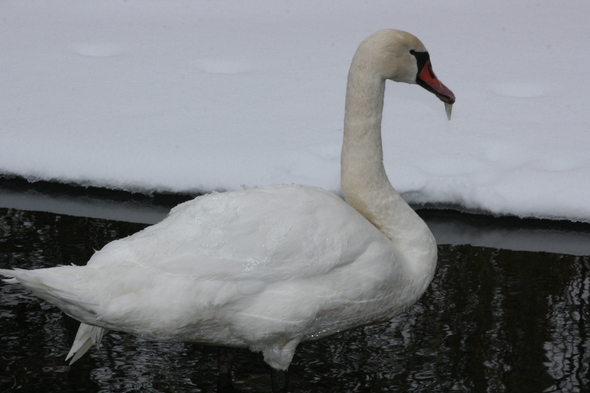
A possibly injured mute swan at Mill Pond Park in Saline.
Lisa Allmendinger | AnnArbor.com
The fate of the possibly injured mute swan in Mill Pond Park in Saline will be left up to Mother Nature — or concerned citizens — following a vote Thursday by the state's Natural Resources Commission. The vote bans wildlife rehabilitators such as Carol Akerlof from assisting and releasing mute swans back into the wild.
“Mute swans shall not be released back into the wild in Michigan,” the new mandate states.
In addition, mute swans and their eggs and nest may be taken by Department of Natural Resources and the Environment personnel and those authorized by the department to control mute swans to reduce the invasive species' ever-increasing population.
The swans compete with state-threatened common loons and other native waterfowl for nesting areas, destroy aquatic vegetation, and as the swan population has grown, so has the swans' conflict with humans, according to the state.
"Reported attacks on humans in boats and on shore have become increasingly frequent throughout the state," according to a letter from Rodney A. Stokes, chief of staff for the state's Department of Natural Resources and Environment.
People began calling Akerlof, director of the Bird Center of Washtenaw County Inc. last month after someone saw an icicle hanging from the bird's mouth. Other people who spotted the swan and were concerned about its welfare also contacted her.
“I’m kind of numb because the decision is so new. I’m praying that someone doesn’t call me about a swan," Akerlof said,
Mute swans, recognizable by their bright orange beaks, were brought to the United States from Europe, and their numbers have increased from 5,400 in 2000 in Michigan to about 15,000 in 2010, the letter states.
The recently enacted order “removes the need for written approval for designated partners to assist the department in the removal of mute swans when beneficial to Michigan’s natural resources,” according to the letter.
It states mute swans can be removed from an area for the following reasons:
- To stabilize or reduce the mute swan population or to prevent new populations of feral mute swans from being established in this state.
- To prevent mute swans' interference with the establishment, reestablishment or reproductive success of native wildlife, native vegetation or endangered or threatened species
- To protect health, safety or welfare
Akerlof said her hands are tied when it comes to helping the Mill Pond Park swan.
Concerned Saline residents have been feeding the swan loose leaf organic lettuce and corn, but several swan watchers said Friday they had not seen the bird recently.
Should Akerlof capture the bird, she’d have to take it to be euthanized, so she’s hoping that people will continue to feed it.
“Ordinary people can help it,” she said, and they could even capture it and take it to a veterinarian if they are still concerned about its welfare.
Disregarding the new mandate could cause her to lose her state-issued license, which she’s had since 1984. The center’s 90 volunteers and summer student interns handle about 2,000 calls a year and in 2009, worked with 830 birds.
The state estimates that there are about 15,500 mute swans in Michigan. In 2000, that population estimate was 5,400.
In the summer, there are usually two pairs of mute swans at Mill Pond Park, neighbors say, but in the winter, these swans tend to head to more open water.
Lisa Allmendinger is a reporter with AnnArbor.com. She can be reached at lisaallmendinger@annarbor.com. For more Saline stories, visit our Saline page.
Comments
fishjamaica
Mon, Feb 14, 2011 : 6:55 a.m.
@ Chapmaja- we have very liberal hunting seasons for canada geesehere in Michigan, around 100 days a year.The seasons are timed to help reduce the population of "resident geese". Just not enough hunters out there. If Ann Arbor schools would offer hunter safety, perhaps we could get more people involved in hunting and help reduce the population of these pesky, edible creatures.
jns131
Sun, Feb 13, 2011 : 6:52 p.m.
Sounds like another trail of tears revisited. Man needs to leave stuff like this to nature. If we do not interfere the birds will go elsewhere. Just like the dandelion. This was a species of Europe. Now it is an invasive species. Who cares. Leave the dandies alone and they go away in July. If we do not feed the Canadian Geese they will go home. So there to fore? The swans will too. Sad plight we have done to these beautiful birds.
blph
Sun, Feb 13, 2011 : 12:58 p.m.
I would like to make one correction to the story. I have lived in a home along the Saline River for 24 years and have never seen more than one pair of swans. However, by the end of the summer, the cygnets are large enough to appear to be adults. And, from time to time, a pair of swans who are migrating stop on the river for a day or two.
TrueBlue90
Sun, Feb 13, 2011 : 4:14 a.m.
Maybe we need a "short hunting season" to eradicate members of the so-called "human" species who are sick or defective!!
Joe Wood
Sun, Feb 13, 2011 : 2:36 p.m.
That is a dumb thing to say.
jcj
Sun, Feb 13, 2011 : 2:10 p.m.
The story is about invasive species. So you would have to look at that human element. And there are plenty!
timjbd
Sun, Feb 13, 2011 : 1:40 p.m.
Or healthy ones.
DBH
Sun, Feb 13, 2011 : 12:32 a.m.
I thought so, too, but apparently Canadian Goose is acceptable (though not preferred). See <a href="http://dictionary.reference.com/browse/Canadian+goose" rel='nofollow'>http://dictionary.reference.com/browse/Canadian+goose</a>. Perhaps it is similar to the acceptable (though not preferred) spelling for minuscule, "miniscule." I think it comes down to: When enough people do/say/spell the wrong thing/word/phrase often enough, it becomes acceptable. Fortunately, this usually does not apply to criminals.
TripleVSix
Sat, Feb 12, 2011 : 9:07 p.m.
It's "Canada Geese," not "Canadian Geese."
Urban Sombrero
Sat, Feb 12, 2011 : 9:02 p.m.
Poor little things can't even cry for help, being mute and all.
timjbd
Sat, Feb 12, 2011 : 7:05 p.m.
How often do you ever hear a common loon anymore- let alone see one? I'd find it hard to believe that swans have pushed them out, though. How do swans and geese taste? I'm a vegetarian but maybe a short hunting season IS the answer. At least they are free-range™..
Epengar
Sun, Feb 13, 2011 : midnight
Swans and geese are good to eat, and there is a legal hunting season for most goose species (including Canada geese) in Michigan. If the native swans weren't so rare (thanks to overhunting and habitat destruction) we could hunt them too.
Stephanie
Sat, Feb 12, 2011 : 6:25 p.m.
heartless...
Ben Connor Barrie
Sat, Feb 12, 2011 : 5:50 p.m.
I think this is a good, but difficult decision. Hopefully residents will quit feeding the mute sawn and let nature take is course. If the mute swan population can be reduced or eliminated in the state, we will likely see an increase in the native trumpeter swan population. Trumpeter swans "play nice" with other waterfowl species. Mute swans drive away our native swans, ducks and geese. It is sad because we see the swans as beautiful and majestic we find it difficult to make a decision that ultimately preserves and strengthens our natural communities. "A thing is right when it tends to preserve the integrity, stability, and beauty of the biotic community. It is wrong when it tends otherwise." Aldo Leopold, Land Ethic
chapmaja
Sat, Feb 12, 2011 : 5:10 p.m.
I think this policy is a good policy since we are talking about an invasive species. As for the Canadian Geese. I think there need to be more controls put in place for geese populations as well. The Geese, while a native species are just as, if not more damaging than the swan's are simply because there are so many. Maybe there needs to be an additional hunting season for geese to help lower and control the population.
mireader
Sat, Feb 12, 2011 : 4:42 p.m.
Canadian Geese are aggressive, but we have to put up with them everyhere because they're "native?" No thanks.
DDOT1962
Sun, Feb 13, 2011 : 2:02 p.m.
lol @timjbd
Epengar
Sat, Feb 12, 2011 : 11:57 p.m.
There is a hunting season for Canada geese, and legal methods of controlling them.
timjbd
Sat, Feb 12, 2011 : 9:40 p.m.
Are those the ones with mullets that you see at hockey games?