

Saline school district revamps Alternative High School to boost success
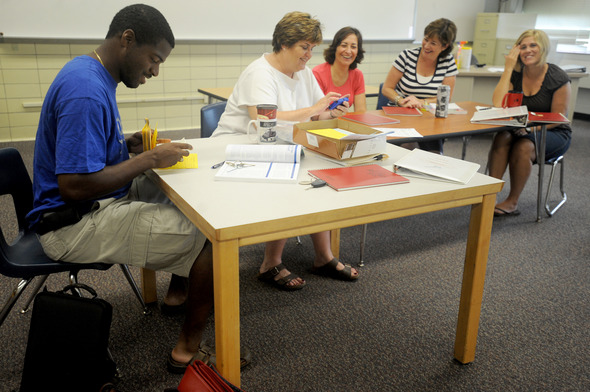
Principal Carol Melcher, second from left, plans many changes at Saline Alternative High School. Here she discusses plans for the upcoming year with, from left, school social worker Jason Pickett; para-educator Nancy Miller; counselor Cathy Redies; and para-educator Tracy Lamb during an organizational meeting.
Angela Cesere | AnnArbor.com
Editor's note: This story has been updated to correct a name in the caption and the age of the school.
Mike Rothman is a testament to the importance of alternative education programs. As a freshman at Saline High School last year, he felt lost in a sea of 1,800 students. By the end of the first trimester, he was failing three classes. In classrooms of 30 students, he couldn't get the individual instruction he needed.
“I didn’t really care about the homework,” he admitted. “I figured if you have me trapped in that school for seven hours I’m not going to go home and spend five more hours doing this ton of stuff.”
But at Saline Area Schools' alternative high school, he made a dramatic improvement in an environment where help was readily available. “You don’t even really need to ask,” he said. He made up his lost credits and started to enjoy school.
But many students have not had that kind of success. In its 13 years of existence, Saline Alternative High School's best graduation rate was 48 percent. On average, it’s about 20 percent.
That's in a district that consistently produces some of the best test scores in Washtenaw County and in the state of Michigan. So the district is revamping the school and has hired a full-time principal. Carol Melcher has worked with the district for more than 20 years, mostly in special education.
“We weren’t happy with the overall graduation rate, the end result,” said Saline Superintendent Scot Graden. “The program needed some fresh ideas and Carol’s provided that.”
Because Melcher has done a lot of work in the special education departments, “she’s used to making accommodations so that students can be successful,” Graden said. “That’s really what the alternative program is. Making accommodations to our instructional program so that students can be successful.”
Accommodating students
Students at the alternative high school fulfill all of the same educational requirements mandated by the state, just like their peers at the traditional high school. This year, two teachers, two para-educators, and one principal will lead 50 to 75 students.
But the alternative program is set up so that students work at their own pace in courses through e2020, an online learning school. The program had used the e2020 courses in the past for most classes, with a few teachers providing instruction for classes such as English. Starting this fall, all core classes will be online.
Many of the e2020 lessons consist of an interactive PowerPoint presentation, quizzes and activities. Students can access their quiz results, learn what questions they missed and why, and even retake quizzes to fix their mistakes. Instructors monitor how a student is progressing through a course, and can tell if a student is actively engaging in an online class or goofing off on the computer.
Sam Tumulo, 19, liked the online classes because they helped her work at her own pace, and because she found it easier to catch up after absences. Tumulo has dyslexia and sometimes suffers from depression. Dyslexia made it hard for her to keep up, and she was hospitalized for depression twice.
When she returned to school, she wasn’t overwhelmed by the workload because it was all available online. She was also surprised by how much support the staff gave her. “They would really make it seem like I was really wanted. They really encouraged me,” she said. “They would even call me at home to see how I was doing.”
Tumulo graduated a year early and has completed a year at Washtenaw Community College. This fall, she will study graphic and website design at Ferris State University.
Tumulo said that by the time she graduated, she had more than friends: she had a family. She felt close to the teachers and to many other students. Catherine Redies, who works as a teacher and counselor at the school, said the strong relationships are key to giving students the confidence they need to get to graduation. “Rarely do they ever go back to the high school because they like this environment,” she said.
Tumulo knew of students whose parents dealt drugs. She knew of students who had to work to pay for their own apartments. She knew of students who were homeless.
She knew of one student who was good in school but didn’t show up often. “I found out that she had to work because she had to keep this apartment, because there were several students living with her because they had nowhere else to go. She was driving them to school, she was buying them food,” Tumulo said.
This is one reason that the alternative school is important, Graden said. “I don’t want to stereotype the students that we have in our alternative program, but from the Saline perspective they tend to be of higher need.”
Redies said on average, a quarter of the students in the alternative high school receive free or reduced lunch. At Saline High School, that number is less than 5 percent.
Being of higher need makes success all the more important for these students. Tumulo graduated with a lot of “super seniors,” students who take more than four years to graduate. “To see their faces, when they finally got their diploma… Some were 20 years old. They just didn’t stop because they wanted some kind of success,” Tumulo said proudly.
Closing campus, strengthening connections
But in order for students to graduate, they need to attend school. One of the biggest problems at the alternative school has been attendance. Attrition was so high that often it was difficult to tell who was still enrolled. Melcher plans to address the issue by creating “families.” Families will consist of one teacher and five to 20 students. Families will meet each morning. Melcher hopes students will form stronger relationships with each other and with teachers. She hopes the family will give them a reason to show up to school every day.
“This may be the only strong relationship that they’ve ever had in their young lives,” Melcher said. “We want to make sure that that is first and foremost; that they know that we’re there to help them succeed, and all we need is a little bit from them and I can pose a guarantee: that if you attend consistently, if you follow the rules, you will graduate.”
Another way to address the attendance problem is by keeping kids on campus once they get there. For the first time this fall the alternative school will be a closed campus. In the past, students enjoyed an open campus, taking breaks when they felt like they needed them, and going out to lunch.
“They like the freedom but they were too young to handle the responsibility,” Redies said. “So I think closing campus—they’re all going to hate that. But it’s going to be in their best interest.”
One reason that students went out to lunch so often is that the lunch wasn’t great. It was delivered from the middle school, and by the time it arrived, it wasn’t in the best condition.
“The grilled cheese might be good when you make it, but let it sit for half an hour before these kids get it,” Redies said. Students often avoided the hot food and opted for salads, but even the salads weren’t always fresh, Rothman said.
This fall, Melcher hopes to offer a life skills course in which students order, prepare and serve lunch. She is working on establishing a kitchen and the course. The class would be part of the service learning component that Melcher is requiring of all students starting this fall.
Melcher describes service learning as getting students involved in hands-on activities to give them real-world work experience. She is talking with local businesses about the idea.
Students will be able to put this job experience on their resumes, which is another requirement Melcher is implementing this fall. Students will graduate with a resume, created in a format that will be transferable to the web.
“They will have something that they can take with them and show future employers or future college admissions folks what they’re able to do,” Melcher said.
Melcher also wants each student to create an Educational Development Plan with her or Redies’ help. All classes that a student needs and service learning to explore a student’s career interests will be on the EDP.
Melcher also wants to change the way students think about the school.
“In the past, students were placed there almost as a punitive measure for not succeeding in the traditional high school,” she said. “I want to put a positive bent on it that it is really a place where the nontraditional student could succeed, but not a place where students who were choosing not to succeed at the high school were placed because they were not making progress.
“Even though we’re offering the students lots of opportunities that haven’t been there before we’re also asking a lot more of students too,” she said.
Tara Cavanaugh is a freelance reporter for AnnArbor.com. To reach the news desk e-mail news@annarbor.com or call 734-623-2530. To read more Saline news, visit our Saline page.
Comments
saline
Tue, Sep 7, 2010 : 8:47 p.m.
As a former student of saline alternative, I am glad they are starting to think about the alternative program not just dumping the kids they don't want to deal with anymore. in my opinion they do not need their own principle.. and should not do mostly online classes. most of the kids that want to go there go for the more one on one teaching not to do a bunch of classes online. The biggest mistake they could have made was to move Ms. Marsh out of the alternative program. she is the one who was always there for us and pushed us to do our best. I was saddened by the news that she was taken out of the program and feel that they have made a HUGE mistake. Best of luck to the new and returning students of Alt Ed! you can do it! To Ms. Marsh, I hope you love your new position in the district and wish you the best! Thank you for all that you have done, you have touched more lives then you know!
Lentz
Tue, Sep 7, 2010 : 8:47 p.m.
I can understand wanting to make things better for the children. But this "revamp" was the absolute WRONG way to go about it. I went to an alternative school, and the ONLY thing that helped me was the one on one interaction with the teachers. Having 2 teachers and 2 para-pros for 50 to 75 students? Um, no. I remember when there were 10-12 students PER CLASS! And these kids that DO have learning disabilities? They are the ones that need the one on one MOST! You are putting MORE kids into a class with LESS teachers? Sitting a kid in front of a computer all day expecting them to do what they are supposed to do? Um, no. What kid is not going to take advantage of being on the computer to do everything BUT school work? I watched Saline Alternative Ed grow, and they did have their ups and downs, but I think that the school itself was at it's peak. The school board has been wanting this school to go down in flames since day one. Sending kids that are two credits behind in regular high school to alt ed? What for? You are taking the TRAINED TEACHERS of ALTERNATIVE EDUCATION away from the students who need the most help? I HOPE for these kids sake, that things will go well. BUT, you took away some of the GREATEST teachers, who have impacted SOOO many children's lives in the TWELVE years that this school has been around, teachers that were schooled and trained in alternative education, teachers that knew how to deal with learning disabilities, and troubled teens. Good luck to the kids of Saline Alternative Education for the 2010-2011 school year... You will need all the luck you can get...
Susan D.
Thu, Sep 2, 2010 : 2:24 p.m.
Ms. Melcher is not just the principal for the Alternative HS, she is also the Director of Special Education for all middle school and high school students for the Saline Area Schools.
K2
Thu, Sep 2, 2010 : 8:51 a.m.
Kudos to those who are trying to make a meaningful difference by sharing the good educational opportunities to ALL the Saline Students. Thanks, to Superintendent Graden, for recognizing the need and rising to the challenge. And shame on those willing to bicker over the fractionary cost of doing so. Its no doubt that those complaining come from finer homes than some of those in need. How about forking out another 100K for two more teachers. You get what you pay for and more gets you better! Im a K-12 graduate of Saline Schools and have always bragged about the quality of my education. Saline is a bigger town now and with that growth comes a larger variety of students, ALL of whom deserve that same great quality of education. Good luck with the Cafe idea, its a great one! Let that be your legacy to the program, Melcher!
JBizzle81
Mon, Aug 30, 2010 : 7:28 p.m.
Good edit Tara but the best graduation percentage rate is still off. The first two years the percentage rate was more like 80% I know this because I was there both years. In those two years, the kids who attended were good kids who just needed the extra help to succeed. I'm willing to bet that the reason the rate is at 20% now is because the Saline High School has been dumping all the bad apples there instead of the kids who need the help and arent there to cause trouble. I owe my life to the Alternative School, Ms. Marsh and Mr. Beach for making sure I stayed on my game and getting my diploma.
Huh?
Mon, Aug 30, 2010 : 2:42 p.m.
Saline Alternative could be a really great school. They have the opportunity to be progressive, innovative and unique. From my experience, the school has not received good support from the district in the past. They should embrace what they are and be proud of it! They are in a position to help a number of at-risk kids succeed. They definitely need more resources...TEACHERS and COUNSELORS! Online learning can be beneficial, but it should not be the sole source of education for these kids.
JBizzle81
Sun, Aug 29, 2010 : 4:50 p.m.
The Alternative School in saline has been in exsistance for more than 8 years Tara. The school opened in August of 1998 and I attended the first two years. The school was a success while I went there with all of the seniors graduating on time and most of the underclass reaching their goals also. It was the best thing that happened to alot of us as the school and its staff allowed us to get the extra help we needed to graduate on time. It seems as though in the last few years it has become a dumping ground for bad kids and not the kids who need the help the most. Letting Ms. Marsh go is also a very very big mistake!
A2CarGuy
Sun, Aug 29, 2010 : 12:58 p.m.
Tens of thousands of dollars "is not going to be a problem"? We've gone from needing to pass a bond to it's "not going to be a problem"? We've gone from laying off teachers to "it's not going to be a problem"? I hope I'm not hearing here that this person is going to be working as a special ed teacher (Saline has lots of very good ones) but being paid as a high school principal. That would mean this wasn't just an inefficient staffing move, but it could be in violation of at least one collective bargaining agreement. Try something like that in the private sector and you'll get grievances, discipline of the people who made and signed off on the assignments, and a possible investigation from the feds. The fact that additional students will bring additional funding doesn't excuse a staffing decision that is, at best, wasteful. That funding would come in just as well with other methods that didn't involve putting a $100,000 "principal" in charge of 50 students.
Fat Bill
Sun, Aug 29, 2010 : 11:16 a.m.
I seriously doubt Mrs. Melcher will be spending her time piloting a desk. These kids tend to need the extra attention, and I seriously doubt the difference between a skilled special ed teacher and a principal's salary is going to be a problem. $12 per hour truant officers rounding up kids has not worked, this is not jail... Remember that these kids will bring in over half a million dollars in school aid funding. Given the net cost of hosting mostly online classes, it is conceivable that they will bring in more money than will be expended.
A2CarGuy
Sun, Aug 29, 2010 : 9:39 a.m.
It's great the district is trying to do better for these kids. Two teachers and two TA sounds like lean staffing for 50-75 students. But a full time principal?? That person will make in the neighborhood of $100,000 a year! Most likely will be one of the highest-paid people in the county. For 50-75 students taking online classes? How do the rest of us sign up for a job like that? Wouldn't those kids be better served with two teachers? Or four teaching assistants? Or a few $12/hr attendance officers and on on-site cook? Obviously the people who made this decision weren't thinking about what was best for the kids. Where is the oversight?