

Saline Area Schools puts a new emphasis on literacy
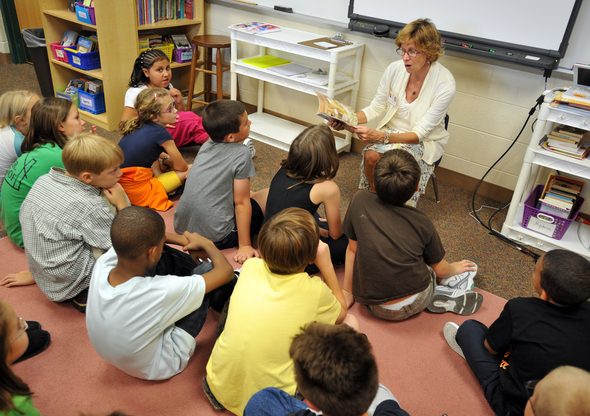
Mary Jane Tramontin, a fourth-grade teacher at Heritage Elementary School in Saline, reads Sarah Stewart's book "The Gardener" to her class as part of their Reader's Workshop Wednesday afternoon.
Lon Horwedel | AnnArbor.com
Through a program called Reading Workshop, Saline teachers will use a series of mini-lessons to help each student progress at his or her own reading level. Teachers will also adopt uniform standards in assessing student reading progress, so students are monitored consistently between grades.
Reading Workshop was developed by the teacher’s institute at Columbia University. Teachers using the program say it's not a revolutionary concept. Instead of all students reading the same story for a lesson, students will read books at their particular level. Steve Laatsch, assistant superintendent for instructional services, said the program aims to get kids reading books that are “just right” for them.
“Kids don’t progress in literacy if they’re reading at a level that is completely frustrating all of the time,” Laatsch said.
Debbie Kolacki, a kindergarten teacher at Harvest School, said the approach is “very developmental… If I have a reader, I can move him along, but if I have a child who doesn’t know letters or sound, I can move him along too.”
Teachers need to determine the student’s reading level, and then provide lessons and reading materials that are best for that level. Mary Jane Tramontin, a fourth grade teacher at Heritage, prepared for the start of school and the Reading Workshop program last week by labeling the books in her library by level.
Laatsch said Saline students consistently score well in reading on state tests, but teachers were often using different methods of assessing student reading levels.
“There are all sorts of assessments out there,” Laatsch said, “so this makes sure that they’re being uniform.”
Laatsch estimates at least half of those who teach literacy — elementary teachers and middle school language arts teachers — are working Reading Workshop into their lesson plans this year. He said the goal is for all teachers who deal with literacy to use it in their classrooms next year.
Comments
Mertie
Fri, Sep 10, 2010 : 5 p.m.
BTPud- I didn't say that it was a bad school district- my grandson goes there. I just stated that why is there a new emphasis on something that should be a given. My son, again, who is not an overachiever, was reading Louis L'Amour westerns in 5th grade as his choice and then a little later progressed to Steven King novels. I did read the article but didn't really think that this was newsworthy. All school districts should be doing this now. If my child was in a school district that was not using this principle I would be knocking on their doors.
Mr. Common Sense
Thu, Sep 9, 2010 : 11:11 a.m.
I had a hard time reading this article...
ViSHa
Thu, Sep 9, 2010 : 9:56 a.m.
i know this story is about literacy, but what really drives me crazy is the de-emphasis on correct spelling. even in middle school many teachers tell the kids not to worry about spelling words wrong. i know we all have spell-check, but i still think it is important to spell correctly. also, about the literacy, it is so much easier to find books that interest my daughter than my son. Boys are starting to have more choices with the Lightening Thief series and the Wimpy Kid series, but it seems girls have way more books to choose from.
BTPud
Thu, Sep 9, 2010 : 9:31 a.m.
Mertie- Saline has always been a good school district when it comes to literacy. I can attest to that both a graduate myself, who consistently read at a high reading level, and as a parent of a SMS student who is reading at a college level and more or less enjoys the same books I do. If you read the article, not just the headline (which is rather misleading) the focus on literacy remains, they are merely standardizing how reading levels are assessed, so that students like my son end up reading books that are challenging and interesting to them, rather than being forced to read a book simply because it's at the level of some other kids in the class, and students who aren't the greatest readers will be able to read something at their level, rather than struggling to keep up. By matching the child with a book that fits them, I think the kids will remain more interested and learn more.
Mertie
Thu, Sep 9, 2010 : 8:25 a.m.
Duh...Shouldn't there have been an emphasis on literacy all along..including the two other "R'"- writing and 'rithmatic. In Milan schools 23 years ago my then second grader son was reading at a 5th grade level and enjoying it (thanks to his teacher).
Brendhan Givens
Thu, Sep 9, 2010 : 5:36 a.m.
Because literacy is a key to learning, I'm very excited to hear about the renewed vigor in reading!! My son is a seventh grader at Saline Schools, and I want him to be a *great* reader. It will help him understand his math story problems too! I wanted to specifically call out this partial sentence: "....the program aims to get kids reading books that are just right for them." Very nice idea! But how do you do that? I'd like really like to know!