

Secretary of state candidate Jocelyn Benson calls on help from University of Michigan students
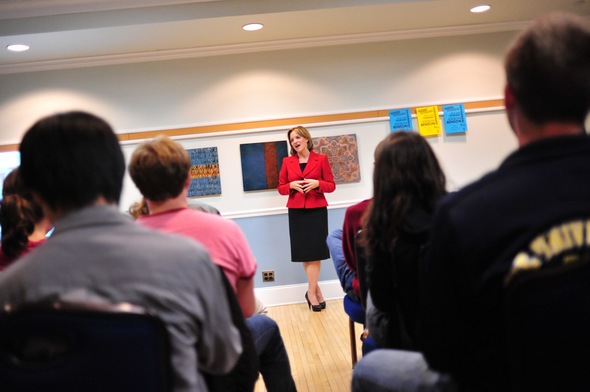
Michigan secretary of state candidate Jocelyn Benson, a Democrat, called on University of Michigan students Thursday night to be the 'secret weapon' in her campaign. Benson is down in the polls, but popular among young voters.
Ryan J. Stanton | AnnArbor.com
Michigan secretary of state candidate Jocelyn Benson borrowed a page from the playbook of Virg Bernero on Thursday and showed up unannounced at the office of her opponent, Oakland County Clerk Ruth Johnson, to pressure her into setting a date to debate.
Benson, a Democrat, walked away empty handed, but later on Thursday the two sides apparently agreed to meet next week to work out a deal.
Benson, a Wayne State University law professor who has accused her Republican rival of ducking invitations to debate, made a stop in Ann Arbor Thursday night to talk about her campaign with the College Democrats at the University of Michigan.
"The real secret weapon of our campaign is all of you," she told the crowd of about 60. "Just like in 2008 when your generation elected a president, in 2010 you will have an opportunity to ensure that the next generation of leadership in Michigan is one that can directly help you."
A new poll shows Michigan Republicans are ahead in races to keep control of the offices of attorney general and secretary of state in the 2010 election.
In the race for attorney general, former appeals Judge Bill Schuette, a Republican, leads his Democratic rival, Genesee County Prosecutor David Leyton, 39 percent to 25 percent, with 31 percent undecided, according to the survey of 600 likely voters.
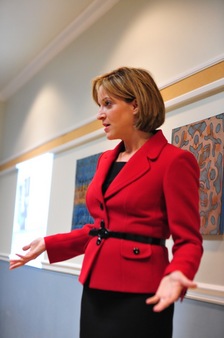
Benson promises to improve customer service at secretary of state branch offices by creating a "Plan Ahead, Skip the Wait" program.
Ryan J. Stanton | AnnArbor.com
Johnson leads Benson 31 percent to 25 percent in the secretary of state race, with 39 percent undecided, according to the poll. But voters aren't well educated about the candidates yet — only one in four voters surveyed had heard of Johnson or Benson.
Benson commented on the poll during her stop in Ann Arbor, noting that the two Republicans currently lead among all age groups — except among young people. Benson was ahead among voters under 40, while Leyton was ahead among voters under 30.
Benson noted that she quickly is closing the gap in the polls.
"A week ago it was 15 points, now it's a 6-point difference," she said. "And the key to winning, for both Democrats and for our own campaign, is going to be young voters turning out."
Benson, a Detroit resident, told U-M students that's where they will play a crucial role in the next six weeks leading up to the Nov. 2 election. She mentioned that her husband, Ryan Friedrichs, is a U-M graduate and actually started Voice Your Vote, a commission of the Michigan Student Assembly that engages in outreach and gets students registered to vote.
"With young people working together with our campaign, we will win," Benson said. "And that's how I want to win. I want to win with the student generation. We all have a stake in Michigan's future, a real stake. We need to see the state turn around. We need to ensure that this is a state where you can stay and invest and work. Michigan used to lead the way in so many things."
Republican Secretary of State Terri Lynn Land has been in office for eight years. She was elected in 2002 with 55 percent of the vote and reelected in 2006 with 56 percent.
Benson criticized Land's track record and promised to be "someone who's going to fight for voters." She said she would fight fraud and end deceptive practices with elections in Michigan, and would work to promote accountability and transparency in government by supporting no-reason absentee and early voting and increasing disclosure of campaign contributions.
Benson told students she specifically would work to repeal Rogers’ Law, which requires voters to have the address listed on their driver’s license match the address on their voter registration card. The law is seen by many Democrats as a barrier to voting for college students. Proponents of the law, however, say it alleviated complicated voter registration lists.
Benson's Record
- Successfully led an effort in 2007 to block the closing of a Secretary of State branch office near Saginaw, convincing the U.S. Justice Department that the closure violated the Voting Rights Act.
- During the 2008 election, was called to testify before the U.S. House Judiciary Committee, where she called on Terri Lynn Land to ban the use of foreclosure lists to challenge voters' eligibility on Election Day.
- Developed and supervised two statewide nonpartisan election protection efforts in Michigan in 2007 and 2008.
State Rep. Rebekah Warren, D-Ann Arbor, has introduced legislation to repeal the law multiple times. The bill has failed to get past the Republican-controlled Senate.
"We need to ensure that all of you can choose to vote where you live and where you reside," Benson told students. "And if you want to register to vote at your college, you should be able to do so without having to change your driver's license address."
Benson said she would create a youth advisory council on which college students would serve. She said she would meet with them regularly to get feedback on important issues.
Benson also said she would create mobile branch offices that would go to universities and register students to vote and provide easier access to licenses and other state services.
In her campaign literature, Benson vows to eliminate unfair drivers fees, investigate overcharging of licensing fees and allow opportunities for multi-year license plates.
She also promises to improve customer service at secretary of state branch offices by creating a "Plan Ahead, Skip the Wait" program to allow residents to make an appointment ahead of time. Another program she proposes involves opening "job service centers" in branch offices with information on job openings and starting new businesses.
Benson, who holds a law degree from Harvard, began her career as an investigator for the Southern Poverty Law Center, investigating hate groups and hate crimes throughout the country. Today she teaches election law at Wayne State and has authored a book on the role of the secretary of state in enforcing election and campaign finance laws.
Ryan J. Stanton covers government and politics for AnnArbor.com. Reach him at ryanstanton@annarbor.com or 734-623-2529.
Comments
Rob T
Sat, Sep 25, 2010 : 12:37 p.m.
Unable to find the source for a fraud rate of below 0.001% in Kansas elections, but this study from NYU Law includes several cases studies and attempts to analyze the impact of ID check laws and other voting restrictions. http://www.truthaboutfraud.org/pdf/TruthAboutVoterFraud.pdf (PDF)
Rob T
Sat, Sep 25, 2010 : 12:18 p.m.
Here's a citation for the level of voter fraud in Kansas: seven cases in seven years. The office of SoS was held by a Republican until 16 March 2010, so a Republican administered the office during most of these years.
Rob T
Sat, Sep 25, 2010 : 12:15 p.m.
It is so much harder to vote in Michigan than it is in any other state I have lived, and I know people who have been disenfranchised by early registration deadlines, onerous ID requirements, and the like. Before moving to Michigan, I voted in Kansas and Minnesota. Both states had Republican SoS candidates claiming that lax voting requirements permitted widespread voter fraud and even allowed illegal immigrants to vote. Not one candidate could substantiate their claims, and audits of voting records in Kansas showed very few suspect ballots (fewer than one in every 10,000). Roger's Law simply serves to disenfranchise students, voters who move frequently, and people with limited access to state services. It's not pure coincidence that these populations skew Democratic and Roger's Law was drafted by Republicans.
InsideTheHall
Thu, Sep 23, 2010 : 9:27 a.m.
The young will wise up when they have to get out on their own and are weaned from the parental bosom. After 8 years of DEM rule in Michigan and now the failed Obama policies the young will soon realize it is not utopia they will flee from the DEMs. As college grads settle for service work because they cannot get a job in their field of study they will see the DEM armor up close and see the rust of a failed liberal ideology.
Killroy
Mon, Sep 20, 2010 : 1:02 p.m.
"Benson promises to improve customer service at secretary of state branch offices by creating a "Plan Ahead, Skip the Wait" program." Nonsense, going to Sec of State in Michigan means sacrificing 2-3 hours to get anything done. I actually had a to leave work early just to do a title transfer and get tags. Compare that to one 5 minute phone call to get insurance and proof of insurance faxed to the Sec. of State office!
Scylding
Sat, Sep 18, 2010 : 11:37 p.m.
@Speechless: glad to see that you admit that the Chicago political machine is the archetype of political corruption, since it gave birth to the man in the oval office right now. :-) Couldn't have set that one up better myself!
Scylding
Sat, Sep 18, 2010 : 11:28 p.m.
Great, she wants to spend taxpayer funds to "create mobile branch offices that would go to universities and register students to vote" so that Democrats will be more likely to win in future. Nice. So, how would Dems like it if Repubs blew hundreds of thousands (maybe more) of taxpayer dollars on getting creative in registering Republican voters? Not only are her motives corrupt, she brags about it like it's something to be proud of! Is she makin' ya proud, Ann Arbor libs?
Speechless
Fri, Sep 17, 2010 : 12:54 p.m.
Why not call the Rogers' Law for exactly what it is: A Jim Crow rule for on-campus college students in Michigan. Good for Joycelyn Benson for wanting to toss this trash legislation into the dustbin of history. Here she appropriately extends discrimination-fighting principles from her days in the Southern Poverty Law Center to a relevant issue under the purview of the Secretary of State office. Sure, students living on campus can usually vote absentee in their town of origin, but that should be an option determined by voter preference, not a virtual requirement under the law as it is now. Rogers' Law applies the principles of the Old South to "drive away" student voters for the benefit of Republicans and conservative Democrats running for office in districts near college campuses. This law might as well include a literacy test, too. ------------ As a red herring argument, another writer above seems to imply a natural link between on-campus student voting and a form of voter fraud which exploits absentee balloting. This could be read to falsely imply that Rogers' Law functions as a good-government reform, rather than as politically opportunistic disenfranchisement. Particularly in the age of computers, there's no excuse for state and local governments not keeping track of where someone votes and whether they've already cast an absentee ballot. Also, election corruption has a long tradition in Illinois, especially in Chicago. Among others, Richard Daley the First was noted for the strong voter support he received from cemeteries and vacant lots. To place a heavy initial emphasis on African American law students and Jesse Jackson, Jr., shows an obsession with racial stereotypes more than ending voter fraud.
xmo
Fri, Sep 17, 2010 : 9:12 a.m.
Benson sounds like a slimmy canidate. Her wanting to repeal Roger's Law is typical of how low the DEMOCRATS have to go to win. Why would you want to debate somebody who is not HONEST? Jocelyn Benson craw back into your hole and leave us alone!
InsideTheHall
Fri, Sep 17, 2010 : 7:44 a.m.
Well, if you can't get adults in the real world to vote for you go after the young who are most likely still on the parental dime. The DEMS seek to transfer the young from the parental dime to government dependency by handing them a few crumbs.
ChrisW
Fri, Sep 17, 2010 : 7:29 a.m.
After waiting more than 2 hours at Ann Arbor's secretary of state branch a month ago, it's time to vote for the Democrats this time around. Multiyear plates are long overdue and we should be able to register vehicles by mail/internet/fax as well. One downside to term limits is that the lame duck in charge has no reason to improve services.
Chase Ingersoll
Fri, Sep 17, 2010 : 7:06 a.m.
When I was in graduate school at the University of Illinois with Jesse Jackson Jr, members of the Black Law Student Association returned from the polls in Champaign, Illinois and laughed in the halls of the Law School how they had voted in Champaign, even while they had cast absentee ballots in Chicago. 18 years later, my classmates who were openly committing voter fraud and violating the civil rights of every voter are along with their classmates who looked the other way are: in public office; officials in bureaucracies; partners in well connected private firms. Back in my hometown over lunch with an Insurance Agent that served on the City Council and County board I discussed what was going on at the University of Illinois and he advised that his daughter who was in Graduate School in St Louis had also observed open and widespread voter fraud including the election workers filing out ballots of anyone on the voter rolls who had not shown up at the polls. How can we expect a democratic system that tolerates cheating at the ballot box to not elect the biggest cheaters and those cheaters to not enact laws that are nothing but fraud/abuse against those who did not cheat at the ballot box? Your secretary of state and attorney general are the offices that protect the value of your ballot access. All candidates for these offices need to be asked questions on this topic. I don't from this article, that these questions are being asked.
jcj
Fri, Sep 17, 2010 : 7 a.m.
Sounds like a be all save all candidate! If your a college student. Another that has to grandstand at an opponents event to get an audience! Not the kind of candidate I want in office. Promise the moon to get elected.
stunhsif
Fri, Sep 17, 2010 : 6:07 a.m.
Repeal Roger's Law Eh. That alone Ms.Benson will ensure I vote for your opponent. Good Day