

Advice for Ann Arbor drivers: Clear your windshield in the winter
Seeing clearly while driving is a necessity. A clean windshield, windows and mirrors - coupled with an uncluttered dashboard area - can make anyone a much safer driver.
Keep your windshield as clean as possible both inside and out. Glare produced by a dirty windshield causes eye strain and fatigues the driver. In addition to keeping a clean windshield, keep the dashboard clear of objects - especially light-colored paper objects, which reflect up into the windshield and can limit vision.
In the winter, 5-10 minutes should be added to normal drive times to clear the windshield of frost, snow and ice. Remember to clear more than a 3-inch square near the defroster before departing. Clear the entire windshield, side windows, mirrors and rear window. Remove the snow from the hood, so it won’t blow back and frost over the windshield once you're driving.Â
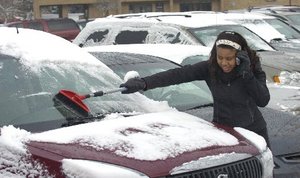
Chamel Douglas, an Eastern Michigan University student from Southfield, brushes the snow off the windshield of her car in the Briarwood Mall parking lot in this 2007 file photo.
Driving with a frosty windshield is illegal. It's also a pet peeve of most police officers. It is likely if the cops see you  - and remember, you won’t see them because you didn’t take the time properly clear your windows - there may be a ticket issued, or at the very least you'll be clearing your windshield in traffic with a police car behind you.Â
On a bright note, you'll provide a little mirth for motorists driving by chuckling at your buffoonery and subsequent misfortune.
Avoid hanging objects like tassels, crystals or - heaven forbid - drug paraphernalia like “roach clips” from the rearview mirror. The swinging crystals can mimic an emergency vehicle’s flashing red or blue lights when they catch the sun or headlights. The drug paraphernalia blocks a driver’s view and begs an officer to search the car for drugs. Unsecured items that can slide on the dashboard should also be avoided. Â
The point here is to prevent things from sliding or swaying from side to side in the driver’s forward field of vision. Danger will be transmitted to the brain quicker should a child, pedestrian, bicycle or vehicle move into your path. Reaction time will be reduced because the brain won’t have to process whether the movement is a crystal dangling from the mirror or a child running into the street.
Sunglasses are also a necessity for driving, especially in the winter. The rising or setting sun and glare off snow or ice can be blinding. Polarized lenses are most effective for minimizing reflected glare, but any sunglasses are better than depending solely on a vehicle’s sun visors.
Lock it up, don’t leave it unattended, be aware and watch out for your neighbor (who you will be able to clearly see through your clean windshield).
Rich Kinsey is a retired Ann Arbor detective sergeant who now blogs about crime and safety for AnnArbor.com.
Comments
Woman in Ypsilanti
Mon, Dec 21, 2009 : 1:32 p.m.
I like to keep the snow on my roof because then it blows off onto *tailgaters* windshields when I drive. If you get snow on your windshield from the car in front of you, you are driving too close.
bigD
Mon, Dec 21, 2009 : 8:33 a.m.
Being a former 20 year resident of AA I certainly understand the need for this article. Cannot begin to tell you the staggering amount of times I was forced to follow behind someone with snow covered windows and tail lights. As far has hanging stuff from your rear view mirror (I have a handicap plaque myself) not removing the plaque from the mirror before operating your vehicle is the height of laziness and stupidity.
hussflier
Sun, Dec 20, 2009 : 3:34 a.m.
don't eat yellow snow
hussflier
Sun, Dec 20, 2009 : 3:18 a.m.
should i put my left foot in front of my right when i walk?
Rosie
Sun, Dec 20, 2009 : 12:01 a.m.
Yes I agree that it is sad that a reminder needs to be given about these kinds of matters. I would also add that folks need to drive with their headlights on when it is foggy. A few weeks ago when we had a very very dense fog on Sunday morning I counted over 40 vehicles I passed on my way to church that did not have their headlights on. I used my odometer to check the visibility distance that morning and it was 1/10th of a mile and yet all of these people were driving with no headlights on. Many of them were driving white or gray vehicles and were impossible to see. One woman pulled out in front of me in a silver mini-van and luckily I had enough time to avoid t-boning her. As I pulled up next to her I could see that she was more concerned with sipping on her morning drink that worrying about her driving.
bunnyabbot
Sat, Dec 19, 2009 : 10:28 p.m.
What I hate is I take the time to clear off my car, the hood and even the top if there's three or four inches (or it will just dump on the back window) etc and then the guy in front of me didn't bother to do this and the first gust of wind blows all his roof snow onto my windshield. the largest pet peeves are people who don't turn their freaking lights on, don't signal turns or that so many people forget how to drive in snowy or slippery weather from one year to the next.
TXteacher
Sat, Dec 19, 2009 : 6:18 p.m.
The author of this article must have only decided this information was necessary after monitoring the millage debate on this site last month.
djm12652
Sat, Dec 19, 2009 : 5:51 p.m.
I have a better idea Larry, if it's snowing that much, let's all sleep in and meet at the Arena for lunch...buses stop right by there and the bus garage has "people" to scrape the bus windshields...eezy breezy
Larry Diesbach, Jr.
Sat, Dec 19, 2009 : 5:19 p.m.
I see some readers screaming about common sense. However sometimes when its 10 degrees out and you very late for work your so focused on getting where your going there is no room for common sense. However we try to help encourage all drivers to clear the vehicle of debris before we replace a windshield 95 % of them say they will do it and do not. So I wonder is it just common sense or being lazy? Here is an idea if you know its going to snow wake up 1 hour early, that way you have no excuses.
Sara K.
Sat, Dec 19, 2009 : 3:05 p.m.
Is this really necessary? I thought people knew this already. But then again, Ann Arbor doesn't clear most of the snow from its residential streets....at least in my parent's neighborhood between Washtenaw and Geddes...so maybe people don't know this? But seriously...there has to be something more important to write about then the obvious.
TripleVSix
Sat, Dec 19, 2009 : 1:09 p.m.
The pictures tell us a lot about what our world has come to: Scraping the windshield while talking on the phone. Also, among the list of dangerous things to hang from your mirror, which is also illegal I believe, are those big handicapped parking passes.
YpsiLivin
Sat, Dec 19, 2009 : 12:44 p.m.
You would think it would go without saying, but I was very nearly hit head on by a driver whose windows were fogged/frosted over and who couldn't see me until literally the last second. He swerved to avoid hitting me, then skidded most of the way down the hill on Broadway trying to recover.
djm12652
Sat, Dec 19, 2009 : 11:55 a.m.
@akk...you're sooooo right, and don't worry about the mechanical safety either, if the tires are bald as long as they aren't flat you can still drive, as long as it starts [oil light? what oil light?]...and you don't need driving glasses if you failed the vision test cuz you know how to drive...so simple...however, can you let us know when you're going to be out on the road so we can avoid you?
Jason
Sat, Dec 19, 2009 : 11:35 a.m.
you have to be an idiot not to clear youre windsheild of snow in the winter.but since there is people here in Ann arbor who dont care. who will gab on the cell phone and try to navigate their car on the road do us all a favor and hang up that cell phone clear you're winsheild bottom line.
A2voter
Sat, Dec 19, 2009 : 11:31 a.m.
Cibachrome, I think it's (recently so) no longer illegal to have something dangling from the rearview mirror, but otherwise I agree it's a sad day for humanity. Cars are improving; they're 'smarter' than ever before, but humans seem to sliding backwards in the common sense department. Are people so stupid they need to be told that there's no logic or safety in driving a car with only 2" of ice cleared from your windshield yet leaving the rest of your car hidden under snow? I have difficulty recognizing that snow pile as a car unless you're moving...which means that you are on the same road that I am on and now dangerous to those other than yourself and those in your little world. I sometimes wonder if driver's disregard for rules and regs stems from the changes in Secretary of State/Driver's Education and drivers knowing that they can get away with it because Police are understaffed and must focus their efforts elsewhere. I wish each of you could be cited the very moment you roll onto a public street for doing this; the local municipalities would be rolling in money generated from these fines as I see dozens of you every day and evening on my commute. I can see you because my windshield is CLEAR of snow.
djm12652
Sat, Dec 19, 2009 : 11:31 a.m.
And you guys forgot about the slamming on the brakes as you approach an intersection when the light is green [in case it may turn red in 30 seconds] or pedal to the metal when the light is yellow a half block away...geeesh
Dave66
Sat, Dec 19, 2009 : 11:17 a.m.
Here's more good advice. Having a clear windshield doesn't do you any good if you have no eyes. So be sure you have eyes, too. And you also need a butt for putting in the seat. And hands for the steering wheel and feet for the gas and break pedals. Also, be sure your eyes can move freely within their sockets, and your head can swivel on your neck and shoulders. This makes it possible to look left and right before crossing an intersection. (That one is actually important here in Michigan. How many times have you seen some idiot just go straight through an intersection without looking left or right?!!?) Sadly, if someone is stupid enough that they need all this advice, they're probably too stupid to follow it anyway, so there really isn't much point in writing it all down.
Chris 8 - YPSI PRIDE
Sat, Dec 19, 2009 : 10:19 a.m.
GOOD ADVICE!!!! I must add that HEADLIGHTS should be wiped with window cleaner ans clean towels to remove the grime picked up from the road. Your view will be "noticeably" clearer in the dark. TRY IT!
The Picker
Sat, Dec 19, 2009 : 10:17 a.m.
After having gotten to know the typical A2 resident, I see why articles like this are published!!!!!!!!!
mbill
Sat, Dec 19, 2009 : 9:41 a.m.
I bought a new car and it turns the head lights on for me. But it didn't come with the delay wiper, can you believe it. I have to go watch TMZ, Tyra, Today, etc. now as they also have important news while I stuff my self with Cheetos, but I'll watch a episode of the Dr.s and be all better.
Isanopinion
Sat, Dec 19, 2009 : 9:23 a.m.
If you have your wipers on, please turn on your headlights. Please remember to pull to the RIGHT if there is an emergency vehicle behind you with its lights on.
Commoncents
Sat, Dec 19, 2009 : 8:30 a.m.
You guys need to stop being so cynical. I think this is good information and a worthy news article. I have to go to the bathroom, what should I do? I guess I'll google it...
Sarah
Sat, Dec 19, 2009 : 8:08 a.m.
cibachrome, you left out "turn on your headlights when it's dark and rainy." I know you're stating the obvious, but this one should be but isn't and it's kind of scary on Michigan roads in a heavy rain!
mr54
Sat, Dec 19, 2009 : 7:43 a.m.
WOW!!! If i hadn't turned on my computer and went to Mlive this morning i would not have known i need to clean my windshield before driving my vehicle. Why do people have to be reminded to do the most obvious things before driving? Because a lot of drivers do not have the common sense required to be a good driver.
cibachrome
Sat, Dec 19, 2009 : 7:06 a.m.
Its a sad day for humanity when a person has to be taught such things. What ever happened to "common sense"? BTW: Its also illegal to have anything dangling from the rear view mirror. Make sure you have your doctor's certicicate when you get stopped for blacked out windows. Turn your headlights on when its dark. Use the proper directional signal (left when turning left...) Take your foot off the gas when you want to slow down. You must start braking at least 5 feet before you hit the car in front of you. When you get onto the expressway, merge by holding your fast food in your right hand, your cell phone in your left hand and steer with your right knee. Also in this situation, be sure to stop at the end of the acceleration lane so that traffic will have to wait for you to merge in at 5 mph. Did I mention that you should remove your windshield wipers in winter so they don't smear your windshieled when your low washer fluid situation peeks its little head? Flat tires get better fuel economy and bald ones get better traction when going above the speed limit in fresh snow and ice. That should cover it for a while. Happy Holidays!