

New digs at Kellogg Eye Center tower offer expanded opportunities for helping patients
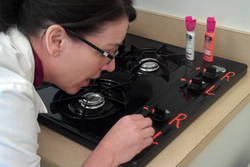
Karen Murphy, an occupational therapist at U-M's Kellogg Eye Center, shows one way she teaches her patients with low vision to mark their stoves with brightly colored, raised paint to more safely use them. Tina Reed | AnnArbor.com
With its stove, refrigerator and cooking essentials, the new low-vision rehabilitation room in the expansion of the University of Michigan's W. K. Kellogg Eye Center looks a lot like a typical kitchen or staff break room.
But look closer, says occupational therapist Karen Murphy, and you'll see an example of how Ann Arbor area eye patients will benefit from all the extra space and design put into creating the new Kellogg Eye Center building that officially opened earlier this month.
A stove inside the room is dotted with bright orange puffy paint markings. A table holds a few place settings with both contrasting bowls and plates, as if ready for the next meal. Both are examples of how low-vision patients can help themselves better see their food and their cooking.
"They want to be independent," Murphy said. "With this, they can come in and see it in a real setting. Before I was pulling things out of cabinets."
It's an example of the realistic environment Murphy says she now has to train her patients to live more independent lives with limited vision.
It's been a few weeks of settling in. Even late last week, both staff and patients were still buzzing about the building and searching around for the simple things, like finding where appointments or where trash cans are located.
Many working at the center say the new space should be more accomadating for patients - getting them through the appointment process more efficiently - and has much more space to better run programs the previous building wasn't designed for.Â
One of the greater goals for the facility, they say, is to handle already growing volumes of eye disorders - including problems commonly related to diabetes - from a large and aging baby boomer population.
In 2009, the eye center had 125,311 patient visits and 5,341 surgical procedures. That's up from 79,424 patient visits to the center a decade earlier.
"We have much more clinical space than we have had in the past, and we have an opportunity for growth here that we have not seen before," said ophthalmologist Michael Smith-Wheelock.
The building's design - down to the way its new waiting rooms are set up - should be quicker, he said.Â
"The flow from the time you check in to the time you check out will be much more rapid than it has been in the past and hopefully much more efficient from the patient standpoint," he said.
The low vision and visual rehabilitation clinic is just one example of the ways the design and space in the expanded Kellogg Eye Center will make a difference to patients, several people who work in the new building said.
Even a few weeks ago, trying to handle more than a single wheelchair at the optical shop - where patients can purchase new glasses frames - in the former eye center might have caused a big problem because the space was so much smaller than the new shop.
The new optical shop has been doubled.Â
"We have a lot more space so people can move around without bumping into each other and its very comfortable and beautiful," said John Williams, director of optical services. "We love it."
The photography department at the center, which takes detailed images of patients' inner eye, also has benefitted from better design in the new building. For instance, rooms were converted into darkrooms in the 1980s for the staff photographers, who have since converted to digital. Now, the group has extra camera rooms and a room dedicated to its servers.
"One of the main advantages of our new building is we're in direct proximity to the retina clinic," said Richard Hackel, director of Ophthalmic Photography. "It seems like an easy enough task but in our old space, we were really quite a bit separate from the main clinic so here it's just logistically we are much closer and able to serve patients more effectively."
Smith-Wheelock was careful to point out its not the building, but the medical reputation of the expertise there, that makes the difference.
"People can expect to receive state-of the art, tops in the nation care for their eyes no matter what their needs might be," he said. "And the new building, while it provides us with a beautiful environment and lots of technological opportunities to provide these services, is really a place to house all this expertise that we have to offer."
In the low vision and visual rehabilitation program, separate space is devoted to training patients in both low-tech and high-tech solutions for daily living with limited vision, Murphy said. Some of the low-tech solutions might include ideas for enlarged labels for common kitchen items, enlarged check registers and manual devices for measuring a diabetics glucose injection.
Ideas that require technology include magnifying devices that mimic a computer mouse with a camera that can enlarge printed words onto a TV or computer screen by simply tracing over the words with the device. Solutions can include finding a chair lamp that reduces glare.
"A lot of people who come into the clinic may not know what to ask. They may not know there is a solution to their problem," Murphy said.Â
Furthermore, patients who are struggling in their daily lives to see what they are doing may be embarrassed or may fear losing more of their independence if they ask for help, she said.
That is, until they see solutions presented in a manner that seems to realistically fit their life, Murphy said. "Realistic is what they're living with," she said.
Tina Reed covers health and the environment for AnnArbor.com. You can reach her at tinareed@annarbor.com, call her at 734-623-2535 or find her on Twitter @TreedinAA.
Comments
es
Mon, Mar 15, 2010 : 9:33 p.m.
The occupational therapy facility sounds wonderful! Contrary to the comments of Kafkaland, just telling someone how to make a few adjustments to their environment is not satisfactory. Its one thing to tell someone to put dots or bumpy markers on an appliance; it is quite another for someone to learn to cook safely. Try closing your eyes and using a stove! Learning competence in safe techniques requires actually doing the tasks under instruction. Such techniques exist and can be taught for measuring, pouring, testing for doneness, using the stove top and oven. Further, there is an enormous range of topics which the professional can address as appropriate, from lighting solutions to activities of daily living to adaptive technology for reading and communicating. Patients suddenly confronted with vision loss or worse, need assistance to select what is appropriate to their diagnosis and prognosis. To Kafkaland who is concerned about societal costs, know that a small investment in this installation can keep people independent in their own home, reducing the need for high cost long-term care. It will go a ways to prevent depression and serious falls with their attendant morbidity, two huge and expensive results of vision loss in the elderly.
CTF
Mon, Mar 15, 2010 : 8:38 p.m.
To Kafkaland: These common sense solutions sound common to you now but did you know about them prior to this article? Just telling people or giving handouts does not have the effective carry over into the home as actual hands on experience and training with "displayed" solutions for low vision. These "elaborate" training suites are very cost effective and necessary for low vision training. Without low vision training there is increased risk for injury in the home for the visually impaired which is very costly to our health system. We need more "elaborate" low vision training suites.
Kafkaland
Mon, Mar 15, 2010 : 12:13 p.m.
Much of this is great - better and more fficient eye care is definitely a good thing. But as medical costs spiral out of control, I can't help but wonder if a golden-platter presentation of common-sense solutions for low vision - like larger labels on kitchen items or bright paint markings on appliances is really necessary. I would imagine that just telling most patients plus a few examples that can be pulled out of a drawer would have the same effect as elaborate training suites - at much lower cost.