

Sierra Club opposing transit center project on Ann Arbor parkland
A proposal to build a new transit station on Ann Arbor city parkland is facing opposition from a local environmental group.
The executive committee of the Huron Valley Group of the Sierra Club, representing about 3,000 members in the area, has passed a resolution opposing the city's Fuller Road intermodal transit station project.
"We are outraged over the notion that the city, very recently after passionately assuring the public that the city’s parkland would never be sold to outside interests without a vote of its citizens, would turn right around and spend hundreds of thousands of its dollars and study a proposed permanent car structure to be built on city parkland," said James D’Amour, a Sierra Club executive committee member.
"Very clearly this violates the spirit - if not the fine print legal definition - of the city’s ordinances," he said.
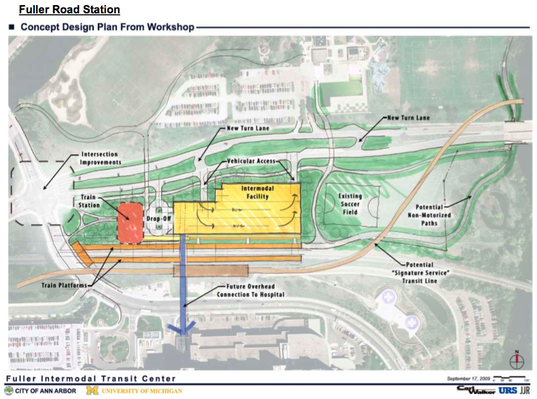
The city is partnering with the University of Michigan to build a new transit station - for buses, trains and other modes of transportation - near the university hospital. City officials have said the project will be completed within the existing footprint of a surface parking lot the city currently leases to the university.Â
The revenue from that lease currently goes to the city's parks and recreation operations since the parking lot lies within the boundaries of the city's Fuller Park.
Mayor John Hieftje said he has wrestled with some of the same concerns that the Sierra Club members feel strongly about. He said any revenues generated from the parking lease agreement with the university will continue to support city parks.
Hieftje said it's important to note that the land - although under the umbrella of the city's parks system - has been a parking lot for as long as anyone in city government can remember. He said he sees an overall benefit to the community - including some environmental gains - by making a small environmental tradeoff.
"I see the huge environmental benefit and society benefit to having transit, particularly in an age where we can look at gasoline prices going up and up and up, where we're trying to curb carbon," he said. "Even if the rail didn't come along immediately - which I'm totally convinced it will - this is a transit center that will serve buses, it'll serve our bicycle lane system, it prevents the university from building two parking structures on Wall Street, where they were then planning on putting people on a bus and taking them back to the hospital.
"Two million people a year visit the hospital, 17,000 people a day go to work there, and a whole lot of these folks come from the east," Hieftje said. "So the environmental tradeoffs and the benefits - given that this was the only place in town that could serve this need - is something that I thought long and hard about but had to make the decision that we did."
D’Amour acknowledges no actual green space is being taken away. But he said it's wrong to turn what might have been considered a temporary parking lot - that could have reverted to parkland someday - into a permanent transit station.
"The use of public lands designated as parks should be dedicated exclusively for city parks use, not for other purposes," he said. "The use of parkland for, well, parking ... is not really a parks and recreation use."
At a meeting in December, City Administrator Roger Fraser presented council members with varying options for eliminating general fund support for parks, discontinuing maintenance of some parks or selling parks. No decisions were made.
The Fuller Road transit station project is expected to come before the University of Michigan Board of Regents for approval Thursday. Timothy Slottow, executive vice president and chief financial officer, is recommending the board approve hiring Walker Parking Consultants to proceed with designs.
The first phase of the development includes constructing an intermodal facility with four covered bus loading zones and waiting areas, a covered area for bike hoops and lockers, parking for 1,000 vehicles (78 percent for university and 22 percent for city use), improvements to Fuller Road immediately adjacent to the site for vehicle access, and upgrades to a multi-use path along Fuller Road.
"This project is unique since we would be constructing the facility on city-owned property and following city building codes," Slottow wrote in a memo to the board. "We will also need approval for the lease on city-owned land since it would be for a period of greater than 10 years. We will seek approval of the lease at a later date, but prior to seeking bids or awarding construction contracts for the project."
Slottow said the city will be in charge of managing the site preparation at an estimated cost of $3 million. In addition, the city will pay for an environmental assessment of the property.
He said there will be an increase of about 780 university parking spaces as a result of the project. The estimated cost of the project at $46.55 million.Â
Costs will be shared between the University of Michigan and the city of Ann Arbor in proportion to the number of parking spaces available to each - 78 percent and 22 percent, respectively.
"This is going to be a transit center that is something we've needed for a long time," Hieftje said. "And when I look at rail, which is coming down the tracks, we probably only have one chance at this. There's a whole lot of federal money going into it. This may be our best chance in decades. Southeast Michigan is the only place in the nation that doesn't have commuter rail, and so we're going to keep working on it."

Ryan J. Stanton covers government for AnnArbor.com. Reach him at ryanstanton@annarbor.com or 734-623-2529.
Comments
Do not taunt Happy Fun Ball
Mon, Jan 25, 2010 : 9:56 a.m.
Sierra should deploy all it's resources - and I mean ever dime they have - to stopping the Asian Carp form coming to the Great Lakes.. That will be one catastrophe that I will blame on the Environmentalists.
James D'Amour
Wed, Jan 20, 2010 : 12:59 p.m.
A number of commenters here have suggested that our position is myopic in terms of this issue. I want to make it clear. The Huron Valley Group of the Sierra Club is certainly supportive of the Sierra Club is certainly supportive of many efforts, private and public to encourage non-automobile transit. I also note that this current proposal contains little in the way of concrete plans for non-automobile transit. its focus (as Mr. Stanton has reported) is on the 1000-car parking structure, with most of the parking (78%) going to University staff parking and only approximately 200 spaces for a proposed train station. With no public process or review, and defacto release of parkland without a public vote, a strategic proposal touting non-automobile transit (but in form the opposite) is being put into place. On these matters, after careful consideration, our organization has raised these concerns.
logo
Wed, Jan 20, 2010 : 1:03 a.m.
Moose and Vivienne: State law has for a long time said that a town cannot sell parkland without a vote of the people. The charter change approved by voters sometime back closed a loophole that was exposed when Novi changed the zoning on parkland and then sold it. It wasn't politically expedient it was just good policy. The state does not address leases nor did the ballot language. If this did not involve land that had already been leased for decades as a paved over parking lot; I could see Vivianne's point that it was somehow evading the spirit of the law, but no, it has been just a surface parking lot for a long time. There are very compelling reasons to make this a parking garage and transit center. It is a smart thing to do and shows a lot of leadership, the mayor must have known there would be this type of opposition but went ahead anyway. I find it very telling about the build-nothing-anywhere attitude of local the Sierra Club that they can't see the value of transit on this perfect site. It says a lot about the shallow nature of their vision and makes you wonder if they are environmentalists or just NIMBY's. What in the world is the problem with having the AATA help in funding a bus transit station? They get more and more federal money for every bus rider. Why shouldn't a bus company help pay for a bus station?
Moose
Tue, Jan 19, 2010 : 11:23 p.m.
This is why it's stupid to pass a politically expedient law prohibiting the sale of public property regardless of it's designation as parkland or whatever. This stupidity applies specifically to property such as this whose history as a parking lot and potential for a higher purpose that expands on it's current use.
Vivienne Armentrout
Tue, Jan 19, 2010 : 10:19 p.m.
This is a complex issue. Part is the concern about the city's leasing public land (still technically parkland) without adherence to the spirit of the recently passed ordinance change that prohibited sale (but not leasing) of parkland without a vote of the public. There weren't even any public hearings. What precedent does this set? Could the city begin leasing parkland all around the city to various worthy enterprises? There has been a tendency in recent years for city council and administration to treat public land like their own bank account to be sold, developed, or whatever, without consulting the public about its use. Another concern is that raised by Karen Sidney. There is no money to develop the "transit" part of this. (The parking structure will doubtless be built by the UM on time.) As I laid out in my blog, http://localannarbor.wordpress.com/2009/12/10/aatas-uncertain-future/, the city has apparently been hoping to nab the AATA millage for this project. This will not advance the cause of mass transit. Furthermore, even the money already allocated to the project was taken from other funds (as I detailed in the blog). It is easy to make things sound simple - stupid Sierra Club can't tell a parking lot from a park. But they are rarely so simple.
bruno_uno
Tue, Jan 19, 2010 : 7:38 p.m.
I read that the Sierra Club is also is a proponent of the Ambassador Bridge owner and is actually suing over the new bridge crossing proposed down river. I didnt know they were such radicals which scares me. Is this the organization behind those kids that come to our door all the time asking for money for the environment? Is this what our money supports? These radical actions?
nowayjose
Tue, Jan 19, 2010 : 4:18 p.m.
Im so shocked a group in Ann Arbor is throwing a fit about development. I mean is this really news anymore. Anytime anyone wants to put up something as simple as a hot dog cart, the vocal minority comes out to whine about it.
ShadowManager
Tue, Jan 19, 2010 : 3:32 p.m.
I dropped out of the Sierra Club years ago as most of one's dues go towards propping up a bloated administrative infrastructure, and towards advocacy projects in the far west of the U.S. They are largely a blowhard heavily-advertised do-nothing organization that puts out fancy glossy flyers, calendars, and does little real environmental work locally other than make rich members feel self-satisfied and "green" for belonging. Plus, if you join, you will recieve more junk mail than you've ever seen in your life...all paper from trees.
Moose
Tue, Jan 19, 2010 : 2:44 p.m.
Cooperation between powerful institutions requires strong leadership. Something which is in extremely short supply on council. Leadership isn't the only problem. Mayor and Council are not known as good negotiators or building public consensus, which is their only tool on issues like this. Other than being the property owner, the only power they have is public consensus, which they continually squander because they have a habit of shooting themselves in the feet.
Rhe Buttle
Tue, Jan 19, 2010 : 2:21 p.m.
To the Sierra Club - why don't you take on a worthy adversary, the UoM, and have them STOP expanding? This area isn't a park, it is a PARKING lot. How about stopping the expansion of Ann Arbor? Save the green space OUTSIDE the city? Get your head out of your backpack and look around... Where were you when they destroyed green space to build Briarwood? And why didn't you save downtown AA? Getting cars off the roads is the only thing that matters AT THIS POINT, and the transit center will do it. Want a worthwhile cause? Stop the 3rd lane on US-23. Get light rail built. Take people out of cars, whether gas, diesel OR electric. Get with the program Sierra Club. We're not talking about putting an asphalt road on the Appalachian Trail.
B. Corman
Tue, Jan 19, 2010 : 1:54 p.m.
I already view the UM as treating this as a partnership. Didnt the UM stop the plans for their own parking structure over on wall street so they could invest in this site? UM will need to build parking for their employees as the medical center expands one way or another (as the new childrens hospital opens, new wall street building/addition opens etc.). If this transit project is not built, then UM will just go back to their original plan and build another parking structure nearby. This project is a better solution because it also encourages mass transit, which helps out the entire community and the environment. I actually think that the city/and/or state should fund most of the project because the community at large benefits from this as a whole. The UM can build their own parking if they desire, so this is no way a giveaway to them. I view the UM as being cooperative in this and combining strategies to achieve similar goals. Arent we always saying that there should be more cooperation between government entities? Rather than have UM build their own structure and the city build their own transit center, it is much more efficient and beneficial to all for them to combine efforts.
RobertinSaline
Tue, Jan 19, 2010 : 1:03 p.m.
City taxpayers spend hundreds of thousands of dollars so that more and more non-residents (not paying city taxes) can work here. The next step is a millage paid for by county residents to fund transportation for non-residents (who also aren't paying again). Slippery slope - a regional funding of these projects must be examined and implemented.
Ryan J. Stanton
Tue, Jan 19, 2010 : 1:02 p.m.
Some more information on the amount of land being talked about: According to the Fuller Road Station Concept Plan Report, the site is about 3 acres (680 feet long by 150 to 250 feet deep).
Moose
Tue, Jan 19, 2010 : 12:42 p.m.
The problem here is that the City cannot be fully responsible for funding or generating political acceptance just because they're working with other powerful institutions. How about a partnership of equals with U Hospital, AATA, Amtrak and the railroad owner? The City provides the land. U Hospital and U of M, AATA and regional transportation authorities and the railroad fund the construction.
Karen Sidney
Tue, Jan 19, 2010 : 12:38 p.m.
I'm concerned about where the city's share of the money for this project will come from. The city has already committed to spend several hundred thousand dollars on project design. The spending resolution was introduced to the council agenda after the meeting had started. The latest capital improvements plan shows that the city's share of the capital cost is several million dollars. If the city can't find money to keep current police and fire staffing levels, where will they find the money for this project? Even if the city finds the money for the capital improvements for the transit center, there will be no trains without a source of funds for the operating subsidy. I've heard that some want to divert the city millage that now goes to run the buses to the trains. I don't see how cutting existing public transit for another type of public transit is beneficial. Without the trains, the project is just a large parking structure for the U of M hospital. We keep hearing that much of the city's financial problems are because the UM does not pay taxes. If that's true, why is the city not asking that the UM pay 100% of the cost of the structure plus pay for the land?
Ignatz
Tue, Jan 19, 2010 : 12:26 p.m.
How about a swap? Trade this parking lot for some real park land elsewhere. It'll save money by not having to revert the asphalt to a more natural state.
B. Corman
Tue, Jan 19, 2010 : 11:49 a.m.
Not only has this space been a parking lot for as long as most can remember, but has been leased by UM for years for UM employees use. Most in the public never even knew that this parking lot was a city resource. Common sense says that this is a good idea, a forward thinking idea and a win-win for everyone involved. Those who are opposed tend to be the type who avoids all change at all costs. Ann Arbor should live up to their reputation of being forward thinking and progressive and do something that actually lives up to this reputation. IMO, I think that this project does that and will reap huge benefits for the community in the future. For the Sierra club to insist that this transit center should not be built on so-called parkland is an insult to environmentalist everywhere. Do they not get that mass transit is more beneficial to the environment than a simple parking lot (as a previous poster said)? It sure seems like the personal, political agenda of a few local activist is taking precedent over the true mission of what the Sierra Club is supposed to stand for. If you go to the Sierra club website you will see that the goals of the Climate Recovery Partnership are the following: Beyond Coal, Limiting Greenhouse Emissions, Clean Energy Solutions, Green Transportation, Resilient Habitats and Safeguarding Communities. http://www.sierraclub.org/goals/ The Sierra club should be behind this, and if theyre not, I think their local charter should be revoked.
Ryan J. Stanton
Tue, Jan 19, 2010 : 11:24 a.m.
Let me add that Mr. DAmour's comments on behalf of the Sierra Club acknowledged that this is a parking lot being talked about here, but he was concerned for the precedent it set. He called it a "breach of trust by the city with its citizens to protect and maintain its parks for present and future generations to enjoy." He also added that the Sierra Club is "deeply angered by the city spending hundreds of thousands of dollars on consultant fees to study building a car structure on city parkland while city administrators threaten closure of existing park facilities on the basis of lack of funds." On a completely separate note, I saw today that Mayor Hieftje signed his name to a letter of support for the Active Community Transportation Act: http://bit.ly/90SIUu
Technojunkie
Tue, Jan 19, 2010 : 11:16 a.m.
The local Sierra Club needs to read "Whole Earth Discipline: An Ecopragmatist Manifesto" by Stewart Brand. I'm still skeptical about the economics of commuter rail, even if gas goes to $10/gal, but the station would work for buses too. Modeling the benefits of such a station in the event of a fuel price spike would be very useful, btw, to help calculate the cost and benefit of the economic security it would provide.
Gary Schmidt
Tue, Jan 19, 2010 : 10:33 a.m.
Wow. When I first read the Sierra Club's position on this, I pictured some kind of massive parking deck replacing the soccer fields or playground at Fuller. "Outside interests" sounds scary too--more developers running amok, this time in our parks. But the real story is that the city is going to create a parking lot out of, um, a parking lot...? Seems pretty benign to me. I never even knew the lot at Fuller was supposed to be temporary. It's been there as long as I can remember. When something is in place for decades, is it really temporary? And this isn't some bullying for-profit developer trying to muscle in; this is forward-thinking planning that should have long term social, economic, and environmental benefits. I suppose I understand the Sierra Club's desire to fight for every bit of open space, but to even bother taking a position on something like this just seems weird. Not every change is a plot of developers and nature haters.
Nerak
Tue, Jan 19, 2010 : 9:54 a.m.
I've watched with dismay as the beautiful Fuller Road corridor has turned into a mass of parking lots since the early 1990s. It's about time that something lively and that serves the whole community -- not just U of M -- is envisioned in this area. I continue to be disappointed by the parochial views of the local Sierra Club chapter, when the national organization is so much more enlightened about the benefits of rail and other forms of mass transit. Fast-forward 50 years, and if Ann Arbor embraces multi-modal transit, maybe we'll be the "new" Detroit. Or better yet, Chicago.
Moose
Tue, Jan 19, 2010 : 9:44 a.m.
The local Sierra Club is on the wrong side of this issue and so far behind growing public sentiment that it isn't funny.
Moose
Tue, Jan 19, 2010 : 9:39 a.m.
Parkland is not holy. It is a public asset that Ann Arbor has in abundance. Regional mass transit is sorely lacking in SE Michigan. Giving up a few acres of public property for mass transit that will serve the region and bring more people to Ann Arbor is a far higher use than golf, soccer or in the worst case, selling parkland for condos.
Top Cat
Tue, Jan 19, 2010 : 9:34 a.m.
kb raises a good point but I cannot think of any location near the intersection of the Ann Arbor Railroad and Norfolk Southern that would accomodate something of this size and scope.
Alan Benard
Tue, Jan 19, 2010 : 9:30 a.m.
Sierra Club has it wrong on this one. Absolutism on preserving parkland to the point of protecting parking lots will not improve credibility.
Moose
Tue, Jan 19, 2010 : 9:29 a.m.
First off, I am neither pro or anti development. I am in favor good development and transit systems that serve large groups of people. But opposing this idea of a main transit hub that has the ability to connect trains, busses and autos and is located near a place that many people coming from places other than Ann Arbor, NEED to be, (the UM Hospital) is nuts. If you keep saying NO to everything you WILL eventually have to accept something that no one likes or at the worst NOTHING! Ann Arbor desperately need a main transit hub as the beginning of a regional transit system and this location will serve the needs of many people.
mrblond
Tue, Jan 19, 2010 : 9:09 a.m.
more information is needed to firm up my opinion, but expanding viable mass transit options in the area is likely to have a much, much greater environmental impact than turning that little piece of land (the parking lot) into "parkland". Sierra Club trying to position themselves into getting something more out of the deal? or am I missing something? there might be reasons to oppose this plan, but I'm not sure swapping that parking lot for the transit center is one of them.
xmo
Tue, Jan 19, 2010 : 8:51 a.m.
The Sierra Club needs to think of all of the children that will be saved by having easy access to the U of M hospital.
kb
Tue, Jan 19, 2010 : 8:30 a.m.
A better location would be north of the existing station, where there is access to two rail lines, that would still be easily accessable from the hospital and closer to downtown.
Lifelong A2
Tue, Jan 19, 2010 : 7:45 a.m.
The Sierra Club's position on this issue is outrageous. According to the Sierra Club's website, their mission statement is to "protect our communities and the planet." Mass transit -- by reducing congestion and auto emissions -- will do far more to protect our planet than would be achieved by keeping this land a parking lot used by hundreds of SUVs being driven by commuters from Livingston County. Even if the land were used as a park, mass transit does far more good for the environment than a park. This is another example of how our local chapter of the Sierra Club has been taken over by a group of local conservatives whose mission is not to protect our local environment. I and my family gave up our memberships to the Sierra Club a few years ago because of this issue, and their local membership has declined by 25%, based on their own statistics as reported to the media. I urge others to also give up their membership.