

Snyder tax plan would be costly for thousands of Michigan residents, including many seniors
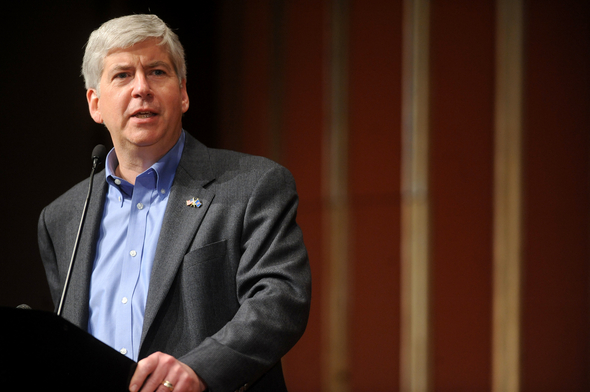
The tax overhaul plan proposed by Michigan Gov. Rick Snyder, shown speaking at the at the University of Michigan earlier this month, could be costly for thousands of Michigan residents.
Angela J. Cesere | AnnArbor.com
LANSING -- However “simple, fair and efficient” Gov. Rick Snyder says his overhaul of Michigan’s personal income tax is, it’s still a whopper of a tax increase for hundreds of thousands of Michigan residents.
For politically active seniors, the increased tax bill could easily run into the thousands of dollars -- sticker-shock territory.
Michigan is only one of four states with an income tax that exempts retirement pensions from the levy. Economists have said it is fundamentally unfair to tax the income of wage-earners, but not the retirement income of seniors who rely on many of the same state services as everyone else.
Given the demographic trends of an aging population, moreover, the percentage of Michigan residents with no income tax liability is growing.
Gov. Snyder's tax plan
Rate: Currently 4.35 percent under present law, scheduled to drop to 3.9 percent by 2015 Proposal would lower it to 4.25 percent and freeze it.
Retirement exemptions: Current law exempts all Social Security, public pension payments, IRA, annuity and employer-contributed 401(k) withdrawals from income tax. Private pensions up to $45,120 for single filers and $90,240 for joint filers are also exempt. Under proposed law, all retirement income, except for Social Security, would be taxed at a 4.25-percent rate. Eliminates exemption, $20,115 for joint filers, for dividend, interest and capital gains income receive by seniors.
Homestead Property Tax Credit: Current law provides refundable credit on property tax bills that exceed 3.5 percent of household income, up to a maximum of $1,200. Non-seniors get a 60-percent credit; seniors, 100 percent. Credit is fully phased out when household income exceeds $82,650. Proposed law would provide an 80-percent credit to all filers, keep the maximum at $1,200 and lowers the income threshold to $70,000.
Michigan Earned Income Tax Credit: Three-year-old law provides an average of $432 annually to some 800,000 low-income wage earners. It equals 20 percent of the federal EITC. Proposed law would eliminate it.
Exemptions: The $2,300 senior exemption, the $600 dependent children exemption and the $3,700 personal exemption for single filers over $75,000 and joint-filers over $150,000 would be eliminated.
Credits: Tax breaks for city income tax payments and donations to universities, public broadcasting, food banks, community foundations, libraries, museums and historic preservation projects would be eliminated.
Source: House Fiscal Agency
But politics, not economics would well drive the votes of lawmakers being asked to reformulate the tax code for some 1.1 million seniors that for some could amount to the largest single tax increase in modern Michigan history.
A senior couple with $77,500 in overall retirement income, $48,000 in pension, $2,500 in other income, and $27,000 in Social Security benefits -- that would remain untaxed -- would pay $1,840 in new income tax, according to examples crafted by the Michigan Department of Treasury. That couple would also lose about $720 in refundable homestead property tax credits because Snyder’s plan ends eligibility for the credit at $70,000 in household income, down from the $82,650 current cutoff. It adds up to nearly $2,600 in new tax liability.
A couple with $42,000 in total retirement income and a $2,250 property tax bill would pay about $700 more, including $544 on $20,000 in pension income. While they’d still qualify for the homestead credit, it would be $156 less under Snyder’s plan. Ten days after Snyder proposed nearly $1.9 billion in income tax changes to finance a similar level of business tax reduction, Republican lawmakers taking concerned calls from seniors back in the district haven’t rushed to endorse the plan.
“I don’t think it’s going to pass at all,” said Sen. Joe Hune, R-Hamburg. “I don’t even know if it will come up for a vote. For the last two years, I’ve said I wouldn’t stand for new taxes.”
“The governor’s probably right on the fairness issue, but I just don’t want to tax seniors, period,” he said.
In relying on higher taxes on seniors to finance a business tax cut he says would transform Michigan’s troubled economy, Snyder is essentially asking for sacrifice from grandparents to improve the job prospects of their children and grandchildren.
“When people talk about how they’re affected by this tax act,” Snyder told state association executives in a speech last week, “what I ask you to do is empathize with them that they may be asked to give up something.”
“But after that change is made, are they being treated fairly? Are they being treated in a fair fashion with the rest of the citizens of our state?” Snyder asked. “I think you’ll find the answer is yes.”
Indeed, a married couple with one child, $45,255 in income and a $2,250 property tax bill would gain $134 in homestead credits through the change. Under current law, non-seniors get a 60 percent refund on the amount of property tax that exceeds 3.5 percent of their income, but seniors get 100 percent back. Snyder’s plan would equalize that so every credit recipient would get 80 percent.
But a family of four earning $25,000 would see an $856 increase in taxes, according to an analysis by the Michigan League for Human Services. They’d pay $450 in income tax that gets refunded now under the Michigan Earned Income Tax Credit that Snyder’s plan would eliminate. And they’d lose another $406 in cash back that the credit currently provides.
There is Republican support for eliminating the MEITC, which costs about $355 million in fiscal year 2011, but the toughest aspect of Snyder’s plan will be taxing seniors.
“When you’re an elected official, at the bottom of the list of constituencies you want to take on is seniors because they vote frequently and they have time on their hands,” said Jeff Padden, a former legislator who runs Public Policy Associates in Lansing. “Senior citizens matter a lot in elections.”
AARP Michigan is mobilizing its 1.4 million members to phone and write their legislators in opposition to both the pension tax and the elimination of the MEITC.
It’s unclear whether the business groups whose members would be the biggest tax beneficiaries of Snyder’s plan will mount the lobbying effort required to push through the less popular income tax replacement revenue.
The Michigan Chamber of Commerce backs all aspects of Snyder’s plan, says the chamber’s chief tax analyst Tricia Kinley.
“We can support the direction the governor has taken on the budget and all the tax reform. The attitude is that it’s the right and fair thing to do.”
Republican leaders in the Legislature are still studying the plan, to be introduced in the House on Wednesday in one single bill to cover both the business tax cut and the income tax changes.
Lawmakers who oppose the pension tax will be told to fill the resulting hole some other way, through specific spending cuts or other revenue.
“The pension part is going to be the most politically difficult, but the governor’s proposal is focused on the policy side of things and that’s how we’ll try to address it as well,” said Ari Adler, spokesman for House Speaker Jase Bolger, R-Marshall.
“Some (seniors) might be opposed, but we’ve heard from others who are willing to help out,” he said. “We are taxing the youngest generation and there are no jobs for them, so no wonder they’re moving out of state.”
You may reach reporter Peter Luke at pluke@boothmichigan.com.
Comments
Sk8er
Thu, Apr 14, 2011 : 3:47 a.m.
We all know how this is going to play out. Same as it always does. Businesses get all the tax breaks and loopholes, then move or keep their factories in China and India, and the poor, middle class, and now elderly are left to pay for their greed. Thanks tricky Ricky...wish we had a governer with a new trick up his sleeve, one with the people's best interest for a change.
lloyd payer
Tue, Mar 22, 2011 : 12:30 p.m.
bye bye michigan hello florida senor do not buy michigan products or buy anything in michigan it pay back time
Dr. G.
Sun, Mar 20, 2011 : 11:36 p.m.
"sustainable development is development that meets the needs of the present without compromising the ability of future generations to meet their own needs." When the value of certain populations, such as students and elders is degraded, future growth and advancement is compromised since these are the repositories and conservatories of knowledge and wisdom through learning and experience.
sherry
Thu, Mar 3, 2011 : 1:51 p.m.
This is a large increase for seniors. They may be willing to pay some but this is huge. Don't be surprised if you see a further exodus from Michigan to southern states like Florida where they don't pay any income tax. Do folks realize that Michigan has one of the largest groups of part time residences. All it takes is being out of the state 6 months and 1 day and you can be a Florida resident. Even if you can't sell your house in Michigan with this incentive I think real estate in Florida may look better every day. Michigan could lose in more ways than one with this plan. Short term gain, long term loss. Young folks aren't staying now the old folks will leave too.
Carole
Thu, Mar 3, 2011 : 1:23 p.m.
Cash could not have stated it any better. Over the many years, seniors have paid for many of the things that the younger set are thoroughly enjoying at the present time, many who are still working and somewhat able to stay ahead of the rising cost of living. As a senior, I still work and pay taxes even though I have a small pension (which I am grateful for) and social security. But, one has not increased over the many years and social security as all know has not gone up in two years -- The reality of life, many what this and that paid for by the government or for free -- when the reality we all end up paying for it by increased taxes -- take a look around folks.
Huh?
Mon, Feb 28, 2011 : 2:27 p.m.
Didnt someone from AA.com print this last week, word for word?
Cash
Mon, Feb 28, 2011 : 10:27 a.m.
Here's a good link for further information. <a href="http://drivetoendhunger.org/?cmp=KNC-DRV2ENDHNGR-2" rel='nofollow'>http://drivetoendhunger.org/?cmp=KNC-DRV2ENDHNGR-2</a>
Tru2Blu76
Mon, Feb 28, 2011 : 6:58 a.m.
Re: " Plus, those that have pensions also get social security which means they are not poor or hurting so bad."-- A person 66 years of age gets about $16,000 per year in social security payments: that's less than $2000 above the poverty level. -- conclusion: someone needs serious upgrade in their knowledge of this topic. Re: "Most pension retirees in Michigan are living quite large compared to the average Joe because they have pensions that were defined/built when everyone was living large."--- Exactly WHAT source is used to draw this broad (inaccurate) conclusion??!! Also: "when everyone was living large" was when (1) taxes were higher and (2) before the Republicans turned the US economy into a non-manufacturing "service jobs" economy while putting U.S. workers in competition with workers in Third World Economies -driving down wages and benefits for EVERYONE here. Anyone notice: the net effect of Republican rule has been to get Americans to target groups which were once respected and valued for contributions made during the 40s, 50s, 60s and 70s. In other words; the Republicans have got us at each others throats.
John B.
Mon, Feb 28, 2011 : 10:57 p.m.
Divide and conquer. It's one of the oldest tricks in the book, and ignorant people still fall for it all the time. Couple that with Goebbels-style propaganda, and it's working quite well for the Koch brothers, oops, I mean the Republicans. "Remember, an ignorant and uninformed constituency is your best constituency..." ;-)
Kai Petainen
Mon, Feb 28, 2011 : 4:53 a.m.
I'm not picking a political side on this.... I talk about the stuff I know about and I ask questions on the stuff I don't know about. So, I have a question... If so many folks are mad at Snyder, then why did they elect him?
Tru2Blu76
Mon, Feb 28, 2011 : 7:04 a.m.
Acknowledging first: the Democrats weren't exactly "stellar" in their time in Michigan's driver's seat. But the Republicans have been working on their now decades old strategy to demonize not only Democrats but groups within our population who WERE formerly respected and given credit for real contributions to our economy and culture. They have succeeded in working on people's ignorance (not stupidity) and trust to make themselves appear to have "all the answers" to our major problems (which they've had a direct role in creating). That is why people bought $nyder's "reasonable Republican" campaign image and voted for him. But he's appointed all the old guard Republicans to every appointed position.
Stephen Landes
Mon, Feb 28, 2011 : 3:51 a.m.
I find it quite amusing that folks commenting here want us to be like other states when it comes to a progressive income tax, but NOT like other states when it comes to taxing pensions.
Edward R Murrow's Ghost
Wed, Mar 2, 2011 : 4:03 a.m.
. . . and vice versa. Good Night and Good Luck
L. C. Burgundy
Mon, Feb 28, 2011 : 3:23 a.m.
Uh, people, I got news for you. Corporations don't pay taxes. They are a line item on the budget that generally has to be recovered in the price of goods and services that are sold or with reduced expenditure on things like salaries. The idea that you can stick it to the (rich) man by keeping high corporate taxes is just silly wannabe class warfare. And I mean "wannabe" in that high corporate taxes just manifest themselves in high unemployment and higher prices anyway. And the pension income tax issue? Tell you what, we can either eliminate Michigan's personal income tax entirely or pensions will be covered as well. The current exemption is a massive political gift to government and union retirees and little more, because 401K and other retirement plan income is NOT exempt, so it's clearly not about concern for our elders.
Stephen Landes
Mon, Feb 28, 2011 : 3:52 a.m.
You are right on target in both cases.
RDParsons
Mon, Feb 28, 2011 : 3:16 a.m.
I'm a pensioner. I don't mind pitching in and contributing my fair share as long as everybody is "sacrificing". The Michigan business community gets a big wet kiss from the Governor in this budget. Seniors and working poor take a more painful treatment. When the Governor or his sycophants call this fair, it sounds completely out of touch at best, or cynically disingenuous at worst. Either way, it's consistent with Republican rhetoric lately.
MARK
Mon, Feb 28, 2011 : 1:45 a.m.
The State of Michigan is only one of 4 states that do not tax seniors' pension so not taxing it the outlier. Just getting Michigan in line with what other states are doingl
Cash
Mon, Feb 28, 2011 : 10:25 a.m.
Well that is incorrect..... Seven states have no state income tax: Alaska, Florida, Nevada, South Dakota, Texas, Washington and Wyoming. Two others, New Hampshire and Tennessee, tax only dividend and interest income. Four others have income tax but do not tax the elderly for their retirement income.
TripleVSix
Mon, Feb 28, 2011 : 12:57 a.m.
The children are whining very loudly now that adults are in charge. Get used to it, kids. We gave you a bunch of money, told you to manage it responsibly, and you blew it all. No, that's not entirely true - you blew that money, borrowed even more and blew that as well. Now we have removed you from this task and will show you how to do it right. Of course you're upset - you no longer have the truckloads of cash you had when you were in charge. Learn how to handle money like an adult and perhaps some day we'll let you in on the decision-making again.
Tru2Blu76
Mon, Feb 28, 2011 : 7:15 a.m.
Thanks for another total misstatement of facts, TripleVSix. In view of the fact that you skipped it: you and everyone here should know that the income gap between the top 5% incomes and the lower 95% is now by far the greatest EVER in this country's history. The top 2% of incomes is 180 times the national average income. So the real question is: what do they do with all THAT train load of cash besides waste it on ridiculous luxuries while the number of homeless grows year by year??
mw
Mon, Feb 28, 2011 : 12:46 a.m.
Why should retired seniors pay tax on their pensions.... Why should retired seniors with 401K's pay tax on their withdrawals while the (more fortunate) seniors with defined pensions get their retirement money tax free? It's simple fairness.
breadman
Sun, Feb 27, 2011 : 10:41 p.m.
Well! If Michigan is one of four states for tax break for seniors of are the other three states? Time to move the old folks out of Michigan. My parents as seniors are still paying AA Public school and the last child to get out of school was 1990. They need the tax break.....
Awakened
Mon, Feb 28, 2011 : 8:40 a.m.
MS, PA, and AL. GA exempts the first $35,000 from pensioners. Additionally there are states that have no income tax at all. TX, AK, WY, NH, TN, SD, WA, and NV.
OLDTIMER3
Sun, Feb 27, 2011 : 9:56 p.m.
Why should retired seniors pay tax on their pensions to give businesses a tax break. They are making money while our income is a set without raises and I don't get my property tax refunded like the article states.
Mick52
Mon, Feb 28, 2011 : 12:44 a.m.
Equality. People with 401ks have to pay taxes, so pensioners should too. In most cases they can likely afford it better than those with 401ks.
1bit
Mon, Feb 28, 2011 : 12:07 a.m.
Why not have small businesses pay even more taxes so retirees don't have to pay taxes on their 401k's either?
tommy_t
Sun, Feb 27, 2011 : 9:42 p.m.
The measures stand a good chance at passing as the Repubs now control the legislature. The amazing spins and omissions used to confuse the public is masterful. Seems like the art of critical clear thinking is becoming another lost one. Examine the words and phrases, shared sacrifice, painful for all, get tough, fix it once and for all, equally share etc etc . Now examine where the benefits go and where the money comes from to pay for it. "Life's tough. It's tougher when you're stupid." - John Wayne
golfer
Sun, Feb 27, 2011 : 8:46 p.m.
you can say what you want. i still say it is not fair. it is not even. tax retires and give those working a break. sounds like it is backwards. i think they should tax what you make. straight across the board..... that will be fair. either way you look at it. sounds like it is not playing on an even field. i would say most seniors over 65 are not loaded with a spare money belt. all i am going to do is see who votes for it and then keep that person in my mind next time i vote. sorry you look out for yourself so will i.
Cash
Sun, Feb 27, 2011 : 9:33 p.m.
You aren't alone, Mort. I think it needs to be clear to every elected official. You vote to take money from the elderly to pay the big corporations, and you will NOT be elected again...ever.
Wolf's Bane
Sun, Feb 27, 2011 : 8:03 p.m.
I think the Republican strategy is brilliant; stick it to a portion of the middle class and let them fight it out! How dare Snyder and Republicans pit Teachers, Fire & Police personnel, and others reliant on public sector benefits and unions against private sector "middle class" citizens and the retired? What's so sad is that a majority of folks commenting on this board are more than willing to throw union-based, public sector employees and citizens under the bus for a few scraps from Snyder's tax plan!!! You should all be ashamed of yourselves!
John B.
Sun, Feb 27, 2011 : 8:28 p.m.
Unfortunately, those who fail to learn from history are often doomed to repeat it. This is nothing new - it goes back over 30 years, to Ronald Reagan. We have been on an ever-accelerating path to an ever-greater separation of the haves and the have-nots since then.
RedWingGuy
Sun, Feb 27, 2011 : 7:30 p.m.
We should make all financial transactions progressive. All payments are adjusted for income. Examples of this would be housing, food, prescriptions, school, gasoline, entertainment and taxes. Just think we will have reached true Nirvana!
Snehal
Sun, Feb 27, 2011 : 7:26 p.m.
Whatever happened to Republican claim that they will give tax breaks! BTW, taxing senoirs and working class people and giving tax breaks to business world - if this is not socialism then what exactly is this?
Michael K.
Sun, Feb 27, 2011 : 7:17 p.m.
There is no coherent philosophy or pragmatic justification here at all. I have an MBA and have started companies - I don't in the least believe that Snyder's plan will create jobs. He is rewarding his base, while taxing the poor who have the least political clout. As Michael said above, the only coherent taxation philosophyis one that taxes progressively, so that those who can afford to pay are the ones that carry the burden. That includes me when I made $140K+ per year, and the well off seniors. But not those in any category trying to live on $20,000 a year. Instead we get twisted and convoluted justification to tax and blame those we hate, however we define that at the time. That is the true basis for most of the "justifications" exposed by Snyder or any other ideologue. The motgage interest deduction was justified as the "right" kind of social engineering, while film tax credit are rejected as "picking winners and losers." And so it goes. The only thing I know is that statistically and morally, you can't balance the budget on the backs of the poor who can't afford food, heat, or transportation. And who collectively represent a small portion of the total income in the state, even if their numbers are large.
Cash
Sun, Feb 27, 2011 : 7:16 p.m.
al1944, You'd better tell corporate Michigan that....as the millions will be handed to them in the form of Corporate Welfare.
Mick52
Sun, Feb 27, 2011 : 11:58 p.m.
Cash, could you explain that? How millions will be handed to corporations? As I read this the Gov wants to change how businesses are taxed. I do not see anything about handing them any money at all. We did that with the film industry, handed them $137.5 million in incentives to generate $80.6 million in film industry revenue. It appears that idea was to draw the industry but overall it has been a loss. That did not work. I don't know if the Gov's plan will work either, Michigan is competing with the other 49 states but I don't see anything that says we will be handing them money, just not taking an unfair amount and hoping that will draw more to the state. I think that is worth a try since what we have been doing is not working.
thinker
Sun, Feb 27, 2011 : 6:57 p.m.
We all will have to sacrifice if we are to get out of all the debt our city, our state, and our federal government are in! No one will escape it. So stop whining, everybody! Most of us have benefited in some way from all the expenditures we now have to cut back on. Grow up!
Mick52
Sun, Feb 27, 2011 : 11:52 p.m.
John B., The corporations in Michigan have been whining- about the high business taxes. Corps who don't whine are those from out of state who don't need to whine, they just run their business in other states with lower business taxes. My understanding of this plan is to change business tax so to make Michigan a more friendly state to expand in. Who knows if it will work? The hope is that businesses pays lower taxes they will hire more and that will result in overall more tax revenue from the business tax plus employee taxes. One thing we know for sure, Michigan is not attracting business. Another aspect to business in Michigan is that it is a union state. Mi was a finalist for a VW plant (2006 jobs) in 2006, but was rejected because of the UAW. Tennessee I believe has the plant. I suppose those folks would rather have a non union job than a union card and no job.
sh1
Sun, Feb 27, 2011 : 9:43 p.m.
List here what you are willing to give up in order to finance the big tax cut to businesses:
John B.
Sun, Feb 27, 2011 : 7:39 p.m.
I don't hear any Corporations whining. They get a windfall out of this plan. Must be nice.
thinker
Sun, Feb 27, 2011 : 7 p.m.
And I applaud any governor such as Snyder or Walker who have volunteered for the job of being very unpopular in order to help his given State! Keep working, Gov. Snyder! I am behind you!
Edward R Murrow's Ghost
Sun, Feb 27, 2011 : 6:53 p.m.
Barking Bear wrote: "The problem is people are paying so many different taxes (many of them hide) that we don't even have a clue what our total tax bills are! We need small and less government in addition to a lot fewer public sector employees! The whole system is draining us dry!" This is nonsense. According to Forbes (not exactly a source in favor of higher taxes), the United States ranks 27th out the 30 western industrialized nations in per capita tax burden. See: <a href="http://www.forbes.com/global/2006/0522/032a.html" rel='nofollow'>http://www.forbes.com/global/2006/0522/032a.html</a> Good Night and Good Luck
Edward R Murrow's Ghost
Sun, Feb 27, 2011 : 11:43 p.m.
There are several states that have no sales tax: <a href="http://en.wikipedia.org/wiki/Sales_taxes_in_the_United_States" rel='nofollow'>http://en.wikipedia.org/wiki/Sales_taxes_in_the_United_States</a> Again, Forbes is hardly one to understate tax burden. States are thinking about taxing mileage rather than gasoline? Makes sense to me. The purpose of the tax is for road construction and maintenance, and miles driven would be a far more fair measure of what one should pay in taxes for use of those roads. Bottom line is that we have become a nation who wants something for nothing. Any cuts in government services should be for the other guy, and don't raise my taxes for the services I demand, in your example, road maintenance. Good Night and Good Luck
Mick52
Sun, Feb 27, 2011 : 11:28 p.m.
Ghost. I looked at the chart and as much as I consider Forbes a fairly good source, there appears to be a lot of hidden tax and fees missing or oddly calculated. And it is from 2004. Perhaps the listed taxes are averages. For example, the chart has sales tax in the US at 4.6. That seems low. Sales taxes differ from state to state. In Ca. they are nearly 10%. I do not know if any state has sales tax as low as 4.6%. The gas tax on the chart is.....hmm, missing. Vehicle registration fees and licensing, toll fees and all that is not here either. I think Barking Bear was referring to all this, the hidden fees and taxes that are not in the news as much as those listed on the chart. So it is hard to determine what your overall tax liability is and this chart lists only the basics. Good thing about the hidden taxes and fees is that if you want you can avoid them. That said, all that stuff esp gas tax and fees related to driving, are much higher in Europe. And some countries have VAT tax too, so in comparison to other countries our tax liability may be lower. But for many reasons I do not think it is accurate to compare the US with other countries. And who cares where the US ranks globally. What you want to know is how much you are paying. Things are changing. Several states are thinking about dropping the gas tax and replacing it with a tax based on how many miles driven. That is because fuel efficient cars are cutting gas tax revenue by the millions in some states, so to make that up, mileage may be taxed. Pretty cool, eh? One way or another they are going to get your money.
Edward R Murrow's Ghost
Sun, Feb 27, 2011 : 7:57 p.m.
"So you want to be like Europe?" A question that could be asked only out of ignorance, fear, or, more likely, large doses of both. Good Night and Good Luck
John B.
Sun, Feb 27, 2011 : 7:38 p.m.
I'm voting for the Ghost/Cash Gubernatorial ticket after the recall...!
Barking Bear
Sun, Feb 27, 2011 : 7:32 p.m.
So you want to be like Europe?
Matrix
Sun, Feb 27, 2011 : 6:41 p.m.
We seem to be arguing and fighting with another over scraps. Rather than fighting, maybe we should look at what is causing all the economic turmoil. Then we can solve the problem. If you look pass the trees and at the forest, you will see that the banks are sucking the life out of the states. If states can keep more of the money rather than sending it to the federal government where it is being given to the banks/Wall St., we'd solve this financial mess. Significantly reduce the federal income tax (more reduction for the middle class) and slightly increase the state income tax. Simply put, but problem solved. More money and control for the states and its people.
Barking Bear
Sun, Feb 27, 2011 : 6:40 p.m.
The problem is people are paying so many different taxes (many of them hide) that we don't even have a clue what our total tax bills are! We need small and less government in addition to a lot fewer public sector employees! The whole system is draining us dry!
Rodney
Sun, Feb 27, 2011 : 6:20 p.m.
we need to start a recall petition and get rid of this guy, I'm glad i voted for the other guy , snyder is going to run more people out of michigan, he is for the rich and wants to get rid of the lower income and middle class too, I knew he would do this and I told people so , now there crying over this and all i can say is told you so.
sbbuilder
Sun, Feb 27, 2011 : 8:36 p.m.
Rodney The 'other guy' just proposed raising taxes in Lansing. That would be across the board, and include the poor, middle class, etc. How is that different?
Cash
Sun, Feb 27, 2011 : 6:53 p.m.
Amen brother. I'm guessing there are people already working on that! I know I'd be glad to take a petition around.
Dennis
Sun, Feb 27, 2011 : 6:16 p.m.
I just received my retirement check from Ford Motor Company. State taxes were deducted from it along with federal taxes. Just saying !!!!
Michael
Sun, Feb 27, 2011 : 6:05 p.m.
Since so many are declaring a progressive income tax structure to equate to class warfare, I would like to clear this up: Progressive Tax systems directly follow from the Law of Diminishing Marginal Utility applied to Income or Wealth. Before spouting your beliefs on how to fix the economy, you really would be good to bother learning economics. Now, I'm not here to end your ignorance, and have far more valuable things to do with my time than attempt to teach an internet forum. Good day.
sh1
Sun, Feb 27, 2011 : 6:15 p.m.
Well, certainly you have time to post a link.
Tony Livingston
Sun, Feb 27, 2011 : 5:41 p.m.
The underlying assumption here is that lessoning the taxes for businesses will help the state financially. How has anyone shown this to be true? It is pure speculation.
Stephen Landes
Mon, Feb 28, 2011 : 3:44 a.m.
Reducing corporate tax rates has been shown to improve business and increase jobs -- even JFK took that action when he was President.
1bit
Mon, Feb 28, 2011 : 12:03 a.m.
You're right - small businesses will get a tax reduction. That's mostly because the Michigan Business Tax is one of the dumbest things ever conceived. You're also correct that reducing taxes doesn't necessarily correlate to increased jobs (I agree that "trickle down" doesn't really work in practice). However, that doesn't mean that small businesses should bear the burden of a punitive tax code. I like what Gov. Snyder is doing in combining everything. He is telling all players (but particularly the majority) that it's time to fix things. If not the pension tax, then something else. No more kicking the can down the road (yes, I do hate that euphemism too)...
Edward R Murrow's Ghost
Sun, Feb 27, 2011 : 11:35 p.m.
Someone is getting a break--a BIG one. Governor Snyder is proposing a reduction in business taxes of $1.5 billion from the current MBT. Doesn't looked like shared sacrifice. So the point remains. It is entirely unproven that tax cuts for businesses produce jobs. Good Night and Good Luck
1bit
Sun, Feb 27, 2011 : 7:18 p.m.
Actually, big businesses will get a tax increase. What you see in Gov. Snyder's proposal is not "dogma" but rather simplification of the tax code. Every special interest believes it should get a tax break. I'm less inclined to agree and prefer what Gov. Snyder is fashioning. If "fairness" becomes an issue, I am also not opposed to a progressive income tax as long as other loopholes in the tax code have been eliminated.
Edward R Murrow's Ghost
Sun, Feb 27, 2011 : 5:46 p.m.
It is conservative dogma, not open to debate, and certainly not necessary to show evidence to support. Indeed, massive evidence (e.g., the Bush II tax cuts) to refute. But doesn't matter. Dogma cannot be argued with. Good Night and Good Luck
Edward R Murrow's Ghost
Sun, Feb 27, 2011 : 5:19 p.m.
@dotdash above has provided a website where you, too, can try to balance the budget. It is at: <a href="http://janus.pscinc.com/budgetsim/default.aspx" rel='nofollow'>http://janus.pscinc.com/budgetsim/default.aspx</a> Playing with it I came up with this: 1) Leave the business tax alone for now--will come back to it later 2) Across the board 10% reduction in state agencies 3) Eliminate all grants for business development. 4) Enact prison sentencing reforms 5) Extend sales tax to all services while reducing the sales tax from 6% to 5.5% 6) Raise the beer and wine tax by 2 cents per can/bottle According to this website, these actions will leave the State of Michigan with a $500 million SURPLUS. With that $500 million surplus the governor could then go back to 1) and he could simplify the MBT and give his business buddies the tax break he so badly wants to give them--just not as big a break as he would like. And the website above does not have several other options that ought be on the table, the most obvious one moving to a graduated state income tax. Thirty-Five states (including most of those allegedly "low tax" states in the South) have a graduated income tax. It's time Michigan joined the 20th century in this regard (yes, I know we are now in the 21st century). There are other options to solving the state's fiscal crisis that are not as harmful to the elderly and to the poor as the governor's current proposal. Time to find out if our new governor is the moderate he ran as or the right-wing ideologue he appears to be. Good Night and Good Luck
Edward R Murrow's Ghost
Tue, Mar 1, 2011 : 1:51 p.m.
You'll have to explain to me how a sales tax, one paid for by the buyer at the time of the transaction, will lead to companies leaving the state. I can see those dentists, and doctors, and lawyers, and movie theater, and golf courses getting up and leaving . Makes no sense to me. Good Night and Good Luck
L. C. Burgundy
Mon, Feb 28, 2011 : 3:30 a.m.
Ed, your budget is a total nonstarter. A 5.5%-6% across the board services tax would slaughter a lot of professional service jobs. Slaughter them. I can tell you without a shred of exaggeration that I would have no choice but to leave the state with the other 30 employees at the business I am employed with with a gigantic tax hike of that magnitude. I do not think you comprehend how damaging that kind of tax would be to employment.
Edward R Murrow's Ghost
Mon, Feb 28, 2011 : 3:12 a.m.
"Well, its off to Ohio to buy my beer and wine" Hope you live near the border or have a hybrid. You might save a whole .50 for a case of beer and pay $3.50 a gallon to get there. We are one of few states who spend more money on prisons than on higher ed. It is a very weird set of priorities. And no one is talking about releasing violent felons. We house thousands of people convicted of possession of small amounts of drugs. Few states have more draconian penalties for minor drug offenses. Good Night and Good Luck
Mick52
Mon, Feb 28, 2011 : 12:55 a.m.
Well, its off to Ohio to buy my beer and wine. Prison sentencing reform? Yuck, yuck. Our prisons are full of violent offenders. If you look at the link Vivienne gave us on the new tax plan, this line is in the notes: Under five different Treasury Department scenarios above, retirees with total pension and other income of $42,000 or less would pay no state income tax under Snyder's tax plan Doesn't sound like this plan is too tough on the poor, retired or not.
Edward R Murrow's Ghost
Sun, Feb 27, 2011 : 11:32 p.m.
Snoopdog, Military pensions remain excluded in the governor's proposal. If he wants to tax that, fine by me. Shared sacrifice works. But, right now, I don't see a shared sacrifice. I see the Snyder budget being balanced on the backs of the poor and the elderly while the governor's business buddies get a huge tax break. Good Night and Good Luck
snoopdog
Sun, Feb 27, 2011 : 11:21 p.m.
Oh, but heaven forbid that we tax your pension Ed. I for one will let the Gov know that I support taxing pension income. Why not pension income Ed, probably because you are getting one from the military eh ?
1bit
Sun, Feb 27, 2011 : 8:59 p.m.
If you think that seniors are mad about taxing their pensions just wait until you tell them you are planning on taxing their doctor bills (that is, after all, what you are "extending" in a services tax). That will add up to much more than any pension tax and will go over like a lead balloon. Sorry, try again...
Cash
Sun, Feb 27, 2011 : 6:54 p.m.
Ed, Please run for governor. Cash
Edward R Murrow's Ghost
Sun, Feb 27, 2011 : 5:35 p.m.
Correction to above: To get the $500 million surplus one has to raise the sales tax on goods AND services to 6.5%. If that does not happen--if the services are taxed but the sales tax moves from 6% to 5.5%, the budget would be balanced--no surplus, but no deficit, either. Good Night and Good Luck
Richard Dawn
Sun, Feb 27, 2011 : 5:14 p.m.
All of these tax increases on retirees, families and individuals have been put forward so that Gov. Snyder can offer Michigan businesses a $1.5 billion tax cut. Since he has in fact decided to pick winners and losers, I would like to see more analysis about what businesses will be the winners in this scheme and citizens can decide whether the tax breaks for those types of businesses meet the equity tests he is suggesting pensioners and others follow.
Gary Clark
Sun, Feb 27, 2011 : 5:14 p.m.
I am a recently "retired", formerly self employed person. I receive a bit of Social Security and my IRA contributions were taxed going in because it was earned income I contributed, and will be taxed as income coming out. I think I should pay my fair share of taxes and contribute to society in a positive fashion, as long as it is truly fair. The top 2% and corporations are clearly undertaxed (see the figures above), and they can AFFORD to be taxed. If they were, our "crisis" would be mitigated to a great extent. Such people should be willing to give back to the culture, society and environment that made it possible for them to be successful in the first place. Such taxation makes it possible for the culture to continue to create prosperity with safe cities (fire and police protection) good roads, trash collection, providing and maintaining sewage and water services, protection of natural resources (remember our greatest asset the Great Lakes), federal grant programs that provide various types of jobs, and on and on. Like a pervious writer, I will be traveling less, spending less money for goods and services (less eating out, no tree trimming, driveway repair, no kitchen remodeling for me either), in short, I am less able to contribute to JOB CREATION and retention which seems essential to economic growth. I also have to continue to work and take a job from a younger person in order to pay the rising costs of everything. I know I am not alone in this situation. These are facts which to me at least, seem to point to another fact: the governors budget plan will not work. The whole Republican strategy seems flawed, unless you, like Snyder and most politicians these days, are independently wealthy. The strategy takes jobs away and those it does create are at wages so low folks can't afford the goods and services they themselves provide. Lower incomes mean less money from taxation. The spending cuts he talks about all cut jobs.
NoSUVforMe
Sun, Feb 27, 2011 : 5:06 p.m.
Oh My! A Republican that wants to give tax breaks to corporations and the rich while putting more of the burden on working people, retirees, and poor people! How could he! Where have you been, folks? This is the Republican Agenda -- rickle-down as espoused by right-wing ideologues on this board. Forget the facts that show that trickle-down doesn't really work. Remember Reagan era deficits? Bush era deficits? It's a scam. Trickle down is nothing more than a means to eliminate social programs and shrink government until it can be "drown in the bathtub." You can complain, or you can vote.
Mick52
Mon, Feb 28, 2011 : 12:26 a.m.
I don't know where you have been but I have been here in Michigan and I see that we have been doing in the previous eight democrat agenda years is really now turned out so good. We did vote, that is why we have a republican Gov. Who knows if it will work, but what we have been doing has failed. The typical response by democrats is tax the rich. That does not always work: <a href="http://www.investmentnews.com/article/20100808/REG/308089976" rel='nofollow'>http://www.investmentnews.com/article/20100808/REG/308089976</a> <a href="http://open.salon.com/blog/richard_rider/2010/03/01/study_shows_high_taxes_more_outmigration_--_duh" rel='nofollow'>http://open.salon.com/blog/richard_rider/2010/03/01/study_shows_high_taxes_more_outmigration_--_duh</a> Raising taxes on seniors does not always work either, they can migrate too. I do not see any way to attract business to Michigan if the business tax is higher than other states. Heck to get the movies here we had to pay them and that did not work either. Mich paid out $137.5 million in incentives to generate $80.6 million in film industry revenue. That was a Dem plan.
clownfish
Sun, Feb 27, 2011 : 4:49 p.m.
Just added up the net worth of 10 citizens of Michigan. $19,600,000,000. Those poor folks cannot handle any more class warfare!
NoSUVforMe
Sun, Feb 27, 2011 : 5:09 p.m.
Clownfish, This is less than $2 billion each. No wonder they are complaining about helping working people.
sh1
Sun, Feb 27, 2011 : 4:41 p.m.
I'm still waiting to hear from those who opposed the repeal of tax cuts to the rich but who favor tax increases on seniors to explain their thinking...Anyone?
Cash
Sun, Feb 27, 2011 : 4:29 p.m.
Probably won't happen anyhow............... Curtis Gans, director of the nonpartisan Center for the Study of the American Electorate at American University in Washington, said seniors vote at a rate of about 60 percent more than young people and about 10 percentage points higher than the national average. Like much of the general electorate, older Americans are not single-issue voters, unless they feel a particular candidate threatens their Social Security, retirement and Medicare health benefits, Gans said. 'Nuff said. Self-preservation in the legislature may just make this part of Snyder's assault on the poor and elderly go away.
clownfish
Sun, Feb 27, 2011 : 4:27 p.m.
Well,it's pretty darn clear that EVERYBODY wants change, wants to balance the budget, and VERY FEW want to make any personal sacrifice to do it. If someone bringing in 77k in income cannot afford $1800 more in tax, how is a family bringing in 25K supposed to afford $856 more? These are the details that Snyder did not want to talk about in his campaign. Who exactly is going to pay more, live with fewer govt programs? Guess what? YOU ARE! What are YOU willing to sacrifice to make MI a better place? So far it looks like most people want everybody else to pay, as long as it does not effect them. Classic. ---- shepard145 at 10:09 AM on February 27, 2011 SHEP, taxes have been lowered for the last 10 years. Income at the top has increased while income at the middle and bottom has slowed or remained stagnant. Why, if the wealthy have more money than ever, and lower income taxes, has job growth not followed from their investments? "A tax on business is a tax on the consumer." this is mostly true. However, Mr Snyder, as CEO of Gateway, could have taken less in compensation to pay for some of the tax on his business, not always passed that tax onto his customers, but it looks like he chose to pass it on most of the time. This is true of the CEO, CFO's, presidents and vice presidents of Dominoes, Little Caesars, Ford GM, Fed Meijers, or the following with their net worths. William Davidson 4.0 billion Richard DeVos 3.5 billion Rodger Penske 2.2 billion Rhonda Stryker 2.0 billion Jon Stryker 1.7 billion Mike Illitch 1.5 billion A Alfred Taubman 1.4 billion William Pulte 1.2 billion Dan Gilbert 1.1 billion John Brown 1.0 billion Surely with $1,000,000,000 in assets these people can afford a couple of percentage points in new tax and not suffer too greatly? Whereas someone that makes $25,000 will finds an new hit of $800 will definitely feel it, hard. If govt needs to act like business, the do it, go where the money is.
Edward R Murrow's Ghost
Sun, Feb 27, 2011 : 4:45 p.m.
But your logical sentiments were quite clear. Good Job! Good Night and Good Luck
clownfish
Sun, Feb 27, 2011 : 4:38 p.m.
Sorry, that last sentence is terrible! Whereas someone that makes $25,000 will find a new hit of $800 hard to bear. That is rent payment that gets missed, a car repair that does not get done, a gas bill that goes into collection.
james Kurtz
Sun, Feb 27, 2011 : 4:25 p.m.
I feel that seniors that have a net income of over 75000.00 should pay more taxes than a person paying less. In most cases that 75,00.00 would include income over an above their pension and Social Security combination. The majority of these seniors worked over 40 hours per week for 40-50 years. Don't be harsh on that group. They kept our economy going from 1940 to the present.
dotdash
Sun, Feb 27, 2011 : 4:21 p.m.
Great link below! You can try to balance the state budget -- gives a sense of the crunch we are in and the relative size of the various "fixes". <a href="http://janus.pscinc.com/budgetsim/default.aspx" rel='nofollow'>http://janus.pscinc.com/budgetsim/default.aspx</a>
Edward R Murrow's Ghost
Sun, Feb 27, 2011 : 4:36 p.m.
I dunno. Doing this makes a less drastic solution pretty clear: 1) Simplify the MBT (lots of complaints about its complexity) so that is revenue neutral 2) Tax on services as most states do--no loopholes--all services, period. 3) Increase the beer tax by .5% (that will cost me a lot of money) 4) Reduce spending in state agencies by 10% Enacting these measures, according to your website, will result in a budget SURPLUS. 2 and 3 could have an expiration date so that they would have to be re-enacted at some point in the future. It is DOA, however, because the only taxes that are popular in this state are taxes on the poor and on the elderly. Good Night and Good Luck
jns131
Sun, Feb 27, 2011 : 4:14 p.m.
Granholm put us here and we voted Snyder in to fix this problem. Guess what? Could live in IL where they pay 10% more in taxes every year. Plus the citizens are still waiting for their refunds. Queen Granholm spent like no ones business and we are now paying for it because she dragged her feet. Once Snyder gets us up and rolling again taxes might lessen for the elderly. Although I do feel their plight because they are not the working class either. So we are all going to feel the pain at the pump, if you know what I mean. Don't like it? Join the other millions who have moved out of state and somewhere else.
macjont
Sun, Feb 27, 2011 : 8:22 p.m.
No, Granholm did not put us in the shape we're in today. She tried to fix problems created by years of Republican / conservative state leaders, but was resisted by their continued control of the state legislature.
clownfish
Sun, Feb 27, 2011 : 4:28 p.m.
"Queen Granholm" signed budgets given to her by congress. Often her ideas were ignored. ALL parties are to blame.
AA
Sun, Feb 27, 2011 : 4:02 p.m.
Seniors set it up so they have it made in retirement, one that I will never have. They took the riches and the gold and should have saved for the future. The problems we now face economically and socially I lay directly at their doorstep.
macjont
Sun, Feb 27, 2011 : 11:04 p.m.
"Set it up?" What does that mean?
Nephilim
Sun, Feb 27, 2011 : 10:13 p.m.
More so it sounds like you are the me oriented generation. I want I want I want all right now and do not care about my future. Thats why you have a huge house with curbside appeal, your new car, your eating out and socializing every weekend, your lavish vacations. Now the economy has tanked and you want to blame the generation that prepared for their future. Spot on for the current generation,
Cash
Sun, Feb 27, 2011 : 4:13 p.m.
I guess you'd better start saving your money like elderly people tried to do. No movies, no cable, no internet, no cell phone,no eating out, etc. Save, save, save. I'm sorry but I'm not sure if you do not think you will live long enough to retire on your savings, or you can't save money?
dotdash
Sun, Feb 27, 2011 : 3:58 p.m.
At the base, this is a transfer of tax burden from corporations to individuals, if I'm reading this right. Would that also make it a transfer of more tax burden to Ann Arbor, with its largely already-tax-exempt employers (who wouldn't benefit from the business tax break)? I'd like to see a map of areas in the state where the tax burden would get lighter vs areas of the state whose tax burden would go up.
Greg
Sun, Feb 27, 2011 : 3:57 p.m.
Sadly the only fair way is to tax so everyone feels the pain, not just some. Those who pay nothing do not really understand that state money costs somebody. Same should be true for federal taxes as well, but will never happen as there are far to many heavily vested special interests who will fight that ever happening. A flat tax has so many benefits, is so easy to apply and administer but is unlikely to ever see the light of day as groups from the IRS (less power), it employees (less jobs), the rich and corporations with loopholes they have gotten into law will oppose any real changes.
Barking Bear
Sun, Feb 27, 2011 : 6:30 p.m.
The problem is people are paying so many different taxes (many of them hide) that we don't even have a clue what our total tax bills are! We need small and less government in addition to a lot fewer public sector employees! The whole system is draining us dry!
Hot Sam
Sun, Feb 27, 2011 : 3:31 p.m.
Bottom line is that there is nothing fair about the thousands of pages of loopholes, credits, corporate welfare, giveaways etc. that have become our tax codes. They invite lobbyists and corruption of all styles and colors. The intense divisions that any changes create are further proof that we need to abandon all of this nonsense for some form of flat or fair taxation.
zip the cat
Sun, Feb 27, 2011 : 3:28 p.m.
You, who voted for him voted for a change. Your getting what you voted for. So whats the problem? You thought that resolving a 1.8 billion shortfall wouldn't hit you in the pocket book. Your dreaming,plain and simple. I doubt that in the end he will get the cuts he is seeking. The rich always look out for there own,always have, always will.
John B.
Mon, Feb 28, 2011 : 10:39 p.m.
And let's remember that way more of that current defecit was created by the 'conservative' George W. Bush regime (during good economic times) than has been by the current Administration (during the worst Recession ever, which was left to us by, um, let's see..., oh yeah, George W. Bush's regime).
Nephilim
Sun, Feb 27, 2011 : 10:10 p.m.
Kind of like when everyone who voted for change and respect abroad voted our great president into office? Look where he has put us? I'm not happy but at least Snyder is trying to take a grip on the state deficit. You can flee the Michigan deficit but unless you want to jump countries, you are not going to flee the federal deficit which is looking pretty awesome at this point.
Mike Ball
Sun, Feb 27, 2011 : 3:26 p.m.
Corporate windfalls like the ones in this proposal do not, have never, and will never create jobs. Sorry, facts are facts. And the simple fact is that the cash lodges in the pockets of millionaires at the top of the corporate ladder and stays there. Even the Reagan-era architects of this trickle-down economic mindset have admitted that their idea has been a colossal failure. And to finance a giveaway like this on the backs of the poor, the middle class, and fixed-income seniors boggles the imagination. Mr. Snyder, I have always thought of you as a decent man. You really need to give this a little more thought.
Edward R Murrow's Ghost
Sun, Feb 27, 2011 : 11:28 p.m.
See my proposal below, SB. Or do you doubt that this is a multi-billion dollar giveaway to businesses at the expense of the elderly and the poor? Good Night and Good Luck
sbbuilder
Sun, Feb 27, 2011 : 5:35 p.m.
I'm just wondering where Ghost is, demanding that you provide 'facts' to support your position. What would you propose as a solution to our state? Who will share in the pain, and who won't?
bugjuice
Sun, Feb 27, 2011 : 3:21 p.m.
The Nerd has learned the secrets of the worlds greatest magicians. Distract and divide with one hand while the other does the dirty work of taking from one person's wallet and putting it in one of his business buddies bank account. Nothing up my sleeve!
Mike
Sun, Feb 27, 2011 : 4:12 p.m.
Medical marijuana will save the state............
Do not taunt Happy Fun Ball
Sun, Feb 27, 2011 : 3:13 p.m.
Michigan has to take action. We can not just stare in to outer space and wait for free money to fall from the stars - like Jenny did. Income is Earned. No free lunches, no free health care, no free retirement. Michigan simply can not handle it. Property Values are dropping - unemployment is sky high. We need business to open and hire and grow. No businesses = no jobs!
macjont
Sun, Feb 27, 2011 : 8:19 p.m.
Businesses will not open, will not hire, and will not grow unless and until consumer demand is revived. Playing games with business taxes will accomplish that end.
shepard145
Sun, Feb 27, 2011 : 3:09 p.m.
The class envy and economic double speak continue into 2011 without missing a beat. The days of the "receiving class" endlessly demanding more while paying or offering society little or nothing in return is coming to a big speed bump. This budget is not about rich and poor (economies do not grow from the unemployment line up regardless of what nitwit Pelosi claims), but attracting business to Michigan, which helps EVERYONE. Sitting in your trailer wishing for Obama's formula of using higher taxes to punish "the rich" for their success and make you feel better helps NO ONE. The "rich" do not keep their wealth buried in the yard in a pirate chest. They I N V E S T it!! ..and investment does what? …generate economic activity that generates jobs! ..and in the process they make MORE MONEY. That market economy has allowed the US to enjoy unheard of prosperity, generating over 25% of the world's Gross Domestic Product in 2006 with 4.3% of the population. That is also the economy that Obama is trying to dismantle, but that lesson is for another show. We have ushered out an oddball leftist lawyer far over her intellectual head in Lansing and elected a brilliant business mind. This is it folks! Instead of more complaining, Michigan residents should realize that Governor Snyder is it. If someone of his talent can't improve Michigan's future, there is no plan B.
macjont
Sun, Feb 27, 2011 : 8:17 p.m.
Is this reply an analysis or a revival meeting?
John Q
Sun, Feb 27, 2011 : 6:22 p.m.
Do you have that copy-and-paste response saved on your computer so you can post it in every thread? It gets kind of old and it's neither accurate nor insightful.
Nave
Sun, Feb 27, 2011 : 3:07 p.m.
When I completed my undergraduate studies in 2008, 75% or more of all my friends fled the state (D.C., Texas, East Coast, etc). My wife and I plan to leave the state as well when our graduate studies are completed in the next two years. We are both born and raised in Michigan and would love to stay in Michigan though. In plain terms, Michigan has few job prospects (or future growth), generally a poor economic outlook for the state and a stagnate aging population. I am not very politically savvy, but the 2010 census is clear proof that Michigan is hemorrhaging young talent. Coupled with my anecdotal evidence, Michigan is headed for even tougher times if voters are not willing to make changes for "fairness" and "reasonableness." My wife and I are willing to forgo the earned income credit, homestead credit and higher tuition costs to help balance Michigan's ailing budget. Those voters unwilling to make sacrifices are ensuring that jobs and talent leave the state expeditiously.
John B.
Mon, Feb 28, 2011 : 10:33 p.m.
@Nave: Actually, there are a total of 13 states that either have no State Income Tax at all, or don't tax pensions. That's one-fourth of the country. Giving more money to large businesses isn't going to create any new jobs, either.
Nave
Sun, Feb 27, 2011 : 8:37 p.m.
@bugjuice I wish you were more correct! Unfortunately, state funding accounts for roughly 5.56% of the University of Michigan's 2011 budget. My tuition is $1600/credit hour (not including housing, food, etc.) Please review this link to see the budget for yourself: <a href="http://www.vpcomm.umich.edu/budget/fundingsnapshot/index.html" rel='nofollow'>http://www.vpcomm.umich.edu/budget/fundingsnapshot/index.html</a> The program is 60 credits, which equates to roughly $100,000 I am putting into the university without including all the additional costs. Retirees need to start paying taxes too. There are no other retirement savings vehicles today that allow for a 100% tax free growth and tax free income. Get over it.
bugjuice
Sun, Feb 27, 2011 : 3:27 p.m.
Let's see... You're leaving Michigan when you graduate, but you're willing to give away the tax breaks for retirees pensioners, seniors, working poor etc before you leave? Thank you so much for cutting and running after getting your eduction at a tax payer subsidized university! As far as leaving Michigan for greener pastures, the grass always looks greener on the other side of the fence, but that is not always so.
Edward R Murrow's Ghost
Sun, Feb 27, 2011 : 3:03 p.m.
Dear 20-something, You don't wish to subsidize the "lifestyles" of those who are living on fixed incomes? Fine. Nor do they wish to subsidize yours. If you are or ever were a student at a state-funded college, university, or community college, it's time for you to start paying full freight. For any community college credits you have, time to write a second check for twice the amount of the tuition you already paid (at WCC, for example, tuition covers only 1/3 of the cost of a student's education). For any credits at 4-year schools, time to pony up as much a 4 times the amount of tuition you have already paid. And since you want to have a fiscally healthy state, I know you'll be more than happy to do so. Signed, A 50-something WHO (not that) wants to live in a fiscally healthy state and who thinks it's time the younger generation starts to pony up for all the freebies they have received but about which they are completely ignorant. Good Night and Good Luck
bugjuice
Sun, Feb 27, 2011 : 4:43 p.m.
@fishnuts Talk about promoting class envy much? Pitting retirees and pensioners against 20 somethings is right in line with Snyder's tactics and contradicts a few of your earlier posts. Nothing new, I guess.
Edward R Murrow's Ghost
Sun, Feb 27, 2011 : 4:07 p.m.
An epiphany!! Stunhsif has regaled with his tales of the tuition he is paying as a parent of an MSU student. Conclusion: Stunhsif doesn't mid receiving welfare from the state. He just doesn't want the poor or the elderly to receive it. Indeed, he expect THEM to pay for HIS. Good Night and Good Luck
Edward R Murrow's Ghost
Sun, Feb 27, 2011 : 3:55 p.m.
How so, stunhsif? Why don't you enlighten us with some facts to support one of your never-ending fact-free opinions. Good Night and Good Luck
stunhsif
Sun, Feb 27, 2011 : 3:49 p.m.
As if you can compare the benefits a person in their twenties gets to what a retiree gets with their social security, their medicare, their untaxed pensions etc ! Not even close and you know it. Ridiculous Good Day No Luck Needed
Edward R Murrow's Ghost
Sun, Feb 27, 2011 : 3:47 p.m.
OK--censors. @catfish commented on another person's manifest sense of entitlement, and you deleted that post? How, exactly, does that violate your policies? Please reply via e-mail. Good Night and Good Luck
Edward R Murrow's Ghost
Sun, Feb 27, 2011 : 3:45 p.m.
@catfish, No doubt. Good Night and Good Luck
A2K
Sun, Feb 27, 2011 : 3:01 p.m.
As a 30-something who has essentially a "fixed income" due to paltry raises for the last decade, my husband and I have somehow managed to make ends meet. Time to pay your share - especially as many of you continue to work as you started drawing a pension at age 50. I am reminded of engineers and tool-die people I know who retired at 50, drawing pensions of around 75-100K/year and now work for the same or a similar organization as contractors or regular employees for 120-150K/year. Time for Michigan to join the rest of the states.
Barking Bear
Sun, Feb 27, 2011 : 6:21 p.m.
75-100K/year ??? No one I know not evn Public sector retires!
bugjuice
Sun, Feb 27, 2011 : 3:49 p.m.
The same paltry raises you received are the same paltry raises that those engineers and toolmakers got. And many of them have families, pay mortgages, pay property taxes (that I doubt that you do). Please stop perpetuating the grossly generalized stereotypical myth that almost everyone older than you had jobs in the 75 - 150k range and retired at 50 with huge pensions. Some of us are still working for a living!
Jack
Sun, Feb 27, 2011 : 2:55 p.m.
Retired folks on fixed incomes can barely survive as it is. How are you going to expect to get blood from a stone. Many can't even afford healthcare right now because of the donut hole & Medicare coverage. Go after people & programs that can adapt and modify. Doesn't make sense that the wealthy won't be affected in this new plan according to the article yesterday yet our most vulnerable population is expected to take a hit? Seniors and the poor are going to be the most affected is what I read last night. I guess he is doing a good job of protecting his rich friends.
David Briegel
Sun, Feb 27, 2011 : 2:48 p.m.
To Whom Much Is Given, Nothing Can Be Expected. That must have been an old Chinese Proverd! And Rick never, ever had to "tip his hand" as to any specifics during his campaign. Slogans, generalities and TeaPublican talking points were all he offered. No journalist dared to press any TeaPublican for specifics. If they did they were ignored!
macjont
Sun, Feb 27, 2011 : 2:45 p.m.
I wish senior citizens would stop complaining about Snyder's efforts to balance Michigan's budget "on their backs." After all, we seniors must help to improve Michigan's business climate by enabling business tax cuts. To "help" my wife and I have planned some simple adjustment to our life-style to offset our loss of disposable income. We hope that what we have done might provide a model for available savings. In that spirit, consider the following: a) We are dropping our land-line telephone service and will rely solely on our cell phones. b) We have abandoned the idea of renovating our condominium, accepting that the features of 1970 construction are serviceable. c) Our habit of purchasing perhaps 500 books per year from local bookstore must end. Amazon, here we come. d) The 5 to 8 meals per week we eat in local restaurants must be cut in half or further. e) In place of summer trips to Michigan's northland to purchase Michigan wines, we have decided that water will serve our needs. We also will save the money we otherwise would have spent on hotels and restaurants. Our efforts to identify additional ways to save money will continue – all, of course, in the spirit of aiding the Michigan business climate by permitting the reduction of those business taxes inhibiting our state's progress. If we are the only seniors who make such changes, the senior expenditures and complaining will continue unabated. If many others follow our "lead," however, surely a significant reduction in senior "crabbing" (and spending) will follow. So business has its man in Rick Snyder, a man who will lower their taxes and balance this loss of revenue by adding a tax on seniors' fixed incomes. My wife and I are not complaining, but we, like the state, must balance our budget. We hope it helps.
Edward R Murrow's Ghost
Mon, Feb 28, 2011 : 12:12 a.m.
@Glen S. You've hit the nail on the head. The irony/sarcasm in macjoint's post is apparently beyond some people's grasp. Good Night and Good Luck
macjont
Sun, Feb 27, 2011 : 11:06 p.m.
sbbuilder, hope you are correct, but doubt it.
sbbuilder
Sun, Feb 27, 2011 : 8:29 p.m.
macjont No, I get your point. When people don't spend their money locally, business will suffer. When that's done on a large scale, the result can be devastating. I'm not convinced one way or another that Mr Snyder's plan is the best possible one, nor if it is 'fair' all the way around. Most likely, there will be a number of false steps on the road to fixing our State's fiscal woes. What you and your wife have done, and propose doing, if adopted in principle by the State, will serve us very well.
macjont
Sun, Feb 27, 2011 : 8:14 p.m.
Hope sbbuilder is not missing my point. It's real simple, what I don't spend, area businesses don't receive in income. I'm not sure what their tax break will be, but, as a person who was in business for 30 years before retiring, I'd rather have business income to be taxed than to have the lowest possible tax on lost income. I don't know how the econometrics work out, but I'm not sure Rick does either.
sbbuilder
Sun, Feb 27, 2011 : 5:27 p.m.
Personal fiscal responsibility. What a concept. It's too bad you have decided not to renovate. However, you join thousands of others who have made a similar decision. I can't blame you for not putting more money into a condo that has depreciated (I assume) drastically, but it sure hurts businesses like mine! What kind of books do you like to purchase, by the way? New, old, first edition, romance novels (just kidding), historical, etc?
Glen S.
Sun, Feb 27, 2011 : 3:40 p.m.
macjont -- Thank you! Glad to see somebody who actually gets it. Too bad so many of the posters won't "get" your ironic post.
havefun
Sun, Feb 27, 2011 : 2:43 p.m.
Most states have a graduated income tax. Michigan is one of only eight states with a flat income tax. Flat income tax is unfair, as it takes a relatively small portion of the wealthy's disposable income well taking a significant chunk of the lower and middle class disposable income. Michigan needs to move to a graduated income tax. This could also help with the whole issue of taxing pensions. I know many wealthy seniors that can easily afford the pension tax. A graduated income tax would help protect the seniors that really can't afford to pay more taxes.
Rork Kuick
Mon, Feb 28, 2011 : 2:39 p.m.
Folks making seriously more money are more able to pay - I don't get why that is hard to understand. It may involve recall bias instead - please immediately forget this argument's existence.
stunhsif
Sun, Feb 27, 2011 : 3:24 p.m.
A flat tax is not unfair at all. A higher income worker pays more than a lower income worker because their gross income is taxed and they make more than a lower wage worker. Why should someone that makes twice what I make pay a higher percentage, that is ridiculous and class envy.
Heardoc
Sun, Feb 27, 2011 : 2:36 p.m.
Cash What you seem to not address is the disparity between the services, and coast of those services, are used by the elderly to a much greater degree than a 20 something. Medicare, Drug benefits, Social Security -- all this are used by the elderly and adding this up would reveal that this group is greatly benefiting on just these items alone and then add in the tax breaks for the retirement pensions and you have a group of elderly that knows no bounds of taking and refuses any request to give -- this must stop. These entitlements must be cut, there must be a means test for SS and taxing income is proper.
Barking Bear
Sun, Feb 27, 2011 : 6:15 p.m.
What do Medicare, Drug benefits, Social Security have to do with State Income Tax?
Cash
Sun, Feb 27, 2011 : 5:43 p.m.
Medicare? I paid for years and now pay a stiff premium for it besides still paying the tax for it. Drug benefits? You get those if you PAY for them. Social security? I have paid into it for 55 years....and still do as I still work full time. Those are all federal programs that require premium payments/co-payments. There's no entitlement to paying up the kazoo for health insurance!
macjont
Sun, Feb 27, 2011 : 2:47 p.m.
We're talking about the state budget here, so SS does not even belong in the discussion. I agree: taxing income is proper. This tax should be graduated to be fair, however.
mw
Sun, Feb 27, 2011 : 2:02 p.m.
My wife and I have 401(k) accounts. When we retire, we'll be paying tax on the money we withdraw. Why on earth should pensions be tax exempt but 401K withdrawals be taxed? That's grossly unfair. Which is probably why only 4 states have such an inequitable system.
Cash
Sun, Feb 27, 2011 : 5:40 p.m.
mw....I hope you think about what you wrote when you are elderly. I may have written exactly what you did until I saw first hand the suffering of the elderly. If you live into old age you will be very different people, believe me.
Dr. I. Emsayin
Sun, Feb 27, 2011 : 2:01 p.m.
My retired friends talk about moving out of state to be with their out of state children. Those who can afford it, or who can afford to make their primary residence out of state and rent when they return to Michigan, may want to flee. That leaves the least able to afford the tax increases to foot the bill. I remember a friend saying that Rick Snyder was really a Democrat who was running as a Republican so he could win. I think my friend was really a Republican posing as a Democrat!
catfishrisin
Sun, Feb 27, 2011 : 3:36 p.m.
Rick is more like a wolf in sheep's clothing
Vivienne Armentrout
Sun, Feb 27, 2011 : 1:59 p.m.
Sorry, the link to the census doesn't work because of a parenthesis I used. Here it is again. <a href="http://quickfacts.census.gov/qfd/states/26000.html" rel='nofollow'>http://quickfacts.census.gov/qfd/states/26000.html</a>
Vivienne Armentrout
Sun, Feb 27, 2011 : 1:57 p.m.
First, here is a calculation of tax changes for different classes of people that is more comprehensible: <a href="http://www.thecenterformichigan.net/how-snyders-income-tax-plan-impacts-you/" rel='nofollow'>http://www.thecenterformichigan.net/how-snyders-income-tax-plan-impacts-you/</a> I'm opposed to the elimination of the MEITC. We need to support low-income working families now more than ever. But as a "senior" myself, I think that the changed treatment in retirement income makes sense. It would follow the Federal example, I assume, and would only tax that portion of pensions and annuities that were not already paid for with after-tax funds. Many people have IRAs, 401Ks, etc. that were from before-tax funds withdrawn from paychecks and it makes sense that upon distributing these, the state would then be able to levy tax on that income. Defined benefit pensions work the same way, with a minuscule amount not taxable (assuming that the individual paid something toward the pension benefit at all). If you look at the calculator, you'll see that only seniors whose pension income is at or above the state's median income (a little over $48,000 according to the census site <a href="http://quickfacts.census.gov/qfd/states/26000.html)" rel='nofollow'>http://quickfacts.census.gov/qfd/states/26000.html)</a> pay much of anything new at all. And Social Security payments still would not be taxed. I believe that taxes should be progressive. Michigan, of course, has a flat tax. But short of a graduated income tax (the best option), taxing better-off recipients of retirement income makes sense.
John Q
Sun, Feb 27, 2011 : 6:17 p.m.
"We have done better in this state with the flat tax -- stops income redistribution which I am sure is you main complaint about a flat tax" This is hilarious. I didn't know that the Tea Party talking point is now that Michigan's flat income tax saved the state. Who knew!
Vivienne Armentrout
Sun, Feb 27, 2011 : 3:56 p.m.
Heardoc, I've always considered myself to be a liberal-leaning moderate, actually, but more to the point, I am a communitarian who believes that we all have responsibility for each other. This seems to be falling out of style. I guess that I am defining "better-off" as people with incomes above the median. The other kinds of calculations are too complex for me, especially trying to judge who is lazy and who is not.
A2Since74
Sun, Feb 27, 2011 : 3:34 p.m.
As a retiree, my taxes will go up by about $2200 per year under Snyders plan to tax pension income. I guess I can swallow this, so long as public pensions are also taxed.
Heardoc
Sun, Feb 27, 2011 : 2:51 p.m.
leftist you are -- graduated income tax is not the best -- that is why we have a flat tax and the feds have a graduated tax. We have done better in this state with the flat tax -- stops income redistribution which I am sure is you main complaint about a flat tax. you go into class warfare regarding 'better-off recipients of retirement income' to be taxed. Please define what or who is 'better-off' and what that means. Do we look at accumulated wealth? Do we look at fixed as well as liquid assets? Do we consider debt load? What about the lesser one who is just lazy? How do we be sure that the ones who are receiving these benefits should get the benefits? Who decides? As you can now se Doctor, you came here ill prepared. The concepts delineated by you post are really just liberal, far left notions.
Dr. Rockso
Sun, Feb 27, 2011 : 1:55 p.m.
I have been invested in the stockmarket for years and I will tell you this. The CEO's and high-level management have been robbing the shareholders blind. If you think taxing seniors and poor people will produce a dime for the shareholders you are kidding yourself.
Stephen Landes
Sun, Feb 27, 2011 : 1:48 p.m.
First, I am retired and I have, at the moment, two sources of income: pension and 401k/IRA. Why should my pension be tax free while my 401k/IRA withdrawals are taxed? Maybe if we put both of those sources of income on an equal basis we will find it easier to move current employees on defined benefit pension plans to 401k-type plans. That would be an enormous help to the state very long term liabilities. Second, who do you think pays the taxes that businesses pay? Do you think you're taxing the CEO's and high-level management? No: Those taxes are paid by customers -- they get passed through to you on everything you buy. They reduce the income available for dividends to stock holders. Do you know who the stockholders are? In most cases they are pension funds, retirees, older women/surviving spouses. The attempt to play the proposed tax changes in a class warfare scenario are way off base.
macjont
Sun, Feb 27, 2011 : 2:50 p.m.
Your assessment of who the stock holders are is only partly correct. Yes, pension funds, retirees, older women/surviving spouses are some of those who have an interest in investment income. If you look at distribution of wealth, however, that interest is small next to the wealthiest among us.
Cash
Sun, Feb 27, 2011 : 1:58 p.m.
Stockholders are mostly the elderly? Hardly.
snoopdog
Sun, Feb 27, 2011 : 1:47 p.m.
I am going to pay more under Rick's plan but so be it. As long as the increases are fair to all I am ok with it. Seniors and "retirees" (whether they are 52 or 82) should be taxed on their pension income. Pensions are income , period. You all have been getting a free pass for years and it is fundementally unfair to non retirees. Plus, those that have pensions also get social security which means they are not poor or hurting so bad. Most pension retirees in Michigan are living quite large compared to the average Joe because they have pensions that were defined/built when everyone was living large. Good Day
macjont
Sun, Feb 27, 2011 : 11:10 p.m.
I want intelligent tax planning, since "fairness," as an ill defined concept, will not take us very far. And applying the "intelligence" test, Snyder's proposal fails miserably. But then what do you expect when a businessman tries his hand at government?
The Ben
Sun, Feb 27, 2011 : 1:47 p.m.
This is a classic case of "please fix the state's problems, just don't do anything that affects me directly." It's not possible to keep everyone happy AND truly fix Michigan. And I'm not talking about just balancing the budget. I'm talking about really fixing this state and setting it up for future growth. Paying zero state income tax on retirement income is not a right. Lots of people do it in other states. This is not the apocalypse.
average joe
Sun, Feb 27, 2011 : 7:59 p.m.
EMRG- Where do you think the money comes from that the "big Businesses" & small ones too use to pay their taxes? It comes from sales, charges for services rendered, etc. In other words the consumer is the end user who eventually pays all of the taxes. You know this is how it works. And you also know that if a company can cut costs in any way, especially taxes, by moving to a more business friendly state they will.
Edward R Murrow's Ghost
Sun, Feb 27, 2011 : 2:53 p.m.
@AJ: So we pay business taxes? Interesting. If so, why does it matter to businesses how high their tax rate is? If so, why would a higher tax rate discourage business growth? Both of the above are Teapartyist dogma. But you, it seems, have found the hole in their argument. Good Night and Good Luck
average joe
Sun, Feb 27, 2011 : 2:12 p.m.
Cash- Believe it or not, "we" are the people that pay those taxes on "big business" when we purchase anything. And the proposed tax reductions will benefit the smaller businesses too that perhaps are in your neighborhood and will likely hire your unemployed neighbors
Cash
Sun, Feb 27, 2011 : 1:57 p.m.
Then perhaps you should have this conversation with corporate Michigan and the rich. Because the tax increases Snyder puts on the elderly and poor, he hands to big business.
MyOpinion
Sun, Feb 27, 2011 : 1:41 p.m.
Michigan is only one of four states with an income tax that exempts retirement pensions from the levy. This is one policy that Michigan can't afford; Snyder is correct on this one. It also isn't like all the seniors in Michigan are going to move to an exemption state. There are only 4 states to choose from. I like the representative who is against tax increases. Was he consistent and voted against the change in the EITC; that's a tax increase on the poor.
Cash
Sun, Feb 27, 2011 : 5:38 p.m.
Well that is incorrect..... Seven states have no state income tax: Alaska, Florida, Nevada, South Dakota, Texas, Washington and Wyoming. Two others, New Hampshire and Tennessee, tax only dividend and interest income. Four others have income tax but do not tax the elderly for their retirement income.
shipdog7
Sun, Feb 27, 2011 : 1:32 p.m.
Oh yeah! He can relate to those on fixed incomes. Gov. Snyder Puts Investments In Blind Trust Exact Net Worth Of Rick Snyder Not Known PrintLANSING, Mich. -- Multimillionaire Rick Snyder has put his personal investments into a blind trust to avoid any potential conflict of interest while he's Michigan governor. Snyder spokeswoman Geralyn Lasher gave The Associated Press the preamble to the blind trust on Friday. In it, Snyder said he wishes "scrupulously to avoid the possibility" that any decision he makes as governor could be influenced by his financial interests. Lasher said she doesn't know how much money the former Gateway computer executive and venture capitalist has in the trust. Snyder spent nearly $6 million of his own money in his successful race to become Michigan's 48th governor. The 51-year-old Republican signed the paperwork amending his trust two days before he was sworn in as governor on Jan. 1. A trustee will now make all investment decisions. Several published reports were unable to nail down exactly how much Snyder is worth, but being that in the last year of his tenure at Gateway saw sales reach $5 billion, it's most likely in the tens of millions of dollars.
Ace Ventura
Sun, Feb 27, 2011 : 1:18 p.m.
Voting for Rick and his cronies was the biggest mistake I ever made in my life. It is one I will not make again. This guy is robbing the least fortunate a rewarding the most fortunate.
Peter Jameson
Fri, Mar 25, 2011 : 4:43 p.m.
cronies! hahahah. Live under a rock?
amazonwarrior
Sun, Feb 27, 2011 : 2:54 p.m.
Ace, you're just NOW figuring this out? You weren't listening to Snyder's campaign speeches. The man is out of touch with the reality the rest of us live in. He's a republican and they always take care of their cronies first. Glad I didn't vote for him!
average joe
Sun, Feb 27, 2011 : 1:15 p.m.
Right now, pension funds are not taxed when they go in during employment, or when they come out after retirement. To be absolutely fair, this has to change. And keep in mind that this isn't all about 'seniors', as many people retired & drawing on their pension are in their 50's.
jcj
Sun, Feb 27, 2011 : 8:28 p.m.
You want to talk about fair! Do some research into Proposition A. What is fair about this? Two identical houses side by side on a street. In one house the owners have lived there for 20 years and pay $1500 in property taxes. In the other house the owners just bought the house last year and pay $3000 in taxes. Both owners have 2 kids in college and two cars. What is fair about this system?
Tony Livingston
Sun, Feb 27, 2011 : 5:38 p.m.
Yes, and if you have property in the city of Ann Arbor, you are paying for all of the city employees that take retirement at age 50. I would start with removing that golden parachute immediately. Yet there is never any mention of saving money or fairness when it comes to city employees.
graceekerr
Sun, Feb 27, 2011 : 12:55 p.m.
Our kids, all with college degrees, have all moved out of Michigan because they couldn't find a job, . We need that tax money so we can see our grandchildren. Most of the things we were promised when we retired from the phone company were taken away. The seniors have paid enough taxes, we haven't recieved a cost of living increase in SS, but everything else is going up.
Bluefire
Sun, Feb 27, 2011 : 12:11 p.m.
No one who voted for Snyder cannot say they didn't see this coming.
Edward R Murrow's Ghost
Sun, Feb 27, 2011 : 2:36 p.m.
"Thats [sic] not true at all." Then they weren't looking very hard. The state was projected to have a $1.8 billion deficit this year and he promised a $1.5 billion tax break to his business buddies. He was completely silent on how he was going to make up the resultant $3.3 billion hole in the budget. But, COME ON, given these facts, this was the only way this was going to happen. Anyone who voted for him and who didn't realize this is, at best, naïve . Good Night and Good Luck
Craig Lounsbury
Sun, Feb 27, 2011 : 12:30 p.m.
Thats not true at all.
Cash
Sun, Feb 27, 2011 : 11:49 a.m.
These estimates of Snyder tax burdens were calculated for The Detroit News by Joel Ungar of Silberstein Ungar PLLC, an accounting firm in Bingham Farms. Tax estimates under the proposed changes by Gov. Rick Snyder were provided by the Governor's Office. Middle-income retired couple $48,000 — Retirement | $27,000 — Social Security | $2,500 — Other income | $5,550 in property taxes Change: 356% tax increase __________________________________________________________ High-income married couple with two children Income $250,000 — Earned income | $4,500 in property taxes 7% tax increase ______________________________________ Upper-middle-income married couple with three children Income $110,000 — Earned income | $1,500 — Other income | $3,500 in property taxes 2% tax increase _____________________________________ Single retired senior Income $21,000 — Pension | $13,400 — Social Security | $4,000 in property taxes 62% tax increase
Cash
Sun, Feb 27, 2011 : 1:19 p.m.
The Detroit News has the full articles.
Brian Kuehn
Sun, Feb 27, 2011 : 1:15 p.m.
It would shed more light on the issue if amounts of tax and percentages were revealed rather than just percentages. If my tax was $1 and now it is $2, that is a 100% tax increase. On the surface that sounds like a huge increase but once the actual numbers are shown, the information is more balanced.
Cash
Sun, Feb 27, 2011 : 11:27 a.m.
The Ben, The elderly DO pay taxes. Perhaps you are unaware that the roads are not funded by Michigan Income Tax. The elderly pay property taxes, Michigan gas tax, federal gas tax, federal income taxes, Michigan sales tax and have paid Michigan income tax since it was originally devised until they began to receive retirement pay...and still do if they have any income outside of their retirement. Now if you are lucky you will get old someday too..... and I hope that you do live a long life. However here is what you will face. Your income will be set when you retire and will never increase. The cost of everything you buy will increase and your general health begins to fail. Doctor bills and dental bills increase as your health fails. Your medicine cost increases. You Medicare bill increases. The price of gas to go to a hospital or doctor increases. The cost of food increases. If you are ill you must pay someone to help you at home or go into a facility to be cared for. Try going to Heartland or another elderly care facility today and see the joy of old age. You may thank your lucky stars you are young and have a future and are not facing the beginning of the end of your life in pain after a lifetime of working and saving.
Barking Bear
Sun, Feb 27, 2011 : 6:09 p.m.
The problem is people are paying so many different taxes (many of them hide) that we don't even have a clue what our total tax bills are! We need small and less government in addition to a lot fewer public sector employees! The whole system is draining us dry!
AA
Sun, Feb 27, 2011 : 4:45 p.m.
Seniors set it up so they have it made in retirement, one that I will never have. They took the riches and the gold and should have saved for the future. The problems we now face economically and socially I lay directly at their doorstep. You seem like an intelligent person so you should be able to understand. Perhaps you are one of them.
The Ben
Sun, Feb 27, 2011 : 11:04 a.m.
If seniors don't want to pay taxes, then please stop driving on taxpayer-funded roads. I don't really feel like subsidizing your lifestyle anymore. Signed, 20-something that wants to live in a fiscally healthy state
macjont
Sun, Feb 27, 2011 : 11:11 p.m.
With this many positive votes, this post must be ridiculous.
GettingBluer
Sun, Feb 27, 2011 : 10:46 p.m.
It's worse than that in other places (like California). Used to tick me off that I had to pay 4x the property taxes for a comparable house that someone bought just a few years earlier. How is it fair that I can't save up for MY retirement because I am subsidizing THEIRS?
StartupGeek
Sun, Feb 27, 2011 : 6:30 p.m.
@The Ben. I would be posting nasty comments at you if I received a pension tax-free in and tax-free out. Just because you can't get this deal, too bad. You should have been born earlier, or gotten elected to public office, or worked for a public sector union. Or the CIA protecting us form all the evil-doers everywhere, like a friend of mine who retired with gov. pension after only 15 years of work (5 yrs in ROTC counted to 20 and out).The older retirees get way more out of medicare and FICA than you or I will ever will. Too bad, the older vote and the younger don't, suckers.
NoSUVforMe
Sun, Feb 27, 2011 : 5:28 p.m.
Sad when people spout based on ignorance. 20-something, try to use facts not ideology.
bugjuice
Sun, Feb 27, 2011 : 3:38 p.m.
It sounds like most of the young people who got a taxpayer subsidized education in Michigan plan to leave the state. You too? All those "Seniors" paid a heck of a lot of taxes over the years for those roads. Where were you?
local
Sun, Feb 27, 2011 : 1:37 p.m.
the ben, these seniors were paying taxes before you were even born. Most are on a fixed income, pretty bogus to ask them to take a hit like this. I hope you don't have grandparents who are retired, that would make for an awkward talk. "Sorry grandfather, I know you worked for 40 years, but you need to pay!"