

Rick Snyder wants 3% funding boost for public universities
Last update: 12:22 p.m.
After double-digit funding decreases last year, Michigan's 15 public universities may get the increase in state backing they've been calling for, although not in a form they'd prefer.
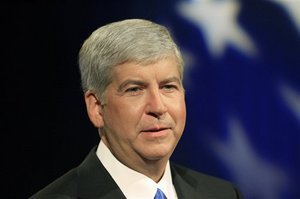
Gov. Rick Snyder
“We can’t forget community colleges and higher ed,” Synder said. “We do need to get more people with college educations.”
The 3 percent increase is tied to a formula that state legislators have been working to establish for months, using input from universities who have offered assistance but expressed concern about formula funding.
The formula will be based on four metrics: The growth in the number of undergraduate degree completions, the number of undergraduate completions in critical skill areas, the number of undergraduate Pell Grant recipients and compliance with tuition restraint.
If state universities increase tuition more than 4 percent, their funding will be affected, said Lt. Gov. Brian Calley. The 4 percent benchmark is significantly lower than the current metric of 7 percent.
"If we're going to be increasing state support, we're going to ask that tuition restraint be lowered from that previous benchmark," Calley said.
In 2011-2012 just two universities, Central Michigan University and Eastern Michigan University, kept tuition increases below 4 percent.
This year, university funding dropped 15 percent. Schools were threatened with further cuts if tuition rose 7.1 percent or more.
University of Michigan this year absorbed a $47.5 million cut. After President Barack Obama's recent Ann Arbor speech on the soaring cost of higher education, U-M President Mary Sue Coleman urged the state to "reinvest" in public universities.
"Every year: Cut, cut, cut, cut," she said. "The state is coming back, it’s coming back pretty dramatically and it's going to have to make choices."
Coleman also knocked Snyder's move toward formula funding.
"It can't be just a simple formula. It's more complicated than that," she said.
As a part of the uptick in funding, Snyder wants to advance 18 capital outlay projects, usually expensive construction undertakings that are supported jointly by the state and the university seeking improvement. On average, no more than two to three outlay projects are advanced each year.
In Snyder's budget community colleges also see a 3 percent funding increase. The $8.5 million bump will be tied to a formula that is largely based on the number of degrees and certificates offered in critical skill areas.
Kellie Woodhouse covers higher education for AnnArbor.com. Reach her at kelliewoodhouse@annarbor.com or 734-623-4602 and follow her on twitter.
Comments
trespass
Thu, Feb 9, 2012 : 6:10 p.m.
UM does not get many Pell grants because only 4% of UM students have family incomes of less than $50,000 even though the median household income in Michigan is $47,000. The number of degrees in critical areas (probably science and engineering) should be limited to American students. Why reward UM for graduating engineering students who are going back to China? UM will not like the 4% limit on tuition increases and may not follow it so overall UM will likely not fair as well as other universities in this formula. This is a clear intent to tell universities what the State govermnet wants for their priorities but UM will likely beat their chest about their constitutional autonomy and do whatever they want.
Sparty
Sat, Feb 11, 2012 : 5:39 a.m.
Restricting degrees to Americans isn't dicriminatory? UM is an international research university with collaborations around the world; studies and exchanges take place regularly. Do you have any concept what you propose would do within higher education generally?
trespass
Fri, Feb 10, 2012 : 12:51 p.m.
@Sparty- I did say American students, which includes all ethnicities. It is not racist but rather it is nationalistic (or patriotic if you prefer) to want money spent by US taxpayers to be spent on US citizens.
The Black Stallion3
Thu, Feb 9, 2012 : 10:24 p.m.
If they are American citizens then they are American students...Duh!!!
Sparty
Thu, Feb 9, 2012 : 8:54 p.m.
How do you know engineering students are going back to China? That seems to be fairly racist and discriminatory to suggest that science and engineering should be limited to American students. Who is to say that Asian students may not be American citizens? UM will not like "fair" as well? What does that mean? Do you mean "fare" as well?
Kara
Thu, Feb 9, 2012 : 5:01 p.m.
What I would really like to know is what exactly these "critical skill" areas are. Math, science, engineering, and business? I hope they are more broadly focused than that.
B2Pilot
Thu, Feb 9, 2012 : 4:57 p.m.
"University of Michigan this year absorbed a $47.5 million cut". - AND saved over $40 million on benefit reduction to staff - she forgot to mention "Every year: Cut, cut, cut, cut," she said - must be refrencing benefits to employees, certainly not talking about administrations generous salary increases right before Christmas after students left. AND certainly not talking about cutting tuition increases.
shutthefrtdoor
Thu, Feb 9, 2012 : 4:28 p.m.
In my opinion the universities have plenty of funding. They can get it from wealthy donors and the like. How about putting it into the K-12 system so they can have a better chance at making it to the "universities"?