

Gov. Rick Snyder's proposal to cut historic tax credits and incentives could significantly slow Ypsilanti's redevelopment, officials say
If Gov. Rick Snyder's budget is approved, a mix of historic tax credits and incentives will end. In Ypsilanti, where the state programs have spurred the rebirth of dozens of properties over 12 years, developers and city officials are worried.
Will the city's redevelopment lose steam?
Among the projects using state and local historic credits and incentives are the recently completed Peninsular Place student apartments, several downtown buildings, and a dozen residences. Officials say developers have used the incentives in more than 45 projects — projects that would've been impossible or significantly more difficult without the tax breaks.
Several works in progress are also making use of the tax breaks, such as Water Street, the Thompson Block and Mellencamp Building. Under the current proposal, works-in-progress won't lose their tax incentives.
The state credits are especially vital to Ypsilanti because of its large stock of historic buildings and a large historic district, said city planning director Teresa Gillotti. Ypsilanti is built out and rents there are lower than in a city like Ann Arbor, making it more difficult to recoup investment costs. The credits and incentives make it financially possible to develop in Ypsilanti, she said.
Representatives from Snyder's office did not return calls for this story, but he has previously proposed eliminating specific incentives as part of streamlining business taxes, then creating a pool of $100 million to reward some projects.
In interviews with AnnArbor.com, local developers echoed officials' concerns about what could happen in Ypsilanti if Snyder's plan goes forward.

Ypsilanti developer Karen Maurer at SPARK East inside the Mack and Mack Building.
Tom Perkins | For AnnArbor.com
Developers Eric and Karen Maurer of Maurer Management and Properties used a combination of credits and incentives for three downtown renovations over the last 10 years.
The Maurers say they will have invested approximately $6 million and received $2.5 million in state, local and federal breaks, by the time the Mellencamp Building at 120 to 124 W. Michigan Ave., is complete in September.
Prior Maurer renovations include the Mack and Mack Building at 211 to 215 W. Michigan and part of the West Michigan Lofts project at 200 to 204 W. Michigan Ave.
Crucial to each those projects were State Historic Preservation Office tax credits for $200,000.
“We basically started with a shell on those, so you’re talking about a whole lot of money to renovate,” Karen Maurer said. “I think it’s more expensive to restore than to put up a new building because you have to take what you have and make it work, and there are so many codes now. It wouldn’t be possible without breaks.”
The Maurers also used Brownfield incentives, which are offered for properties in need of significant cleanup or those with “functionally obsolete” structures.
At the local level, Ypsilanti’s City Council also approved an Obsolete Property Reduction Act abatement on several Maurer properties. That abatement freezes a building at its current value when construction begins. The freeze continues for up to 12 years, and owners are exempt from paying certain millages during that time.
The fate of local incentives is still unclear, but officials say they're preparing for the worst.
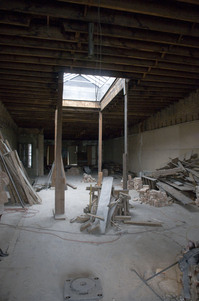
Renovations are under way at the Maurer-owned Mellencamp Building in downtown Ypsilanti.
AnnArbor.com file
Developer Stewart Beal has also received breaks on projects in Ypsilanti. He partnered with the Maurers and George Fotiadis to complete the West Michigan Lofts project. He owns the property at 208 W. Michigan Ave.
The 20 lofts on the building's second floor share a hallway and an elevator, but each developer owns his or her own units. Beal said those have been occupied since their 2006 completion, and each developer owns storefronts on the ground level, which have seen varying occupancy rates.
In total, Beal estimates the project cost $3 million, and he said about $700,000 of that was covered in state and federal historic tax credits.
“That project would not have gone forward without federal and state historic tax credits, and the OPRA,” Beal said, referring to the Obsolete Property Reduction Act. “Those are the three tools we used. We actually wouldn’t have even bought the buildings if those tax credits weren’t in place. It was always our intention to use them, and if those tools weren’t there, those building would be how they were before.”
Beal is also using a combination of credits and incentives for the Thompson Block building, on which he says he will resume construction this spring. As with the West Michigan Lofts, the Thompson Block wouldn’t have been a consideration without the breaks, Beal said.
State records show Brownfield and historic preservation credits alone have provided $3.5 million in breaks in Ypsilanti, not including local and federal incentives, over the last 12 years. Completed or planned investment in those projects utilizing state breaks totals $21 million. Adding the stalled Water Street development to the tally equates to another $120 million in investment once the project is complete.
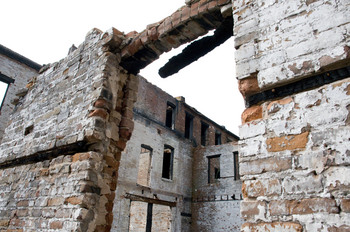
Renovation of the Thompson Block will require a combination of state, federal and local tax breaks.
Tom Perkins | For AnnArbor.com
Even when federal and local tax breaks are added, the city still sees roughly $3 of investment for ever $1 in breaks. It's not clear whether the cuts would affect local Brownfield incentives and the Obsolete Property Reduction Act. Under Snyder's budget, state Brownfield incentives would go away.
"We have had great success in using the OPRA in combination with (state and local Brownfield) or historic tax credits to renovate and finish off some of our buildings in downtown and Depot Town," Gillotti said.
Brett Lenart, director of the Washtenaw County Brownfield Authority, estimates state Brownfield projects helped provide 180 construction jobs in Ypsilanti over the last eight years. Beal said his construction company currently has 70 people working on a project tied to Brownfield incentives in Detroit.
“I voted for Snyder and I’m really interested in making Michigan a pro-business state, but I don’t understand how eliminating tax credits makes your state pro-business,” Beal said. “Maybe he has a long term plan for way, way, way down the road, but, in the short term, it’s a slap in the face to business.”
Beal said the loss of the incentives would mean developers would have to raise far more cash to complete a project, making most renovations unfeasible. He also said rents in Ypsilanti are too low to consider new buildings.
“I have never even investigated building a new building in Ypsilanti,” he said. “All I’ve done for the past 10 years is buy and renovate 50 properties. How do you encourage development without any tax credits is beyond me.”
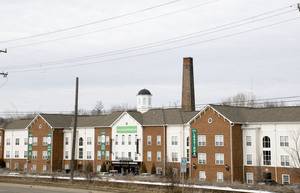
Peninsular Place student apartments on Huron River Drive is one of the only large-scale new developments the city has seen in recent years.
Tom Perkins | For AnnArbor.com
The only significant new development in recent years in the city has been the Peninsular Place apartment project, which brought hundreds of student apartments to Huron River Drive across from Eastern Michigan University’s campus. Peninsular Place developers used local Brownfield incentives to clear the property of the old dam.
Marurer said the only incentive left to buy old buildings is being able to choose from so many in foreclosure.
If Snyder's plan does happen, Ypsilanti Mayor Paul Schreiber and Gillotti fear the changes would lead to increased sprawl. They say developers will use different incentives to start new buildings on open land rather than redevelop the older stock of structures that “core” cities such as Ypsilanti offer.
Lenart said he is also concerned about the long-term balance between Greenfield projects designed to spur new development and Brownfield projects.
“Time will tell what happens, but we have approved a lot of plans solely relying on (Brownfield incentives), so that’s a good indication of the importance they have,” he said.
Tom Perkins is a freelance reporter for AnnArbor.com. Reach the news desk at 734-623-2530 or news@annarbor.com.
Comments
outdoor6709
Wed, Mar 16, 2011 : 2:19 a.m.
Ok, so now we are taking editorials for a socialist website as gospel. Think for yourselves for once
leaguebus
Mon, Mar 14, 2011 : 9:27 p.m.
Well of course the well financed by tax cuts, newly rich will be able to form monied coalitions and do all their renovations from pocket change. And the 90% that cannot afford the high cost of renovation can provide a few more empty buildings for the homeless to burn down and the newly richer upper class will then be able to buy the property for pennies. Good plan guys. Wish I had thought of it.
Andrew Jason Clock
Mon, Mar 14, 2011 : 8:17 p.m.
First, tax credits have worked. This story sites several examples of how they have lead to successful redevelopment. (of course, Peninsular Place and the rest of the "across the tracks" student ghetto has also sucked the life our of Ypsilanti's rental market, but I digress) These aren't money give aways, they are credits. If the work gets done, you get the tax credit. If work doesn't happen, developers don't get a tax credit. Second, has anyone noticed how we're eliminating tax credits to "avoid picking winners and losers" but replacing it this $100M funds that will go to worthy projects, or, in other words, to projects that the governor feels are winners? Can anyone explain how this changes anything, other than making development much, much harder?
Nicholas
Mon, Mar 14, 2011 : 6:26 p.m.
'Snyder's plan constitutes an open and direct transfer of wealth from the working class to the wealthy. The claim by the governor that his budget represents a vision of "shared sacrifice" is absurd on its face. The rich and the corporate elite are not being asked to sacrifice a penny.' <a href="http://www.wsws.org/articles/2011/feb2011/mich-f22.shtml" rel='nofollow'>http://www.wsws.org/articles/2011/feb2011/mich-f22.shtml</a>
Peter Jameson
Mon, Mar 14, 2011 : 4:23 p.m.
Looks like it's up to the good ole free market once again. Will we ever learn that socialism is unsustainable?
Basic Bob
Mon, Mar 14, 2011 : 4:36 p.m.
Socialism is only sustainable if you are willing to accept a much lower standard of living.
outdoor6709
Mon, Mar 14, 2011 : 1:55 p.m.
It may be time to reconsider the "historic distric designation" for all cities. The only way any developer works within those areas is if the state/city gives them tax breaks. Those tax breaks are then paid for by other residents of state/city. Only if we allow the market to destroy old unuseful buildings, IE old trian station in Detroit, will we get true redevelopment. The government puts to many obsticles in the way of re-development. The government is here to help you model has been exposed for the fraud it is. Projects need to stand or fall on their merits, not the wims of politicians.
Marshall Applewhite
Mon, Mar 14, 2011 : 1:27 p.m.
Apparently Stuart Beal doesn't have a fantastic grasp of Gov. Rick Snyder's politics, or politics in general. With the way he has dragged his feet on the project,there's nobody to blame but himself if he never receives tax incentives for the Thompson Block.
Edward R Murrow's Ghost
Mon, Mar 14, 2011 : 1:30 p.m.
Absolutely Correct! Good Night and Good Luck
Andrew Jason Clock
Mon, Mar 14, 2011 : 1:16 p.m.
Not that I don't think its an important story. This one just seems a lot like that other one. Here it is: <a href="http://www.freep.com/article/20110308/BUSINESS04/103080383/1055/SPORTS07/SPARK-founders-Loss-Michigan-tax-credits-would-limit-redevelopment-growth-opportunities?odyssey=nav" rel='nofollow'>http://www.freep.com/article/20110308/BUSINESS04/103080383/1055/SPORTS07/SPARK-founders-Loss-Michigan-tax-credits-would-limit-redevelopment-growth-opportunities?odyssey=nav</a>|head
sesomai
Mon, Mar 14, 2011 : 7:06 p.m.
Thanks for the link. I hadn't read that.
Ypsi-Booster
Mon, Mar 14, 2011 : 1:08 p.m.
On the whole, I'm in favor of these tax credits, but if they are discontinued it looks as if that would be the end of the Thompson Block. As it is, I'm very skeptical that any progress at all will be made on that structure this year. Beal has now had more than a year and a half to commence restoration. The sidewalks are still blocked at the corner of Cross and River, and there is no evidence of work being done on the site.
Andrew Jason Clock
Mon, Mar 14, 2011 : 1:06 p.m.
Wasn't this story in the Detroit News or Free Press last week. I mean this same exact story focusing on the same people by one of their writers?
EyeHeartA2
Mon, Mar 14, 2011 : 12:43 p.m.
I wish you could click on those pictures for a larger version. They are so small that they are pretty useless.
oldrustynail
Mon, Mar 14, 2011 : 12:38 p.m.
Ypsilnati, without tax credit and incentives, can suffer more economic setbacks. Don't worry, be happy. We now have the emergency financial management. Some firm, picked by Lansing, can come in, break all contracts and ignore local elected respresentation and make Ypsilanti a modern version of a "company town". Then that firm can pick the winners and losers. And who knows more about picking winners and losers than Wall Street?
1ofalpha
Mon, Mar 14, 2011 : 1:09 p.m.
@oldrustynaill. I couldn't agree with you more. Thank you for your comment.
InsideTheHall
Mon, Mar 14, 2011 : 12:35 p.m.
Every program has a heart string. If all these programs are so great why are we in the mess we are in??????? Simple, We can't afford it!
Diagenes
Mon, Mar 14, 2011 : 12:27 p.m.
I thought libs were opposed to tax breaks for millionaires.
miscribe
Mon, Mar 14, 2011 : 12:16 p.m.
Seem like a lot of pain to millions in Michigan to benefit a relatively few business owners who may or may not create a few jobs that probably will pay less that we can live on. Our governor is one insensitive nerd. I don't get it.
Edward R Murrow's Ghost
Mon, Mar 14, 2011 : 7:09 p.m.
"So it would be a lot better to extend retraining and unemployment indefinitely? Waiting for the sugar plum fairy to hand out jobs that meet your expectations?" Yes, much better to end benefits immediately, forcing many families to leave the state looking for jobs, leaving behind their mortgages and leases, causing property values in the state to continue to plummet. Some people are SO focused on punishing those they believe to be undeserving that they are willing to harm their own economic interests. Talk about cutting off one's nose to spite one's face. Good Night and Good Luck
Basic Bob
Mon, Mar 14, 2011 : 4:32 p.m.
So it would be a lot better to extend retraining and unemployment indefinitely? Waiting for the sugar plum fairy to hand out jobs that meet your expectations?
Wolf's Bane
Mon, Mar 14, 2011 : 12:02 p.m.
While I echo 1ofalpha's comments with regard to Ricky's 'business as usual" Gateway approach to resolving budgetary issues, I must add my concerns regarding the Thompson Block redevelopment. It is really difficult not to look at the Thompson Block as a total failure on so many levels; the failure of the incentives and tax breaks to move the project forward, the lack of insurance at the time of the fire, the lack of cooperation from Beal, Inc., the City Councils' inability to draw a line in the sand and push the project forward. Maybe we would be better off making sure that any new developments raise their own money first prior to looking for approval?
Jimmy McNulty
Mon, Mar 14, 2011 : 11:26 a.m.
Thompson Block = Waste of money. My prediction is that this eyesore will not even be touched throughout the summer.
braggslaw
Mon, Mar 14, 2011 : 11:25 a.m.
Ypsi like Detroit has been in "redevelopment" for decades. Govt. money will not fix it, only people can.
braggslaw
Mon, Mar 14, 2011 : 10:21 p.m.
Maybe it's cool money and not good money <a href="http://www.coolcities.com/ypsilanti.html" rel='nofollow'>http://www.coolcities.com/ypsilanti.html</a>
Edward R Murrow's Ghost
Mon, Mar 14, 2011 : 7:12 p.m.
Exactly how much "good money" has been thrown away on Ypsilanti redevelopment? Good Night and Good Luck
braggslaw
Mon, Mar 14, 2011 : 4:56 p.m.
Another "aphorism" Good money after bad... it has never worked and will never work.
Edward R Murrow's Ghost
Mon, Mar 14, 2011 : 1:31 p.m.
Government by aphorism. Gotta love it. Good Night and Good Luck
Jeffersonian
Mon, Mar 14, 2011 : 11:04 a.m.
There is no problem with building private coalitions of interested preservationists and entreprenuers- and these people should reap the benefits of their efforts for having taken the risk. The problem begins when government starts picking winners and losers. What becomes lost in the manipulation of taxes is the "forgotten taxpayer" and the opportunity costs associated with offering both tax breaks and subsidies. The concept of market forces determining how investment is made isn't hard to grasp- but it is emotionally difficult to accept by people whose development visions require dipping into public coffers.
Jeffersonian
Mon, Mar 14, 2011 : 7:09 p.m.
1ofalpha-- No system is perfect, subversive forces do afflict capital markets- but nothing compares to what happens when politicians get their hands on taxpayer's money. What works better is more transparency, less obstructionism and a public willing to take measured risks when prudent.
1ofalpha
Mon, Mar 14, 2011 : 1:07 p.m.
@Jeffersonian. And you believe we have a free market operating? Perhaps it would be best to buy a condominium on the Libertarian's ocean vessel. They, too, have a shared delusional system of free markets.
McGiver
Mon, Mar 14, 2011 : 12:37 p.m.
Well stated.
1ofalpha
Mon, Mar 14, 2011 : 10:59 a.m.
This is yet another example of a typical bean counter's approach to problem solving. Short sited, uncreative and devastating in consequences. We need the continued efforts of individuals with creativity, perseverance and forethought if our cities are to flourish, rather than become cookie-cutter flat lands. Hum. Kind of like Gateway did when they went "cheap" on critical components to compete--rather than invent.
1ofalpha
Mon, Mar 14, 2011 : 1:04 p.m.
@McGiver. I understand how you would draw the conclusion re:' "greedy property developers..." I was not clear enough in my initial post. I'm sorry. I meant that those who might well benefit from "re-dos" of old properties are more likely (I think?) to be individuals who are more aesthetics driven than developers are. I presume these individuals would need assistance in return for their hard work, creativity and so on. Also and a point I did not make is this: Contrast putting in another ugly strip mall with improving historic districts. The former would tank Ypsilanti. The latter just might attract more quality individuals to the downtown and, by golly, just positively effect property values. I do not want greedy developers raping the city. That's been done enough already around the US. Let's preserve what we have and move forward.
McGiver
Mon, Mar 14, 2011 : 12:36 p.m.
So just how does giving tax money away to rich, greedy property developers add creativity, perserverance and forethought to downtown development. You need government for that?