

Special Project: Ann Arbor's Hidden Poor
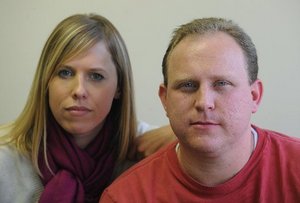
David Jesse and Tina Reed.
Lon Horwedel | AnnArbor.com
Why we did this series on local poverty
We’re all aware of the changes - and the sometimes painful readjustments - Ann Arbor residents have been forced to make because of the economy. The recession began with the housing and banking sectors. But it’s crept into nearly every facet of everyday life in small ways and big ways.
Tough choices. Budget crunches. Cutbacks.
Ann Arbor has a reputation as the oasis in Michigan, a state with one of the nation’s most troubled economies, and it’s been a bit easier here than elsewhere for some to forget the recession.

There's always been a struggling population in Ann Arbor, but in the past it's been largely hidden.
That's not the case now. Nearly everyone has either personally experienced job or benefits losses or reduced hours in recent months or knows someone who has.
More people have been filing for public or non-profit assistance to help make ends meet for basic needs like food, housing, health care, transportation and education.
Meanwhile, county and state agencies — which have traditionally helped those in Ann Arbor's low-income population — find themselves stretched thinner than ever while their budgets are threatened by cuts.
As reporters, this was an issue we wanted to explore.
David Jesse has seen first-hand as an education reporter how being poor can affect a student's ability to earn a high school diploma, even if that student attends one of the highest performing schools in the state. He wanted to see how poverty affects the rest of a person's life.
Tina Reed, a health reporter and former business reporter, wanted to better understand how local residents who worry about making the rent and utility bills could possibly cope with paying for health care.
See a video of the reporters talking about this first installment of the series.
And while we don't claim to have any grand solutions, we hope this series will help spark a conversation in the community.
Over the next several months, we'll explore poverty in Ann Arbor and tell the stories of local residents struggling to meet basic needs and the impact the struggles have on the greater community.
David Jesse covers K-12 education for AnnArbor.com. He can be reached at davidjesse@annarbor.com or at 734-623-2534. Tina Reed covers health and the environment for AnnArbor.com. She can be reached at tinareed@annarbor.com or at 734-623-2535.
Comments
PJ
Tue, Dec 22, 2009 : 7:29 a.m.
If Paul is correct, or even halfway correct, I don't see who could possibly be opposed to his idea. I mean, duh- wouldn't most families receiving benefits prefer to get them without being "steppd on," umpteen times? Wouldn't most taxpayers like to see their hard earned cash being effectively used (or halfway effectively used?) Maybe he's right about Ann Arborites!
JudyG
Mon, Nov 9, 2009 : 5:50 p.m.
I agree with Halima, to set the record straight, I moved to Ann Arbor because it was a beautiful and safe city to live much safer than where I was living. I also found work and support being recently divorced, however I haven't ever considered myself poor. We here in Ann Arbor do need to be reminded of what it really means to be "poor".
Medicine Man
Mon, Nov 9, 2009 : 12:15 a.m.
Tina's kinda hott..
needed perspective
Sun, Nov 8, 2009 : 10:24 p.m.
Here is my guarantee...the poor are not a part of this discussion on the net. To us, we see...a statistic, a number and a comment; to them, one more day of real hopelessness. Those caught in the middle...pre-school children. It cost $0.00 to care and offer a helping hand.
David Briegel
Sun, Nov 8, 2009 : 9:08 p.m.
Excuse me Paul, but why don't you tell us where it went? You did that much research now tell us the rest. Why don't you tell us why all these people don't deserve health care and mental health care and how they should go hungry and homeless. I just want all the naysayers to tell us their solutions. Please!
westa2
Sun, Nov 8, 2009 : 8:10 p.m.
I agree with Mr. Wehr. We all know that many are struggling. Why not look at how the money is spent that is to go to the many programs that support our poor. I see many nonprofits in our area that seem to overlap.
Paul Wehr
Sun, Nov 8, 2009 : 7:10 p.m.
The federal government alone poured $34,176 per person below the poverty line into social programs in 2008. That means a family of 5 is good for $170,880 *every year* (seriously. confirm it for yourself.) And this does not include what the state of Michigan spends, or the city of Ann Arbor, or Food Gatherers, or United Way, or churches, family, friends, et. al. It doesn't strike me as requiring a great deal of investigative journalism to discover that a bottom 20% exists. What I'd like to see is some investigative journalism into why all that money is not getting to the poor, and where it IS, in fact, going. Unfortunately, I don't think there is any market for that information in Ann Arbor, where they would apparently much rather just wallow in stories about the effects of the failure rather than identifying and correcting the cause.
Andrew Thomas
Sun, Nov 8, 2009 : 11:02 a.m.
Congratulations David and Tina on a great job.
David Jesse
Sun, Nov 8, 2009 : 11:01 a.m.
Halima: We used the federal guidelines for poverty as the basis for collecting stats on who is poor and who is not poor in Ann Arbor. However, we know, and note in the series, that because of Ann Arbor's relative wealth, being poor in Ann Arbor can mean that you have more than the federal guidelines for poverty
Halima
Sun, Nov 8, 2009 : 10:49 a.m.
Your articles, although helpful, do not go far enough in defining what poor is. Economically speaking, poor is not having the resources to provide for your food, housing, and shelter. When people need housing assistance or food, etc, as you have defined in the article, they are poor. But being unable to pay for your child's college tuition is not poor. We here in Ann Arbor need to be reminded about what poor is and is not.
Kristin Judge
Sun, Nov 8, 2009 : 9:50 a.m.
Investigative journalism in Ann Arbor! What a wonderful addition. Now with the Ann Arbor Chronicle and Annarbor.com working on important stories, our community will be even more educated on topics that will impact all of us. This topic is dear to me because of my work as a County Commissioner. We help fund many critical organizations that help the homeless and poor in our county. With money becoming more scarce in the next few budget cycles, this is going to be harder and harder to do. Our board understands the importance of funding human services. I will continue to do all I can to help, but we are going to need more support from the community in the future as our budget gets smaller.