

St. Joseph Mercy hospitals make flu, whooping cough vaccinations mandatory for employees
St. Joseph Mercy hospitals have made flu shots for employees mandatory this year for the first time, warning workers that they must get vaccinated or could lose their jobs.
Lakshmi Halasyamani, vice president for quality and systems improvement, said the tougher stance on vaccinations is meant to protect patients. Typically, only about half of St. Joseph employees got a flu shot when an immunization program was voluntary — despite memos, free vaccination clinics and a Centers for Disease Control and Prevention recommendation.
“Patients who are hospitalized are hospitalized because of many chronic conditions and may be on medications that might decrease their immunity,” Halasyamani said. “They may be the least well able to tolerate the flu.”
St. Joseph’s new mandatory immunization program began in November and encompasses more than just the flu. Employees also must receive vaccination for pertussis, which is commonly referred to as whooping cough, officials said. A Tdap vaccine protects against tetanus, diphtheria and cellular pertussis.
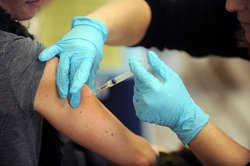
St. Joseph Mercy hospitals employees must be vaccinated for the flu and whooping cough by Jan. 10.
About 7,000 workers at St. Joseph Mercy hospitals in Ann Arbor, Saline and Livingston, as well as the Brighton and Canton outpatient facilities, have until Jan. 10 to get vaccinated.
Washtenaw County is in the midst of a whooping cough epidemic, with 232 cases reported through Dec. 20, according to health department officials. In 2009, 81 cases were reported.
Halasyamani said infants and children are particularly at risk for pertussis, a respiratory illness that can be deadly. The epidemic and vulnerability of young patients are big reasons St. Joseph decided to require an immunization or booster for employees as a condition of employment, Halasyamani said.
The Tdap and flu shots are required of all workers, not just those who work directly with patients, Halasyamani said. Individuals can decline the immunizations if they have documented medical reasons. Those who disagree on other grounds, such as religion, will be evaluated case-by-case.
The hospitals have seen pockets of resistance from employees to the policy change, Halasyamani said. St. Joseph launched an internal blog to address concerns.
“We live in a diverse society, and people have different beliefs,” she said.
Mandatory flu vaccination programs are a growing trend among hospitals nationwide.
David Dull, a vice president for quality and patient safety for Spectrum Health, said the health system’s mandatory vaccination program for the flu began in 2009. The program encompasses five of nine hospitals and 14,000 of 16,700 employees on the west side of Michigan.
Compliance has been about 90 percent.
“It causes about 20,000 deaths in the population every year,” Dull said of the flu. “We know there is an effective vaccination. We also know that patients who come to hospitals are particularly susceptible to complications from the flu. It made intuitive sense to us that we would vaccinate our staff.”
At the University of Michigan Health System, which has about 25,000 employees, most workers must either receive a flu shot or wear a mask during flu season, a more stringent requirement than in years past.
At least six professional organizations for health care workers have penned policy statements since 2009 supporting mandatory vaccination programs.
But the largest health care union in the country is against mandatory vaccination programs, said Zac Altefogt, spokesman for SEIU Healthcare Michigan. The union has no members at St. Joseph hospitals, which are non-union, or the UMHS.
“We think that voluntary programs are the way to go, that they’re positive and increase vaccination rates,” he said.
Altefogt called programs like those at St. Joseph hospitals and UMHS punitive and unnecessary. According to that group’s position statement, the programs can hurt workers by driving them from their professions and providing a false sense of security involving infection control.
Stacy Hickox, an assistant professor in the school of human resources and labor relations at Michigan State University, said it would be difficult to challenge a mandatory flu program in court because of a hospital’s interest in protecting its patients.
“I don’t see it (a challenge) succeeding,” she said.
Juliana Keeping is a health and environment reporter for AnnArbor.com. Reach her at julianakeeping@annarbor.com or 734-623-2528. Follow Juliana Keeping on Twitter
Comments
Matt Cooper
Wed, Jan 12, 2011 : 5:08 p.m.
For all of you that think this is Tuskeegee all over again and that all health care workers should be forced to either get stuck with a needle contaminated with viral particles or lose their jobs, let me ask you one simple question. Where exactly do you think health care workers contract all the viruses you are so terribly afraid of getting? Hmm? From their patients, that's where. So now why are none of you espousing that every patient that walks in the door get vaccinated as well? You cry endlessly about how you don't want to risk getting what we may have, while at the same time thinking nothing of the risks we take in getting what you have. Also, have any of you Einsteins thought even a little about what happens to people that might be allergic to the ingredients used in growing the attenuated or even killed viruses? Hmm? Eggs are oftentimes used to incubate viral particles, and many people are allergic to eggs without ever knowing it. I personally have had a patient about 7 years ago that nearly died because she was allergic to some of the chemicals that are used to harvest the viruses. So what do you tell the parents of someone that dies because their employer mandated they either get a vaccination or get fired? Hmmm? Finally, do any of you have any idea the kinds of anti-septic and anti-viral precautions we take every day in the course of our jobs? Do you have any idea how many times I wash my hands every day? Or how many times I saturate my hands with Purell so as to not spread infection? Or how many pairs of sterile gloves I go through every day? Do you? If not do some research on nosocomial infections (hint: nosocomial does not only include those infection acquired from hospital staff, so keep your misleading numbers to yourself). Stop by your local hospital and ask about their handwashing policies. Talk to an infectious disease nurse and ask about their hospitals infection rates. When you wash your hands upward of 200 times a day such I and most other health care workers do, then talk to me about antisepsis.
BR
Tue, Jan 11, 2011 : 6:06 a.m.
What happens if I get the shot and get an infection or any illness and can't work? Do I receive workmans comp..Who is accountable if something goes wrong,nobody.If these vaccines are so safe why isn't there someone standing behind them.We are unable to file a lawsuit against the producers of the vaccines. Now that it's mandatory St. Joey should be on the hook for any illnesses or deaths since they are pushing it. If you die or are disabled all you'll get is sorry guess you shouldn't have taken the shot.
jns131
Mon, Jan 10, 2011 : 6:20 a.m.
Channel 7 announced that St Joe took its first victim. A nurse was fired for refusing to take that flu shot. Sad. Very sad. I hope the nurse takes St Joe to the cleaners.
FreedomOfSpeech
Mon, Jan 10, 2011 : 1:02 a.m.
1. According to top scientists around the world, at least those not under the WHO umbrella, the fact is that H1N1 could NOT... I repeat NOT have formed/mutated naturally. It is a combo of Avian, Swine & Human strains and it is IMPOSSIBLE for that strain to have done this without... "Engineering". 2. The WHO was caught lying last year. 3. Around the world, despite the local numbers which I suspect are inflated to serve a purpose.... There were record LOWS in vaccination & RECORD lows in Flu cases... Hello! 4. The flu scam was tried in the mid 70s and that was exposed as a scam. Follow the money... 2 examples of the major players in the 70s case... None other that Donald Rumsfeld and George Schultz... Hello. The Washington State case that these... ek hemm... Doctors are holding up is a glaring example of how evil this is. Washington had a law protecting it's citizens from any vaccines containing mercury, for example. They changed the law in a back room deal to allow mercury in the vaccines just in time for total BS H1N1 scam... Hello! To further illustrate the evil and I must say stupidity of compliant (pause for the irony to soak in) media... CBS News aired a story saying that Mercury is actually good for you! Yes Good For YOU! 5. As for safety... The H1N1 engineered (again start there and the rest should be... I repeat should be moot)strain vaccine came out in a nasal spray that even the so called main stream news reported as having... oops... LIVE Flu in it... But don't worry... They fixed that... truuuuuust uuuuusss... Now they are pushing Guardisil on little kids, boys and girls as young as 9 saying it may prevent Anal Cancer... Guardisil should be banned after it has killed and destroyed the lives of many but noooo... Truuusssst Them! They prop up the FDA has approved... As if the FDA isn't a criminal Org.... Just look at how the deadly Aspartame was pushed through with no testing... guess who... Good old Donald Rumsfeld again with help of former Senator Skinner (Jane Skinner of FAUX News & NFL Commish Goodell's wife is his daughter). It's a scientific grid of money power and domination. You have the White House Czar Chief Science John P. Holdren writing that our public water supply should be dosed with sterilants to sterilize us among just some of his great ideas. You have David Rockefeller, Henry Kissenger writing in their books that 70 to 80+ % of the worlds population should be exterminated... Yes that's right they wrote it and if you watch the film I'll link below you'll see the quotes in the books and use the films bibliography it's fact not theory. Bill Gates at TED and other locals just this past year called for using vaccines to "Reduce world Population" again fact you can listen and/or watch him say it. Ted Turner calls for a 90% reduction in world population. You have the Texas Science Symposium of top scientists giving Top Science winner and University of Texas Prof Dr. Eric Pianka a STANDING Ovation after he, with a picture of a pile of human skulls in Rwanda behind him on a screen, calls for weaponising Ebola and killing 70% plus of the world s population... A STANDING OVATION from a large group of "top scientists" this was cover and writing about by a local Austin reporter and then picked up on the radio and Dr. Pianka's Grad students lashed out at the reporter and the radio host... No... Not to deny anything... Many went on to say they loved Dr. Pianka but that he is too liberal and they want to kill off 99% to 100% of humans... Tell you what... You first Drs. Scary and this isn't about keeping people safe in hospitals even though the vast majority of the people on the local level pushing this believe that is the case... God Bless Them... What is it said about willing ignorance though? I hear good intentions can pave roads... Hitler is dead but he did a good job with the roads too... I hear... I wonder if Dr. Mengala took that oath about doing "no harm"? *** Obama Promises to Spend Billions to Address Bogus H1N1 Pandemic www.infowars.com/obama-promises-to-spend-billions-to-address-bogus-h1n1-pandemic/ Big Pharma Concocts First Swine Flu Vaccine www.infowars.com/big-pharm-concocts-first-swine-flu-vaccine/ - Canadian Doctor: H1N1 Vaccination a Eugenics Weapon for Mass Extermination www.infowars.com/canadian-doctor-h1n1-vaccination-a-eugenics-weapon-for-mass-extermination/ Norway Has 23 Case of H1N1, Decides to Vaccinate Entire Population www.infowars.com/norway-has-23-case-of-h1n1-decides-to-vaccinate-entire-population/ The Truth about the Flu Shot www.infowars.com/the-truth-about-the-flu-shot/ Incidentally, if you believe the government will not kidnap you at gunpoint and lock you in a concentration camp and possibly force you to take these toxins, check out Executive Order 13295 of April 4, 2003. www.fas.org/irp/offdocs/eo/eo-13295.htm It states that the government has the authority to establish regulations providing for the apprehension, detention, or conditional release of individuals to prevent the introduction, transmission, or spread of suspected communicable diseases, including diseases at that time not yet isolated or named. Of course, the government will decide if you have a deadly disease or not. Much More )))->.pdf file www.infowars.com/misc/the_truth_about_the_flu_shot.pdf www.ft.com/cms/s/0/375dde06-7559-11de-9ed5-00144feabdc0.html?nclick_check=1 Vaccinations: Deadly Immunity Robert F. Kennedy Jr. - Global Research - July 25, 2009 www.infowars.com/vaccinations-deadly-immunity/ Vaccines Far More Deadly Than Swine Flu The Institute of Science in Society - July 28, 2009 b>www.infowars.com/vaccines-far-more-deadly-than-swine-flu/ Government Swine Flu Advisor On Vaccine Maker Payroll www.infowars.com/government-swine-flu-advisor-on-vaccine-maker-payroll/ Nano Particles used in Untested H1N1 Swine Flu Vaccines www.globalresearch.ca/index.php?context=va&aid=15092 Ingredients Found in Spermicides, Cleaners, and Cosmetics along with Thimerosal, and Squalene Present in Experimental H1N1 Vaccine Jeffry John Aufderheide - VacTRUTH - 09/11/09 See for yourself the study presented at the end of article. Please spread the word and make this go viral no pun intended. Kindly reference and link to VacTRUTH! Ingredients Found in Spermicides, Cleaners, and Cosmetics along with Thimerosal, and Squalene Present in Experimental H1N1 Vaccine www.vactruth.com/2009/09/11/ingredients-found-in-spermicides-cleaners-and-cosmetics-along-with-thimerosal-and-squalene-present-in-experimental-h1n1-vaccine/ H1N1: Panvax Training Powerpoint Received by Health Care Workers in Australia www.infowars.com/h1n1-panvax-training-powerpoint-received-by-health-care-workers-in-australia/ Do Not Skip This One! ^^^^^ International Hearings Begin On Falsified Swine Flu Pandemic www.infowars.com/international-hearings-begin-on-%e2%80%9cfalsified%e2%80%9d-swine-flu-pandemic/ H1N1 swine flu hoax falls apart at the seams www.naturalnews.com/027984_swine_flu_vaccines.html WHO Scientist: Swine Flu Pandemic Was Completely Exaggerated www.infowars.com/who-scientist-swine-flu-pandemic-was-completely-exaggerated/ WHO scandal exposed: Advisors received kickbacks from H1N1 vaccine manufacturers Mike Adams - Natural News - June 6, 2010 www.naturalnews.com/028936_WHO_vaccines.html Film: EndGame: Blueprint For Global Enslavement (2:19) www.video.google.com/videoplay?docid=1070329053600562261 Endgame Bibliography- minute by minute, scene by scene All Facts Backed up! www.endgamethemovie.com/biblio01.html.
NoVaccines4Me
Sun, Jan 9, 2011 : 8:43 p.m.
Vaccines are pharmaceutical products and, like all pharmaceutical products, carry a risk of injury or death that can be greater for some than others. The risk for injury or death from vaccination depends upon the vaccine or vaccines given; the individuals health at time of vaccination; vaccine reaction history; personal or family medical history and whether the person is exposed to other environmental toxins or factors that may affect immune responses to vaccination. There is a gap in medical knowledge in terms of doctors being able to predict who will have an adverse reaction to vaccination, and who will not. A wonderful website is the National Vaccine Information Center at http://www.nvic.org/NVIC-Vaccine-News.aspx Read the article "Forcing Flu Shots on Health Care Workers: Who Is Next?"
NoVaccines4Me
Sun, Jan 9, 2011 : 8:13 p.m.
Let's do the math: 12 Million healthcare workers in America forced to get a flu vaccine EVERY YEAR at $25 per vaccine = BIG PROFITS for vaccine manufacturers!! The Society for Healthcare Epidemiology of America (SHEA) is the organization pushing for mandatory flu vaccines in healthcare workers. SHEA represents ~1,800 physicians and other healthcare professionals. If you look closely at the end of the 2010 SHEA Position Paper you'll see that there were 9 authors- 5 have a financial conflict of interest. VERY INTERESTING!! Thomas R. Talbot, MD, MPH (T.R.T) reports that he is a consultant for Joint Commission Resources, has received honoraria from GlaxoSmithKline through support of the Joint Commission Resources Flu Challenge Program, and has received research support from Sanofi Pasteur for donated Tdap vaccine for a CDC-funded study (his spouse has received research support from Wyeth, Vaxxinate, and Sanofi Pasteur). David J. Weber, MD, MPH (D.J.W) reports that he is a consultant for GlaxoSmithKline and has received honoraria from Wyeth, Pfizer, Merck, and OrthoMcNeil. Edward J. Septimus, MD (E.J.S) reports that he is a consultant for BD Diagnostics and Rymed Technology and has received honoraria from Sage, Care Fusions, Merck, and Cubist. Gregory A. Poland, MD (G.A.P) reports that he is a consultant to Merck, Avianax, Theraclone Sciences [formally Spaltudaq Corporation], MedImmune, Liquidia Technologies, Novavax, EMD Serono, Novartis Vaccines and Therapeutics, PaxVax, CSL, Emergent BioSolutions, and Glaxo-SmithKline, and has received research support from Wyeth and Novavax. Michael L. Tapper, MD (M.L.T) reports that he is a consultant to Human Genome Sciences, Pfizer.
jns131
Sun, Jan 9, 2011 : 1:51 p.m.
I am all for anyone who drives children, rigs and freight to get tested because if they do not and something happens then the government is going to be all over them and their company. Especially parents. Drug testing for straight and semi's yes, but I am talking hospitals and a violation of their rights. By all means drug test me. Driving a straight truck is not fun and driving stoned not something I would ever do. But there is big diff between forcing a hospital worker to do something that is a violation of rights and a truck driver being tested for drugs. Remember this, trucks, cars. trains and planes do kill. A hospital worker with the flu? No.
tracyann
Fri, Jan 7, 2011 : 11:07 p.m.
I'm graduating from nursing school in April and I've had my flu shot! I'm putting my app in today!
Jake
Fri, Jan 7, 2011 : 4:39 p.m.
Being a long time health care worker, I find it sad that there are so many non-health care workers who feel mandatory vaccination is necessary. I worked with many last year who did not take the vaccine amidst the scare mongering going on and cared for H1N1 patients while not contracting the disease. The fact is that more people died of the regular seasonal flu last year than H1N1 and yet the powers that be have combined the seasonal flu vaccine with the H1N1 and a 3rd, with no choice by the person. There are many experts who believe this is unnecessary and a violation of a persons personal freedoms. I too want the best for my patients but thinking that we are walking foments because we don't take the vaccinations is just plain ludicrous. If you work conscientiously in a hospital you know this. One other aspect that needs to be addressed is the political and economic aspect. If you follow the money, there are plenty of people gaining monetarily from this and the powers that be continue to enforce their will upon society, deciding what is and isn't good for us, regardless of what we believe. In the biggest picture, this a severe slippery slope we might not be able to again ascend from.
RuralMom
Fri, Jan 7, 2011 : 2:24 p.m.
I also find it hilarious that the hospital's "liability" is questioned repeatedly. You are not going to sucessfully sue St.Joe's for contracting the flu while you are hospitalized, that's not how it works. My Dad got a Staph infection from St.Joe's after Bypass Surgery - that's not something you can sue for, its an assumable risk complication from surgery and the hospital environment. The ONLY way you could sue and be successful is to prove that any facilty was GROSSLY negligent, such as ordered a sick employee to care for you despite knowing they were ill.
Corey
Fri, Jan 7, 2011 : 11:51 a.m.
Ethically speaking it seems to make sense that hospital employees would choose to vaccinate themselves for their patients' protection. What is sad is that hospital workers don't have that mindset. Instead you have to have a possibility of forcing employees to do the right thing. If you are in the healthcare industry and think you are doing your job by NOT getting vaccinated you are dead wrong. If you don't think that hospital employees should be forced to get vaccinated based on some sort of libertarian principle you are selfish. Put the patients first people, plain and simple. Makes me kind of worried that if I had to have a stay at St Joes that not only am I there for a problem but the problem could get worse because my nurse has the flu. But since they weren't forced to get vaccinated, that was the right thing. Goodness people.
jcj
Fri, Jan 7, 2011 : 10:27 a.m.
For all of you soo afraid to take the flu shot that you are willing to lose your job. Thanks. That will free up some openings for those who's unemployment has run out! But I suspect once your bluff is called you will be on the job.
tim
Thu, Jan 6, 2011 : 10:05 p.m.
Barb lets just give the whole population flu shots---if your not in contact with anyone in the hospital you have less of a chance of giving someone the flu than the bus driver. Don't be dumb
Janet
Thu, Jan 6, 2011 : 10:01 p.m.
I am a St Joe employee who most likely will be losing my job because I choose not to be injected with vaccines that may not be safe. Just because a doctor or the CDC says something is totally safe does not make it so. How many times have they come out and said a drug is totally safe just to take it off the market when people had debilitating side effects or even died? This should be a personal choice and was not a condition of my employment when I took this job--they just changed the rules on me and I am supposed to go along with it. You should see the list of side effects on the paper they want us to sign when the shot is given. I think more people should be furious about this. It may be your company next.
alison10
Thu, Jan 6, 2011 : 9:32 p.m.
I am an employee of St. Joes's and believe this is so wrong! I was threatened several times this week that if I didn't get vacinated, I would be terminated. I have never gotten a flu shot before nor have I had the actual flu. I have worked in a hospital/or nursing home for the past 14 years. There is so much unknown about these new shots that won't be found out for many years. The best thing to do is proper hand washing and stay at home when sick. What about all the patients and visitors who dont have their shots? Are the going to be kicked out too? St Joe's will not offer a position with insurance so I do not have any. I could get something worse than the flu, can't go to the doctor so I come and spread that around? It is ridiculious that they are making pregnant women get these drugs into their body. The vacinnes are 70% or less effective the older you are. Each year a new strain of the flu comes out to combat the flu shot. A shot is not always the answer. Just like with antibiotics. You keep talking them and after awhile they dont work.
dfossil
Thu, Jan 6, 2011 : 6:48 p.m.
I find it appalling the gross ignorance of our health care workers! To not be getting vaccinated for the flu or Pertussis based upon the logic or lack of it they present is shocking. These same arguments are used to justify tobacco smoking, drunk driving, and other self destructive behaviors that are driving health care beyond the reach of most and burying our health facilities in red ink. Any health care worker who doesn't get basic vaccinations does NOT deserve to be inside any responsible care facility. Any Union representing health care workers who fights this should be held up to the most intense public scrutiny as failing their mandates and their charters examine. By the same token, any hospital that demands sick employees work around patients, needs to be exposed for this. All this goes with gloving, hand washing, and all universal procedures. As it is I am far more afraid of hospitals then any vaccine I've ever had!!!!
jcj
Thu, Jan 6, 2011 : 2:30 p.m.
@Matt Cooper Let me refresh your memory. I was responding to the blanket statement that "You can't force anyone, including federal, state and city employees to do anything" I merely pointed out that people can and are, forced to do things everyday as a condition of employment! Matt "And therefore, because of your own fears, you think that it's perfectly okay for you to force me to undergo a medical treatment that I don't want?" No I am not forcing you, you have an option. Find a job that does not have any requirements. @rtt911 "Since it appears you don't like letting people speak their piece," Oh and I thought you were trying to censor me! Report: Autism study was a fake : iplextra.indiatimes.com/article/05ic1cl7BbedD?q=Autism
SonnyDog09
Thu, Jan 6, 2011 : 2:27 p.m.
Here is a link to the CDC's recommendation (Feb 2006) for annual influenza vaccination of healthcare personnel (hcp): http://www.cdc.gov/mmwr/PDF/rr/rr55e209.pdf These are the summary recommendations from page 2 of the report: Educate HCP regarding the benefits of influenza vaccination and the potential health consequences of influenza illness for themselves and their patients, the epidemiology and modes of transmission, diagnosis, treatment, and nonvaccine infection control strategies, in accordance with their level of responsibility in preventing health-careassociated influenza (category IB). Offer influenza vaccine annually to all eligible HCP to protect staff, patients, and family members and to decrease HCP absenteeism. Use of either available vaccine (inactivated and live, attenuated influenza vaccine [LAIV]) is recommended for eligible persons. During periods when inactivated vaccine is in short supply, use of LAIV is especially encouraged when feasible for eligible HCP (category IA). Provide influenza vaccination to HCP at the work site and at no cost as one component of employee health programs. Use strategies that have been demonstrated to increase influenza vaccine acceptance, including vaccination clinics, mobile carts, vaccination access during all work shifts, and modeling and support by institutional leaders (category IB). Obtain a signed declination from HCP who decline influenza vaccination for reasons other than medical contraindications (category II). Monitor HCP influenza vaccination coverage and declination at regular intervals during influenza season and provide feedback of ward-, unit-, and specialty-specific rates to staff and administration (category IB). Use the level of HCP influenza vaccination coverage as one measure of a patient safety quality program (category II).
Ignatz
Thu, Jan 6, 2011 : 2:18 p.m.
I don't understand the objections to this policy. The vaccine is designed to prevent you from getting the flu and in turn, passing it on. There are patients with supressed immune systems who could be adversely afffected if exposed. Why would healthcare workers want to chance that? If you object to being vaccinated or doubt the effectivemness to the point of refusing to get one, then why are you practicing in a place that adheres to the tenents of western medicine?
Barb
Thu, Jan 6, 2011 : 2:16 p.m.
You don't need to be in contact with people to spread illness necessarily. Hospitals have a duty to protect their patients and a liability if they don't take reasonable measures to do so. Let's not be so naive.
tim
Thu, Jan 6, 2011 : 2:06 p.m.
Matt your right. Having someone force you to push a needle/ inject fluids into your body is a far cry from requiring someone to dress a certain way. I'm not saying flu shots are a bad idea but some workers are not in contact with patients.
EMUGrad
Thu, Jan 6, 2011 : 1:54 p.m.
Another thought...if people would be so relieved to know that their healthcare provider was vaccinated because it makes them feel better then those people should plan on living in a bubble. Let's just start with good old fashioned HANDWASHING! Why are we so panicked about the flu to the point that a mandatory vaccine policy was put into place when we have super bugs like MRSA and C-Diff running around hurting patients more than a nurse not getting a flu vaccine? If St. Joe's would give EXCUSED time off for illnesses this wouldn't be a concern. They save money by hiring part-time employees and don't excuse absences with a doctor's note if they don't qualify for FMLA. Common sense tells you if you gave excused absences for everyone that less people would come to work sick and expose patients. Again, referring to another's comment, it's reassuring in some aspects that your healthcare providers are vaccinated. But the amount of time you spend with a healthcare provider in comparison to the general public is small (for the average person). So unless you avidly are applying an alcohol-based hand-sanitizer every two minutes, allowing no one to touch you, have your own air supply, and live in a bubble you're going to get exposed to stuff.
Jenn
Thu, Jan 6, 2011 : 1:40 p.m.
i don't understand legally how they can do this? by law i thought michigan had rights that you can object vaccinations either because of religion, personal reasons, or medical reasons... are they allowing you to were a mask? None of it makes sense, i should have my own rights to decline putting toxins, cancer causing agents,etc. into MY body. How do we get together like a union to protect our rights or at least be allowed to wear a mask?
Barb
Thu, Jan 6, 2011 : 1:37 p.m.
Oh boy... here we go again with the urban legend about how Amish don't vaccinate and don't get autism. First off, some sects of Amish *do* vaccinate their children. But they also have autism rates that are consistent with the rest of the U.S. Basically, it's more proof that the 2 things have nothing to do with each other. I cannot believe how much damage Wakefield did with his "study". I support SJMH (and the other hospitals in the area) who institute this policy. I want healthy folks working on me and my loved ones.
skigrl50
Thu, Jan 6, 2011 : 1:26 p.m.
Just curious how many folks that are against this have had their MMR or polio immunizations? How many nurses out there haven't had their Hep B series? Just as an FYI, pertussis is a bacterial infection that produces a toxin, it is not a viral infection as some are alluding.
treetowncartel
Thu, Jan 6, 2011 : 1:03 p.m.
Sorry folks, but the NLRB already ruled on this one out in the state of Washington a few years back and said it is ok. St Joe's most likely modeled their policy after that ruling.
and9801
Thu, Jan 6, 2011 : 12:46 p.m.
While I can appreciate this policy, I have to wonder about it as well. There have been reports that batches of the flu shots produced in China and used in the US contained the morning after pill. I don't know that this is 100% true, however I would want to know where the drugs were produced and know exactly what was in it (since receiving a flu shot is drastically different than wanting the morning after pill). I'd also want to know whether or not the shots contained mercury (also called thimersol in medical uses). All things that the medical community doesn't really want us to know about. Medical professionals have also been known to lie and even produce batch information that was not the batch actually being used (this happened to me). While I'm sure 99% of medical professionals mean well and only want what's best for their patients, I've had way too many bad experiences to ever truly trust them.
RuralMom
Thu, Jan 6, 2011 : 12:38 p.m.
In our experience its not just St. Joe's, at U of M our daughter was repeatedly bullied about a Flu shot, describing if she didn't what the NURSES would have to do while treating her (wear masks, get suited up). Finally I interjected with "Are you getting a bonus for every patient you innoculate?", Nurse was offended but was not accepting NO (apparently that word confused her)! Told her flat out our Daughter had just been diagnosed with Hodgkins Lymphoma less than 8 hours earlier, a cancer of the immune system, we weren't doing ANYTHING to her immune system until they figured out how to treat the cancer FIRST. Doesn't anyone believe anymore that unless you have a chronic condition (such as asthma or diabetes) to just let your immune system do what its designed to do? Don't anyone tell me that UNTIL IT HAPPENS TO YOU argument, because my cousin died due to the H1N1 last year at the age of 25, I still don't innoculate automatically.
EMUGrad
Thu, Jan 6, 2011 : 12:33 p.m.
As a long time healthcare worker I am extremely disappointed in St. Joe's stance on this matter. And although I am not necessarily a person in favor of healthcare unions, I do feel it is time for the employees at St. Joe's to consider one. If a patient is ensured a Bill of Rights through congress including the right to refuse, why aren't healthcare workers ensured the same rights? Why is it okay for nurses and other healthcare workers to be verbally and physically abused by patients and families and yet that same nurse who takes the abuse as a part of his/her job and doesn't complain is fired for refusing a vaccine? It is completely true at St. Joe's that people come to work very sick because of their strict attendance policy. Sick absences are not excused unless the employee qualifies for FMLA, and then that sick employee must jump through the hoops with HR to apply for FMLA for the illness and hope it's approved. So most people just come to work sick. Administration is worried about employees with the flu causing illness to a patient...well, people there come to work sick regardless of what it is so mandating a flu vaccine isn't going to solve the problem. Also, according to the research I found regarding the T-Dap, you can still get Whooping Cough even if you did get the vaccine...just a milder version of it. And we all know that the flu vaccine is only made to cover what strains the CDC thought would be prevelant during the next flu season. The flu vaccine by no means covers all of the possible flus that are out there. So again, what good does mandatoring the vaccine do? Yes, I myself do get the vaccines. But it is a decision I made and there are days when I questioned if I should have given the fact that we really don't know about any long-term effects. So kudos to those at St. Joe's who are indeed standing up for their rights to refuse and shame on St. Joe's for forgetting their Catholic/compassionate/understanding basis that the Sister's of Mercy founded. At least across the river at the U one just has to wear a mask the rest of flu season...but they have their jobs.
Kaitlyn
Thu, Jan 6, 2011 : 12:18 p.m.
This is old news the vaccines became mandatory a few months back. If a vaccine is now part of your job requirement, then your options are get the shot or get fired. A lot of the people I have heard complain about this new requirement are the ones who do have direct patient contact. I wish people would stop with the vaccine autism link. The one study that showed a link has been found to be a fraud. Now instead of getting vaccinated everyone's kids are spread measles and whooping cough around. People that don't immunize their kids are the reason for the resurgence of pertussis which is why some hospitals and even some schools are making tdap shots mandatory. I got vaccinated before it became mandatory because I prefer not to be sick or spread an illiness around.
Rork Kuick
Thu, Jan 6, 2011 : 12:11 p.m.
I'm glad Matt and Marcy aren't firefighters, police, or military, or otherwise concerned with the welfare of the people. Ian's got the I-don't-get-how-vaccines-work trouble, the conspiracy theory, the Amish myth, and the autism myth. Tight.
rrt911
Thu, Jan 6, 2011 : 12:03 p.m.
jcj, you seem pretty steamed up about us voicing our right to decide whether we want to put a foreign substance in our bodies, can't imagine why, but oh well. You then compare an airlines decision to not let a 13 yr old girl fly unassisted to this--wow. Perhaps reading a bit more might make you more familiar with putting mercury and dozens of other things in your body blindly like they have done to our kids years ago. Those reports, I assure you, are not fake as you claim. They have altered many vaccines for those very reasons. So please educate yourself more before you criticize others. Since it appears you don't like letting people speak their piece, I wonder how much your personality suits letting your employer dictate what you can actually put in your body.
SonnyDog09
Thu, Jan 6, 2011 : 11:34 a.m.
Healthcare Associated Infections (HAI), which include influenza, are among the top ten leading causes of death in the United States. http://www.cdc.gov/hai/
Ian
Thu, Jan 6, 2011 : 11:11 a.m.
How barbaric. Instead of improving the health of hospital workers so their immune systems can get stronger, they want to inject toxins (mercury, squalene, etc.) into people. All it takes are high doses of vitamin D, eating well and exercise. This is how it works. If they can get doctors and nurses to accept mandatory injections, then they can get the general public to buy in. Their (big pharma) goal is for mandatory vaccination of the entire U.S. and the world. We are next. The Amish do not inject themselves with toxins and they are perfectly healthy. I'd say far more healthy than your average public. Not only that, there are hardly any cases of autism in the Amish community. U.S. now has autism rate of about 1 in every 70-100 children.
Marcy
Thu, Jan 6, 2011 : 10:46 a.m.
wow wow wow..as a nurse I wash my hands after and before patient care. I take care to provide as clean as service as I can. I am shocked that everyone thinks its okay for St Joes to do this. There are serious health risks with the flu shot!!!! Because I am a nurse I should be willing to take this risk!!!! Truckers given a urine is much different from injecting a subtance! One is output, the other is input! Wearing scrubs does not affect my health..who cares about dress codes! Just keeping giving up your private rights for the good of society and pretty darn soon...none of us will have any!!!
Matt Cooper
Thu, Jan 6, 2011 : 10:26 a.m.
jcj: "Right truckers don't have to get tested for drugs. WRONG!" Let's not confuse drug testing with medical treatments. There is a huge difference. If an individual takes an illegal substance into their body you can test them for the presence of that substance. Forcing someone to undergo a medical treatment against their will such as getting a flu vaccination, however, is a seriously different thing. In the first case, the person makes a choice to take in that substance, in the second he did not. "Right there are no places of employment that have a dress code. WRONG! Maybe we should also allow workers to take their "medical" marijuana while on the job. NOT" How you can possibly equate requiring, or not requiring, a dress code to allowing marijuana use on the job is beyond me. "While this would still leave numerous loopholes for picking up an illness at the hospital, I would rather not get something fromthe ones that are suppose to help me." And therefore, because of your own fears, you think that it's perfectly okay for you to force me to undergo a medical treatment that I don't want? Nowhere in my job description does it say that I am required to receive medical treatments against my own will simply because my patient thinks it's the right thing for them and their care. Nor should it.
jcj
Thu, Jan 6, 2011 : 9:58 a.m.
@rrt911 To quote from a previous post of yours. "A corporation should have the right to deny this liability." How about if I choose to sue the hospital because I contracted an illness from you while you were on the job? Should not the hospital have the right to " deny this liability"? You need to be true to your convictions if you know what they are.
Rork Kuick
Thu, Jan 6, 2011 : 9:46 a.m.
That other precautions are not also being taken is really not an argument that increased vaccination among health care workers is a bad idea. I am wildly enthusiastic, since by these means we will reduce sickness and death, which seems a pretty central goal for health care. Is anyone disputing that this will help? I have always felt it my ethical obligation to get the flu jab (and other vaccines like TDaP), even if I am only in contact with "ordinary" people, since that is me protecting my fellow citizens. Some people's ethics may not include any such considerations. I realize it is also the perceived risks that is part of the problem in their calculation. A paper about this that got allot of attention earlier this year, and that references previous studies on the effectiveness of vaxing health care workers is DOI: 10.1086/656210. It also discusses the relative ineffectiveness of merely voluntary programs. We can expect many more studies now that some health care systems have gone to these tougher policies. Prepare for success stories. Criticism for author: There's a useless poll, but not a single link to the various position papers, or the policies at Mercy or UM. Not the best use of this medium.
sas1425
Thu, Jan 6, 2011 : 9:46 a.m.
I used to work in the healthcare field and would have no problem going along with this rule. I don't quite understand why anyone would not want to be vaccinated against these viruses, but that's just me. Also, if I'm understanding this correctly, the article states that St. Joes is non-union, so I don't see why they couldn't make this a condition of employment. Lastly, as someone who's getting ready to have a baby at St. Joes, I'm pretty happy to hear that most workers there will already be vaccinated against pertussis before my little one arrives. My husband and I have both had the vaccine in preparation. As a patient, I appreciate that they're watching out for me.
ypsitiff
Thu, Jan 6, 2011 : 9:31 a.m.
I agree with the mandator policy for folks coming into contact with patients. Anyone with a real medical concern about the flu shot should be able to discuss with their doctor and receive a note exempting them if there is greater risk from allergies etc. An optional clinic for employees with no patient contact would make more sense to me. If I were hospitalized I would certainly not want my caretakers to put me at greater risk for illness and would also expect my visitors to take the same precautions.
skigrl50
Thu, Jan 6, 2011 : 9:20 a.m.
Hospital employees have to be up to date on their MMR's, Td, Varicella, Polio, etc. Is it asking too much for them to get the Tdap so they are covered for tetanus, diphtheria and pertussis?? Personally, I can't figure out why anyone would not want to be up to date on their pertussis booster, would they really rather get pertussis and miss at least 5 days of work while they are being treated with antibiotics and cough for weeks??
jcj
Thu, Jan 6, 2011 : 9:16 a.m.
@jns131 "You can't force anyone, including federal, state and city employees to do anything" Right truckers don't have to get tested for drugs. WRONG! Right there are no places of employment that have a dress code. WRONG! Maybe we should also allow workers to take their "medical" marijuana while on the job. NOT While this would still leave numerous loopholes for picking up an illness at the hospital, I would rather not get something fromthe ones that are suppose to help me. Some of these posters probably did not allow their children to be vaccinated because of a FAKE study that said it causes autism!
Juliana Keeping
Thu, Jan 6, 2011 : 8:56 a.m.
This story has been updated. SEIU is the largest union in the country.
rrt911
Thu, Jan 6, 2011 : 8:51 a.m.
They tried this crap here in NY and ask that we sign an agreement that we could not hold the hospital liable for any problems--threatening our jobs if we didn't. Ha! That lasted a month, why? Union. I was totally against a union when I moved there, but now--this crazy stuff doesn't happen. Brad, which kind of flu shot are you being given--how many strains are there? Add that up if you can. What about people who have had a reaction to these shots? Oh, right, you're going to wear a mask all day long--that's insane. Hospitals don't want to scare people. In this day of isolated patients with MRSA and VRE CDiff, etc; it's a joke. If the patient has to go somewhere for a test, these precautions aren't used in the hallways at the hospital because it will scare people. You wouldn't have the faintest idea if you brushed up against someone who had MRSA. Not to mention how it is exposing the employees who are also not allowed to wear protective garb other than gloves and a mask while transporting patients. How about the patient who is being ruled out for TB? Often a homeless person that will ultimately be tested over 3 days for the highly contagious airborne disease. Guess who's been giving them breathing treatments, listening to their lungs BEFORE they get into isolation--? Respiratory Therapist. We're down there giving them treatments without the benefit of a specialized nebulizer OR being told they have a chest xray that is suspect for TB! Using universal precations helps a lot, but not when you're transporting. You are starting to see patients that are wearing gowns in their family members rooms, but no gloves... Oh well, as long as St. Jo and others get away with this mandating health care workers will continue to get the short end of the stick caring for your loved ones. I don't think I have ever ranted this much-but this one is too difficult to ignore. Robert Earl and others bring up some very valid hypocrasies that the public has no idea exist. Sorry for my verboseness on this issue-well not really...
Ypsi Gizmo
Thu, Jan 6, 2011 : 8:34 a.m.
I agree with Robert above. SJMHS sends out newsletters urging people not to come into work if they are ill. Then, when they call in sick as directed, Human Resources starts disciplinary action. It's frustrating and leaves the employee searching for the appropriate course of action. Typically they decide to come in sick so as to not put their jobs in jeopardy, whether it be the flu or some other nasty virus or bacterial infecton.
tim
Thu, Jan 6, 2011 : 8:18 a.m.
Their making workers who never set foot in the hospital or come in contact with patients get flu shots--- strange policy.
Brad
Thu, Jan 6, 2011 : 8:14 a.m.
If I was in the hospital I'd be relieved to know that the personnel were all immunized against commonly-transmitted viruses, etc. The question is, who wouldn't?
notsofast
Thu, Jan 6, 2011 : 8:09 a.m.
Not happy about this AT ALL!! I also work in the health field and our hospital is also trying to mandate the flu shot. If you do not get the shot you have to wear a mask when you are giving direct care to the patient. Does not matter if you're not sick... mask MUST be worn. What about family members and visitors that have NOT had the flu shot.... they aren't making them wear a mask while around patients. We asked why they are not making the visitors wear mask... our infectious disease dept. couldn't give us an answer. I have refused to get the flu shot... I have never had the flu to begin with.
racerx
Thu, Jan 6, 2011 : 6:56 a.m.
Wow! I wonder how many Republican's at St. Joe's has issues with this! LOL!
Robert
Thu, Jan 6, 2011 : 6:54 a.m.
I find it hilarious that they are trying to make employees get flu shots. yet allow employees to come to work sick as hell because of their superstrict sick call policy. i heard from a U of M employee that if you were sick during the height of the H1N1 flu. you were off a mandatory 7 days. at st. joes if you call in more the once every 3 months they take disciplinary action against you no matter what! so you have hospital employees coming into work with colds and god knows what other illnesses around already sick patients because they are concerned about getting in trouble. sounds hypocritical to me.
jns131
Thu, Jan 6, 2011 : 6:36 a.m.
Lawsuit haven waiting to happen. You can't force anyone, including federal, state and city employees to do anything and if they do? I would go union and sue the dickens out of St Joe. At any rate, this is not going to fly. I would love to see a walk out on this one and I would pick up a picket sign and stand there with them. Good luck St Joe you are violating our rights.