

State and federal officials get firsthand look at troubled Stadium bridges in Ann Arbor
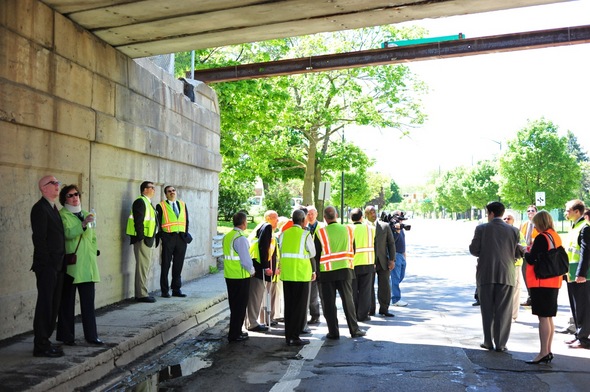
State and federal officials joined representatives from the city of Ann Arbor today to inspect the crumbling East Stadium Boulevard bridge span over State Street. The city is going after federal stimulus funding and is hoping the deputy secretary of transportation's firsthand experience helps the city's case.
Ryan J. Stanton | AnnArbor.com
Standing in the middle of State Street in Ann Arbor, U.S. Deputy Secretary of Transportation John Porcari peered up at what remains of the failing East Stadium Boulevard bridge above.
"In non-engineering terms, it's pathetic," Porcari said of the crumbling bridge, half of which was removed last fall to avoid the risk of falling concrete. "In engineering terms, it scores 2 out of 100. This particular bridge was completed in 1917. We had not yet declared victory in World War I at that point. I think we've gotten our money's worth out of this."
Porcari flew in from Washington, D.C., today at the request of U.S. Congressman John Dingell, who also was on hand this afternoon as city, state and federal officials got a firsthand look at the failing bridges.
Mayor John Hieftje and other city officials have been in close talks with Dingell's office lately, and a whirlwind of political support is building around the city's proposal to replace the two Stadium Boulevard bridge spans that run above State Street and nearby railroad tracks.
After at least five years of trying, the city has been unsuccessful so far in getting state or federal grant money to fix the bridges. City officials say it's about a $23 million project and would cripple the city's ability to repair local streets for the next few years if it had to pay for the bridges on its own.
"Communities don't finance projects like this on their own. I don't know of another instance when it happened," Hieftje said. "We've been after those funds for quite some time, but we're very hopeful now. You can't do much more than bring the deputy secretary of transportation to town along with the congressman. Both of our national senators signed onto this project, and we just think it's something we can make happen."
Both the bridge span over State Street, built in 1917, and the span over the nearby railroad tracks, built in 1928, are functionally obsolete. Dingell's office noted heavy trucks no longer can travel over the bridges.
The city is going after the second round of federal stimulus funding for transportation improvements — also known as TIGER II. The city now is asking the federal government to cover 80 percent of the $23 million cost.
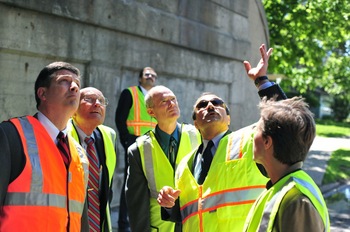
From left to right, U.S. Deputy Secretary of Transportation John Porcari, Congressman John Dingell, Mayor John Hieftje, Homayoon Pirooz and Council Member Margie Teall inspect the Stadium bridge above State Street.
Ryan J. Stanton | AnnArbor.com
Ann Arbor was unsuccessful recently when it applied for the first round of TIGER grant funding. Earlier this year, $1.5 billion in funding was available nationwide, and the U.S. Department of Transportation received more than 1,400 applications with requests totaling $60 billion.
Porcari said the pot of money is $600 million this time. Fifty-one projects were assisted in the last round of funding, so it's realistic only about two dozen projects will be successful this time around.
"It's exceedingly competitive and, I hate to say this, but there are unfortunately bridges like this all over the country," Porcari said. "It's a generational issue where we're living off the investments our parents and grandparents made, and we're not doing the same."
But Porcari also said Ann Arbor makes a good case for its bridges. He said the Department of Transportation uses certain criteria to determine which projects receive funding. Part of that is the regional, state and national significance and economic impact of the project.
"This is a vital link to the University of Michigan, which is a regional, statewide economic powerhouse obviously," he acknowledged. "That certainly helps make the case, but we'll see. I can't predict where it ends up, but more than anything else it's illustrative of the need that's out there."
Homayoon Pirooz, head of the city's project management unit, said the city has until July to prepare a preliminary application and must submit a final application in August. He expects to hear back in October or November.
Pirooz told officials on hand today the project is badly needed. Without the bridges, he said, there would be a complete disconnect between the east and west sides of Ann Arbor and Ypsilanti to the east.
"There are so many businesses that are depending on this corridor to be around and be operable," he said. "There are transit systems that use these bridges and many more. We have the largest high school in the state on one side, and we have residents on the other side. This is the way to go from point A to point B and we need this connection."
Pirooz presented a financial plan to the City Council earlier this week that showed — in the absence of TIGER funding — it still would take $9.5 million in other federal funding and $3 million from the Michigan Department of Transportation, while the city would have to pay $10.5 million.
Other officials were in attendance today representing the Ann Arbor Transportation Authority, Ann Arbor/Ypsilanti Regional Chamber of Commerce, SEMCOG and the Washtenaw Area Transportation Study. Also there was Kirk Steudle, director of MDOT, who is championing the project now.
"If you drive over Stadium, all you know is there's a flashing arrow there and there's a lane gone and you're mad," he said. "But if you drive State Street and you look up, you realize, 'Oh, there's only half a bridge.' It's pretty significant. I mean, this is a major thoroughfare — twenty-some thousand cars in each direction. And frankly, if this bridge isn't here, this becomes a very congested intersection. So this really is a key piece in Ann Arbor and in Washtenaw County from a transportation perspective."
Steudle said bridges all over the state are in disrepair, but the Stadium bridges are particularly important because of the volume of traffic they carry and their location - a stone's throw from the University of Michigan.
"Neither of these are state trunklines, but from a transportation perspective it is a critical link, so I'm here really supporting the city, saying this needs to get fixed and we need some money to get to it," Steudle said.
Dingell's office called the bridges "vital connectors" leading to and from the U-M football stadium and athletic campus. It has been hinted recently that city leaders would like the university to chip in for the cost of repairs.
Asked to address that option, U-M spokesman Jim Kosteva recalled the university in February committed to covering nearly $500,000 worth of costs — which could have come from the city's pockets — on reconstructing North University Avenue and installing a new water line.
"This frees up funds that may be directed to the city bridges," Kosteva said, adding the university is "continuing to consider additional means to support the city in this project."
The Washtenaw County Road Commission is one of several agencies that have gone on record in support of the project recently. Chairman David Rutledge said it's a shame it has taken this long to fix the bridges.
"This bridge is so vital to the quality of life for this area," he said. "It's unconscionable that we would allow an infrastructure like this to fall into this kind of disrepair, but it is what it is and we've got to do better than this. And so that's part of this delegation today. We're trying to impress upon the deputy secretary of transportation the importance of the TIGER grant application that the city will submit It's critical that this be approved."
City Council Members Margie Teall and Marcia Higgins both represent the 4th Ward where the bridges stand. They said today they thought the deputy secretary's visit was hugely beneficial in terms of finding out specifics of what to include in the city's grant application for TIGER II funding.
"That was information that's priceless. It's our job now to make this as good as we can make it," Higgins said.
"I know this competition is going to be extraordinarily stiff, but I think it did enable us to learn from the deputy secretary what they're looking for more specifically in these applications," Teall said. "Hopefully this visit particularly will imprint in his mind what we're applying for when he sees the application."
Ryan J. Stanton covers government for AnnArbor.com. Reach him at ryanstanton@annarbor.com or 734-623-2529.
Comments
a2grateful
Mon, May 17, 2010 : 10:38 a.m.
Another irony: had the City replaced the bridges almost a decade ago (when everyone knew of the pending failure/replacement need), it could have been done with federal funds. Asleep at the wheel? Consumed by folly? Which is it, a2.gov?
81wolverine
Mon, May 17, 2010 : 10:29 a.m.
Blame the city here for putting us in the position to have to scramble for funds beyond the last minute to do this project. Work on these bridges should have STARTED several years ago. This stadium bridge fiasco is a perfect example of what is wrong in this country with the way we manage (or mismanage) our funding priorities. One huge problem is politicians don't have any understanding of economics and how investing in infrastructure creates jobs and increases in economic output. But, only having $1.5 billion in federal funds available in Tiger I nationwide and $600 million in Tiger II is a complete joke. That won't even scratch the surface of the country's decayed infrastructure problem. So much for Obama's promise of fixing our infrastructure. Funny how they found $750 billion to hand the banks, but they can only find a paltry $2.1 billion to fix our roads and bridges? Politicians in the U.S. have been paying lip service for years now on how important the decaying infrastructure is. Yet when they get into office, they suddenly forget about it - channelling money into politically sensitive projects that buy them votes. They do it in Lansing (bigtime), Ann Arbor, AND Washington. The only way we can express our dissatisfaction is to send letter and emails to them, AND vote them out of office at the next election if they fail to carry through on their responsibilities to the people.
Hot Sam
Mon, May 17, 2010 : 6:49 a.m.
During a visit to southern France in 2001, we went looking for the Pont Julien...I told my friend that according to the map, we must be close...turns out we had just gone OVER it. Two thousand years old and still working...(it has since been joined by a new traffic bridge...http://www.horizon-provence.com/bonnieux-luberon/pont-julien-roman-bridge.htm Bottom line...when it comes to roads and bridges, we are not getting what we pay for...
a2junkie
Sun, May 16, 2010 : 5:20 a.m.
@Vivienne was just using them as examples of how money gets locked into a project and cant be used on anything else. The underground parking garage is commonly thought of being a city project which its a DDA project. And yes everything is a direct cost to the taxpayers eventually and not commonly refereed as loans but really are http://www.mlive.com/news/ann-arbor/index.ssf/2009/02/budget_details_coming_together.html which shows they have to pay it back like a loan. A grant is money they get from various federal funding like the broadway bridge and the airport runway this isn't free money but they don't pay the government back.
annarbor28
Sat, May 15, 2010 : 9:50 p.m.
Have any of these people in the picture above determined whether the bridge could actually collapse, as the bridge in Minneapolis did? Why isn't the bridge shut down, as it looks very unsafe? Maybe just allow emergency vehicles on it, if they need that route? Should it be dismantled due to the risk of the falling debris below? Why does U-M take no responsibility for a bridge that they heavily use, esp for all of the heavy construction traffic and football days? I realize they are not legally obliged, but doesn't it rain on its football parade? Lastly, the businesses do need it. I used to travel over it to go to shop on the other side, but I have personally declared it unsafe for my own use, and stay on my own side of the bridge. I suspect I am not the only one who avoids it.
Vivienne Armentrout
Sat, May 15, 2010 : 9:27 p.m.
@a2junkie, the police/courts building came out of the fund balance, the fountain comes mostly out of sewer and water fees, and the underground parking garage is supposed to be paid for out of parking fees. None of these are "grants and loans" but direct costs to the taxpayers.
a2junkie
Sat, May 15, 2010 : 9:20 p.m.
I don't think people understand how government money gets used and it makes them angry. The city's general fund is the only money they have to throw at different needs the other improvements that are happening like the police/courts building, the fountain, underground parking garage and the airport expansion comes from other funds like grants or loans from the government. So in turn you don't get funding for a airport runway and just spend it on a bridge they want the money spent where it supposed to be spent. The feds give out alot of cash all the time for projects and id say the city is begging on this one.
Alice Ralph
Sat, May 15, 2010 : 8:27 p.m.
Thanks, Wystan, for clarifying the history. Stadium was a "business route" at one time, but is no longer, since Wahtenaw/Huron got that designation. It's good to remember that the bridges are within a residential stretch that is at least two miles long, including a middle and high school. As a resident living on East Stadium, I have a personal take. When the bridges were only about half their age, our section of Stadium was widened. (Possibly for football traffic...) It was to be widened again, in the 70s, but the engineers did not seem to have realized that the previous widening took about as much as there was to give. So they said "our bad" and nothing was done. Fast forward. Since the bridges were "modified", partially demolished, I have given up the "cutoff" and the State Street underpass. It is inconvenient but it is a way to remind myself of how serious the deterioration is. I used to bicyle over the bridges to get to work about 15 years ago. There wasn't enough room to share with pedestrians, even though the route had been so marked. The concrete shards were a hazard even then. These bridges that could be designed to provide more efficient daily traffic management and continuity with the "4-to-3" lane configurations which give bicycles dedicated on-street lanes. This would provide one travel lane each way for cars. (Bridges don't need turns lanes, right?) There would still be width for sidewalks on BOTH sides. I grew up in "football towns" that STILL manage that occasional traffic volume with a few hours of one-way in followed by one-way out on certain street. I'm not saying this is the solution for Ann Arbor, but we should look systematically at both cost-saving and effective ideas.
Wystan Stevens
Sat, May 15, 2010 : 5:30 p.m.
@Bear, the road now called Stadium Boulevard did not exist in historical times. It did not come into existence until the 1920s, when the football stadium was constructed. The road was called "the cutoff" when it was built as a downtown bypass, intended to link Washtenaw Avenue on the eastern outskirts of town with Jackson Road on the west, while allowing through traffic to avoid the center of the city. The bridges were built when the road was built. That page of "Michigan Stadium History" that you linked to says nothing about the road, and the fact that football games previously had been played on Ferry Field has no connection with the existence of the two bridges over State Street and the Ann Arbor Railroad tracks. @Awakened, you may go back to sleep. Your history lesson is wide of the mark. The name of Stadium Boulevard has no connection whatsoever with the baseball field that used to be near the NW corner of Liberty -- a popular, privately-owned venue known as Sportsman's Park, which always was known by that name, not as a "stadium." Sportsman's Park was not built until 1939. (The old Stadium Tavern, on the corner, took its name from Stadium Boulevard, not from Sportsman's Park.)
Mick52
Sat, May 15, 2010 : 3:32 p.m.
Carl Levin and Liz Brater sounding off on the crumbling bridge. Celebrity bureaucrats. This is nothing but election year posturing. Where were they when this problem was identified?
Vivienne Armentrout
Sat, May 15, 2010 : 2:04 p.m.
@logo, the Library Lot parking structure is "paid for" by a designation of future parking revenues. But the city is on the hook for the bonds if the revenues don't match expectations. I've gone into this in wretched detail at my blog, Local in Ann Arbor. Note also that the DDA is transferring millions in parking funds to the city as a plug for the general fund. Those same funds also have to pay for maintenance of the rest of the parking system. So saying the structure is "paid for" is like saying that your 30-year mortgage is "paid for" because you are currently making enough money to cover the payments month to month. Your summary of the finances involved in the city hall is inaccurate too but I don't have time to list all the points, only to mention that operating costs have already been acknowledged to be higher for the new building and a $3 million deficit exists because First and Washington has not sold. Oh, and there was the several million dollars in fund balance transferred into the municipal center fund. Oh yes, the additional money from the DDA (they seem to be an inexhaustible source!). The apologies for the city hall always remind me of the joke one of my friends used to tell about her shopping sprees. She said that she got things on sale, so she "bought them with the money she saved".
WLD1
Sat, May 15, 2010 : 1:55 p.m.
I know a lot of people in Ann Arbor are real narrow minded. An can't think ouside the box. But at this point why not get corporate sponsors and allow them to hang a plaque (billboard) on the thing. I don't care if I drive by the bridge and see a plaque that says "Tampax" on it as long as I can get from point A to point B. And not Drive a around the whole city. Actually I think the U of M should rebuild the bridge since they buy all the land in ann arbor and lower the amount of tax revenue that comes in. Not to mention it is next to their property and they can decorate it with U of M all they want. And it is all their sporting event and graduation traffic that helped kill the bridge anyway.
tlb1201
Sat, May 15, 2010 : 12:18 p.m.
Gee, Liz Brater is really on top of things. I would imagine that the bridges were brought up a long time ago when she was on city council and was mayor and she still doesn't have anything better to offer than the words "full support" for fixing them. Except for those seeking election year photo ops, is anyone really looking out for their constituents? When asked about the subject, Brater somehow steered the conversation from the bridges to spending on other things to more taxes to diesel particulates. Not that some of those things aren't important, but focus, Liz, focus! You were elected to represent Ann Arbor! And "sustainable transportation"?! Exactly what in the world is that?! I dunno either, but it sounded good. I think horses may have been the last form of sustainable transportation we had. They ate organic hay and grain, they provided fertilizer, and they reproduced themselves. They weren't as fast as cars, but they also didn't need railroad bridges. I guess it's popular right now to work the word "sustainable" into political-speak when your agenda doesn't fit the current situation and your arsenal of ideas to provide constructive solutions is empty.
Awakened
Sat, May 15, 2010 : 11:38 a.m.
Historically Stadium Blvd was named after a baseball stadium that existed just northwest of the intersection of Stadium and Liberty. The large lot behind the chinese resturant and BP still has the outline of the original field. If you look at old aerial photos you will see it existed until about 1960. It was not a U of M field. Stadium was built in its odd curved shape to allow Ann Arborites easy access to the field.
belboz
Sat, May 15, 2010 : 10:04 a.m.
Tons and tons... Well, they must not be good enough for the 8 other at grade crossings throughout downtown Ann Arbor - including State and Main. If they are so important, why are they not being built? None of them even have gates. The train passing through A2 is a non event. The train is used 2 times a day, non business hours. But hey, it is only an extra $10 million dollars. Why not? Such a big need, the State has denied funding more than once, as well as the feds. There is no need for a bridge, only a want. These days, that is not enough.
Rod Johnson
Sat, May 15, 2010 : 7:36 a.m.
There are tons of reasons not to do an at-grade crossing. They've been articulated again and again and again. That is a dead horse. Try and keep up.
logo
Sat, May 15, 2010 : 7:23 a.m.
Many posters here don't seem to keep up. Towns don't do this type of project on their own. Look at the Broadway Bridges or any big bridge project in any town in Michigan. They will get some federal money, maybe not all of it but a great effort is being made. BTW the downtown parking structure is paid for with parking revenues, it has a steady funding stream that will pay off the bond. No property tax dollars involved. The new court house and police station uses $800 K the city saves from not having to rent other space plus DDA money that can only be spent in the downtown. The reason roads in this county and state need so much work is the state has been diverting the roads money to pay for general fund expenses in the worst economy in recent history.
dfossil
Sat, May 15, 2010 : 6:31 a.m.
Troubled? TROUBLED! That is the only adjective you can think of to describe an antique concrete structure pounded to bits by years of 24-7 truck and car traffic including Stadium RVs & "land yachts"and you call that "troubled" I wonder what falling down looks like to you at the News; irritated?
belboz
Sat, May 15, 2010 : 6:27 a.m.
The easy answer is "fix the bridge". But, why are the bridges needed? How about we save $10 million and just put in an at grade road? They are not there to bridge state street. Ann Arbor does not build bridges to serve as traffic calming measures. So, they are there for the train. And the city will tell you they are unable to force the train oompany to allow them to put in a bridge. But, what the city will not tell you is that there is a process to install an at grade crossing where one does not exist. It is an on site review with MDOT, the City, and the Train company. A simple process for the parties to review the site and for the party wanting the at grade crossing to state its case. The process can also involve the courts if the Train company does not agree to put in the crossing. Talk to Tina in the Train Safety department. However, the city does not want to save $10 million. Just as the city jut wanted to spend the $50 million to build the new city hall. Just as the city wants to spend $100k per parking space for the new parkiing lot downtown. Sure, the city has sat on this project. But, what I find more appalling is that they did not due dilligence to push for the $10 million savings in not building the bridge. They just sit there and spend money that we don't have, the state doesn't have, and the federal government does not have. We have 8 at grade crossings in the city already. So, no excuses. But, hopefully this fall we get a new council and mayor, who can then push for a city administrator that feels some financial accountability.
5c0++ H4d13y
Sat, May 15, 2010 : 6:11 a.m.
Really? What does coming to ann arbor and standing under a crumbling bridge really tell them? Maybe they could put their high-viz back on and check out the pot holes at the end of my street?
a2grateful
Sat, May 15, 2010 : 6 a.m.
Anyone see the irony of the City "finding" money to build an unneeded $50mil underground parking garage, when the roads and bridges to feed the garage are on the verge of no longer functioning?
Bear
Sat, May 15, 2010 : 3:55 a.m.
Wystan, did you ever think that perhaps the road was called something other than Stadium Blvd. before the stadium as built? Actually, Ferry Field was used for the football squad before Michigan Stadium was built and guess what? Ferry field is located on State St. right by the Stadium bridge. So there you have it. http://www.umich.edu/stadium/history/
Wystan Stevens
Fri, May 14, 2010 : 11:58 p.m.
I think that naming 1917 as the supposed year of construction of this bridge is ten years too early. Stadium Boulevard did not exist before the football stadium was built, and the football stadium opened in 1927. And if the bridge over State Street had been built before the bridge over the railroad tracks, it would have been a bridge to nowhere, with westbound traffic lurching up, shooting over State Street, and then immediately dropping down again to cross the tracks at grade. But that road never crossed the tracks at grade level -- Stadium Boulevard never existed without those bridges.
Ryan J. Stanton
Fri, May 14, 2010 : 11:38 p.m.
I should note I caught up with state Sen. Liz Brater, D-Ann Arbor. She's in full support of fixing the bridges, but she thinks there's a larger issue to address. "I think we're very short-sighted right now in the Legislature in not seeing that we need to invest in not only infrastructure, but education and human services and all the things that keep our state great," she said. "If we want to attract visitors to our state, we need to put our best face forward. I think we need to have an adjustment to the gas tax, the formula isn't working given the new fuel efficiency of the vehicles we have on the road. We also need to deal with the diesel tax. I'm very concerned that there be an adequate amount of that funding going into transit as well, because we can't build our way out of this congestion and it's very important to have sustainable forms of transportation. One of the things I'm really concerned about is the diesel particulates. We're trying to get some cleaner diesel on the roads and working with MDOT to try to see how we can do that."
Ryan J. Stanton
Fri, May 14, 2010 : 11:27 p.m.
@anti-thug You're right. Perhaps if it lasts seven more years we can all take part in celebrating its centennial anniversary.
voiceofreason
Fri, May 14, 2010 : 10:48 p.m.
Dingell knows he will get the support of Ann Arbor regardless of whether he delivers this project. Combined with the fact that we are weathering the economic storm rather nicely compared to other areas, our chances of receiving federal funding for the bridge are currently hovering somewhere around 0%. If this city is interested in suckling from the "Government Pork Teat" in the future, there needs to be at least the threat of voting for the opposite party. Because this will never happen, Ann Arbor residents will continue to provide funding for projects taking place in other parts of the country.
townie
Fri, May 14, 2010 : 10:23 p.m.
I smell bacon again.
Diagenes
Fri, May 14, 2010 : 10:15 p.m.
Why is the repair of a local bridge, a federal matter? Have we become so impotent that we can no longer manage our own affairs without a big shot from Washington riding to the rescue. Are we so fiscally inept that we cannot budget funds for road maintenance? We puff out our maze and blue clad chests with false pride, while holding out our tin cup to our neighbors, begging for spare change to repair our bridge. Is it a coinsidence that Rep. Dingell waits until six months before an election to promise to fill our cup?
anti-thug
Fri, May 14, 2010 : 9:48 p.m.
1917! they should declare the crumbling bridge a historic land mark. it's not everyday you find a nearly 100 year old bridge.
Dalouie
Fri, May 14, 2010 : 9:42 p.m.
Even if they could legally transfer the money from the art piece (fountain) to the bridges it wouldn't make much difference but then, they can't. This seems like a fine use of federal money. When the city rebuilt the Broadway Bridges a few years ago they used 20% local money. the rest came from state and federal sources. It would be great if they could do that again. I don't think any local government in Michigan could pull this off on their own.
Sling Blade
Fri, May 14, 2010 : 7:50 p.m.
What a perfect location for a roundabout with a fountain in the center.
Left is Right
Fri, May 14, 2010 : 7:24 p.m.
Does anyone else find it embarrassing that we live in a city that allows its infrastructure to deteriorate to this extent? Maybe it's time to re-prioritize what the city funds. Maybe it's also time for a long overdue house-cleaning in our city's government and administration.
jcj
Fri, May 14, 2010 : 7:04 p.m.
@Lokalisierung Are you really saying that you see no problem with the bridge? Maybe you only drive over it! It was not safe to drive under before they removed some of the old concrete! It is certainly easy to post here without having to think about the whole story.
Lokalisierung
Fri, May 14, 2010 : 6:50 p.m.
Of course if it were up to me I'd say, push the waterfall back 3 years, during that time put on a ban on consultants which should cover those costs. Then transfer some of the over 20 million you've got laying around for the bridge into safety services to keep the residents safe, drive over a crummy bridge for another year or two. Then in a couple of years we can all come on aa.com and complain that there doing work on a bridge and it's slowing my drive time down.
Lokalisierung
Fri, May 14, 2010 : 6:42 p.m.
I personally do not know what City Council members should know about and when they should know it (obviously we all know now this thing is a mess). To me that seems like it would be the job of city engineers or whoever to tell the city council about this years ago. Maybe they did, I do not know, so I'm not going to comment on it. What I think I know, is that now if you can get a "free" 23 million from grants to replace the bridge, we should give it a shot. I realize for some reason a crumbley bridge, that never hurt anyone, that is down to 2 lanes and yet doesn't slow me down when I cross it everyday, has become the peeled onion for aa.com commentaters crew. Is it becasue it's ugly? Is it because it's a black eye on a city that thinks it's above having a crummy bridge in it? Is it that you think it points to poor city council work? I really don't know...probably all of them. To me I think, "that bridge has always been crappy so it doesn't bother me." You might think that since it's been crappy for so long that should have told people they need to fix it, and I understand that point of view too. To me it's not dangerous like everyone talks about. It isn't going to fall anytime soon, we can wait. Just my opinion though. A new fountain isn't the greastest thing in the world, but the city has money to fix the bridge and the fountain isn't dipping into that.
a2grateful
Fri, May 14, 2010 : 6:19 p.m.
Prolly right, except that OUR city runners (ruiners?) woudn't know... Look... it's a bridge... Look... it's broken... Look... we have a new fountain : ()
Lokalisierung
Fri, May 14, 2010 : 5:19 p.m.
probably harder to run a city than post comments about it on aa.com. Naw...that couldn't be right.
bunnyabbot
Fri, May 14, 2010 : 5:03 p.m.
Porcari said. "It's a generational issue where we're living off the investments our parents and grandparents made, and we're not doing the same." -REALLY? how dare they spend money on a phallic fountain when we need a bridge (and police officers and firefighters) and I agree, typical, fly in some big wig on the tax payers dime. I'm sure they took him to Zingermans too on the taxpayers dime while he was in town.
Lokalisierung
Fri, May 14, 2010 : 5:03 p.m.
No need to tear it down...life is going on just fine with it down to 2 lanes.
jcj
Fri, May 14, 2010 : 4:21 p.m.
Fair is fair. This is a hard pill to swallow but if John Dingell can pull this off I say kudos to him. If stimulus money is going to be thrown all aver the country we might as well get our share. Now can someone tell me 2 other things Mr Dingell has accomplished ( I know this is not a done deal)for Ann Arbor?
a2grateful
Fri, May 14, 2010 : 4:12 p.m.
Or, we could have just sent them a hunk-o-concrete... I wonder if anyone talked about the folly fountain?
dconkey
Fri, May 14, 2010 : 4:10 p.m.
Typical big government, spending thousands of dollars to fly out here and look at the bridges when some good digital photos and a few e-mails would have sufficed.
a2grateful
Fri, May 14, 2010 : 4:08 p.m.
Knock it down. We don't need it. Life will somehow go on.; )
enjoy
Fri, May 14, 2010 : 3:46 p.m.
Ann Arbor was unsuccessful recently when it applied for the first round of TIGER grant funding. Earlier this year, $1.5 million in funding was available nationwide, and the U.S. Department of Transportation received more than 1,400 applications with requests totaling $60 billion. Was it really only 1.5 million?
chimarathon
Fri, May 14, 2010 : 3:41 p.m.
I would not be standing under that thing!