

State court rules that government officials' personal e-mails aren't subject to FOIA
A sweeping decision released by the Michigan Court of Appeals today places new limits on the state's Freedom of Information Act, concluding that personal e-mails exchanged between government officials are not subject to disclosure.
The ruling stems from a case out of Livingston County Circuit Court involving the Howell Education Association, the Howell Board of Education and Howell Public Schools. Click here to read the full opinion.
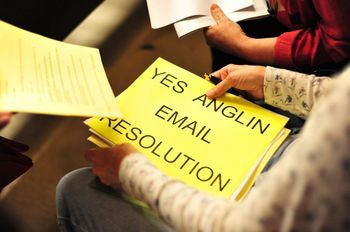
Ann Arbor residents showed up to a City Council meeting last fall in support of Mike Anglin's resolution to create a public database of e-mails exchanged between council members. The council voted it down.
The state appeals court ruled this week that e-mails exchanged between teachers union officials on a school district’s computer system are not subject to FOIA. The three-judge panel reversed a lower court ruling from 2007 that found e-mails stored on the school system's server were public records.
According to the new ruling, only records created to further a public institution’s official duties are subject to FOIA and that "personal communication," even if related to school issues such as union contract negotiations, are exempt.
"This is a difficult question requiring that we apply a statute, whose purpose is to render government transparent, to a technology that did not exist in reality (or even in many people’s imaginations) at the time the statute was enacted and which has the capacity to make 'transparent' far more than the drafters of the statute could have dreamed," the judges opined. "When the statute was adopted, personal notes between employees were simply thrown away or taken home and only writings related to the entity’s public function were retained. Thus, we conclude that the statute was not intended to render all personal e-mails public records simply because they are captured by the computer system’s storage mechanism as a matter of technological convenience."
The judges went on to acknowledge the growth of electronic technology has "greatly increased tension between the value of governmental transparency and that of personal privacy."
"As we stated out the outset, the ultimate decision on this important issue must be made by the Legislature and we invite it to consider the question," the judges wrote. "However, based on the statute adopted in 1977, the technology that existed at that time and the caselaw available to us, we conclude that the trial court erred in its conclusion that all e-mails captured in a government e-mail computer storage system, regardless of their purpose, are rendered public records subject to FOIA."
Leigh Greden, a local attorney who was ousted from his seat on the Ann Arbor City Council last year in the wake of controversy over e-mails he sent during council meetings, said the new court opinion means some of the e-mails he sent should never have been released under FOIA.
Joan Lowenstein, another local attorney who served on the City Council with Greden, agreed.
"I have litigated a number of FOIA cases on behalf of media clients. I don't think the FOIA was ever meant to cover personal communications," Lowenstein wrote in an e-mail to AnnArbor.com today. "It was meant as a way for citizens to gain access to documents compiled by the government. I've read the opinion and it seems well thought-out. The court said the legislature should act, and I think the legislature should look at other states, such as Colorado, which specifically exclude personal e-mails from their FOIAs."
Ryan J. Stanton covers government for AnnArbor.com. Reach him at ryanstanton@annarbor.com or 734-623-2529.
Comments
Mick52
Sat, Jan 30, 2010 : 1:14 a.m.
Another dumb decision by the MI court of appeals. Most likely it will be reversed. It should be but the legislature should act anyway and make all communications provided by a govt unit obtainable by the public. Officials should not be using govt supplied media devices for personal reasons, only for public business. If they want to have personal conversations get a personal phone. Kilpatrick is probably fuming this came out so late. I don't care if council members are chit chatting they shouldn't be during meetings and if they are they may not be doing their duty. I don't want to see a situation where govt employees argue their communications are private, which would require a judge to review questioned documents. If any official thinks they should not be released, then they are likely doing something they should not be doing. FOIA was meant to make public business open and anything stored on a govt units servers should be subject to FOIA. I think perhaps its more critical today with the demise of the print media.
Tom Teague
Thu, Jan 28, 2010 : 1:01 p.m.
It's a decision that only a lawyer would love to read and ponder. I wonder if it will survive a vigorous challenge or if it will be cited as precedent in the Wisconsin case. Ultimately, though, any email sent from a public account, especially during a public meeting, runs a risk of disclosure since it will be difficult for government bodies to apply the court's test perfectly every time someone files a FOIA. Once released -- fairly or not -- the emails won't go away. Anyone using public email accounts should re-read their messages carefully before clicking 'send' and should apply this test: How is this going to reflect on me when it's posted on the web?
Chetly Zarko
Wed, Jan 27, 2010 : 7:37 p.m.
David Cahill (long time, no see), I was the intervenor in a "reverse FOIA" which the Howell Ed Assoc. filed to stop the school from releasing e-mail to me after a 2007 request. As much as you say the "court distinguished" purely private e-mails, don't be so sure it distinguishes anything favorable to FOIA requestors. The facts at hand were teachers, on public computers that had a plain disclaimer that all records were public property (didn't say FOIAable, but did say could be published or subpoenea'd, an artistic distinction at best) while in the classroom. The judges seemed to be afraid that their own e-mail might become subject to FOIA (it wouldn't because FOIA excludes the judiciary) and were afraid that someone using a public wireless network which the public body had put a sniffer capture on (they normally don't, but the judicial understanding of that wasn't there) would be subject to FOIA (I'd agree that someone using a network shouldn't be subject just because the network is public, and in fact, that's already protected by federal law and could have been factually delineated. They could easily rule based on this decision that city council e-mails are personal if the e-mails don't discuss business. You and I obviously agree that the very act of being at a council meeting is business (as is the very act of being in a classroom on a public computer solely intended for educational use), but the court used a content based measure. Kwame would be Mayor today if the ruling in my case existed 3 years ago. The records were created by public employees on the clock using public computers after seeing a disclaimer that all the records were public property (if a public employee isn't told explicitly about FOIAbility, he may be exempt, which opens a whole new hole public bodies and employees can drive truck through). I concur that there are valid "privacy concerns," but this ruling was written in a horrible way that opens a whole new door of public body evasion. Privacy concerns can be logically dealt with - redefining public records as not public because a public employee mentions something personal is so open to interpretation as defy my expression of it.
B. Corman
Wed, Jan 27, 2010 : 6:01 p.m.
No big surprises, Karen? Really? Actually, the majority of the emails that have been previously FOIA'd and released were personal emails that were basic chit-chatting amongst the councilmembers. People were critical of them because of the tone and off beat humor in them. These emails should never have been released, because as the court has now ruled, they are not public record, are personal communications and should not be released to the public. All these recent FOIA requests in the city of Ann Arbor were/are all about personal political agendas and nothing more.
Karen Sidney
Wed, Jan 27, 2010 : 5:39 p.m.
I did not find any big surprises in this case. The city has been redacting the contents of some emails obtained through the citizen FOIA project. I assume these are the ones with 100% personal content.
TruthAlert
Wed, Jan 27, 2010 : 5:34 p.m.
Mr. Cahill is half right and half wrong. E-mails regarding City matters would be public records. But my recollection is that many of the e-mails released were not about City matters (they were chitter-chatter between Councilmembers teasing each other). Those wouldn't be public records.
DaRyan
Wed, Jan 27, 2010 : 5:08 p.m.
Also, did you talk to the plaintiff? What's his/her next step? There's very little to this story to get any real meaning of what this is, and applying the ruling to the a2 email-gate seems premature....
DaRyan
Wed, Jan 27, 2010 : 5:06 p.m.
Who was the plaintiff in the case before the court? Details, details, details...
David Cahill
Wed, Jan 27, 2010 : 4:58 p.m.
There is less here than meets the eye. The court distinguished between purely personal e-mails that happened to be captured by an e-mail system (not public records) and e-mails generated during the carrying out of an official function (public records). A City Council meeting is, plainly, an official function. Ergo, e-mails sent during such a meeting about City affairs (including scripting votes) were, and remain, public records.
treetowncartel
Wed, Jan 27, 2010 : 4:43 p.m.
In the immortal words of Homer Simpson, "Doh".
B. Corman
Wed, Jan 27, 2010 : 4:41 p.m.
I am quite happy that the courts ruled this way. The opinion makes such perfect sense and follows such plain and simple logic that it astonishes me that the city of Ann Arbor never realized this and tried to fight this issue in court themselves. BRAVO!