

Greening the fairs: Organizers continue efforts on environmental responsibility
The goal for creating net zero waste at the Ann Arbor Street Art Fair was, to say the least, noble.
In practice, however, organizers say it's not really possible — at least, not this year.
In such an open and uncontrolled environment like the Ann Arbor Art Fairs — with such a variety of different vendors — the idea of actually eliminating waste through recycling and composting just couldn't be effectively monitored or measured, said Maureen Riley, the executive director of the Street Art Fair, one of four fairs that jointly make up the annual four-day event.
So three years after the Street Art Fair launched its zero-waste initiative, Riley said, the fair had to back away from that goal. Instead, organizers say they will redouble environmental efforts — but also make them a little more realistic.
That means the fair is still continuing recycling and composting efforts.
But "the newest thing for us is really focusing on all of our projects on an educational component and making sure there's a direct tie to the environment so people walk away and feel like there is something they know they can do," said Michelle Schaefer, programs manager.
Visitors to this year's Street Art Fair, located at Ingalls Mall off of North University Avenue, will see environmental awareness as a key theme, she said.
"With all that's happened in the last year, with global warming and the oil spill in the Gulf, it's just something that's close to all of our hearts in the office. It just made sense," Schaefer said.
Among events at the Street Art Fair in the Art Activity Zone at the north end of Ingalls Mall are:
• Community art: Led by artist Chris Bednash and supported by the National Wildlife Federation, those interested can join in constructing a 6-foot paper mâché spotted turtle. The goal is to raise awareness about the threatened species and other threatened species in the Great Lakes ecosystem. "We wanted to have a project that would bring the community together in an environmental capacity," Schaefer said.
• Those interested can learn how to transform old clothes into ones with a new artistic twist using silk-screening with Modati.
Meanwhile, the Townie Street Party earlier this week featured Japanese carp kite-making out of recycled materials with the goal of teaching kids about the Great Lakes. The Ann Arbor Public Schools Educational Foundation was teaching kids about planting and giving out seeds for native plants, soil, containers and water to do it. The party also featured the community art project called "Invader-Invasive" led by local environmental artist Leslie Sobel. Those interested were invited to help create a collage of invasive non-native species.
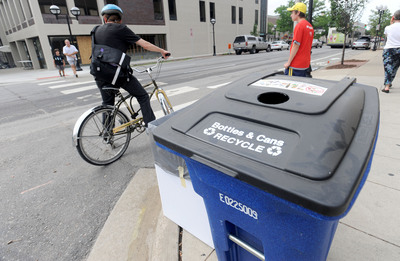
Recycling bins are available throughout the Ann Arbor Art Fairs, although trash cans will continue to be more numerous.
Angela J. Cesere | AnnArbor.com
And the Ann Arbor Street Art Fair is not the only fair pushing environmental efforts.
Each of the fairs has been promoting the city's water fountain stations, which allow visitors to refill their own water bottles, rather than purchasing and tossing out disposable bottles.
The Ann Arbor Summer Art Fair, based in the Main Street area, is among those selling prewashed, reusable plastic bottles so visitors will have a bottle on hand that they can refill as they walk around town, said fair Director Debra "Max" Clayton.
The fair will continue encouraging vendors to recycle all cardboard, and there are recycling containers scattered throughout the fairs.
Reaching zero waste would be an immense challenge for any of the events, even though there is increasing interest from vendors and visitors alike, she said. "We hope someday," Clayton said. But what the food vendors are doing, for example, is not really in the fair's control, she said: "I think there's a happy medium where we can do a lot of things, like making receptacles more visible."
In future years, she believes, making more environmentally sustainable choices will be easier because more products that are biodegradable or recyclable will be more readily available and education will improve.
Visitors to the South University Art Fair and the State Street Area Art Fair are seeing extra recycling containers, said Maggie Ladd of the South University fair and Kathy Krick of the State Street fair.
One of the biggest goals is keeping water bottles out of landfills, Krick said: "Having those carts around … people will seek them out."
All T-shirts and reusable tote bags distributed at the South University fair are made from eco-friendly materials, Ladd said.
"I think we all work toward that goal (of creating zero waste.)" she said. "But I couldn't honestly say we've reached it."
The Ann Arbor Street Art Fair's initial zero-waste efforts, which continue this year, did make a real impact, organizers said. According to a report, the fair had 23 recycle stations for bottles and cans, paper and trash in 2008. It was able to reduce waste in trash containers by 41 percent, diverting seven tons of waste and completely eliminated overflow in trash containers.
In 2009, only two of three large trash containers were used for trash while the third collected compost bags.
The Townie Street Party, which the Street Art Fair organizes, was the focus of a composting pilot program that debuted last year. Vendors contractually agreed to replace styrofoam and petroleum plastics with biodegradable plates and utensils.
Five of the seven vendors fully complied with the compostable tableware components, according to a report about the success of the pilot. But two didn't comply because one was misled by confusing labeling and the other did not understand the program.
The fair continued its composting efforts again this year in more controlled, defined areas like where the Townie Party is held or at its artists' tent.
Other efforts, such as the ongoing use of a biodiesel-powered generator for music, recycling of cardboard and art materials and reuse of items like signs are also continuing.
Bottle recycling, which was started in 2007 and recycled 70,000 bottles in its first year, will also continue.
For the second year, the city of Ann Arbor will provide about 100 bright blue recycling containers throughout all four art fairs, said Tom McMurtrie, the city's solid waste coordinator.
And with the recent launch of a single-stream recycling system, containers will also be able to take more materials this year.
But, he said, trash cans from the city will still outstrip recycling containers by six to one.
Often, trash created at the fairs is composed of items that just can't be recycled, like food wrappers and napkins. And increasing the number of recycling bins could come at a great expense, he said. "We're recycling all the materials at art fair that we can," McMurtrie said.
There is a possibility in the future that recycling efforts at the fair may be ramped up if it looks like there are opportunities to do that, he said.
Tina Reed covers health and the environment for AnnArbor.com. You can reach her at tinareed@annarbor.com, call her at 734-623-2535 or find her on Twitter @TreedinAA.
Comments
Bob Krzewinski
Fri, Jul 23, 2010 : 7:16 p.m.
One thing really sad about the 2010 Art Fair is that this year, unlike 2009, there will be no free valet bicycle parking. The Washtenaw Bicycling and Walking Coalition provided the service last year, but due to the hassle and cost of obtaining permit after permit (again for a free service provided by volunteers), decided that this year it just was not worth it.