

Pedestrian safety law: New strobe lights and crosswalk rules approved in Ann Arbor
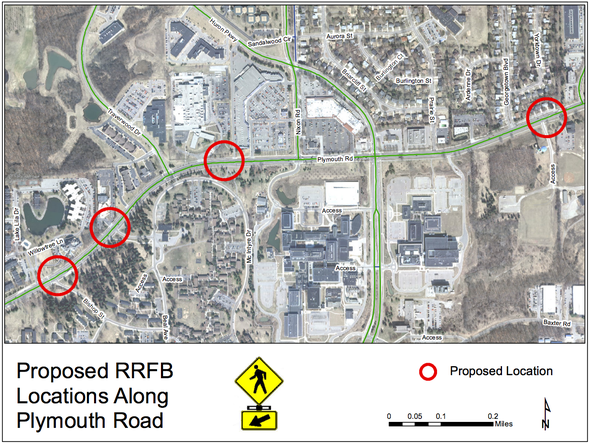
The Ann Arbor City Council voted 10-0 Monday night to approve spending $81,000 for the installation of Rectangular Rapid Flashing Beacons — or RRFBs — at five locations.
That includes four crosswalks along Plymouth Road that were the subject of discussions last week, as well as a fifth location on Seventh Street just south of Washington Street where the city installed a pedestrian refuge island about two years ago.
The strobing RRFBs, complementing existing crosswalk signs, are designed to grab attention and get motorists to stop safely for pedestrians.
And, officials hope, they'll help put an end to a recent string of rear-end accidents that have happened — largely along Plymouth Road — as a result of motorists not stopping in time after vehicles in front of them hit the brakes for pedestrians at crosswalks.
Here's a video showing how the RRFBs work:
The council also voted 10-0 Monday night with Marcia Higgins absent to approve changes to the city's pedestrian safety ordinance.
Much controversy has surrounded the ordinance, which requires motorists to stop not only for pedestrians within crosswalks, but also those approaching. There have been numerous rear-end accidents at crosswalks since enforcement of the ordinance began in September.
The changes approved Monday night are an attempt to offer clarity and take the guess work out of figuring out whether a pedestrian might be considered "approaching."
The revised ordinance now states that when traffic control signals aren't in place, drivers must stop for pedestrians "stopped at the curb, curb line or ramp leading to a crosswalk."
Drivers also must stop for every pedestrian within a crosswalk when the pedestrian is on the half of the roadway on which the vehicle is traveling, or when the pedestrian is approaching so closely from the opposite half of the roadway as to be in danger.
That last distinction brings the city's ordinance closer in line with the state's Uniform Traffic Code.
But Ann Arbor's ordinance still goes one step further than the UTC by requiring drivers to stop for pedestrians waiting at the curb.
"I have faith that the changes we've proposed tonight will help clarify how this ordinance is supposed to work for us all and that people will adapt," said Council Member Sabra Briere, D-1st Ward, who believes Ann Arbor drivers are becoming more aware of pedestrians.
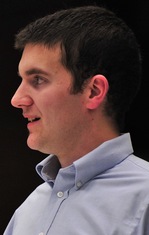
Tim Hull
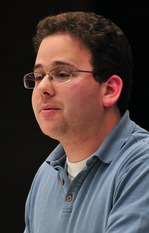
Michael Benson
"I don't feel more safe as a result of the ordinance," said Tim Hull, a 2nd Ward resident who ran for council earlier this year.
Hull said Ann Arbor's crosswalk law could be perceived as a "revenue-generation scheme designed to milk out-of-towners." He urged the council to instead lobby state lawmakers to introduce a statewide pedestrian safety law.
Michael Benson, a University of Michigan graduate student and president of Rackham Student Government, agreed with Hull that the incongruity between Ann Arbor's crosswalk ordinance and what's allowed in other places in the state is problematic.
Eli Cooper, the city's transportation program manger, recommended the revised pedestrian safety ordinance language to council.
"Somewhere between 15 and 20 percent of our population walks to work every day," he said. "Drivers should be in a position to understand that they have a right to the road, but they have a responsibility to share it properly. And what we're doing here is providing that balancing legal framework that should otherwise occur by plain common sense."
Briere noted that RRFBs don't fit the definition of "traffic control signals," so the pedestrian safety ordinance — which only applies where traffic control signals aren't in place — still will be the law at the crosswalks getting the RRFBs.
The four crosswalks expected to get RRFBs along Plymouth Road are located near Beal Avenue, Bishop Avenue, Traver Village and Georgetown Boulevard. City officials said installation could start in February and be finished by the end of March.
Funding is coming from the city's major streets fund balance, which city officials said had an estimated $7.44 million as of June 30.
Per the city's fund balance and debt policies, the major streets fund should be maintaining one year's collection of weight and gas tax revenues, or about $5.4 million.
Annual operations and maintenance costs for the RRFBs are estimated to be $160 per crossing.
Craig Hupy, interim public services administrator, said some of them might be solar-powered and some might be hard-wired as the city experiments with different options.
It's reported that the RRFBs achieve average yield compliance rates ranging from 77 to 85 percent, city officials said.
RRFBs consists of two rectangular stutter flash beacons below pedestrian warning signs. They're activated by pedestrians with the push of a button.
City officials said the beacons are similar to the lights on top of emergency vehicles, but they're much less likely to trigger an epileptic episode or migraine.
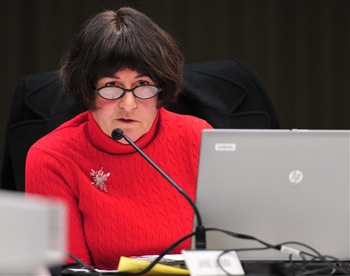
Council Member Jane Lumm, an Independent who represents the 2nd Ward, tried unsuccessfully Monday night to scale back the number of RRFBs going in at sidewalks and to limit the pedestrian safety ordinance so drivers only have to stop for pedestrian already within crosswalks.
Ryan J. Stanton | AnnArbor.com
She said she didn't think they were needed at Traver Village and Georgetown Boulevard, given low pedestrian volumes there and the close proximity to other crossings.
Homayoon Pirooz, head of the city's project management unit, disagreed with Lumm and said he doesn't think having RRFBs at four locations along Plymouth Road is excessive. In fact, he said, he'd probably recommend putting them in more places.
Pirooz said he actually measured some of the distances between crossings on Plymouth Road and it's about 600 feet or one block from the Traver Village crosswalk to Traverwood Drive. It's also about 700 feet or one block from Traver Village to Nixon Road.
"This is exactly the right spot where you want to have a pedestrian crossing point," he said. "So that's why we picked these locations when we picked them eight years ago."
Deciding whether certain crosswalks get RRFBs shouldn't be driven by the number of pedestrians crossing, Pirooz added. Rather, he said, it should be based on the speed of the vehicles and how many lanes of traffic pedestrians must cross.
"Hopefully in the future we will have something like a rapid flashing beacon in most of the places where pedestrians have to cross four or five lanes of traffic," Pirooz said.
Pirooz also stressed that the RRFBs will be particularly useful when it's dark or raining and drivers otherwise might have a hard time spotting pedestrians.
Lumm also fought unsuccessfully Monday night to amend the pedestrian safety ordinance so drivers only would have to stop for pedestrians already within crosswalks — not those waiting at the curb line. She couldn't get another council member to support her motion.
Lumm argued the city's signs at crosswalks are inconsistent with the city's own ordinance as they only instruct drivers to stop for pedestrians "within" crosswalks.
Cooper said there's only so much fine print a motorist can be expected to read when traveling down a road and the signs convey the basic message.
City Attorney Stephen Postema said even though the signs use different language, the city still will enforce the ordinance and leave the outcome of any case up to a judge.
The fine for violating the pedestrian safety ordinance in Ann Arbor is $100 plus $30 in court costs. Contrary to information put out by supporters of the ordinance previously, there are no points added to a driver's license for violations of the ordinance.
In making the case for the RRFBs, city officials noted Plymouth Road is five lanes between Murfin Avenue and Huron Parkway. The posted speed limit ranges from 35 mph to 45 mph, with a daily traffic volume of about 22,000 vehicles.
Nearby developments include the University of Michigan's North Campus housing and offices, apartments, shopping malls, businesses and religious facilities.
Seventh Street at Washington — near Slauson Middle School — has a posted speed limit of 30 mph and a daily traffic volume of close to 10,000 vehicles.
Ryan J. Stanton covers government and politics for AnnArbor.com. Reach him at ryanstanton@annarbor.com or 734-623-2529. You also can follow him on Twitter or subscribe to AnnArbor.com's email newsletters.
Comments
chapmaja
Thu, Dec 22, 2011 : 2:39 p.m.
This law is stupid and it is a stupid implementation. I was driving along a road (don't recall which one) the other day and saw the "local law stop for pedestrians in crosswalk" sign. I looked over and right in the ramp was a person standing waiting for the bus. The bus stop sign is located about 2 feet from the ramp and the individual waiting for the bus was waiting in the ramp. By law, this meant nobody could pass because there was a pedestrian on the ramp leading to the crossowalk. The simple fact is the City of AA has royally screwed up on this and now is spending more money to cover the mistake they made. The City of AA needs to simply enforce the state law which states a driver must stop for a pedestrian in the crossowalk.
snapshot
Thu, Dec 22, 2011 : 4:48 a.m.
Hiefjie needs to apologize to the taxpayers of Ann Arbor for the poor leadership he exhibited in passing this ordinance without properly vetting it and his poor performance in addressing the overwhelming opposition and confusion surrounding it. This is just a waste of money and an example of poor leadership pushing personal agendas. Shameful. Hope the state does something about these folks tweaking standardized traffic laws.
Nick
Thu, Dec 22, 2011 : 4:46 a.m.
Please, please explain how anybody is going to drive through the areas in front of the Michigan Union or in front of the Natural History Museum or Dental School with pedestrians who walk through crosswalks from all angles without looking up, pausing to check traffic or even showing concern for their own safety. Just daring drivers to mess with them. So now it's our job duty to keep them from being idiots on top of trying to operate a vehicle? How is this balanced protection when the responsibility is solely on drivers?
Nick
Thu, Dec 22, 2011 : 5:16 a.m.
Maybe they should turn these into transit malls much like the Nicollet Avenue area in Minneapolis. A transit mall is a street, or set of streets, in a city or town along which automobile traffic is prohibited or greatly restricted and only public transit vehicles, bicycles and pedestrians are permitted. Transit malls are instituted by communities who feel that it is desirable to have areas not dominated by the automobile, or as a way to speed travel time through an area—usually the city center—for transit vehicles and as a transport hub for interchanges, making them more efficient and thereby more attractive as an alternative to car use. Converting a street or an area to a transit mall can be a form of pedestrianization, allowing pedestrians and cyclists as well as transit vehicles to move more freely, unimpeded by private motor traffic, if autos are banned completely. However, some transit malls are not auto-free, but rather restrict cars and other private traffic to only short segments or only one lane, with other lanes being limited to buses or trams (streetcars).
Jason
Wed, Dec 21, 2011 : 8:52 p.m.
The number of times I see people standing, talking to friends at the curb near a crosswalk, with their back to the street is quite large. Now, the number of times that person then takes a few steps back, before finally turning around when they're in the crosswalk, is just about as large. I drive in downtown Ann Arbor a lot, and the stress level is astronomical, to see the lack of attention paid by the pedestrian. They know it's the drivers' responsibility now to watch for them, so they forget to pay attention, and that they can still get hurt. Why is it so hard to have a button pedestrians push when they want to cross, which triggers a red light for traffic, or a flashing yellow light? Hell, they already have these for school zones. The curbs are typically not lit well enough to be able to see a pedestrian when it's dark. There is a spot on Washtenaw Ave, just before it meets up with Stadium, where it is not lit at all (even the crosswalk itself.) It's a 45 MPH zone, and a five lane road. You want pedestrian safety? Light up the crosswalks and the sidewalks on either side of the crosswalks.
CincoDeMayo
Wed, Dec 28, 2011 : 2:23 a.m.
Jason, it is five lanes there. Two westbound, two eastbound and a center turn lane. That is an extremely dangerous crosswalk that hardly anybody ever used, until recently. They are no safer crossing there now than they were before, though.
Jason
Thu, Dec 22, 2011 : 6:06 a.m.
Ah. That's my fail. I thought the strobe lights were an on-going thing, not so much a pedestrian triggered thing. Also, Washtenaw is four lane road, not five lanes. My bad again. :D
Peter Baker
Wed, Dec 21, 2011 : 9:24 p.m.
"Why is it so hard to have a button pedestrians push when they want to cross, which triggers a red light for traffic, or a flashing yellow light? Hell, they already have these for school zones." That is what they're doing on Plymouth. It's not an option to do that at every single cross walk in the city though, so where in residential areas, where you should be driving safely to begin with, it's not that hard to identify people waiting to cross, and safely stop for them.
Emma B
Wed, Dec 21, 2011 : 3:42 p.m.
I realize that I'm late to the party, but I figured since many others have submitted their opinions on various courses of action, I would to. I use Plymouth Rd almost exclusively as a pedestrian. Therefore I believe that the best solution is to close Plymouth Rd and create a giant sidewalk. That would be the most convenient solution for me, personally. In all seriousness, I actually primarily use Plymouth Rd as a driver. I manage to leave my house early enough to follow the speed limit and stop and allow pedestrians to cross. And even if I'm running late-- for any reason, I am aware that my own personal failure to be on time does not mean that I should risk the lives of those around me, and so I continue to go the speed limit and allow pedestrians to cross. I even do these things when I am driving in other communities or out of state.
toothless wonder
Wed, Dec 21, 2011 : 3:24 p.m.
Flashing strobes at intersections! Trip the light fantastic!
Ron Granger
Wed, Dec 21, 2011 : 2:49 p.m.
This makes it so much harder for problem drivers to justify their failure to yield. "I was confused!" isn't going to cut it. Time to get the police out to enforce the pedestrian right of way on the drivers who routinely refuse to stop. And while they're at it, they can ticket the speeding cars on Plymouth.
guyfroma2mi
Wed, Dec 21, 2011 : 4:55 a.m.
I'm a little confused as to why the city is going this route versus a button-actuated standard traffic light, which provides added safety by having the "yellow" warning that allows time for cars to stop safely; this seems unnecessarily confusing and could still result in drivers slamming on the brakes for fear of getting a ticket. And even the company's own video boasts of just an 80% compliance rate; since it's only activated by a pedestrian waiting to cross the street, does that mean 1 in 5 pedestrians will be dodging cars that don't stop? Why does the City Council feel the need to reinvent the wheel, spend countless hours of staff time pondering and studying, and go with something that's different just for the sake of being different as they stare the safest and least confusing solution in the face?
justcurious
Wed, Dec 21, 2011 : 12:28 p.m.
Daniel, guyfroma2mi said this "I'm a little confused as to why the city is going this route versus a button-actuated standard traffic light, which provides added safety by having the "yellow" warning that allows time for cars to stop safely; this seems unnecessarily confusing and could still result in drivers slamming on the brakes for fear of getting a ticket. " No where does he mention a HAWK light. He has a good point. Install a regular traffic light somewhere near the middle of the cluster they are planning. People would not have to walk that far to get to it, they would be crossing at their own risk between traffic lights. Hopefully UofM students have enough sense of self-preservation not to do that, right?
Daniel Soebbing
Wed, Dec 21, 2011 : 5:28 a.m.
The only alternatives on the market cost around 7 times more. The "HAWK" traffic light that was installed at Huron, near the YMCA cost over $100,000, and that was for just one crossing. The city is going to get 5 crossings for less than they paid for the one light near the Y. The compliance rate for the HAWK lights is around 90%. Paying much more money for an additional 10% compliance doesn't make a lot of sense.
martini man
Wed, Dec 21, 2011 : 1:07 a.m.
There can be only one reason for this type of idiocy ..too many liberals in seats of power. No other rational reason can be given. It looks like 99% are against this potentially dangerous and life threatening ordinance. Even the people who support it in theory, seem to realize that it's a disaster. But those inflated egos of the all knowing, all caring, AA city council will fight to the end to prove their superior intellect.
peg dash fab
Wed, Dec 21, 2011 : 10:39 a.m.
you are repeating yourself you are repeating yourself
Billy Bob Schwartz
Wed, Dec 21, 2011 : 1:05 a.m.
Okay...I hope nobody reads this, because that means this topic is dead for now. I just wanted to say that the egocentric folks are the ones who refuse to admit that all sides in this mess are responsible for safe streets, and pointing fingers at the others is crap. Just because you, in your car, on your bike, on foot, whatever, think only you can be right here, that doesn't mean that the rest of us think like that. I for one think way to many drivers, walkers, runners, strollers, etc. etc. etc. are wandering through life totally unaware that they are in traffic and need to put away the ear buds, cell phones, wandering minds, texting programs, computer games, alcohol and other drugs, thoughts of getting there quickly or that the day is over and they can wander home like the old gray mare or whatever the heck other distractions they conjure up, and PAY ATTENTION TO WHAT THEY ARE DOING!! Everybody does this, and everybody pays. Please do not now say that I hate pedestrians or don't understand the needs of drivers. They are all nuts, and more nuts in A2 than anyplace I have ever been except Washington, D.C. The solution is not more weird ordinances. It may include enforcement and HAWKs and other things that cost money, but the one thing I'm pretty sure the community could do is to encourage pedestrians...the ones who will get most hurt...to watch what they are doing. Try that with cars, too, and good luck on that.
Daniel Soebbing
Wed, Dec 21, 2011 : 12:58 a.m.
I am in favor of the new lights and I agree with Lumm's resolution.
Real Life
Tue, Dec 20, 2011 : 11:18 p.m.
How about we require every one of these new-fangled "automobiles" to have a person carrying a red flag in front of them within the city limits? These horseless carriages will be the ruination of us all! (I see how Ann Arbor is still relentlessly pursuing its war against the automobile. For the nonce, my New Year's Resolution will be to stay the hell off Plymouth Road. I might offend some pedestrian's sensitivity.)
babs
Tue, Dec 20, 2011 : 10:19 p.m.
The STREET light hasn't even worked or is burned out at the corner of BISHOP and Plymouth Road, it has been dark there for months if not a year. If even this can't be maintained, (and I think if there WAS a pedestrian incident after dark, a lawyer for the victim would be all over this fact of negligence), how do we expect to maintain these newly installed lights?
G. Orwell
Tue, Dec 20, 2011 : 9:27 p.m.
Finally, we live in the 21st. century where a good percentage of people read emails and text while driving. AA city council is adding another obstacle for these people to do more damage. You are NOT doing pedestrians a favor. You are putting them in greater danger.
63Townie
Tue, Dec 20, 2011 : 9:21 p.m.
Ever since this new ordinance has been enacted, I can't tell you how many pedestrians I have seen boldly step out into traffic against a crosswalk signal. It's especially bad downtown. I have also seen drivers on Plymouth Rd. come to a complete stop at a crosswalk when no pedestrian is in sight. Just because Boulder scratches itself doesn't mean Ann Arbor has to as well. Use some common sense for once.
cornelius McDougenschniefferburgenstein jr. 3 esq.
Tue, Dec 20, 2011 : 8:09 p.m.
pedestrians should be required to extend arm+point if not yet in crosswalk.a logical cheap,fix .vote all the tyrants out.(except lum)
Woman in Ypsilanti
Tue, Dec 20, 2011 : 11:19 p.m.
Where are you walking? I don't usually do the extend my arm and point thing because I think it makes me look stupid but in the interest of seeing if it would work when it came up in a previous conversation, I gave it a try. Every single time the cars stopped for me. This was downtown and on the west side. In Ypsi on Michigan Ave, no one stopped but they don't have any kind of ordinance.
Peter Baker
Tue, Dec 20, 2011 : 9:48 p.m.
Yes, I've tried it, a lot. Even while standing IN the crosswalk. Driver's don't feel like they're supposed to stop for anything.
jamullet
Tue, Dec 20, 2011 : 9:23 p.m.
How will that help if motorists aren't supposed to have look to the side of the road or ever slow down for anything? The real complaint I've read here is that people don't want to ever have to slow down - even though they are already driving 40-45mph through my neighborhood where the posted speed limit is 25mph. But wait - aren't the motorists the law abiding ones who are being imposed upon by this tyranny?
MIKE
Tue, Dec 20, 2011 : 9:18 p.m.
Peter, have you tried it?
Peter Baker
Tue, Dec 20, 2011 : 8:30 p.m.
Doesn't work.
ranger007
Tue, Dec 20, 2011 : 7:58 p.m.
PkThe cross walks on Plymouth rd are poorly lit, have a AATA bus stop at the cross walk so you have to guess if the person is crossing or waiting for a bus which causes people to suddenly slam on their brakes because someone might be crossing...would it make sense to make the yellow "cross walk" sign flash..I mean its already wired for power..what's a strobe light bulb or 2 cost ...probably not 65k
leaguebus
Tue, Dec 20, 2011 : 7:41 p.m.
We need to recall everyone on council that voted for this. How dare you enact a statute that would penalize drivers who are not paying attention to their driving. This will cause more rear enders which will get drivers hurt. Right now, if we hit a pedestrian, only they get hurt. Start the petitions now....
martini man
Tue, Dec 20, 2011 : 7:09 p.m.
There can be only one reason for this type of idiocy ..too many liberals in seats of power. No other rational reason can be given. It looks like 99% are against this potentially dangerous and life threatening ordinance. Even the people who support it in theory, seem to realize that it's a disaster. But those inflated egos of the all knowing, all caring, AA city council will fight to the end to prove their superior intellect.
fjord
Tue, Dec 20, 2011 : 7:02 p.m.
There is no truth to the rumor that Higgins' absence was due to her vehicle being rear-ended after she stopped for a pedestrian approaching a crosswalk.
EyeHeartA2
Wed, Dec 21, 2011 : 1:39 a.m.
I feel like I got rear ended with this law...
simply amazed
Tue, Dec 20, 2011 : 6:01 p.m.
I haven't read all 116 comments so I apologize if this has already been mentioned, however, my real question here is whether the AA police officers that hide around the corner of the crosswalks and hand out tickets to drivers will also be handing out tickets to the joggers, parents walking their babies in strollers, pet walkers and all other walkers that choose to bolt across the street NOT at a crosswalk. I see this every single morning and evening to and from work on Liberty between Stadium and Seventh. And there are multiple well identified crosswalks in this stretch. Without fail, instead of walking or jogging 2 houses down in the same direction they were headed in the first place, they dart to cross the street unsafely. I guarantee that those will be the same people crying 'foul' when they are injured because in their haste they trip, hit a curb, get emotionally rattled, or scare their pet or child because a car had to squeal to a halt due to their own willingness to not cross at obvious crosswalks created for their safety. I'd be curious as to the last time a ticket was issued to a pedestrian for impeding traffic, jaywalking, causing a traffic accident. Several weeks ago downtown, I witnessed an AA police officer in a clearly marked AA police SUV at a downtown intersection that sat and watched a pedestrian stand in the middle of his lane, wander back and forth, and eventually step up to the curb. Yes, I believe he was impaired, was most likely homeless as the weather was cold/raining and the person had no coat on, and yes, the same guy that begs at the entrance to the parking structure. Surprisingly, this officer did nothing to get him out of the road or check on him to make sure he was OK when he finally did cease obstructing traffic or impeding that same police officer and the traffic behind him from going through their green light. Point....rules need to work both ways.
justcurious
Wed, Dec 21, 2011 : 12:41 a.m.
It was my understanding that the police have pretty much ignored this law as well..they have better things to do.
Woman in Ypsilanti
Tue, Dec 20, 2011 : 10:07 p.m.
I am not sure it is actually against the law to jaywalk as long as doing so doesn't disrupt traffic, fwiw. A minor quibble to be sure but I just thought I would throw that out there.
jamullet
Tue, Dec 20, 2011 : 9:20 p.m.
You know, we could spend all day giving examples of all of the laws motorists and pedestrians break on a daily basis. How does that prove your point? Why just yesterday, I watched from the through lane as ALL 4 cars in the turn only lane ran the red light - which is marked as no turn on red - 2 of those 4 cars going straight from that turn only lane. There are plenty of opportunities for officers to hand tickets out to motorists if all they wanted was revenue. They don't need to create a new ordinance for that. The purpose of the ordinance is to try to get motorists to acknowledge that there are other people in the world besides themselves.
ranger007
Tue, Dec 20, 2011 : 7:36 p.m.
Well said
simply amazed
Tue, Dec 20, 2011 : 6:04 p.m.
And yes, you'd be shocked at the number of people I see put their child in a stroller or their pet in danger with this practice.
Enso
Tue, Dec 20, 2011 : 5:58 p.m.
The first time around it didn't work.... let's try a Disco Inferno!
DadooS
Tue, Dec 20, 2011 : 5:54 p.m.
This decision is a definitive example of the phrase "don't throw good money after bad". A 10-0 vote hopefully means a 0-10 rate of incumbent re-election.
SalineBob
Tue, Dec 20, 2011 : 5:39 p.m.
I watched the video and even though this stobelight demonstration occurs someplace that looks like a downtown I notice the vehicles still stopping rather abruptly. I can see this working on Main Street downtown. Plymouth Road? No way. Speeds are too fast, street is too wide, trucks can block your view, people are gabbing on their cell phones, it's snowing heavily, etc. The only way to get people to stop is to put up... (drumroll please)... a stop light. OVERHEAD so people can see it. A RED stoplight so people from out of town also will know what it means--to STOP.
SMC
Tue, Dec 20, 2011 : 9:12 p.m.
No, I did not say that Plymouth Road has enough traffic volume to justify converting it into a highway. What I did say was that there was sufficient traffic volume that putting crosswalks where there aren't already intersecting streets, simply isn't safe. Looking both ways before crossing is what you do when crossing at any crosswalk, even one that is at an intersection. Perhaps you were confused with my reference to freeways, so I'll clarify: before there were freeways, there were just roads. These roads had streets intersecting them, but that meant that traffic couldn't flow freely, because drivers were always slowing down for traffic turning onto the main road that hadn't accelerated up to the speed of traffic yet. So, to make things more efficient, interstate freeways were developed, based on Germany's Autobahn system. Now, because there are varying degrees of traffic volume, there exist several types of road that are larger than a 2-lane, yet smaller than an interstate. On many of these roads, there are no pedestrian crossings, because it simply isn't feasible to have them. I can think of a few roads in this town that qualify, and Plymouth is one of them.
Peter Baker
Tue, Dec 20, 2011 : 8:33 p.m.
You say Plymouth Road has enough traffic volume to almost justify a highway, yet you also say looking both ways before crossing the street should suffice. You can't have it both ways, or in this case, only your way.
SMC
Tue, Dec 20, 2011 : 8:07 p.m.
@Peter: Motorists are not entitled to unimpeded traffic flow, unless they are on a restricted-access highway, with no traffic signals. How do such highways come into existence? They are constructed when responsible government realizes they are necessary because existing (limited-access) roads are no longer capable of handling the volume of traffic on them. In the case of Plymouth road, while there is not yet the need to construct a highway linking Green Rd to Main St, there is enough traffic volume on it that simply placing blinking lights where you think pedestrians should cross, isn't a safe solution. @Foobar417: As I've said before, the pedestrian ordinance is the A2 City Council's way of attempting to improve people's driving habits via legislation, which has been proven ineffective, time and again. As far as the self-centeredness of motorists, you're calling the kettle black. What prevents the pedestrians from being more aware of what's around them when they cross the street? When last I checked, it's not terribly difficult to look both ways. Yes, it may take a bit longer to cross as a result, but if you were in that much of a hurry to get where you were going, there's a bus system.
foobar417
Tue, Dec 20, 2011 : 7:55 p.m.
And yet, strangely, there are rules preventing that as well. For instance, as reported by aa.com, the reason the city had to put a HAWK signal in at 3rd/Chapin and Huron is that the state would not allow another stoplight. So, picking on that examples, our options were no stopping devices between 1rst and 7th (which was a significant burden on the elderly living in Lurie towers trying to reach the Y and on the Y children trying to reach West Park), a HAWK signal ($100k), a pedestrian overpass (which in practice is rarely used) for a $1million or $2 million, or or a strobe light ($20k). I'm glad they tried the HAWK signal there, but I think trying the strobe lights is reasonable too. But making vacuous platitudes about "pedestrians should get the hell out of the way or put in a stop light" is pretty typical "it's all about the drivers" self-centeredness. I've driven Plymouth for years and it's never hard to stop in time. If you drive at a relaxed pace, stay off your cell phone, drive at or under the speed limit, and realize you have the privilege of driving a potentially lethal machine and that there are vulnerable human beings who may not have the awareness (kids), physical abilities (elderly), or resources (too poor for a car) to stay out of your way, it's pretty easy to be a responsible member of the community.
justcurious
Tue, Dec 20, 2011 : 6:19 p.m.
That was what I was trying to say...wayyyyy up there.
Peter Baker
Tue, Dec 20, 2011 : 6:18 p.m.
But you're not entitled to unimpeded traffic flow everywhere you go. Sometimes you have to stop, and yet, amazingly, you'll still get where you're going.
SMC
Tue, Dec 20, 2011 : 6:12 p.m.
You're absolutely right; if you have a valid drivers license, and own a vehicle that is compliant with safety and emissions requirements, and have paid to insure the vehicle and register it with the state, you are therefore entitled to drive it on all public roadways. So yes, most drivers are, in fact, entitled to do so.
Peter Baker
Tue, Dec 20, 2011 : 5:43 p.m.
I'd like to see the outrage from this website if the city put up more stop lights, thereby impeding entitled drivers even more.
newsboy
Tue, Dec 20, 2011 : 5:29 p.m.
Pedestrian adjective Lacking liveliness, charm, or surprise: arid, aseptic, colorless, drab, dry, dull, earthbound, flat, flavorless, lackluster, lifeless, lusterless, matter-of-fact, prosaic, spiritless, sterile, stodgy, unimaginative, uninspired. See excite Sound like City Council to you?
Peter Baker
Tue, Dec 20, 2011 : 5:14 p.m.
One problem with the notion that everyone should always just look both ways and wait for the cars to clear is that there are many streets in Ann Arbor where traffic never clears enough for some pedestrians, especially slower pedestrian traffic like the elderly or disabled, to cross safely. There are a lot of common sense safety rules that are being ignored by drivers as well, and it'd be nice if people showed even a fraction of the outrage displayed here against those much more common issues.
Woman in Ypsilanti
Tue, Dec 20, 2011 : 9:58 p.m.
Yes, I definitely support adding signaled crosswalks but they should be INSTEAD of this ordinance not in addition to it.
SMC
Tue, Dec 20, 2011 : 9:01 p.m.
@Peter: If it's that dangerous to cross such a road (and it is), then perhaps there shouldn't be a crosswalk there at all. It would be an inconvenience to some, but unfortunately, the world isn't fair, and it owes you nothing. If Hieftje & Co were in charge of the whole country, I'll bet they'd install crosswalks on the interstate freeway system, then wonder why so many people were getting killed trying to cross the street.
Peter Baker
Tue, Dec 20, 2011 : 8:35 p.m.
No, an elderly person would have trouble crossing a TWO-lane street in enough time to make it between gaps in traffic. ANYONE would have trouble crossing four-to-five line roads between waves of cars on Plymouth Road.
SMC
Tue, Dec 20, 2011 : 7:55 p.m.
So, Peter Baker, it is your assertion that the law, and the subsequent purchase of these expensive flashy lights, was strictly for the benefit of elderly pedestrians? Or, to go one step further, elderly pedestrians who demonstrate the ability and determination to walk, just not that far? Regarding the difference between a signaled crosswalk and a flashing light, the signaled crosswalk exists at the intersection of Huron and Chapin streets, near the YMCA, and part of the reason it exists there is because the senior citizens living at their home for the elderly on the North side of Huron were having so much trouble crossing the street to get to the YMCA that the senior home had to use a shuttle bus for that purpose. In that particular case, there's good reason for it. But, how many senior citizens need to cross Plymouth during rush hour,to get to their classes on North Campus? Rare and isolated occurrences, do not an argument make.
Peter Baker
Tue, Dec 20, 2011 : 6:18 p.m.
"If a street is so busy that the traffic never clears enough for pedestrians to cross safely, that is a street where there should be signaled crosswalks." Which is exactly what City Council is enacting, according to this article.
Woman in Ypsilanti
Tue, Dec 20, 2011 : 6:17 p.m.
If a street is so busy that the traffic never clears enough for pedestrians to cross safely, that is a street where there should be signaled crosswalks.
Peter Baker
Tue, Dec 20, 2011 : 6:14 p.m.
"If you're already determined to walk to your destination, I don't think a few more steps should be that inconvenient." So making an elderly person walk to the next stop light – up to a half mile in some places in town – is a reasonable demand, but pausing in your car for a few seconds isn't?
SMC
Tue, Dec 20, 2011 : 6:08 p.m.
If traffic never clears enough for pedestrian traffic, then pedestrians should cross the street someplace else. It's just that simple. I cannot think of a single place in this city where it would be unreasonable to simply walk to the nearest intersection, and use the crosswalks there. If you're already determined to walk to your destination, I don't think a few more steps should be that inconvenient.
evenyoubrutus
Tue, Dec 20, 2011 : 5:12 p.m.
Maybe there needs to be a recall of these city council members. I would join in the effort if I lived in Ann Arbor but alas, I only work there and have to abide by its traffic laws but have no vote that could effect change.
peg dash fab
Wed, Dec 21, 2011 : 10:32 a.m.
you would hate living here
Peter Baker
Tue, Dec 20, 2011 : 5:05 p.m.
This sounds like a reasonable compromise, and should get rid of all the "mind reading" comments. If a pedestrian is waiting to cross a street, and you can stop safely to allow them to safely do so, you should. It's also a real stretch to say that because cars are now supposed to stop for them, that pedestrians are now going to feel entitled enough to walk out in front of a car that's not obviously stopping. Please. Clearly city council is listening, so let's drop all the "ignoring the will of the public" outrage.
Peter Baker
Wed, Dec 21, 2011 : 3:29 p.m.
"Apparently you haven't driven downtown very often." I do it every day. And live 6 blocks from there.
63Townie
Tue, Dec 20, 2011 : 9:25 p.m.
Apparently you haven't driven downtown very often. Pedestrians step out against "don't walk" signals all the time. This morning two people almost walked into the side of my car while I was turning right onto Huron from First.
SMC
Tue, Dec 20, 2011 : 6:35 p.m.
City council is indeed listening, but unfortunately, their attentiveness has an $80,000 price tag. Now, if they used some common sense in the first place, there would be no law that required $80,000 to correctly apply.
Woman in Ypsilanti
Tue, Dec 20, 2011 : 6:15 p.m.
Well, I see pedestrians all of the time downtown who think that when the light is green and the white walk light is lit, they are entitled to cross. I am one of those pedestrians and I do have to admit that I didn't always look before crossing in those situations. But then, after many near misses with turning cars, I've learned to have a little bit more awareness when crossing but most other people don't pay attention at all. I just point this out because I know that if enough people begin to stop at unsignaled crosswalks, pedestrians will stop looking and that does increase the potential for accidents, imho.
G. Orwell
Tue, Dec 20, 2011 : 5 p.m.
This nonsense has to do with "Smart Growth." The ultimate goal being to FORCE everyone to take public transportation, walk or bike to everywhere and make the use of cars less desirable and very expensive. Like they have done in London. That will be great for our economy with car sales plummeting. Google, "Plannedopolis" and you will see what is planned for the masses or us "small people." It is draconian and Orwellian. Everything will be rationed and the state will decide our careers for us. All in the name of "sustainability."
justcurious
Tue, Dec 20, 2011 : 6:16 p.m.
No, they are just trying to make Ann Arbor into a "Complete City". We didn't know it was incomplete before.
Peter Baker
Tue, Dec 20, 2011 : 5:42 p.m.
Um, yeah, and what does a group in London making "World of Tomorrow" cartoons have to do with Ann Arbor trying to let people cross streets safely? Walt Disney told me cars would be driving themselves by now too.
G. Orwell
Tue, Dec 20, 2011 : 5:19 p.m.
Peter, Please research before you state your opinion/claims. Did you research "Plannedopolis?"
Peter Baker
Tue, Dec 20, 2011 : 5:06 p.m.
Wow, that's a stretch. Maybe we just people want to be able cross the street safely.
Woman in Ypsilanti
Tue, Dec 20, 2011 : 4:38 p.m.
I have stopped being mad about this ordinance. The revision is an improvement but it is still a bad ordinance. However, I have been paying attention to how well the city enforces all of its other ordinances involving pedestrians and I think I can honestly say that just ignoring this ordinance altogether will not significantly increase one's risk of getting a ticket. I'll just keep doing what I have been doing which is to stop if I see someone at the side of the road in enough time to stop safely and to wait until traffic clears before crossing when I am a pedestrian. I am not going to worry any more about pedestrians in dark clothing at night or intersections where the pedestrian is difficult to see. If everyone ignores this law, it will just be as worthless as the paper it is printed on. I can tell you as a pedestrian, no one follows this. Just like they make right and left turns over signaled crosswalks, cross over sidewalks when accessing driveways, fail to stop for pedestrians already IN the crosswalk, etc It will be just the like the leash law!
Woman in Ypsilanti
Tue, Dec 20, 2011 : 10:02 p.m.
re: "We'll have to leave it up to the police who witness the situation to decide whether it's cause for a ticket" Yes. And since enforcement of every other law that involves pedestrians is pretty much near 0%, I suspect that I'll never get a ticket for failing to stop for someone at a cross walk. And judging by the reactions of most drivers, I suspect that this ordinance will end up being more useless than bad. People aren't going to stop for pedestrians more than they would if the city just had an ad campaign that encouraged people to do it voluntarily.
justcurious
Tue, Dec 20, 2011 : 6:13 p.m.
Someone stopped suddenly for me as I waited to cross Baker Rd. to the post office the other day. Mind you, there is NO crosswalk there. The cars coming off of Main Street piled up behind her. She refused to move until I crossed the road. It was a bad situation for all. This is DEXTER, where there is no silly ordinance. She was lucky not to get rear ended. I was just waiting for a break in the traffic, like usual.
Peter Baker
Tue, Dec 20, 2011 : 6:09 p.m.
Safety is the important part of all of these rules. We'll have to leave it up to the police who witness the situation to decide whether it's cause for a ticket, or whether there might have been another problem that kept you from stopping safely (ie. speeding or tailgating). I've surely not seen some pedestrians soon enough to stop safely, so I didn't, but I also don't feel like it's such oppression to stop when I do see them.
Woman in Ypsilanti
Tue, Dec 20, 2011 : 6:05 p.m.
@Peter. The ordinance says that drivers must stop. It doesn't say anything about stopping safely. If I don't see the pedestrian in time and would need to slam on my brakes, then I am not stopping. This is particularly a problem at night. I was worried about getting a ticket in those situations but I've just decided to stop worrying. I will say that the strobe light crosswalks will vastly increase the likelihood of my noticing a pedestrian in time to stop safely.
Peter Baker
Tue, Dec 20, 2011 : 5:08 p.m.
"I'll just keep doing what I have been doing which is to stop if I see someone at the side of the road in enough time to stop safely..." That's what the ordinance says! Why does everyone see this as so unreasonable?
ocho
Tue, Dec 20, 2011 : 4:28 p.m.
I'm happy with the law and the signs. In fact it's quite similar to what I've seen functioning in Toronto and other Canadian cities.
cornelius McDougenschniefferburgenstein jr. 3 esq.
Tue, Dec 20, 2011 : 8 p.m.
in toronto do peds extend arm point to get traffic to stop?
justcurious
Tue, Dec 20, 2011 : 6:09 p.m.
In Toronto a pedestrian can cross at some large, busy intersections diagonally...crazy to watch.
CalmDown
Tue, Dec 20, 2011 : 4:27 p.m.
As someone who travels Plymouth frequently I've often found it difficult to see someone waiting to cross at the crosswalk. I think the new lights will be a big help. While the new safety law might be a little on the silly side, I find the general response to it to be pretty over the top.
shadow wilson
Tue, Dec 20, 2011 : 4:56 p.m.
once upon a time in a2 there were pedestrian bridges. A decidedly low tech solution but one that has no ambiguity_ they work. My guess is they were considered unsightly but they would be the best solution in the most traveled places such as Plymouth rd.In fact for a long time there was a ped bridge at plymouth and barton for school kids to cross to northside it seems one could be put up at plymouth and traver
daytona084
Tue, Dec 20, 2011 : 4:27 p.m.
I have to laugh.... the video says that driver compliance with the strobe lights is "an impressive 80%".... are they serious??? They think that's good? So A2 council thinks it's a good idea to spend $81,000 of taxpayer money for devices that will stop 80% of the traffic? One has to assume that the other 20% will continue to rear-end the 80% that stop and sooner or later mow down a pedestrian.
Unknown
Tue, Dec 20, 2011 : 4:23 p.m.
For goodness sakes! This is not going to solve the problem and the problem is a law was created that makes no sense and puts everyone in more danger. Remember the safety rule we all learned when we were 5 years old? Stop, look both ways and WAIT until the cars are gone before you walk across the street. There is no way a law that says, walk across the street and hope the cars stop for you will work! No thank you, when I am walking I think I will go back to common sense and find a real cross walk with a monitor or I will wait until the cars are gone without expecting anyone to stop for me.
KINGofSKA
Tue, Dec 20, 2011 : 4:21 p.m.
On a quick note, if you watch the video posted above, skip to 0:50, the person driving the car has to stop for a pedestrian in the middle of an intersection. As long as the pedestrian gets across safely, no other lives are in danger.
KINGofSKA
Tue, Dec 20, 2011 : 7:58 p.m.
I'm glad I'm not the only one who noticed that then.
justcurious
Tue, Dec 20, 2011 : 6:07 p.m.
I mentioned that earlier.
KINGofSKA
Tue, Dec 20, 2011 : 4:15 p.m.
When they said they were going to rethink this ordinance, I was hoping they'd get rid of it, instead of spending almost 100k dollars. If they are going to install these, why not install them in other locations around town? For example, one place that really needs it is in front of the clocktower entrance at Pioneer.
justcurious
Tue, Dec 20, 2011 : 6:07 p.m.
They had a traffic light there for a while. Then they took it away. Then they screwed with the number of lanes along Stadium. Just to keep us guessing, I suppose.
Eddie
Tue, Dec 20, 2011 : 4:02 p.m.
Looking at the larger picture, it appears that our city council, except for perhaps one member, has been hellbent on taking a simple issue (pedestrians need to be safe) and applying to it as little common sense as possible....and they continue to complicate the problem, wasting more time and money. This isn't the only issue council has demonstrated bad judgement on, but this one seems to be stirring up a lot of anger and disgust because it's so nonsensical. Let's remember this next time we have a chance to vote. It's pretty clear that Ann Arbor voters need to clean house. We need a mayor and council who can demonstrate common sense and intelligence, no matter what their party affiliation. And we voters need to do our homework next time we have a chance to cast our ballots! (At this point, if Elmer Fudd were running for council in my ward, I'd seriously consider his candidacy!)
CPS
Tue, Dec 20, 2011 : 4 p.m.
When I grow up, I want to make simple devices that municipalities will buy from me so I can become rich very quickly. $20,000 a pop sounds like I could retire within a few short years... Once I retire after ripping off the municipalities, then I want to get a job where I can spend other peoples' money without a care as to budgeting concerns or future repercussions after the money has run dry. What do I care? It's not like I am *personally responsible* for the funds, right? I can just give up my post, move on to something more entertaining, and let someone else deal with the fallout....
Chase Ingersoll
Tue, Dec 20, 2011 : 3:32 p.m.
As a dog returneth to his vomit, so a fool returneth to his folly.
ranger007
Tue, Dec 20, 2011 : 3:25 p.m.
Im still wondering what has happened to self responsibility? When I was growing up I learned to look both ways to make sure there was no traffic then cross ..maybe the U of M should offer "safety town" for all its students
Usual Suspect
Tue, Dec 20, 2011 : 4:08 p.m.
"When I was growing up I learned to look both ways to make sure there was no traffic then cross" The problem is people don't grow up anymore. They forever remain dependent children, and once they leave their parent's house they look to the government to be their parent.
Ron Granger
Tue, Dec 20, 2011 : 3:24 p.m.
Some drivers will use any excuse to avoid stopping for a pedestrian. Previously, we read all the complaints about how some drivers could not mind-read the intent of a pedestrian. Now that the flashing lights make the intent clear, we get a bunch of random excuses about how this won't work, how they're too distracted to see the lights, how they can't possibly stop in the street, how they won't stop, etc. Slow down, hang up your phone, pay attention, and yield the right of way to pedestrians. Operating a piece of heavy machinery comes with certain obligations regarding the safety of others. If that seems inconceivable, take the highway. I hear Dearborn is nice for cars.
Billy Bob Schwartz
Tue, Dec 20, 2011 : 10:50 p.m.
I don't do anything but concentrate on my driving. Ever. Still, I dread driving in a place where flashing lights that may not be visible from the left lane can cause me to hit someone who thinks I know to stop, and where some pedestrians will not push the button but just walk into traffic and whatever. Yes, I'm also a pedestrian, and I get it. People in A2 drive like total troglodytes, and always have, at least back over a half century. Something needs to be done. I get that, and I agree totally. I just don't think this is a solution that will do anything but drive people nutsier than they already are. Traffic rules need to be somehow coherent and uniform throughout the state. This just makes Ann Arbor that much harder. And I still think, while everyone knows that A2 drivers are nuts, it's time for the council to notice that the walkers and runners and strollers and dreamers and bicyclists and skateboarders and everyone else need to learn to stop being so nutsy, too. It isn't one or the other or another. It's the whole nutsy bunch of us.
grimmk
Tue, Dec 20, 2011 : 3:15 p.m.
Well, I guess I'm never going to Ann Arbor again. Even looking at them for a little bit gives me a migraine. I'll have to take the back way in to see my parents now.
Billy Bob Schwartz
Tue, Dec 20, 2011 : 10:41 p.m.
Justcurious...Here's a thought. Drive to the edge of Ann Arbor. Hop a bus downtown. Take a non-taxi taxicab around town. Hop a bus. Drive home. Leave the driving (and nervous breakdown) to them. lol
justcurious
Tue, Dec 20, 2011 : 6:04 p.m.
Seriously, I have cut down on my trips into Ann Arbor substantially. It's just too nerve wracking to drive there - between the crazy driving, the jaywalking pedestrians, the traffic law breaking bicyclists, the numerous dedicated left turn lanes, the bicycle only lanes, the one-way street changes, the amount of traffic and the sign litter, it's just not worth it to risk a ticket, an accident or killing someone inadvertently. Everything I really need to do and things I need to buy can be purchased outside of Ann Arbor. I'm glad I have a choice. I'm not the only one that feels this way.
Jim Walker
Tue, Dec 20, 2011 : 3:13 p.m.
Any part of the pedestrian safety ordinance that differs from state law and the Uniform Traffic Code is wrong. True traffic safety comes from uniformity of laws and enforcement procedures so that drivers do the right things, in Ann Arbor, Sturgis, Sault Ste. Marie, Ironwood, and everywhere in between. James C. Walker, National Motorists Association, <a href="http://www.motorists.org," rel='nofollow'>www.motorists.org,</a> Ann Arbor, MI
Lou Perry
Tue, Dec 20, 2011 : 2:49 p.m.
Joan Lowenstein a few days ago argued that if California and other states can have these pedestrian laws why not Ann Arbor and that pedestrian laws like this makes us a more progressive city. In case Ms. Lowenstein forgot, Ann Arbor is a city within the State of Michigan. The law needs to be statewide if at all, not only implemented when you reach State Street. Our city hosts many events that bring people from all-over Michigan and other states. I wonder enforcing this law has figured into the increase in ticket revenue in the next city budget. This along with our obnoxious parking enforcement, Ann Arbor has more city auto enforcement powers then other cities. I double parked on 6th Avenue in Manhattan the other day for almost an hour; I didn't get a ticket or tow. Again, logic needs to prevail.
EcoRonE
Thu, Dec 22, 2011 : 4:14 p.m.
The state law for energy efficiency in home building codes is woefully outdated - as desired by homebuilders. The state took away the ability of cities to be more energy efficient in their codes. There are many other examples where the state's degreed persons have goals other than the common good. I prefer a city where more progressive rules can be implemented.
SMC
Tue, Dec 20, 2011 : 6:04 p.m.
If this law were state-wide, it would never have existed, because when the state passes a traffic law, they tend to hire people with knowledge and degrees and thing, who actually know a thing or two about what they're doing, rather than believing that they can make things happen by wishing harder. Or, to put it even more bluntly, if the state law did say that drivers had to stop for pedestrians approaching a crosswalk (with intent to cross, which only a mind-reader could tell for sure), there wouldn't be crosswalks on Plymouth, or Stadium, or any other major 4 or 5-lane traffic artery through the city, because even an idiot could see that its just plain dangerous to expect that much traffic, travelling that fast, to stop quickly enough for pedestrians. Make no mistake, what this law represents is the anti-speed, anti-car city council trying to bully drivers into recognizing the evils of their motoring ways, even though there is no viable alternative for many people. At worst, it's an attempt to slow the traffic speeds on major roads while simultaneously cutting the police force, which they'll later claim didn't need to be so big in the first place, because look, people are driving slower on Stadium with fewer police to patrol it.
Peter Baker
Tue, Dec 20, 2011 : 5:28 p.m.
So would you support this law if it was state-wide?
Billy Bob Schwartz
Tue, Dec 20, 2011 : 2:47 p.m.
"Those flashing strobe lights you're going to see at some crosswalks in Ann Arbor soon mean one thing: Stop for pedestrians." Oops. You forgot the other thing: Duck and Cover and prepare for the rearender! My new rule: Stay the heck away from Plymouth Road!!!!!!!!!!
javajolt1
Tue, Dec 20, 2011 : 2:45 p.m.
The 'crosswalk strobe lights' are another example of spending taxpayer money that isn't there in order to plug some imaginary void. Serioulsy?? $81,000 because council doesn't think we know how to cross a street or that drivers don't know how to yield to a pedestrian. My guess is there will be as many crosswalk altercations with or without the strobes. Why is it always the taxpayer that has to foot the bill? Why to our City 'leaders' constantly rush to fill some imaginary void without considering all the options. We are broke in this city and running at a deficit for the first time in as long as this 50+ year old resident can remember precisely because City Council feels the need to 'fix' everything that is or is not broken. Stop spending this city into the red!
Billy Bob Schwartz
Tue, Dec 20, 2011 : 4:53 p.m.
Well, I agree, except that I would prefer red lights to strobe city.
foobar417
Tue, Dec 20, 2011 : 2:42 p.m.
The negativity on these forums is overwhelming and sad. Personally, I'm happy our city council has found a very cost effective way to try to improve pedestrian safety on a vary dangerous road where people have been killed in the not-too-distant past. I'm also glad to see the city council try to improve pedestrian safety throughout the city. As the parent of children rapidly approaching the age where they will be walking by themselves, anything to get self-absorbed, self-important drivers to slow down, pay attention, get off their phones, and watch out for pedestrians is good news in my book.
SMC
Tue, Dec 20, 2011 : 6:32 p.m.
@foobar417: "and too darn self-important to chill out and watch out for their fellow human beings." What's more self-important, someone driving a car slightly faster than the posted speed limit (which is always set lower than the maximum safe speed for the roadway and traffic), or the pedestrian who feels motorists should immediately stop whenever he feels like crossing their path? By the way, said pedestrians are in the minority in these parts. I can tell you which of these self-important people Ann Arbor has more of. Unfortunately, they also get elected to city council.
SMC
Tue, Dec 20, 2011 : 6:20 p.m.
"As the parent of children rapidly approaching the age where they will be walking by themselves, anything to get self-absorbed, self-important drivers to slow down, pay attention, get off their phones, and watch out for pedestrians is good news in my book." Ah yes, the "Won't someone please think of the CHILDREN!" argument. When I was a kid, cars took longer to stop, didn't steer as well, and weighed more than they do now. With this in mind, my mother taught me to cross the street properly, and I got a spanking when I didn't obey. "Distracted driving" may not have been such a problem in the early 1980s as it is today, but the same common-sense rules about crossing the street still apply, as they are dictated by the laws of physics. These laws cannot be overturned by the wishes of man, no matter how much the city council wishes it were so.
foobar417
Tue, Dec 20, 2011 : 5:58 p.m.
Sure, Billy Bob's list is a good, but it's also very incomplete, putting most of the onus on pedestrians. I do agree with the points made and teach my kids all that you've pointed out. All that said, I still think anything to slow down the self-absorbed, self-important drivers and try to get *them* to *also* take responsibility is well worth trying as well. If we teach kids to be better pedestrians and drivers to be better drivers, then everyone is safer. Just because pedestrians need to be super cautious because they can get killed by distracted drivers doesn't mean we don't need to focus the attention of drivers on *safer driving*. Every single comment about how hard it is to stop, not rear-end anyone, blah, blah, blah means one more driver who is racing around, not taking responsibility for driving 2000 points of metal, following too closely, and too darn self-important to chill out and watch out for their fellow human beings. What would I really like to see drivers do? Take your time, ease off the gas pedal, leave lots of room between you and the car in front of you, go at or below the speed limit, and watch like a hawk for bicyclists and pedestrians and anyone else who is whole lot more vulnerable than you if they do something stupid. Give everyone space and take it easy. Seriously, it's not that hard. Rushing around is never worth taking a life.
jamullet
Tue, Dec 20, 2011 : 5:35 p.m.
Interesting that Bill Bob's point number 6 is that everyone has to share and take responsiblity for ones' own actions but all of your other points are that pedestrians are the only ones on the road that can be expected to be responsible. I'm really big on personal responsibility - on everyone's part.
MIKE
Tue, Dec 20, 2011 : 5:22 p.m.
Grimmk, that implies personal responsibility, a big no-no in Ann Arbor.
Billy Bob Schwartz
Tue, Dec 20, 2011 : 4:49 p.m.
Sorry, foobar, but this has nothing to do with making pedestrians safer. What you call negativity is actually the almost universal realization that this policy will do little good and most likely will lead to more injured pedestrians and drivers. You need to teach your children something that many (most?) A2 pedestrians either have never learned or have totally forgotten. 1. You have to remember that if you are hit by a car, right or wrong, you will be the one who is most hurt or dead. 2. This means you have to be very, very, very careful when you are walking to make sure you do not get hit by a car. 3. No one else is responsible for you avoiding getting hit by a car except you. (Someone else may be held responsible after you are hit, but you will be in the hospital or dead.) 4. There is no safe place to cross a street. None. If you have a light that says to cross the street, this means you should look every direction to make sure that people are stopped and will let you cross safely. If not, do not cross. If so, cross while watching for idiots. 5. Whenever you can, you should cross at a traffic light. When there is no traffic light within walking distance, cross at a crosswalk. Where there are no lights or crosswalks within walking distance (say 2 blocks) then be *extremely careful* and do as described above. 6. Remember this when you ride your bike, and later when you are driving a car: the streets are for everyone, and we all have to take turns and work with each other so that accidents don't happen very often. Be polite. Share the road with other cars, trucks, bicycles, walkers, dogs, everyone. Don't be a pig. 7. Anything else that foobar can think of that expands on this kind of teaching. It's time for Ann Arbor to get off it's rear end and educate the walkers and runners and cyclists that there are rules for them, too. You don't have to be licensed to do these things, but survival is survival.
mun
Tue, Dec 20, 2011 : 3:54 p.m.
So, a driver is self absorbed is he/she is driving and a pedestrian darts into the street and the driver doesn't stop on a dime?
jamullet
Tue, Dec 20, 2011 : 3:45 p.m.
I have taught my kids to look both ways before crossing. I've also taught them to be mindful, considerate, and to take turns - all concepts that seem to be out of reach for most of those posting here.
grimmk
Tue, Dec 20, 2011 : 3:17 p.m.
What's wrong with teaching your kids to stop and look both ways before crossing the street?
mun
Tue, Dec 20, 2011 : 2:38 p.m.
Apparently telling pedestrians to LOOK FOR CARS is a hate crime and having them cross the street where there is a stoplight is so onerous.
nimbus123
Tue, Dec 20, 2011 : 6:30 p.m.
Truth.
Brad
Tue, Dec 20, 2011 : 2:35 p.m.
So 15-20% of the population walks to work every day. Fine, you have your "pedestrian safety ordinance". How about the other 80-85% of us? Can we get a "motorist courtesy ordinance" now? Make it illegal for a pedestrian to impede motor traffic by: a) entering the crosswalk at a controlled intersection unless it signaled "walk" b) crossing a street anyplace but at a crosswalk As part of that we would also like to fund the installation of the "walk/wait" pedestrian control signals at State and South University and assign an officer full time to enforce clause 'a' of the new ordinance. Let's say a $100 fine and $30 in court costs. Seems only fair.
Billy Bob Schwartz
Tue, Dec 20, 2011 : 4:33 p.m.
That spot is insane, isn't it? It's like a cattle crossing where the cows never stop coming. I vote yes on that.
mun
Tue, Dec 20, 2011 : 2:34 p.m.
"And, officials hope, they'll help put an end to a recent string of rear-end accidents that have happened — largely along Plymouth Road — as a result of motorists not stopping in time after vehicles in front of them hit the brakes for pedestrians at crosswalks." Wrong. The rear endings will only go up. What if the driver is hydro-planing and some pedestrian decides to cross?
Billy Bob Schwartz
Tue, Dec 20, 2011 : 4:31 p.m.
Black ice is ever the best.
B2Pilot
Tue, Dec 20, 2011 : 2:29 p.m.
How long did it take the city council to come up with this?? and how much money was spent trying to come up with this plan?? Amazing. Common sense is dead in A2.... with the exception of council woman Lumm. I think most citizens could of come up with a more reasonable solution as stated in many of the comments.
G. Orwell
Tue, Dec 20, 2011 : 2:20 p.m.
Again, even with the lights, this is a very poorly thought out ordinance. For example, how soon after the lights start flashing does a motorist have to stop? A motorist traveling at 45 -55 miles per hour will have to slam on the breaks once the light starts flashing? In an area where the speed limit is 25, it might make some sense as the above video shows (deceptive video since all the cars are traveling very slowly prior to stopping). But in a 45 mph zone with curves, you are going to have many more rear-end accidents. Can the city be sued if someone is injured or killed because of this very poorly thought out ordinance?
Billy Bob Schwartz
Tue, Dec 20, 2011 : 10:29 p.m.
Curious......That's assuming dry pavement. Wet or snowy or slushy or, heaven forbid icy roads, really make it interesting. I really don't understand why people think this is a matter of cars versus walkers. It should be a matter of common sense and cooperative use of the pavement, plus decent traffic management. Making up light systems no one understands and ordinances nobody understands is not the same as good traffic management. Then what we need is to get some enforcement out there to back it up.
justcurious
Tue, Dec 20, 2011 : 5:54 p.m.
The stopping distance for a car traveling at 40 mph is apps. 120 feet - or, the height of a ten story building.
jamullet
Tue, Dec 20, 2011 : 3:51 p.m.
Motorists aren't supposed to be travelling that fast here.
Roy Munson
Tue, Dec 20, 2011 : 2:13 p.m.
With how terrible and clueless drivers are in this city, I certainly wouldn't trust strobe lights to keep me safe enough to step out into Plymouth Road during rush hour to play a game of Frogger.
MIKE
Wed, Dec 21, 2011 : 8:28 a.m.
*not at ALL
MIKE
Tue, Dec 20, 2011 : 9:17 p.m.
Not at league. We slow down and stop all the time. Stop sign, red lights, traffic jams, accidents, emergency vehicles, jaywalkers, bad weather, etc,etc.etc. What do pedestrians slow down for, besides waiting for their turn to cross?
leaguebus
Tue, Dec 20, 2011 : 7:49 p.m.
And we all know that people in cars should never be slowed down by anything, especially those pesky pedestrians
MIKE
Tue, Dec 20, 2011 : 5:20 p.m.
Just cross when there's a break in traffic. I drive Plymouth everyday during the evening rush hour. I never stop for people standing on the sidewalk. I do glance into the rear-view after I pass, sometimes I see them cross safely at a break in traffic, sometimes they remain waiting for their bus.
jamullet
Tue, Dec 20, 2011 : 3:50 p.m.
So what would your constructive suggestion be to make crossing safe? Or is everyone just supposed to act like sheep in SE Michigan and do what everyone else does - drive everywhere.
MG
Tue, Dec 20, 2011 : 2:12 p.m.
The city is so hell bent on pedestrians, that they don't stop to think twice about halting heavy Plymouth road traffic at rush hour with constant stop-n-go. I'm sure the lights will not be smart enough to corral them at intervals so they aren't constantly going off when classes let out. Perhaps the city can get complaints about that and then decide to give into more expense with hiring a consultant to figure this out, and then increasing the costs of the solution once again. When will the city start some real useful work and crack down on bicyclists? Bicyclists should: - not be on pedestrian walkways or crosswalks - not simply break the traffic laws and cross through red traffic signals - have to come to a stop at stop signs like the rest of us.
aabikes
Wed, Dec 21, 2011 : 3:57 p.m.
And how would cracking down on cyclists be "real useful work"? When will the city start some real useful work and crack down on drivers? Drivers should: -stop before the stop line rather than in the crosswalks -not simply break the traffic laws and speed dangerously with several tons of steel -have to come to a stop at stop signs like the rest of us.
snark12
Tue, Dec 20, 2011 : 7:36 p.m.
PS I agree they shouldn't be on pedestrian walkways and crosswalks, although I believe the law permits it. I never ride on sidewalks because I feel it's too dangerous.
snark12
Tue, Dec 20, 2011 : 7:34 p.m.
I keep reading about all these problematic cyclists. But I don't read about people in cars being killed by them. Odd.
Peter Baker
Tue, Dec 20, 2011 : 6:04 p.m.
If only all drivers felt the same way about their cars. Stopping in crosswalks, breaking traffic laws and not stopping at stop signs is hardly a cyclist-only problem.
justcurious
Tue, Dec 20, 2011 : 5:49 p.m.
Has anyone on here EVER seen a bicyclist follow the same laws that a vehicle has to follow? I haven't. I have let them know on more than one occasion also.
grye
Tue, Dec 20, 2011 : 2:12 p.m.
Maybe what we need is the flashing stobe lights to tell the drivers to stop followed by govt/military style steel poles that extend out of the street to fully protect the pedestrian. Drivers that fail to stop will definitely stop upon hitting one of the poles. After a few of these incidents, drivers will pay more attention to driving and less to cell phones and other distractions.
Billy Bob Schwartz
Tue, Dec 20, 2011 : 4:27 p.m.
Or we can have pulsars flashing at them and wait and see if running into a car that panic stops in the middle of a main highway teaches them the same lesson. I think that's what we should do. Oops...that's what is happening.
Usual Suspect
Tue, Dec 20, 2011 : 2:05 p.m.
Why would they put up signs that they know mislead people about the ordinance? How can that anybody think that's acceptable?
PLGreen
Tue, Dec 20, 2011 : 2:05 p.m.
When will we have a law that fines pedestrains for failure to cross at a crosswalk. Pedestrains need to be held accountable.
Peter Baker
Tue, Dec 20, 2011 : 8:37 p.m.
Maybe they read these comments and realized nobody would stop for them anyways.
SMC
Tue, Dec 20, 2011 : 8:10 p.m.
At approximately 6:30pm yesterday, I witnessed two individuals jaywalking across Huron street, wearing dark clothing. They were less than 200 feet away from the HAWK signal at Chapin. So much for that theory, Peter.
Peter Baker
Tue, Dec 20, 2011 : 5:24 p.m.
The more safe the crosswalks are, the less likely people will feel the need to jaywalk.
Roy Munson
Tue, Dec 20, 2011 : 2:05 p.m.
They have lights like this in Florida to keep geezers from mowing down people. There really is no debate on what you are to do when things things go off, especially at night. Things like this make sense though in 25 or 30mph zones. Not in 40 or 45mph zones where people drive 10 over. There will still be accidents on those roads.
Sparty
Tue, Dec 20, 2011 : 1:58 p.m.
Well, at least there is now one reasonable person on the council - Jane Lumm. Thank you for your logic, patience in dealing with fools, and for pushing for the citizens of AA. May the next election open the eyes of voters to the foolishness of those that sit near you on Council. No surprise the invisible Marcia Higgins failed to appear again. How could anyone vote for this "person"?
Edward R Murrow's Ghost
Tue, Dec 20, 2011 : 3:47 p.m.
Ms. Lumm voted for this, along with the 8 others. So, on this issue, what makes her more "reasonable" than the other 8? GH&GL
JP2
Tue, Dec 20, 2011 : 1:58 p.m.
Or, we could stop coddling the pedestrians, aka college students, and have them walk the extra couple hundred feet to a traffic light to cross the street (there are PLENTY of traffic lights on Plymouth)!!! There would be no deaths, rear-enders, pedestrian issues or hundreds of thousands already of dollars wasted. Plymouth Road is NOT a pedestrian crossing street already. Wow!
leezee
Tue, Dec 20, 2011 : 1:57 p.m.
Another rash decision. Is it possible to try ONE of these strobes to see if it makes difference and if does, then pursue the purchase of additional. Also, I still and always will believe that at least one of the crosswalks on Plymouth between Huron Parkway and Murfin should be eliminated. Remember there are several actual lights to cross at along that stretch as well, so there are more than enough options. Why not move one further down Plymouth so that the students who have to cross to get to the bus stop across from Arbor Water have some protection? Crazy town!
ez12c
Tue, Dec 20, 2011 : 1:52 p.m.
I was completely against the previous revision. This new strobe works for me. As a driver, it is almost impossible to 1)identify a pedestrian 2) judge whether I think it is safe to pass them or are they waiting for me to stop 3) figure out what other motorists are going to do and 4) determine whether a cop would say that person was approaching the crosswalk or not. I still have not figured out how to use State Street around the Union. Seems the pedestrians are on a continuous "approach". The lights make it clear to me. Now they need to address the crosswalk at Washtenaw Rec Center. That's a deadly one. 5 lanes at 45mph. Poor angles and poor visibility due to weather and traffic.
MIKE
Tue, Dec 20, 2011 : 5:16 p.m.
I'm against these crosswalks, but I will say that the guy from Pittsburgh needs to be aware of his surroundings, no matter how important his destination is. So do pedestrians trying to cross the street, please wait for a break in traffic before activating these lights, one will be coming along in a matter of seconds.
Billy Bob Schwartz
Tue, Dec 20, 2011 : 4:22 p.m.
I hope the lights make it clear to the guy from Pittsburgh who is behind you thinking about his wife's appointment at U. of M. Hospital for cancer treatment. Otherwise, BOOM! I also hope that no driver will assume that the lack of a flashing strobe light in any way indicates that the people approaching the crosswalk have any intention of pushing a button and waiting for the strobe lights before lunging into the crosswalk in front of their car. To me, this changes nothing, except that it makes it more likely that pedestrians will assume that they can just plunge ahead and cross the street, and everyone else will look out for them. Be careful out there.
G. Orwell
Tue, Dec 20, 2011 : 1:45 p.m.
The city council does not represent the people. They have an AGENDA and they will do everything to implement it. Even though the ultimate goal of the agenda is against the interest of the people and city. With all the planned signs and flashing lights, the city of Ann Arbor will appear more like a red light district rather then the beautiful tree town it once was. What a shame. Isn't there a sign pollution ordinance?
MjC
Wed, Dec 21, 2011 : 12:08 p.m.
Don't throw Lumm into this scenario. She's the newest member of the Council, elected by the voters in Ward 2 who were sick of the old Council NOT LISTENING to the voters.
Billy Bob Schwartz
Tue, Dec 20, 2011 : 4:17 p.m.
At least red lights would tell a person to stop. What the heck do flashing disco lights do for anyone but distract them from the person stepping out into the crosswalk:
Edward R Murrow's Ghost
Tue, Dec 20, 2011 : 1:33 p.m.
There is a traffic light with crossing signals at the intersection of Plymouth and Traverwood--one block away from the Islamic Center. With that in mind, can someone please explain why all this effort is being made to ENCOURAGE pedestrians to cross a 5-lane stretch of road with a speed limit of 35 mph (but where the actual speed is usually 45mph)? And why build similar sites elsewhere which, councilwoman Lumm noted, are not needed given the low pedestrian traffic volume? Gee, it couldn't be to give cover for the crossing at the Islamic Center, a crossing that is one block away from a traffic light with crossing signals. So, inquiring minds want to know: Why cannot the folks at the Islamic Center (and everyone else, for that matter) use the existing crossing signals? Good Night and Good Luck
Edward R Murrow's Ghost
Wed, Dec 21, 2011 : 3:53 p.m.
Now I see the connection. Just as the city is forced to change the speed limit to accommodate lawbreakers who will not adhere to the speed limit, the city is building crosswalks to accommodate lawbreakers who insist on jaywalking? Makes sense. Good Night and Good Luck
MjC
Wed, Dec 21, 2011 : 12:07 p.m.
Because the State told City Council that this was one of the roadways where the speed limit was too low; they were being required to increase it to 45mph. So instead the Council decided to put in four crosswalks along with the two stop lights. No way to increase the speed on Plymouth now.
Daniel Soebbing
Wed, Dec 21, 2011 : 12:48 a.m.
It's not that it's a problem, Ghost, it's just that people aren't likely to do it. They will just jaywalk instead of walking down to the nearest intersection and back.
Edward R Murrow's Ghost
Tue, Dec 20, 2011 : 8:38 p.m.
"Walking down to a crossing also involves walking back to where you started on the other side of the street. So it's usually double the original distance." And this is a problem? GN&GL
leaguebus
Tue, Dec 20, 2011 : 7:56 p.m.
Walking down to a crossing also involves walking back to where you started on the other side of the street. So it's usually double the original distance.
snark12
Tue, Dec 20, 2011 : 7:30 p.m.
I think the situation has less to do with the Islamic Center than all the students from North Campus crossing to and from their apartments north of Plymouth Road.
nimbus123
Tue, Dec 20, 2011 : 6:28 p.m.
Yes. And so we get down to the REAL reason for all this.
Brian Kuehn
Tue, Dec 20, 2011 : 4:12 p.m.
I must admit I never thought about the reason behind the proliferation of crosswalks on Plymouth Road. Your analysis seems to be right on the money. I believe there are 7 crosswalks and/or stop lights on Plymouth within a one mile stretch. The crosswalk that has always puzzled me is the one at Georgetown. The only structures on the south side of the road are the water tower and a small office building. I have never seen anyone use that crosswalk. If it is so important to have pedestrian crossings every .1 mile on Plymouth, why are there not more crosswalks on Washtenaw?
EyeHeartA2
Tue, Dec 20, 2011 : 3:56 p.m.
Actually, Ed, see the first paragraph of G. Orwell's post below. I think that sums it up nicely.
EyeHeartA2
Tue, Dec 20, 2011 : 3:55 p.m.
Ed; You just don't understand. The city has plenty of money, and all other issues in America's smartest city have been resolved. This was the last thing on the list. Now, let's go to the art store! We gotta lotta art money to spend there!
Mike
Tue, Dec 20, 2011 : 1:27 p.m.
Government by the people, of the people, and for the people.....I don't think so.
average joe
Tue, Dec 20, 2011 : 1:21 p.m.
"City Attorney Stephen Postema said even though the signs use different language, the city still will enforce the ordinance and leave the outcome of any case up to a judge." In other words, this city attorney is admitting that the wording on the signs do not reflect the ordinance itself, & hopefully, violators won't challenge it in court because the city will probably lose.
Are you serious?
Tue, Dec 20, 2011 : 2:07 p.m.
My understanding is that the CIty Attorney's office opposed the original ordinance as unenforceable.
Mike
Tue, Dec 20, 2011 : 1:17 p.m.
Only in Ann Arbor where people have PHD's and are litearlly rocket scientists do they need to be told how to cross the street, when to turn left (wait for the arrow even if there is no traffic), espouse environmental concerns but don't allow replacement of ineffficient windows in historic districts, purposely design traffic congestion and the increased polution that goes along with it (Stadium Blvd), build bicycle bridges while car bridges are crumbling, spend millions on a redundant bike path on Washtenaw Avenue that can only be used a small portion of the year; it's pretty amazing when you stop and think about it.
Silly Sally
Tue, Dec 20, 2011 : 4:50 p.m.
Don't forget all of the painted bicyle lane symbols, the potholes in the actual bike lanes, the bike lanes that suddenly end w/o any warning toi the poor bike rider, roads such as Pontiac Tail with NO bike lanes at all. But we have a big university where many students could learn from a 5th grader about crossing a street.
Kathleen
Tue, Dec 20, 2011 : 1:01 p.m.
Why don't they put the same crosswalks in over Plymouth Road like the one on Huron near the Y?
justcurious
Tue, Dec 20, 2011 : 5:40 p.m.
That would be considered a "basic" expenditure. And we all know the Ann Arbor is not a Basic City.
Usual Suspect
Tue, Dec 20, 2011 : 2:07 p.m.
... and the cost of half a fountain.
Waterdipper
Tue, Dec 20, 2011 : 1:21 p.m.
If you're referring to the HAWK signal, it comes down to cost. One HAWK signal is apparently about as expensive as 4-5 RRFBs, if I recall a previous article correctly.
Wolf's Bane
Tue, Dec 20, 2011 : 12:54 p.m.
I must echo previously stated points. The primary issue is of compliance and the lack of a comprehensive statewide pedestrian safety law; the bells ans whistles really don't matter at this point. Thank goodness I don't have to take Plymouth road.
A2James
Tue, Dec 20, 2011 : 12:47 p.m.
Well, there goes more wasted money. The issue has never been the drivers, it is ultimately because most pedestrians are inherently ignorant of crossing devices. If someone wants to run into traffic, oblivious to their surroundings, no strobe light is ever going to save them... Wait one year for the results, and I bet the accident rate will be the same or neglible. Good job A2 City Council, give yourselves a well-deserved facepalm!
Gorc
Tue, Dec 20, 2011 : 12:38 p.m.
This still does not address crosswalk space that is shared with a bus stop. If pedestrian is at one of these crosswalks and he/she intends to catch the bus... ...do I sill have to stop my vehicle? ...am I suppose to be clairvoyant?
Usual Suspect
Tue, Dec 20, 2011 : 12:37 p.m.
"Briere noted that RRFBs don't fit the definition of 'traffic control signals'" What are they controlling, if not traffic? Birds?
Jim Osborn
Tue, Dec 20, 2011 : 12:37 p.m.
Where a strobe light is most needed is at the traffic circle on Nixon. When entering it, a driver has his or her attention focused on traffic that is already in the circle, as he attempts to merge. He is looking to his left. If a pedestrian is crossing in a crosswalk to his right, it is far too easy to miss, especially at night. While this once was a very safe intersection for children, it no longer is. A flashing light would solve this, telling any driver, "LOOK FOR THE PEDESTERIAN!!"
babs
Wed, Dec 21, 2011 : 6:52 a.m.
I agree that it is quite under lit, especially in fall and winter when there is still a lot of evening pedestrian activity. And if people would drive through the circle at the 10 MPH as posted, it would give people a chance for safety. I couldn't believe it last summer when I saw a car with a teenage boy hanging out of every window driving through the roundabout, going around and around and around at a high rate of speed, preventing cars from entering. Whooping and laughing their heads off.
Billy Bob Schwartz
Tue, Dec 20, 2011 : 10:07 p.m.
I always thought that the term Roundabout comes from the expression, "Roundabout six accidents a day."
justcurious
Tue, Dec 20, 2011 : 5:37 p.m.
Anyone who has visited England or a Eauropean city knows that these roundabouts, or traffic circles as they call them are entirely too small in circumference to be safe. They do not allow people to gradually change into the proper lanes as traffic in roundabouts is meant to do. Add in pedestrians and it's a real accident waiting to happen.
Simon Green
Tue, Dec 20, 2011 : 12:33 p.m.
What will they do when their $81,000 DJ light system fails to reduce rear-end collisions? The problem is not compliance with the law, the problem is traffic stopping at random on a major road.
Silly Sally
Tue, Dec 20, 2011 : 3:28 p.m.
At least now drivers will see a flashing light and be warned. Presently they have no warning at all except for the brake lights of the car in front of them, that they are tailgating while talking on their cell phone and eating and ...
cinnabar7071
Tue, Dec 20, 2011 : 12:33 p.m.
While crossing the street there is only one person who can guarantee your safty, and when you put that on someone else all bets are off. I'm a distratcted driver most of the time, I have close to a million things on my mind at any given time and I have no idea when you will step off that curb in front of me, if I know you are there I will surely stop, but dont count on me cause I have my way too many things going on in my life to pay full attention to what you are doing. So I'll say it ahead of time in case you decide to put your life in my hands. Sorry I didnt see you.
peg dash fab
Wed, Dec 21, 2011 : 10:12 a.m.
cinnabar, go ahead and knock off some pedestrians. you'll be sorry all right. or you could pay attention while you drive ... worth a try, anyway.
bhall
Tue, Dec 20, 2011 : 6:02 p.m.
The original poster's comment shows exactly why tougher ordinances and better driver education are required. You see, personal responsibility does NOT mean it's everyone else's responsibility to get out of the way of drivers who ADMIT they are operating in a distracted manner, which is to say they are operating improperly. I've always suspected the trope of "personal responsibility" actually means what the original poster alluded to, which is that he/she thinks they are more important than anybody else. This line of thinking is exactly why regulations and ordinances are required. To protect OTHER people and make YOU accountable.
cinnabar7071
Tue, Dec 20, 2011 : 5:56 p.m.
Yes jamullet that is what I would say to them, or their next of kin. I do pay attention, but things happen.I really wish I didnt have to worry about my kid, my job, or all the other things in life that distract, but this is the real world and my check just doesnt arrive at my house. SORRY! Instead of getting mad at me, how about you dont walk out in front of my car when its going 50 mph and I'm late. Again SORRY!
justcurious
Tue, Dec 20, 2011 : 5:35 p.m.
jamullet said it well. When YOU are behind the wheel of that 2000 POUND or more vehicle, it is YOUR responsibility to do it safely. What MUST be on your mind is safety, not "a million things I've got to do." If you can't do that, Stay OFF the road.
jamullet
Tue, Dec 20, 2011 : 3:42 p.m.
Is that what you would say to other motorists that you run into as well? That even though it is your responsibility to pay attention when you are operating a motor vehicle you are more important than everyone else in the world so we should all leap out of your way? That is a grand example of a seriously self centered individual.
Usual Suspect
Tue, Dec 20, 2011 : 2:09 p.m.
I disagree. I believe they cannot be woken up. The only solution is to get rid of them (except Lumm).
Wolf's Bane
Tue, Dec 20, 2011 : 12:56 p.m.
It will take a fatality for council to wake up.
WalkingJoe
Tue, Dec 20, 2011 : 12:33 p.m.
Let me get this straight. This city is making budget cuts in many departments most especially public safety, i.e. police and fire layoffs, but they have the money to install $81,000 worth of flashing strobes at pedestrian crosswalks. I guess I must be in the minority in thinking something is just not right with this city council.
EcoRonE
Thu, Dec 22, 2011 : 3:54 p.m.
There are separate funds for operating the city. The voters approve these separate funds. There's one for roads, one for schools, one for libraries, one for public transit, one for parks, one for greenspace, etc. The police and fire are out of the general fund. The roads fund and the general fund are separate. Voters wanted it that way. So yes, we can have money for RRFB's in one pot and not have money for police in another pot. That's the way the system works.
MjC
Wed, Dec 21, 2011 : 12:03 p.m.
We voted for change in Ward 2 and Lumm is showing that change. Now we just need the rest of the voters to do the same. She can't it alone.
Peter Baker
Tue, Dec 20, 2011 : 6:33 p.m.
"It seams from most of the comments that people agree with you. But when it comes with the voting booth, they always vote the same." A lot of that comes from the fact that this is the internet, and has no requirement for residency to comment here. Many of the actual voters and residents of Ann Arbor agree with the direction City Council is trying to take Ann Arbor, as indicated by the elections.
Forever27
Tue, Dec 20, 2011 : 5:25 p.m.
@jay, that's because when it comes time to vote, people assume their rep is fine and it's all the others that are insane. Sadly, that's the case at all levels of representation. Also, it's not like we've had that many qualified candidates step up to the plate recently, especially in the mayoral race last election.
WalkingJoe
Tue, Dec 20, 2011 : 3:42 p.m.
You got that right Jay79.
Jay79
Tue, Dec 20, 2011 : 2:06 p.m.
Joe, It seams from most of the comments that people agree with you. But when it comes with the voting booth, they always vote the same.
justcurious
Tue, Dec 20, 2011 : 12:31 p.m.
In the video they just don't show up as all that bright and noticeable in my opinion. Also, they aren't showing them being used on a 5 lane fairly high speed road, like Plymouth. As someone else stated in a previous article's comment, yellow has always meant use caution, not necessarily stop. Bright white would have drawn the eye better. The part of the video where the vehicle stops in the intersection for the pedestrian also bothers me. Lastly, having them at the side of the road does not seem to be the best place for them. They can easily be blocked by taller vehicles in the right hand lanes, and also can blend in to the general singe chaos on the street. Having the lights hang over the lanes of traffic would have been a better location.
Billy Bob Schwartz
Tue, Dec 20, 2011 : 4:08 p.m.
"In the video they just don't show up as all that bright...." You *are* referring to the lights, right?
Jim Osborn
Tue, Dec 20, 2011 : 12:57 p.m.
I overlooked your comment about having them on the overhang. You are quite correct. If they already went to the expense of installing this sign (overhang), then the light should hang from it. And, the colors should vary from dark yellow to lighter, since the background light does depending upon the time of day and sunlight.
Jim Osborn
Tue, Dec 20, 2011 : 12:42 p.m.
They can be as bright as a police car, those are easy to see
golfer
Tue, Dec 20, 2011 : 12:31 p.m.
once you start someting it will gain speed and you will get lots of request for them maybe? how about stadium bldv. what about those cement ugly things in the street. still not going to stop people from running them. cell phones and rear ends are going to get lots of tickets for ann arbor. another thing the council is doing that makes the art fund look dummer?
peg dash fab
Wed, Dec 21, 2011 : 10:07 a.m.
dummer ... then wut?
Kathy Griswold
Tue, Dec 20, 2011 : 12:30 p.m.
Council unanimously approved the crosswalk ordinance after a very confusing discussion. Most disturbing is the fact that Council knowingly approved an ordinance that is not consistent with the language on the newly installed sign after receiving a staff report stating, "To modify these signs a request to experiment would need to be sent to, and approved by, the Federal Highway Administration." The sign language, "Local law STOP for within crosswalk," is consistent with the Michigan UTC. However, council passed an ordinance that is more restrictive than the UTC, giving the right-of-way to a pedestrian at the curb line. Per staff, Boulder, CO, is the only community in the US with similar restrictive language. Boulder has had an aggressive pedestrian safety program for more than two decades. Ann Arbor, on the other hand, has many crosswalk deficiencies (poor lighting, overgrown vegetation, etc.) and amended it sight-distance ordinance a few years ago, from one similar to Boulder's, to a less restrictive ordinance. In addition, it is complaint-based and rarely enforced, thus many neighborhood crosswalks are overgrown and vegetation is taller than the kids. SeeKids.org has a photo and more information. The city failed to educate the public about the original pedestrian ordinance approved in July 2010 – and it is impossible to educate all visitors. Now they expect drivers to know they must stop for a pedestrian at the curb, without any education and with a sign that states "within the crosswalk." Whether the local crosswalk ordinance represents dangerous political pandering or just naive, misdirected public policymaking, it is very dangerous. We need to change our culture and improve pedestrian safety in Ann Arbor, but an ordinance that gives pedestrians the false sense that approaching traffic will stop when they step off the curb line is not the right solution.
Silly Sally
Tue, Dec 20, 2011 : 3:32 p.m.
UM students even think that they have the right of way to step in front of cars anywhere, not in a crosswalk, even at intersections when the car has a green light. Then they turn their heads and don't look. 2 died several years ago, as did an EMU student.
justcurious
Tue, Dec 20, 2011 : 12:35 p.m.
Even Boulder is using signs with the wrong information on them, years later.
pseudo
Tue, Dec 20, 2011 : 11:59 a.m.
Rubbish! Its that simple, this law and its implementation is dangerous to both motorists and pedestrians. Crosswalks at intersections where there is traffic control is safe - this random independent flashing light stuff isn't.
ocho
Tue, Dec 20, 2011 : 4:31 p.m.
What's random? The light pattern? The lights are activated by a human being, not randomness.
A2lover
Tue, Dec 20, 2011 : 11:56 a.m.
So...I only have to stop if the strobe lights are flashing? If a pedestrian is just standing there (have forgotten to or didn't know to push the button) I don't have to stop, thereby, possibly avoiding a rear end collision. Am I correct on this? I hope so, because there are many people who don't get the newspaper on line or in hard copy, and they aren't going to be aware of this new jacked up ordinance, could cause all sorts of confusion and accidents. We'll just wait and see what debacle surrounds the Brains-of-Ann Arbor City Council's romper room decision.
peg dash fab
Wed, Dec 21, 2011 : 10:05 a.m.
hitting a pedestrian in a crosswalk is extremely bad form
Billy Bob Schwartz
Tue, Dec 20, 2011 : 4:01 p.m.
Just c. I would stop if the pedestrian is out on the road in a crosswalk, because hitting a pedestrian is hard to explain. lol Of course, the key here is that so many people are walking around A2 in a daze with thoughts floating them out into space that they will most likely not even realize they are in a crosswalk. Great idea, City Council. Between people who don't read the paper in A2 or who have logical minds that can't wrap around this stuff and the pedestrians who think they always have the right of way because Council says so, the accidents and epileptic seizures and rear end smashes (some that will drive the stopping car into the pedestrian) and all the other ninnyhammer nonsense, the courts will have a field day. I can't imagine that one law suit would cost less than the cost of HAWKs.
Waterdipper
Tue, Dec 20, 2011 : 1:14 p.m.
I hope the city will apply common sense and instruct the police to not ticket drivers for continuing past a crosswalk that has RRFB's in place if they haven't been activated. In such cases pedestrians now have a tool to clearly indicate their need for traffic to stop, and thus have a responsibility to use it. That being said, driver's need to be cautious at "lesser" crosswalks (i.e., those without signals of any type). I think the new language is an improvement over the previous vagueness, but it is most unfortunate about the signs - and I too am NOT impressed that Mr. Postema thinks it's okay for citizens to have to go through the courts to resolve the problem because the City can't think ahead and get it right in the first place.
justcurious
Tue, Dec 20, 2011 : 12:22 p.m.
That is an interesting point. But, I'm thinking that they could ticket you for not stopping even if the button didn't get pushed....
Alan Goldsmith
Tue, Dec 20, 2011 : 11:49 a.m.
"Good job city attorney Postema. You screwed up massively on the ped x-ing sign language consult and now you say the dumb mess between the ped x-ing signs and city ordinance has to be cleaned up by the courts. More money out the window for nothing." Something to keep in mind in the weeks to come when he's running for higher office.
pbehjatnia
Tue, Dec 20, 2011 : 11:43 a.m.
$81k? Didn't council say it would be $65k? How could the city estimate be off by ca. 20%? That's a big number. Good job city attorney Postema. You screwed up massively on the ped x-ing sign language consult and now you say the dumb mess between the ped x-ing signs and city ordinance has to be cleaned up by the courts. More money out the window for nothing. So, thanks to our feckless leadership we now have expensive disco lights and two sets of rules for drivers to deal with at each and every ped x-ing. I can't wait for the first law suit. But, it's okay because Ann Arbor will vote this box of sillies, headed by Hieftje, right back into office come fall.
motorcycleminer
Tue, Dec 20, 2011 : 11:43 a.m.
Time for the Atty general of Mi. to step in and put these clowns back in their place....Saline ( as did AA ) tried to play this trump the state game with speed limits and got their hands slapped ( so did AA )...Oz gets crazier by the day ..anyone who thinks that pedestrians will pay any more attention " sharing " the road than the bicyclists do now is as dumb as the people who believe in this and the " round about " theory of traffic control ...a great day for the lawyers and kids who will have a ball screwing with the traffic ..cant wait for a couple snow storms and slick roads to put this nonsense to the test....
Carole
Tue, Dec 20, 2011 : 11:41 a.m.
Here we go again. The law didn't work so repeal it. As for the the large amount of dollars spent on this project, it could have been put to better use.
jinxplayer
Tue, Dec 20, 2011 : 11:39 a.m.
From one of the most educated cities comes the most ignorant rule I may have ever heard of. How many other cities have an ordinance like this? At first they tried to re-route pedestrian traffic using nothing but flags, and the hope that the car coming down the road isn't from out of town. Now, they try have a unanimous vote to cover up their shame with another ignorant motion, to add strobe lights along with the signs. What happens when the first out-of-town epileptic person seizes out of no where from these stupid strobes, and sues the city for a mint? They either needed to build an elevated crosswalk, or to add new stop lights in these areas, and they did neither. They did neither because they did not want to spend money on public safety, and instead, their law encourages even more traffic accidents. GG.
babs
Wed, Dec 21, 2011 : 6:36 a.m.
The elevated crosswalk idea is absurd. To clear this major road, it would be extremely high in elevation, would have to have ramps for handicap use and stroller use, would be a major time consumer for pedestrians to go up, across and down....therefore compliance would be non-existent. I wonder if you have EVER driven down this road when students are running across to get to class on North Campus, do you honestly think they will use an overhead crosswalk?? Heck, enough of them don't even bother to go to the crosswalk, but just choose to cross wherever they are, like coming out of Panera and wanting to go to Murfin. Drop the crosswalk idea, it has no merit.
Billy Bob Schwartz
Tue, Dec 20, 2011 : 10:01 p.m.
Snark...only for those who don't have epilepsy, or who won't be crossing the street when a driver or passenger has a seizure and someone gets run down.
snark12
Tue, Dec 20, 2011 : 7:21 p.m.
"What happens when the first out-of-town epileptic person seizes out of no where from these stupid strobes, and sues the city for a mint?" I think that sentence has to win some sort of a prize for Most Over the Top Worry.
Peter Baker
Tue, Dec 20, 2011 : 5:37 p.m.
"How many other cities have an ordinance like this?" Many, and they're working just fine. Cars still get where they're going. "They either needed to build an elevated crosswalk, or to add new stop lights in these areas, and they did neither." This won't work everywhere, and if you don't think putting up 4 new stoplights along Plymouth Ave will get people grabbing pitchforks and torches, you're crazy.
maestra27
Tue, Dec 20, 2011 : 11:35 a.m.
While I do appreciate that City Council is addressing the concerns of Ann Arbor residents related to the pedestrian safety law, it seems the changes to the law will accomplish nothing but create total confusion for residents and non-residents alike. At what point will City Council acknowledge the law was poorly implemented and makes no sense? As a side note, thanks to Jane Lumm for attempting to bring some common sense to this issue. "Lumm also fought unsuccessfully Monday night to amend the pedestrian safety ordinance so drivers only would have to stop for pedestrians already within crosswalks — not those waiting at the curb line. She couldn't get another council member to support her motion. Lumm argued the city's signs at crosswalks are inconsistent with the city's own ordinance as they only instruct drivers to stop for pedestrians 'within' crosswalks."
MjC
Wed, Dec 21, 2011 : 12:01 p.m.
@Ocho - I was on Plymouth yesterday (12/22) and stopped for a pedestrian at one of the too many crosswalks, prayed the guy coming up behind me didn't rear-end me, and then watched the guy on the right whiz right through. Luckily the pedestrian saw the car and decided to wait - like a pedestrian should.
Billy Bob Schwartz
Tue, Dec 20, 2011 : 9:59 p.m.
ocho....when were you there that there was only one ped at a crosswalk? Just curious.
ocho
Tue, Dec 20, 2011 : 4:30 p.m.
I was on Plymouth yesterday. There was one ped at a crosswalk and it did not cause "TOTAL CONFUSION."