

Struggles grow as job losses pull more Washtenaw County families into poverty
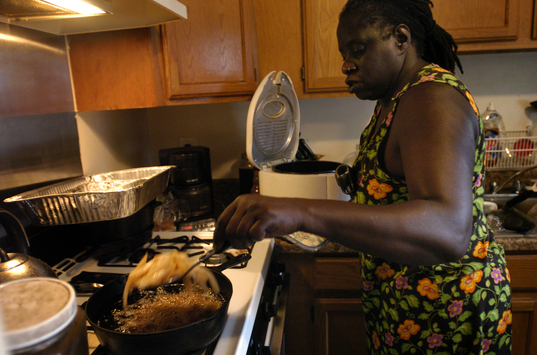
Betty Jean Jones transfers a spoonful of French fries to a cast-iron pan filled with oil after her electric fryer stopped working in her apartment at Hikone. Jones volunteers to help cook meals for children in the after-school program at the Hikone Community Center.
Melanie Maxwell | AnnArbor.com
For a few hours one day before school started in August, Mitchell Elementary School staff members canvassed an Ann Arbor mobile home park to make sure everyone was signed up and ready for school.
It seemed like a good idea at the time, but there was one glitch.
Despite signs that people were home like televisions and lights on, no one answered the door. Not one person. And no children were even playing outside.
The lack of response puzzled staff members until they remembered the demographics of the Ann Arbor elementary school, which has the highest percentage of students receiving free or reduced-price lunch in the district.
Most families wouldn't be able to afford to have a babysitter, nor could they afford to stay home themselves to keep an eye on the young children.
"Kids are told to stay in the house, keep the door locked," Principal Kathy Scarnecchia said. "Parents know they are home, locked in and pretty safe. They’ve got to do whatever it takes so the parents can keep the job. They were just hidden away."
The children are indicative of the larger hidden problem in Ann Arbor, a city generally considered affluent - despite nearly 25 percent of its residents classified as living in poverty.

They live in cooperatives and neighborhoods tucked along the city’s southern border, where traffic is light.
They live in public housing projects scattered across the city, well off the beaten path. Or they live in friends’ houses, sleeping in spare bedrooms or on futons in the basement.
The poor make up a hidden underclass in a city where nearly 40 percent of mortgage payments top $2,000 a month, 52.5 percent of renters report committing more than 35 percent of their income to rent and the average household income is above $70,000 a year.
But Ann Arbor's low-income underclass is starting to come out of hiding, due to an economy that has shed jobs and almost tripled the local unemployment rate since 2000.
“It’s creating more disparity," said Mary Jo Callan, Washtenaw County’s director of community development. "We are a community of haves … but we have a growing community of have-nots. The fabric of society is more strained.”
The rising tide
From his office window at Peace Neighborhood Center on North Maple Road, Bonnie Billups Jr., the center's director, could see a dumpster next to transitional housing the center was building earlier this year. Time and time again, he’d look out to see pickup trucks arriving to scavenge for metal or other scraps.
On his desk, Billups also could see the growing pile of requests for help.
“They are calling us more and more for help or calling other agencies and saying, ‘Can you help me pay my rent? Can you help me get some food? Help me get a tank of gas so I can get to work?'” he said.
Billups and his counterparts at agencies across the city are seeing a growing volume of requests for help from a growing population of city residents who are struggling.
The latest U.S. Census figures for 2008 show Ann Arbor experienced a significant jump in the number of people living in poverty. That figure climbed to more than 24 percent from around 16 percent the year before, said Reynolds Farley, the Dudley Duncan professor and research scientist at the University of Michigan's Institute for Social Research.
That means one in every four Ann Arbor residents qualifies as poor, according to the federal government.
Part of the reason, experts say, is that college students are counted in those figures, meaning many of U-M's nearly 42,000 students are classified as living in poverty.
"Ann Arbor has a very high poverty rate, but something like 70 percent of the poor people in Ann Arbor are college students, or are living in a home of someone enrolled in college," he said.
See University of Michigan Institute for Social Research scientist Reynolds Farley discuss the economics of poverty in Ann Arbor.
That includes traditional students supported by their parents who make little money on their own. But the statistics also include the single mother taking a class or two at Washtenaw Community College while trying to make a living and raise her kids.
A college town with a high poverty rate isn't surprising, Farley said.
"If you look at the cities that have the highest poverty rates in the United States, you get the places in the Rio Grande Valley where the Latino population is very poor, although the cost of living is low, but you also get State College, Penn.; Bloomington, Ind.; and Champaign, Ill."
But there's no doubt people here are living in poverty, he said. According to Census data, 5,000 to 8,000 Ann Arbor residents lived under the federal poverty line in 2007 and weren't attending college. Figures aren't yet available for 2008.
And it's clear the number of Ann Arbor residents living in poverty is skyrocketing, Farley said.
For example, Census data shows the number of people getting food stamps grew from 1,269 in 2005 to 2,078 in 2008, a number likely to keep growing, experts say. The poverty rate for children almost doubled from 2007 to 2008, according to Census data.
Derrick Miller, director of the Bryant Community Center in the southwest corner of Ann Arbor, said more people are struggling with poverty in Ann Arbor than even those numbers reflect.
“Not as many meet federal guidelines for being poor as in other places, but because the cost of living in Ann Arbor is so high, they are poor," Miller said. "Lots of people look good on the outside, but inside are really struggling.”
Rising poverty over the last 18 months has created two classes of poor in Ann Arbor - the traditional poor and the “new” poor, experts say.
The traditional poor

In the neighborhood where Aaron Pressel grew up, success was expected. Those who didn’t make it were an anomaly, said Pressel, director of the community center in Ann Arbor’s Hikone public housing.
For many trapped in poverty, the cycle spins the other way.
“You’re talking about generations of people who weren’t successful and come from a neighborhood where no one was successful," he said. "It would be unusual to be successful.”
Billups knows something about that. He grew up in poverty in Ann Arbor and was helped by programs at the Peace Neighborhood Center, which expanded his world and showed him a way out of poverty, he said.
If that doesn’t happen when children are young, it can be hard to break the generational cycle, he said.
With that in mind, many local community centers run after-school tutoring programs and take kids on field trips. They also help in other ways, like counseling kids on life issues.
“One thing we really try to avoid is teenage pregnancy,” Pressel said. “If you are a teen living in here already with your family, and you get pregnant, you’re screwed.”
LaTisha English spent several years of her childhood living in various Ann Arbor public housing apartments. Now 25, she uses food stamps and a couple other assistance programs to help make ends meet for her and her two sons, ages 5 and 3.
English said she started working various service industry jobs while in high school to help with rent and has been working those same jobs since.
"I'd like to go back to school and get a nursing degree," English said. "I just don't have the time. I'm too busy trying to make money. I just can't break even, let alone get ahead."
The new poor
Ann Arbor was long thought to be the oasis in a struggling state. Protected in large part by the economy built up around the University of Michigan, Ann Arbor’s unemployment rate seemed impervious to the conditions pummeling the rest of the state.
About two years ago, that changed.
The unemployment rate, which had hovered between 4 percent and 5.5 percent, began steadily climbing: to 6.4 percent, then 6.8 percent and 7.5 percent. In September, the unemployment rate in Ann Arbor was 9.9 percent, up from 6.9 percent the same month a year before. The state's unemployment rate in September was 15.3 percent.
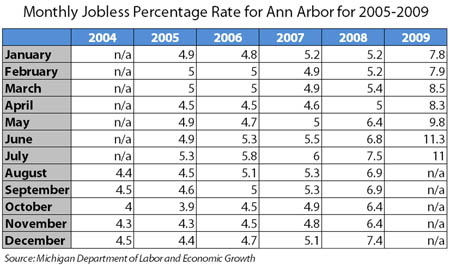
The overall size of Ann Arbor’s workforce, which averaged more than 65,000 people in the prior three years, dropped to about 63,785 in 2008. So far this year, the workforce has stayed between 60,000 and 62,000 people.
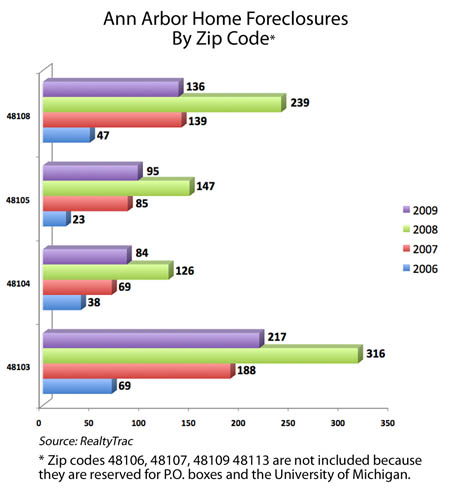
One of the leading indicators of financial struggles is tax delinquencies, said County Treasurer Catherine McClary. Delinquencies totaled $35 million in Washtenaw County last year, up from $32 million the year before.
When the sub-prime housing crisis first hit, it mainly affected the county’s eastern side, which has greater numbers of residents who are low-income and work blue collar jobs. The county expanded its services and public outreach efforts to people threatened with both tax and mortgage foreclosures, McClary said.
|
Delinquent Taxes • Average number of delinquent taxes in Washtenaw County since 1999 - 8,000 |
"But now that wave is over. Now we're seeing prime-rate mortgages, middle class people who at one time had good credit,” she said.
The tide has turned to residents in Salem and Webster townships, Saline and Ann Arbor. A typical scenario: Someone loses a job, can’t find another, misses a mortgage payment or two and can’t sell their home to relocate to a new job opportunity, McClary said.
Tom Moore, 47, is among the wave of new poor. Moore was employed in human resources his whole adult life for a variety of companies, and he, his wife and 15-year-old daughter lived a comfortable life in their Ann Arbor house. But last year, Moore was laid off.
"My wife wasn't working, but we were still making it," he said. "Then I got laid off, and we couldn't make it anymore. We're chewing through our savings just trying to make sure we don't lose the house, but if we don't get some income by the end of the year, we're going to be in trouble. I've stood in line for food stamps for the first time (in October). It's a hard thing to adjust to. I just can't imagine what it will be like if my wife or I can't find a job soon."
Ann Arbor's "new" poor is a growing problem mirrored across the state and nation, experts said.
"What is likely one of the reasons for this is more people who are just on the edge of poverty are sliding," said Sheldon Danziger, director of the University of Michigan's National Poverty Center. "You see increasing inequality in everything. From the high-tech computers people buy their 2-year-olds, when there are people who don't even have books in their houses."
 Hidden away
Finding the poor neighborhoods in Ann Arbor can be a challenge.
One of the poorest is off Stone School Road, tucked between Eisenhower and Ellsworth, south of I-94. Only about 4,000 cars a day travel past it.
“This side of I-94 is our other side of the tracks,” said Miller, whose community center is located in the middle of the neighborhood.
In Ann Arbor, there's a stigma tied to being poor, Billups and others said.
“There’s such a gap between the haves and have-nots,” Billups said. “That’s why you don’t see the poor in Ann Arbor. That’s why they’re hidden."
The stigma starts growing as soon as the fourth grade and really builds in middle school, said Fran Deering, director of Green Baxter's community center off Green Road on the city's north side.
“When you’re living in Ann Arbor, you want the help, but you don’t want to say, ‘Hey, I live in public housing,’” Deering said.
"(Poverty) is a very invisible problem," said Peri Stone-Palmquist, director of the Washtenaw Intermediate School District's Educational Project for Homeless Youth. "People live in the world they inhabit. When you walk around, you don't see it."
Public housing sites are scattered throughout the city. The Ann Arbor Housing Commission runs 355 low-income rental units in 67 buildings on 17 sites.
Those living in poverty are mostly concentrated in one area of town, as evidenced by the Ann Arbor school district’s reduced-price and free lunch program.
Four of the five elementary schools that had the highest percentage of students receiving free and reduced-price lunch last year are clustered in the southeast portion of town.
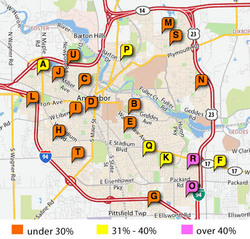
The highest rate belongs to Mitchell Elementary School. Scarnecchia anticipates the percentage of students who need help buying lunch will rise above 60 percent of her student body this year.
“We don’t get a lot of complaints about the food that’s being served," she said. "Our waste rates are really low.”
Public housing residents
Low-income residents in a place like Ann Arbor quickly learn the tricks to stretch a small budget and take advantage of local resources. They also sometimes hide income in order to get help from local agencies and the government.
Those in public housing say they scour the sales at local grocery stores or carpool to places as far as Detroit to find cheaper shopping.
Some residents have side jobs for money, like Betty Jean Jones. She lives in the Hikone public housing complex and repairs and sells computers. Each month, Jones gets along with the money she makes for her computer work, along with about $300 she gets in food stamps and a few hundred dollars she receives in child support payments.
“If I got a bill I’ve really got to pay, I’ll put up a couple computers for $100 a piece to make the bill,” she said.
Jones said it wouldn’t make sense to forgo the money she earns from selling computers in favor of a full- or part-time job because she’d likely lose her Medicaid insurance. With that insurance, she can visit the local Packard Health clinic for checkups after she had a stroke last year. Besides, she said, “I like the way I am doing things.”
During the summer months, she grows vegetables like beans, peppers, collard greens and okra in gardens tucked behind the housing project.
She lives in one of the nine family public housing sites the Ann Arbor Housing Commission operates in the city.
Those who live there generally fall into one of three categories, Pressel said: Either they're immigrants, they have large families or they're single mothers.
Judy Gardner, a CAN board member and resident of the Bryant community, sees two categories of people who live in public housing.
“You’ve got the poor living there temporarily to get a way up and the poor who want to stay poor,” she said.
Getting out of public housing can be a challenge.
“There’s an opportunity to go from Hikone (public housing) to (the) Bryant (neighborhood where people own houses or rent houses), but to go from Hikone to Burns Park is impossible,” Gardner said.
Some people will never leave public housing, said Joan Doughty, executive director of the Community Action Network, noting that some are trapped by a cognitive or other impairment.
"It's really a complex situation," Stone-Palmquist said. "All the families have different needs. There's not a one-size-fits-all answer."
Swamped
The growing poverty problem is threatening to overwhelm many local non-profit agencies.
Eileen Spring, the executive director of Food Gatherers, said her agency has seen a 35 percent increase in requests on average from agencies since last September.
“It’s not sustainable," she said.
Food Gatherers isn't the only local non-profit struggling. Callan said her office funds about 45 local non-profits. "They are all up 20 percent to 60 percent in demand," she said.
Those non-profits are seeing cuts from local governments, and private giving is struggling. That's a double-edged sword, those leaders said.
It's not just the non-profits being swamped. The increased demand makes getting help from government agencies tough. It can mean long lines and lots of frustration.
For instance, applying for a passport requires a two-page form. But applying for food assistance takes a 20-page booklet with more complex questioning, residents said.
Many who are eligible are denied help because of small errors on their paperwork, but never learn why they were turned down and therefore don't get any help, some residents and non-profit organization coordinators said.
At the local human services department, which resembles the waiting room of a doctor's or Secretary of State office, lines get long and tempers get short while people try to sort through the requirements.
Bins with all of the forms sit below poster-filled bulletin boards with messages about finding child care, prescription discounts, jobs and the process of getting food stamps, Medicaid and unemployment benefits.
Filling out paperwork for assistance can feel like a full-time job, many said.
"There is a need in this economy that's forcing families to struggle in ways they've never figured out before," Billups said.
And that struggling is starting to make its mark on the community, Callan said.
"People are desperate. They don't know where to turn to," Callan said. "And those places they are looking to for help are overwhelmed and underfunded. It's the perfect storm."
Comments
lbechard
Mon, Dec 21, 2009 : 9:36 a.m.
Thanks for reminding us that the poor suffer greatly not only this time of year but throughout the year and that more and more families are finding themselves amongst the ranks of the poor. The one compelling message we must learn is to urge our legislators whenever possible that no new taxes or fees can be levied to worsen the plight of the poor who feel the effects the most.
yadabuster
Wed, Nov 11, 2009 : 5:02 p.m.
I have known Betty Jean Jones for a number of years and to my knowledge she is a good person. However, she has been struggling for many years before the so called economic downturn. ( which I refer to as the economic attitude correction) I agree with others, this situation has nothing to do with the articles title. However, I am also very happy that she has "chosen" to make ends meet anyway she can so she can raise her family as a stay at home parent. Even as an fiscal conservative,I have no problem with single moms or dads doing so on my tax dollar if they are really raising their children and not at the casino's. We sorely need some real parenting today from single and dual parent households. Too many are working and ignoring their children. On the other hand, as someone else has said, I have for the last 25 years watched foreigners come here with nothing and who barely speak english create an envious lifestyle for themselves while Americans can't even figure out how to move out of their parents house. The only difference has been the will power to sacrifice. Wake Up America!!!!
An
Mon, Nov 9, 2009 : 4:58 p.m.
I do have a question. The article is titled "Struggles grow as job losses pull more Washtenaw County families into poverty" and yet you focus on Ms. Jones who has clearly been in poverty (apparently, somewhat by choice) for several years. How about some of the stories of people who just found themselves in poverty? Just a thought. It would be more in line with your title.
An
Mon, Nov 9, 2009 : 4:52 p.m.
@cinnabar - I depleted my savings, cashed in my 401 k and so far I have not taken any of your personal tax monies. (Oh wait, I did get unemployment, so I guess that might be YOUR money, but it also might be MY money or my brother's money, or my sister's money etc).
Arboriginal
Mon, Nov 9, 2009 : 1:31 p.m.
The deep fryer broke. Bummer.
cinnabar7071
Mon, Nov 9, 2009 : 1:28 p.m.
The money paid in is for people who need help, it's not insurance. If you have money in the bank and just don't want to spend it, thats your problem. I have savings and hate to dip into it when a problem comes up, but that is what my savings are for. I'm not talking retirement accounts were you would be penalized
An
Mon, Nov 9, 2009 : 1:10 p.m.
So because someone gets laid off they should have to take the financial hit of being penalized for dipping into their retirement funds? I doubt that the welfare office has thought to compensate for that but sure, you're right, all of us who have been laid off are lazy and stupid and obviously are just after YOUR money (forget the money that WE paid in before being laid off).
cinnabar7071
Mon, Nov 9, 2009 : 12:25 p.m.
"The government wants you to eat up your entire savings (checking, savings, retirement, etc.) before benefits will be awarded." Makes since to me, why do you feel you have a right to other peoples money, when you have your own. you are the reason so many people are down on the poor. Do you really feel it's fair to ask for help when you really don't need it?
An
Mon, Nov 9, 2009 : 11:16 a.m.
@Rosie - they also want you to sell your home and your car before they will help you. Great, so now where will people live. Oh yeah, and people are not BUYING houses right now...and if you could sell your house you would probably take a loss because of the economy. There need to be some programs for people like Rosie (and me and countless others left with a layoff and no health care).
Rosie
Mon, Nov 9, 2009 : 10:27 a.m.
I recently lost my job as a teacher due to cuts that were made BEFORE this school year began. Of course I also lost my health insurance and I had to wait some time before I could receive unemployment. I couldn't afford the COBRA coverage. When I finally did get unemployment that was it, unemployment and nothing else. I could not get any other type of assistance, no Medicaid, Adult Health Plan, or any other type of health insurance because the state and county insurance programs are maxed out and not accepting any new applicants. I can't afford to pay out of pocket because I just spent $30,000 of my own money on my master's degree. I am in a bit of a catch 22. There are not teaching jobs available and regardless of what happens in Lansing there will not be jobs available for teachers. I am over qualified for a number of jobs (many of which do not include health care, or are part time) and the remainder of the jobs are looking for someone with specific skills/certification such as nursing, physical therapy, special machine operations, etc. It doesn't matter if I have a master's degree if they are looking for someone with three years experience as a medical transcriptionist. It is true what was stated in the articles and posts about your benefits being less if you have any money in the bank. I could not receive any other assistance because I had some money in my checking account and because I had a few thousand in a retirement account. My caseworker at DHS told me that if that money was suddenly gone and I came in and verified the change in finances then I might be able to receive food stamps. The government wants you to eat up your entire savings (checking, savings, retirement, etc.) before benefits will be awarded. So I agree with what has been said about the difficulty of people being able to get ahead and out of the system. The only way I could get any type of health insurance would be if I was pregnant or disabled. Education is often touted as the way out of the system, but in my case lack of a job has gotten me stuck where I am right now. I know others that are in (or were in before they left the state) the same situation. I love Michigan, but I may have to look elsewhere.
notnecessary
Mon, Nov 9, 2009 : 12:29 a.m.
@Zulu - I'm wondering what these powers that be actually are. Part of the reason that I am skeptical about America's poor is due to those foreign born people who come here with nothing and make it into something. I'm a American-born person, but some of the foreign-born people I know are some of the hardest working people I know. Often when I look for inspiration in my life, to remind myself that I can do great things - I look at some of the foreign born people that I know who came to this country with nothing and built themselves a very decent life in a few short years. Instead of being envious of their success, I want to emulate it. Regarding Betty Jean herself, I do not know her and am attacking more of the attitude that is portrayed here in the article than her herself. She is not the only person that is content with being on government assistance. It's great that she volunteers her time. My only caveat is I wish she would work to get off government assistance AND find time to volunteer at Hikombe as well.
An
Sun, Nov 8, 2009 : 8:29 p.m.
@Jon, I am with you. We manage to pay our mortgage and taxes and not lose utilities and I have never made even close to that 70k a year. There are a lot of people with even tighter budgets, even people who work at U of M. $10/hr only gets you $20,800 a year.
Jon Saalberg
Sun, Nov 8, 2009 : 8:24 p.m.
...and the average household income is above $70,000 a year. I guess we're living on the proverbial shoestring budget, because we own a home less than a mile from downtown Ann Arbor, manage to pay our mortgage and taxes, somehow pay for food and clothing, yet have never made anywhere near this much in a good year - and this has not been a good year.
bunnyabbot
Sun, Nov 8, 2009 : 7:42 p.m.
MY COMMENT DID NOT CONTAIN A PERSONAL ATTACK! Yet it was removed! all I said was it would be nice to have a baby, but I am just not poor enough to have one on the governments dime (meaning the taxpayers, for which I am one)
Chris Blackstone
Sun, Nov 8, 2009 : 6:50 p.m.
I would love to see the elementary school free and reduced lunch stats overlaid with racial demographic data. For all of Ann Arbor's talk of diversity, the schools with the higher rates have a significantly greater minority population vs the other Ann Arbor schools. Data for 2008 is here http://a2schools.org/aaps.about/aaps.data/headcount_by_ethnic_group_by_school
sbbuilder
Sun, Nov 8, 2009 : 6:34 p.m.
Interesting how this article came hard on the heels of the failed millage vote earlier this week. Very difficult to ask marginalized people to give even more. Thing is, I'm not reffering to those on public assistance, but to those who actually have a mortgage to maintain in the face of an uncertain future.
KeepingItReal
Sun, Nov 8, 2009 : 5:51 p.m.
Xmo;drewblows;I don't Want a Nanny: First of all, I would like to thank you for voicing the opinions that you have. While I disagree with it, I think your thoughts are valuable to any conversation on this subject matter. I happen to know Betty Jean and her family. I've known them for years and I will tell you that Betty Jean and her family are no slouches. They have volunteered for numerous years in this community especially to the Hikone community. With that said, I would like to point out that there are many people in this community who are willng to work and earn their keep but for reasons, many of which has been elucidated, they cannot. Add this to the fact that, many native born individuals are competing with individuals who arrive her with little education or not much more than our citizens. Yet, these individuals find a much more receptive community toward getting them started and on their feet. There are individuals that come to these shores and within no time are able to purchase a party store with a liquor license. There are individuals right here in our community that will never be able to purchase a liquor license to open a party store because the liquor control commission will not grant them a license not to mention that these licenses are very expensive. I can cite you numerous instances where non-citizens are granted all kinds of advantages and access to our system that are not opened to our citizens. When we began to get serious about making sure that our citizens are afforded opportunties, ie., education, jobs and entrepreneurship opportunties, then we can hold them accountable for being sluches. I agree, however, that there are many indiviudals who prefer to do nothing and perhaps these individuals should be dealt with differently. But, let's not punish people like Betty Jean who do make contributions to their community.
An
Sun, Nov 8, 2009 : 5:23 p.m.
Some of the attitudes here remind me of Jonathan Swift's "A Modest Proposal" (this is satirical, so if you follow this link, do not be offended or appalled. It does show, however, that issues of the poor have been around for a long time. This story goes back to the 1700's.) http://art-bin.com/art/omodest.html
lifeisgood
Sun, Nov 8, 2009 : 4:59 p.m.
http://www.frc.msu.edu/caring-for-children/childcare/when-can-children-be-left-alone/
Ryan J. Stanton
Sun, Nov 8, 2009 : 4:55 p.m.
Lots of statistics here, but I think these two were quite telling: "For example, Census data shows the number of people getting food stamps grew from 1,269 in 2005 to 2,078 in 2008, a number likely to keep growing, experts say. The poverty rate for children almost doubled from 2007 to 2008, according to Census data."
YpsiLivin
Sun, Nov 8, 2009 : 4:39 p.m.
Lifeisgood, Michigan has no laws that address the legality of leaving children home alone. In other words, there is no legally established minimum age at which children may be left without adult supervision, and no guidance on how long children may be left alone. Calling in CPS would do little good; parents of teenagers might well tell their children not to answer the door while the parents are away. Is that still a matter for CPS? Probably not. Leaving children alone so parents can work is hardly a new phenomenon. Many World War II-era mothers left their young children home alone while they worked to support their families.
David Jesse
Sun, Nov 8, 2009 : 4:24 p.m.
Just a quick note on the school staff - they were theorizing that's what was going on.
David Briegel
Sun, Nov 8, 2009 : 4:10 p.m.
OMG, don't you dare tell these "right to lifers" that there are too many kids. NO SIREE! And don't you dare talk of Mental Health. America won't even provide health care much less mental health care. Poverty and the stupid bureaucratic rules put in place by the "compassionate conservatives" just beat you down and beat you down again. There has been so much written about these subjects that it is mind numbing to hear the ignorance spewed on these posts. If only we were a civilized society with compassion, tolerance and humanity that we could direct to our fellow citizens in need.
YpsiLivin
Sun, Nov 8, 2009 : 4:04 p.m.
Dotdash, Research done by Elizabeth Warren at Harvard shows that the single best predictor of bankruptcy among middle class families is having children; it is a huge destabilizer, whether you're married or not. http://www.news.harvard.edu/gazette/2003/10.30/19-bankruptcy.html Ironically, one of the drivers of middle class bankruptcies is selecting neighborhoods in pursuit of "good" schools. (But you and I won't go there, will we?) :) If you haven't read the book "The Two-Income Trap: Why Middle-Class Mothers and Fathers Are Going Broke" I highly recommend it.
I_love_ann_arbor
Sun, Nov 8, 2009 : 4:01 p.m.
How about the residents of public housing sites that have community centers hire the actual residents instead of hiring persons who have no true connection to the neighborhood. Consider that many of the poor in Ann arbor live in public housing. Many of the community centers receive money through federal grants to employ people. Thank you to Ms. Betty Jean Jones for all of her work throughout the years in the Hikone Community. She is a true example of a volunteer. drewblows.....perfect name, my friend! Do you even know Ms. Jones? Do you volunteer your time and energy to any cause?? If you don't actually now her, then don't act like you do.
notnecessary
Sun, Nov 8, 2009 : 3:53 p.m.
@lifeisgood - I really know not of what sort of experiences you are referring to. Bad things happen when kids are alone, when they're being "watched" by a 15 y/o babysitter who's txting away, or when they are with their parents. Want to make a poor person's life that much worse? Take away their kids. Or better yet, just put them through administrative hell with the CPS so they'll have to deal with that and probably lose their jobs due to time off. The parents have obviously taught them some good skills - they didn't answer the door for the school officials.
notnecessary
Sun, Nov 8, 2009 : 3:29 p.m.
@lifeisgood - you really want to have CPS harrassing all these people? So far in this thread I've been critical of some of the people in this story. But those people that are actually out there working and need to leave their kids behind? Don't harass them. This story doesn't give any data on how old the children were. Are they really that much off better with some smoking, don't give a damn $7.50 /hr babysitter than they are just by themselves for a few hours during the day?
dotdash
Sun, Nov 8, 2009 : 2:44 p.m.
The elephant in the room here is single parenting. When you have small kids, it only makes sense to work if you can make more than a babysitter costs you (or you have a *very* long term view). It just takes more than one person to make child-rearing and income generation work. It doesn't have to be a married couple; it could be a mom and grandmom, or two friends sharing childcare and income, or some other less orthodox relationship. But all these stories simply underscore how hard it is to make a living and raise kids on your own. I wish wish wish that there was some way to impress this fact upon kids before they get pregnant and young couples before they get divorced. We have too many kids raised in poverty because they only have one parent to do the work of two.
lifeisgood
Sun, Nov 8, 2009 : 2:26 p.m.
I can't believe that many children are being left alone! If this was school staff canvassing the area, were CPS reports made? These people should know they are responsible to do so. Please do not leave your kids alone.
MjC
Sun, Nov 8, 2009 : 2:20 p.m.
This is an excellent story and AnnArbor.com should be applauded for covering a topic clearly some the bloggers can't seem to comprehend. My heart goes out to everyone during these very difficult financial times - especially the children.
Janelle Baranowski
Sun, Nov 8, 2009 : 2:20 p.m.
@An- Kudos for your hard work and success. Your story serves as an inspiration to others; you would make a wonderful mentor for others looking to escape the cycle. I can understand where "Nanny" is coming from though. It's frustrating when you hear of people abusing the system. There would be more funds for those who truly need it if abuse was eliminated. Tina Reed is correct. However, in the case of Jones, I don't think this is the case. Her ability to repair/restore computers indicates that she has enough technical skills to secure a good position (some education or training may be required, but there are programs for that.) This is a classic example of why people develop such harsh stances on public assistance. Janelle www.some-other-viewpoint.blogspot.com
notnecessary
Sun, Nov 8, 2009 : 1:59 p.m.
@sh1 - I've never read that quote before (I need to read more Dickens), but I like it.
notnecessary
Sun, Nov 8, 2009 : 1:58 p.m.
@TinaReed - You bring up a good point. It highlights a huge problem. If they do find that poor job that cannot support all their needs, they will lose their government benefits. If they never take the entry level postion, they can never advance to a higher position. Ideally, we should get people off government assistance gradually. If they get that low paying job, make their wages+assistance=their current assistance. If they refuse to get a job, then their government assistance should be cut off. If the problem is mental illness, we should be treating the mental illness not giving them free money. If they can fill out the 20 pages for food stamps and have enough capacity to sit through all the lines, etc, to get government assistance, can't they find a job?
sh1
Sun, Nov 8, 2009 : 1:45 p.m.
Nanny, you're POV sounded a bit familiar. I found it: "If he be like to die, he had better do it, and decrease the surplus population." --E. Scrooge
Tina Reed
Sun, Nov 8, 2009 : 1:40 p.m.
Part of the problem that many residents discussed was the lack of jobs available out there that would cover the health care, rent and food expense that government programs cover. It's a catch-22 that if you get a job, but it's not a very good one, it might not help your financial situation, they said. Residents and local experts also pointed out that many people have mental health or other health issues that make it hard for some to get and hold jobs to cover all of those expenses.
notnecessary
Sun, Nov 8, 2009 : 1:23 p.m.
Sentence all the poor to death? If they are willing to die because of their unwillingness to do anything for themselves then I can't help them. It's all about attitude towards work and life. This article does a good job of stating that - if you grow up in an affluent neighborhood then attitude is that you can't fail. If you grow up in Hicombe, then it's ok (and almost expected) to fail. However, this community attitude is not an excuse for an individual. The individual needs to live up to their responsibilities for themselves. There are charities for unexpectant bumps in the road of life. Sometimes life sucks because you're poor. That's only motivation to work and try a little bit harder to get ahead. Screw the naysayers and do what's best for yourself. If you're not willing to help yourself, then I have absolutely no interest in helping you either.
An
Sun, Nov 8, 2009 : 1:16 p.m.
1. I have been there and I did it honestly and we were unable to pay both rent and gas/electric. So NO you cannot SUSTAIN. I wasn't thrilled with her attitude but I am also not willing to judge. Hows about we just sentence all poor to death?
notnecessary
Sun, Nov 8, 2009 : 1:14 p.m.
@An - Nobody gets rich off welfare - you're right.However, you can live sufficiently live off it. Sufficiently live off the tax money that is forcefully taken from me. There should be much stricter laws regarding government assistance and length of time on it. I don't want to be supporting someone who is content with the situation that I am helping them. If you fall on some bad luck, need some assistance for a little bit, ok, fine. If you are content with the situation of needing assistance to be able to provide the basics for yourself, then I am not content with helping you.
ypsidog
Sun, Nov 8, 2009 : 1:11 p.m.
To XMO: This woman is a hard working person that is giving back to her community through volunteerism. Giving of ones time is far more difficult than giving ones money. You may want to count up your volunteer hours for 2009, I'll bet they can't come close to what this wonam has done.
An
Sun, Nov 8, 2009 : 1:01 p.m.
I wish that I was in the financial situation I would need to be in order to get out of hypocritical Ann Arbor where the residents like to pretend they are socially conscious but really they are all a bunch of really judgmental people. NO ONE gets rich off welfare, or Social Security or Disability.
notnecessary
Sun, Nov 8, 2009 : 12:35 p.m.
People like Betty Jean Jones are why I do not feel bad for most poor people. Rather get food stamps and hustle computers on the side than actually work. It's not about the health care benefits - like a previous commenter said, I doubt too if she'd even work if given health benefits at a job. What's my basis for that? To quote the article: "Besides, she said, 'I like the way I am doing things.' " I don't like the way my tax money is being handled, given to help people like this.
drewblows
Sun, Nov 8, 2009 : 12:28 p.m.
So the featured lady of this article doesnt want to get a full time job becuase she maight lose her Medicaid? What if that full time job came with medical coverage? I am willing to bet she still wouldnt take it. By the way her little side hustle with the computers is illeagal if she is not reporting that income. That money should be counted towards her food stamps, medicaid and subsidized housing. This article did not cause me to have empathy for this lady; it had the opposite effect. She basically admitted she doesnt want better for herself. She would rather suckel from the teat of public assistance.
An
Sun, Nov 8, 2009 : 11:17 a.m.
xmo, I am willing to bet you know nothing about being poor. I, for the record, am one of the lucky ones. I lived in public housing, here in Ann Arbor for 7 years. During that time I worked full time and went to school to get my BS. I then went on to a very good job and I was able to purchase a home through Habitat for Humanity (they are NOT free. There is a mortgage, albeit an interest free mortgage). I am a public housing success story, but, the "system" does make it hard to get out of it. Shame one you, in these rough economic times, for being so smug about your apparent fortunate and wealthy situation that you feel it is ok to be caustic and sarcastic towards those less fortunate than you.
xmo
Sun, Nov 8, 2009 : 8:37 a.m.
Lets embrace this new lifestyle. It is saving the planet. The poor are such noble creatures giving up so much for us. We at least have Hope and Change!