

Study of runway expansion at Ann Arbor airport nears completion with $42.5K contract approval
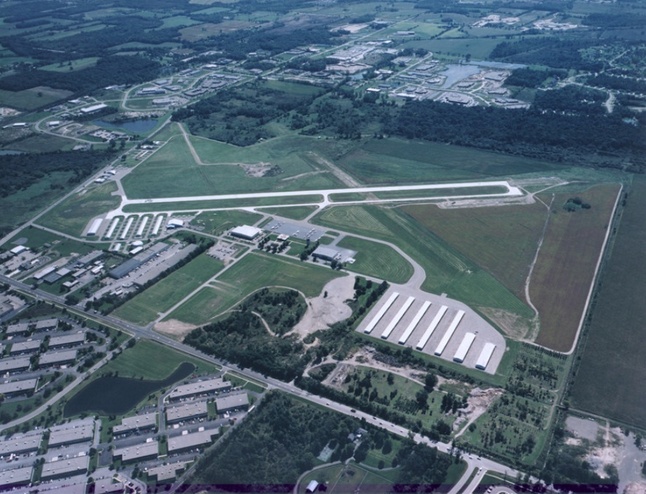
The Ann Arbor Municipal Airport is located just south of the city limits near Ellsworth and State roads in Pittsfield Township. Some nearby residents oppose the proposed runway extension.
The City Council voted 6-3 to approve a $42,500 grant contract with the Michigan Department of Transportation's Office of Aeronautics for work related to the ongoing environmental assessment.
That will cover a reimbursement agreement with the Federal Aviation Administration for completion of the environmental assessment for the project. Specifically, the FAA will review the impacts the proposed runway changes might have on federally owned navigational systems at the airport.
Council Members Jane Lumm, Stephen Kunselman and Sabra Briere voted against going forward with the work, questioning the expense.
Margie Teall and Marcia Higgins were absent.
"I do feel that whether it's city money or not, at what point do we stop wasting money — regardless of whose it is — on a project with very little chance of going forward?" Lumm asked. "I thought we were at that point in April when this last came before us, and I feel the same way today."
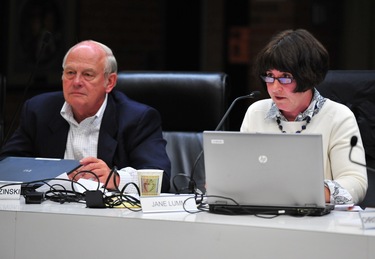
Council Member Jane Lumm said she wants to know when the city is going to put a stop to spending money on a runway expansion project she doesn't think will happen.
Ryan J. Stanton | AnnArbor.com
Kulhanek said the latest expenditure is comprised of $40,375 in federal funds, $1,062 in state funds and $1,063 in airport matching funds.
The airport's share of the grant is included in its current operating budget, and all funding — state, federal and local — will come from fees paid by users of aviation industry services, Kulhanek said.
"The requested action in no way approves any construction or bidding to make any changes to the runway," Kulhanek also told council members.
The environmental assessment process is a requirement of the FAA and MDOT-Aero, which regulates aviation activities at the Ann Arbor airport. Kulhanek said it's a highly regulated process dictated by the National Environmental Policy Act and includes a significant public input process.
Following Monday night's action by council, Kulhanek said it could take six months for the FAA to do a final review and sign off on the environmental assessment. After that, he said, a proposal to go forward with actually designing a runway extension could come back to the City Council for consideration.
Mayor John Hieftje asked if the city would be gaining any information from the work approved Monday night that would be useful even if the city doesn't extend the runway.
Kulhanek said it's important to complete the environmental assessment so the city can have a documented assessment of the potential impacts of any runway changes, which allows for an informed decision on whether to consider the project. He said the FAA, MDOT and the city have invested considerable resources into making sure the final product is an accurate and complete assessment.
"Do we get to the end of this process after this?" Hieftje said, getting a chuckle from Kulhanek, who assured the mayor it would complete the environmental assessment.
The debate over the proposed runway extension — which is billed by proponents as a safety improvement — has been ongoing for at least the last few years.
Pittsfield Township resident Andy McGill showed up to Monday night's meeting to speak on behalf of a grassroots citizens group opposed to extending the runway near their subdivision.
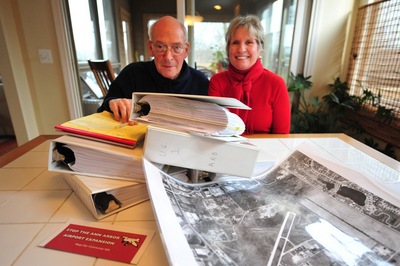
Andy McGill and Kathe Wunderlich pose inside their Pittsfield Township home in 2010 with a large stack of airport records they have obtained while fighting the proposed runway expansion at the Ann Arbor Municipal Airport.
Ryan J. Stanton | AnnArbor.com
Airport officials say the extension reduces the likelihood of overruns, or cases where pilots go beyond the limits of the current 3,500-foot runway.
Council Member Carsten Hohnke, a pilot who says he's used the Ann Arbor airport many times, said the safety data he's seen hasn't convinced him there's any need for a runway extension, but he can see why the runway might need to be shifted away from State Road at some point in the future.
"I think given the opportunity we have here for expending a very reasonable amount of funds to provide the option of understanding how to shift the runway — if that ever becomes necessary and prudent for the city — that it's a wise investment," he said before voting in favor of the study work.
McGill called the nearly $400,000 spent on the environmental assessment to date "staggering." He said it was $100,000 more than what council members were told three and a half years ago.
"The airport EA has become a money pit for taxpayers — federal, state and local," he said, suggesting the FAA isn't exactly enthused about the project, either. "Do you think the FAA might be trying to send you a message in delaying this EA longer than any other in its recent history?"
Since there are federally owned navigational aids — specifically an omni-directional approach lighting system — at the end of the runway, the FAA needs to determine if the system needs to be shifted and what impacts that may have, Kulhanek said.
It originally was anticipated that work would be done as part of the FAA's earlier review of the draft environmental assessment, he acknowledged. But when the FAA-Great Lakes Region Office determined it would not need to sign off on the EA, the work was not undertaken, Kulhanek said.
But then FAA Technical Operations notified the city in April that it would need to complete the navigational aid review under a reimbursement agreement. "There are two federally owned navigational aid systems at the airport and those will both be impacted by the proposed runway safety extension project," Kulhanek said. "What they're doing is taking a look at those two systems and making a determination on how those may be impacted if the project moves forward."
McGill said he didn't have a problem with the council's approval of paying to have the FAA review the final environmental assessment. More troublesome, he said, is the provision to have the FAA study the navigational aids, or approach lighting, related to the proposed runway extension.
"You are actually giving the FAA a blank check from the city of Ann Arbor," he told council members. "Because one condition of that FAA grant contract says Ann Arbor taxpayers must pay to move or replace the navigational lighting — the runway approach lights — long into the future."
McGill estimated that could cost city taxpayers hundreds of thousands of dollars and asked council members: Is that a line you want to cross?
"Do you think it's time to end this thing?" he said.
Briere asked Kulhanek to describe the source of the $1,063 local match the city put up Monday night. He said it doesn't involve tax dollars, but rather revenue from airport hangar rentals and fuel fees.
"That's where these fees for all of these local matches have come from through this entire project," Kulhanek said.
Council Member Mike Anglin, D-5th Ward, asked how many jobs are supported by the airport. Kulhanek estimated about 75 to 100, including three full-time city employees, more than 20 FAA employees at the control tower and dozens of others who work at various private businesses at the airport.
Lumm said she's spoken with someone who has reviewed three decades worth of accident reports at the airport and determined not a single one was due to the length of the runway.
"They were all mechanical and pilot error," she said, acknowledging there have been nine fatalities over the years. She said she feared a runway extension could exacerbate problems, though.
"I don't feel this expansion will materialize," she said.
Responding to questions posed by Lumm, Kulhanek estimated there are about 170 total aircraft at the airport right now, about 60 percent of which are single-engine planes. McGill's group has claimed airport officials are using the runway expansion to position the airport to accept aircraft weighing 40,000 pounds — twice the current limit.
Ryan J. Stanton covers government and politics for AnnArbor.com. Reach him at ryanstanton@annarbor.com or 734-623-2529. You also can follow him on Twitter or subscribe to AnnArbor.com's email newsletters.
Comments
A2Realilty
Fri, Aug 24, 2012 : 2:32 a.m.
It seems like most of the posters commenting on this article are mostly focused on the glee of seeing homeowners in Stonebridge get screwed by louder air traffic. I've seen no comments on the true financial impact of increasing the length of the runway. I doubt that increasing the runway would make the airport generate positive net revenue. At this point, the airport is a money sink for the city. Willow Run provides better service and is 10-15 minutes away from the Ann Arbor Airport. Literally, Ann Arbor would MAKE money by having the Ann Arbor Airport close at this point.
RUKiddingMe
Wed, Aug 22, 2012 : 8:06 p.m.
"I do feel that whether it's city money or not, at what point do we stop wasting money — regardless of whose it is — on a project with very little chance of going forward?" We need more people who ask questions like this. Hang in there, Ms. Lumm. Hopefully we'll get a couple more like you in there soon.
Dog Guy
Wed, Aug 22, 2012 : 7:33 p.m.
About 25 years ago a very worn-out Lockheed Loadstar landed at Ann Arbor Airport after tower hours. A number of duffle bags were unloaded and everyone drove away, abandoning the airplane. Anti-airport Luddites should reconsider their stance that this airport is of no benefit to typical Ann Arborites.
timjbd
Wed, Aug 22, 2012 : 7:54 p.m.
You can't have a war on drugs without the drugs!
Brad
Wed, Aug 22, 2012 : 6:48 p.m.
"Margie Teall and Marcia Higgins were absent." They'd just vote against my interests again anyway.
Sparty
Wed, Aug 22, 2012 : 9:53 p.m.
Please let the recount of Jack Eaton be successful and find Margie Teall a way out of her seat ....
Basic Bob
Wed, Aug 22, 2012 : 3:45 p.m.
Do your homework, people. There will never be passenger or cargo service at our little airport. This airport will only be used by hobbyists and small private jets. The point of the runway expansion is to allow slightly larger private jets to safely land here. Big planes will still need to go to Willow Run. Although the airport is in Pittsfield, they have little say in what the owner (Ann Arbor) wants to do with it. It has been an airport for a long time, when Stonebridge was still a quarry. Besides, Pittsfield's supervisor has thrown the Stonebridge folks under the bus so she can get that boulevard built right to her neighborhood (but not as far as US-12). She needs the runway moved, and that will only happen if she permits the expansion. The master plan is somewhat vague on this, unless you have a PhD in Urban Planning and a pack of consultants and lawyers on retainer. Soon we will have jets zooming over Stonebridge and voters only have themselves to blame.
jcj
Wed, Aug 22, 2012 : 8:50 p.m.
Too bad a2.com could not spend 30 minutes to provide more information on the largest type of aircraft that can land on the proposed runway!
jcj
Wed, Aug 22, 2012 : 8:47 p.m.
Based on my quick research on the size of aircraft that can use a 4300 ft runway. Your comment is THE one that is spot on.
G. Orwell
Wed, Aug 22, 2012 : 3:36 p.m.
Why do politicians allow their underlings to lie and get away with it? Don't they have any integrity? It is obvious the proposed runway extension is not for safety reasons. It is to allow much larger planes to land and take off. Does Kulhenak think the city council are bunch of idiots?
Sparty
Wed, Aug 22, 2012 : 9:50 p.m.
And aren't they, for the most part ? ROFL (Sorry Jane Lumm, you are the exception).
timjbd
Wed, Aug 22, 2012 : 3:25 p.m.
I'd MUCH rather see all this money go toward getting the new train depot up and running. Anyone can take the train into, out of, town. Freight can move in and out. Commerce can take place. Only people with personal planes can fly into that airport. Money spent on expanding the airport ONLY benefits people who own planes. That's only about, what? 1% of the population?
jcj
Wed, Aug 22, 2012 : 1:21 p.m.
As for those of you that moved into neighborhoods near the airport. Please list for us the airports that have reduced in size in the last 50 years.
sellers
Thu, Aug 23, 2012 : 1:30 p.m.
The Saline airfiled (not really a port) did shut down, as did tones of the grass runway airports across the nation. These were often run by one person or a local group, not really government.
salinemom2712
Wed, Aug 22, 2012 : 9:15 p.m.
Saline Airport -closed!
jcj
Wed, Aug 22, 2012 : 8:45 p.m.
Brad I suppose if you had asked anyone 30 years ago what the chances were that the airport would increase in size and use. The overwhelming answer would have been the chances were good that it would increase in size and use. mixmaster I would comment regardless. But would not be affected regardless.
mixmaster
Wed, Aug 22, 2012 : 6:01 p.m.
I don't suppose you'd have a comment if the airport eventually closed due to higher fuels costs and less use by hobby pilots, essentially rendering it useless.
Joe Hood
Wed, Aug 22, 2012 : 5:11 p.m.
a2doc: Ever watched RC planes and note the increased use of lithium based batteries?
a2doc
Wed, Aug 22, 2012 : 3:50 p.m.
Kalamazoo. Poor financial viability lead to diversification into the Airzoo. An excellent counter question is: do we think the use of small planes will expand over the next 20 years with the increasing cost of fuel). The use of the Ann Arbor airport has shrunk over the last decade.
PrevoTownie
Wed, Aug 22, 2012 : 2:55 p.m.
Because the first thing that would have popped into my mind if purchasing a house at the end of a runway would have been "wonder how long before this airport gets bigger?"
Brad
Wed, Aug 22, 2012 : 1:56 p.m.
And that matters why?
jcj
Wed, Aug 22, 2012 : 1:19 p.m.
One of the biggest problem with local politicians is the availability of Gov grants. They think the money comes from some magic money tree in the cosmos! It a grant is available they will apply whether the project needs to go forward or not. The availability of a grant is often the deciding criteria as to the worth of a project.
annarboral
Wed, Aug 22, 2012 : 1:16 p.m.
The study should concude that the airport will be closed and the land turned into a green belt park that everyone can enjoy not just the handful of ELITES with airplanes. The airplanes should be at Willow Run anyway. Pittsfiled Township will never allow expansion. Note that the Ann Arbor Airport is totally surrounded by Pittsfiled Township. The airport is also a safety hazard and a noise polluter. Good riddance!!!!
djacks24
Wed, Aug 22, 2012 : 7:33 p.m.
"The airplanes should be at Willow Run anyway." "The airport is also a safety hazard and a noise polluter." So what would you say to folks that live around Willow Run? Let us have all the noise and pollution so you can have your little green utopia?
PrevoTownie
Wed, Aug 22, 2012 : 2:58 p.m.
Note - from the article the airport "is" in Pittsfield Twp. Also the Twp. Has plenty of park land, some of it still needs to be developed.
mixmaster
Wed, Aug 22, 2012 : 2:52 p.m.
So, by your "reasoning", sellers, because the airport was there before SOME of the houses, it has fisrt dibs and the expansion is a good thing. Wrong on both counts. Airports are more important than people? And airport expansion should ignore the nearby residents? Wrong again.
sellers
Wed, Aug 22, 2012 : 1:35 p.m.
The airpot was there long before most of the houses were there.
conairaa
Wed, Aug 22, 2012 : 1:13 p.m.
Expanding a runway so close to houses, business, and a major north/south thoroughfare just doesn't make sense. Let the bigger planes continue to use Willow Run.
newsboy
Wed, Aug 22, 2012 : 1:12 p.m.
Air travel is just too dangerous and has never led to economic development of a city. If man was meant to fly Darwin would have given him wings! What a waste of tax dollars, a better use would be park land for the residents of Pittsfield Twp...
xmo
Wed, Aug 22, 2012 : 1:08 p.m.
This is an excellent example of "GREEN LAWS" costing us lots of money and not doing much! $400, 000.00 for an environmental impact statement? We could have fed the hungry or given shelter to the homeless, instead the "GREEN PEOPLE" made us waste our money on this!
mixmaster
Wed, Aug 22, 2012 : 5:41 p.m.
Same trick, different day.
bobslowson
Wed, Aug 22, 2012 : 4:57 p.m.
Two tricks if you include some anti Obama rhetoric!
mixmaster
Wed, Aug 22, 2012 : 2:56 p.m.
One trick pony
WWBoDo
Wed, Aug 22, 2012 : 1:01 p.m.
Get rid of the airport and use Willow Run. Don't tell me that the AA Airport is an essential economic engine of Ann Arbor.
sellers
Wed, Aug 22, 2012 : 1:33 p.m.
Willow Run is run by Wayne Co since U-M sold it, and thus jurisdiction would fall out of local control.
Joe Hood
Wed, Aug 22, 2012 : 12:59 p.m.
Wasn't there just recently an article about the new U-M helicopters where they have to keep their fixed wing aircraft in Livingston County, because the runway here is too small? Ann Arbor airport is a lot closer to U-M Hospital than the airport in Livingston County.
aamom
Wed, Aug 22, 2012 : 4:53 p.m.
If UM feels they really need it then they should pay for it.
sellers
Wed, Aug 22, 2012 : 1:33 p.m.
Willow Run is a bit away too.
WWBoDo
Wed, Aug 22, 2012 : 1:09 p.m.
Willow Run! Why not use Willow Run Airport?
jcj
Wed, Aug 22, 2012 : 12:59 p.m.
Would someone please inform us as to what is the largest aircraft that would be able to use the proposed longer runway? In aircraft model and passenger capabilities? It does most of us little good to give the weight. Does anyone know what the max payload of a5 passenger Cessna is? A CITATION XLS , LEARJET 60? How many passengers?
red9seven
Wed, Aug 22, 2012 : 12:52 p.m.
I have not heard of any discussion about how this may improve UofM's fixed wing emergency medical flights. Right now they must travel to an airport on the far edge of Howell because the AA airport is too small for their aircraft. Would an expansion of the AA airport allow them to be a lot closer to the UofM Medical facilities? Is there a life-saving aspect of this that has not been discussed?
JimmyD
Wed, Aug 22, 2012 : 6:57 p.m.
The med-flight folks may still use AA, but a few years ago they had a Cessna jet over-run the runway.
a2doc
Wed, Aug 22, 2012 : 3:46 p.m.
They prefer to use Willow run.. It is safer. It has a 24 hour control tower, and a massive selection of runways accommodating any sized aircraft. Nothing life saving, thank God - except for the aircrew.
mixmaster
Wed, Aug 22, 2012 : 12:17 p.m.
Teall and Higgins absent? Why am I not surprised. The runway expansion is all about Dave Brandon's buddies who sit in the high roller sky boxes at his Big House. They fly into town and fly right out again.
Tom Todd
Wed, Aug 22, 2012 : 9:49 p.m.
But Dave Brandon is rich and they are allowed to do whatever they want because they might start a business also when someone who decides to fly over to low and crash into my roof they will need to call 911 to protect themselves from me.
Brad
Wed, Aug 22, 2012 : 1:54 p.m.
Next up - AATA charter flights to the AA airport. As usual, the taxpayers will foot 80%+ of the bill.
Ron Granger
Wed, Aug 22, 2012 : 12:38 p.m.
I think you are right. That is a lot of it. They want to do larger charters to football games, etc. And they want us to pay for it.
Steve Hendel
Wed, Aug 22, 2012 : 12:16 p.m.
What an incredible waste of everyone's money! The issue of airport expansion, like a bad penny, just keeps turning up. There are 170 aircraft (mostly, I would guess, used for recreational purposes) based at the airport, and for them the City employs three people PLUS the FAA control tower employs @ 20
Swordsman
Wed, Aug 22, 2012 : 12:16 p.m.
I think the real purpose is to position the airport to shift the runway when they decide to widen S State St, which will happen eventually as it is already far overcapacity in that area. This EA would support that and any other airport improvements in the future, so it's unlikely to be wasted $. But I have zero sympathy for those living near the airport - you know what you were getting into when you bought, sorry.
djacks24
Wed, Aug 22, 2012 : 7:21 p.m.
I'm in Willow Run airports flight path. I knew it when I bought the house. I'm fine with it. It would get pretty annoying if they had flights flying in and out every couple minutes like Metro does, but they are from from that. I like seeing the planes come in on approach and I get to see the occasional fighter jet from time to time. I wouldn't have it any other way. I think you people that live near the airport are overreacting. AA airport has a loooong way to go before it becomes something like Metro like you are envisioning. As a matter of fact I think they are pretty land locked for it even to become really noticeably larger. So quit whining!
Unusual Suspect
Wed, Aug 22, 2012 : 2:06 p.m.
No, the analogy would be if you have a 4 lane expressway in front of your house and then complained that they want to add a carpool lane. The mindset that once you buy a house the rest of the world must stop is naive.
WWBoDo
Wed, Aug 22, 2012 : 1:07 p.m.
We are not looking for sympathy--only that AA does not do something stupid, unreasonable. Why do you need the airport with Willow Run less than 20 minutes away? To take your argument, if you have a paved road in front of your house, you should not be able to object if the City decided to widen it to four lanes so that more heavier traffic can safely use your street. Get real.
Elijah Shalis
Wed, Aug 22, 2012 : 12:07 p.m.
I say expand away until it is big enough for 747s. If the people that live near it don't like planes they shouldn't have moved nearby.
kraiford12
Fri, Sep 7, 2012 : 7:16 p.m.
What Rod said, he never responds... trolls hardly do
Rod Johnson
Wed, Aug 22, 2012 : 2:59 p.m.
Don't feed the troll, people.
sellers
Wed, Aug 22, 2012 : 12:36 p.m.
No, I think the comment was you knew there was an airport there, why would you assume it would never change? While I think it would be a bummer to those folks who live nearby - I have to say you should have expected something like this would happen. Cavet Emptor
mixmaster
Wed, Aug 22, 2012 : 12:23 p.m.
So you're suggesting that the people who are already affected by the existing small, light low flying aircraft should now be subject to 747's? And they get to help pay for the increase in noise and danger? Don't they already have to deal with the existing conditions and isn't that enough? That's mighty neighborly of you.
outdoor6709
Wed, Aug 22, 2012 : 12:06 p.m.
Mr Stanton, could you give us an idea of what a 40,000 # airplane is? 9 passenger Folker, 727?
ChrisW
Wed, Aug 22, 2012 : 2:26 p.m.
Jet specifications: http://www.meridian.aero/index.php?page=jetComparison#jetComparison
a2grateful
Wed, Aug 22, 2012 : 12:05 p.m.
It's just another step in the runway expansion. . . The expanded runway affects the ENTIRE city, as it is under the fight path. . . Hopefully, everyone in Ann Arbor loves the sound of low-flying, big jets. . .
Benjammin
Thu, Aug 23, 2012 : 7:23 p.m.
No - the main (paved) runway flight path does not go over the center of the city.
Ron Granger
Wed, Aug 22, 2012 : 12:04 p.m.
The taxpayers of Ann Arbor are in the airport business? Who knew! How much do we make from this business of ours? Where do the profits go? It sure would be nice if there was a clear summary of the finances of this business. Should there be more profits, or are we doing this as more of a hobby? I'll bet the well-healed folk who own planes love it.
Sparty
Wed, Aug 22, 2012 : 1:22 p.m.
Hmmm, yes would be good to know, but we do know it employs 100+ people, there are revenues, taxes paid, income generated, etc. sounds like more than a hobby.
outdoor6709
Wed, Aug 22, 2012 : 12:02 p.m.
To answer Ms Lumm's question, when will AA quit spending $ on a project that will not happen, As soon as AA has to spend its own money. Federal $ (which are borrowed) enrich friends of the politicians. If the expansion is required for safety reasons,does that mean the airport will be declared unsafe and close if we do not expand the runway?
Sparty
Wed, Aug 22, 2012 : 1:19 p.m.
I bet those 100+ job holders are hoping it doesn't close ! And that there aren't an addition to the nine souls lost there .....
Ron Granger
Wed, Aug 22, 2012 : 12:01 p.m.
So they've spent nearly $400K already on "studies". Probably millions more tax dollars to be spent? The article does not say. All so we can have aircraft weighing twice as much flying in and out. Does that mean twice as loud? Or do they want more traffic from private jets? Please stop spending our money on this. Our little airport is just fine.
Roncanada
Wed, Aug 22, 2012 : 12:01 p.m.
"...it doesnt involve tax dollars..." it's only money coming from the city but it didn't come from taxes? That's the kind of thinking that gets us angry at government waste.
A2Realilty
Fri, Aug 24, 2012 : 2:18 a.m.
Um Sparty... the airport has generally run a deficit that needs to be balanced by tax money. Ergo, Airport REVENUES covering these studies doesn't make sense mathematically.
roncanada
Wed, Aug 22, 2012 : 1:57 p.m.
And where does the revenue go if it's not spent? Can I have it? The revenue from the airport goes into general revenue for the city and if there is not enough, the city raises taxes.
Sparty
Wed, Aug 22, 2012 : 1:16 p.m.
No, if you read it, it says it doesn't come from TAXES but from Airport REVENUES. Does that help ?