

Survey results show lack of support for AATA countywide millage
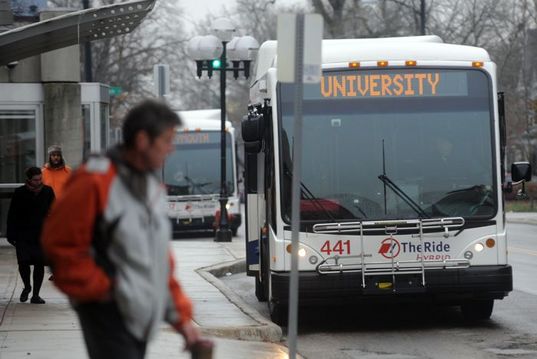
A bus waits at the AATA station on Fourth Street in downtown Ann Arbor Tuesday afternoon.
Melanie Maxwell | AnnArbor.com
Ann Arbor Transportation Authority officials met Tuesday to discuss the future of the agency as it looks to become the transit provider for all of Washtenaw County.
Chris White, AATA's manager of service development, said uncertainty about the future of Michigan's economy is working against the chances of AATA getting a countywide transit millage passed by voters.
"The economy clearly has an effect on people's willingness to vote for a millage at this point," he said, adding that's especially true in the eastern part of the county, which has been harder hit by the recession in Michigan.
White discussed the results of a recent telephone survey of county voters aimed at gauging feelings about a countywide transit millage. He said the survey research firm will make a full presentation to the board in January and respond to questions then.
Giving initial highlights of the report, White said the survey showed county residents typically have a favorable view of AATA and the services it provides. But their willingness to pay a 1-mill levy to expand transit services may not be secure enough for the AATA to have confidence in passing the millage, he said.
The survey sought feedback from 940 county voters, including an even mix of residents in the city of Ann Arbor, the urbanized area outside the city, the eastern townships and the western townships.
White said 59 percent of respondents rated their view of AATA as excellent or good, but only 51 percent favored a 1-mill countywide transit millage. Seventeen percent indicated they definitely would support the millage, and 34 percent said they probably would - which White considered a relatively insecure commitment.
White's report came as the AATA's Planning and Development Committee met during the afternoon on the campus of Washtenaw Community College. The committee meeting was followed by a special board of directors meeting, where AATA officials discussed plans to expand under Michigan Public Act 196.
The AATA was chartered in 1969 by the city of Ann Arbor as a special-purpose unit of government. It currently is supported through fare box revenues and local, state and federal funds, including a 2-mill tax in the city of Ann Arbor.
CEO Michael Ford has recommended AATA reorganize under Act 196 to prepare the transit agency to administer funding for expanded service, including countywide transit and a portion of commuter rail operating costs. Last month, the agency's board adopted resolutions affirming AATA’s commitment to going countywide.
Ford said the current lack of support for a millage may just mean the agency has to do a better job of talking with residents about the future of transit in Washtenaw County. The AATA is hiring a consultant to get the community involved in creating a vision for that plan and identifying service needs throughout the county.
"I think there's more work that we need to do as we move forward and more communication that we need to have," he said. "We don't have a service plan yet that we've communicated to people. At this point, we haven't gone out and talked to folks and heard what they have to say about a service plan. That's going to be critical. The people have to let us know what they think and what they want because that's ultimately the service that we want to provide."
Ford noted that the results of the most recent survey closely mirror results from a similar survey done in 2006.
AATA officials acknowledge multiple options are being considered for expanding countywide, in addition to the idea of layering a 1-mill countywide tax on top of the current 2 mills in Ann Arbor.
A report laid out by AATA Treasurer Ted Annis last month recommended the agency eliminate the current levy in Ann Arbor and replace it with a countywide tax of 1 mill. Under the current funding method, AATA operates on a budget of about $25.46 million. That could increase to $33.25 million under a 1-mill county tax method of funding, according to a report prepared by Annis.
That's an increase of about $7.8 million. Annis claims another $3.7 million in funds could be freed up through realizing better operating efficiencies.
The AATA currently operates 27 public transit routes, paratransit services and carpool-vanpool matching, as well as other transit services throughout urban areas of the county through purchase of service agreements.
Ford said a new millage is only one option of many that AATA leaders will be discussing.
"I think we can look at options and a millage is obviously something that people are focusing on, but are there other funding sources that we just haven't thought about?" he said. "I think that we have to kind of get outside of the box and think about other opportunities - other grants and other mechanisms of sustained funding. The millage is certainly one option."
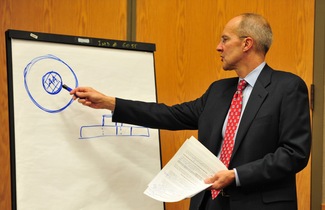
Attorney Jeff Ammon talks about the AATA's options for implementing a new millage for countywide service - either under a "donut" system or a "layer cake" system.
Ryan J. Stanton | AnnArbor.com
At Tuesday's meeting, AATA leaders received advice from the leaders of other Michigan transit systems that have operated as Act 196 authorities as well as two attorneys who discussed the implications of going countywide under Act 196 versus Act 55.
Attorney Jeff Ammon said only cities with fewer than 300,000 people can form Act 55 authorities but any municipality could form an Act 196 authority. Both laws allow levying up to 5 mills of property taxes for five years at a time, though Act 196 allows authorities to ask voters for a millage of up to 25 years if part of the funds are used for fixed guideway systems such as light rail or rapid transit bus service.
Ammon said if the AATA decides to become a countywide authority under Act 196 it has the choice of implementing either a "layer cake" millage system or a "donut" millage system.
Under the "layer cake" system, the existing AATA service would continue and a new countywide authority under Act 196 would form with a separate millage covering the entire county. That would cause two millages - one within the city and one throughout the entire county. Ann Arbor taxpayers would pay both millages.
Under the "donut" system, the new authority would consist of the entire county except the city of Ann Arbor, which would exercise its right to be excluded from the Act 196 authority. That would result in two transit authorities with respective millages resembling a donut when drawn on a map.
A sample timeline provided by the attorneys shows 14 steps needed to convert to an Act 196 authority between now and June. It would involve transferring of assets from the old AATA to the new authority, obtaining state and federal approval as well as agreements from the Ann Arbor City Council, appointment of a new board of directors, adoption of new bylaws and eventually the dissolving of the old AATA.
Ypsilanti Mayor Paul Schreiber showed up at Tuesday's meeting and encouraged AATA leaders to reconfigure the agency in a way that "would knit all of the municipalities and townships together" and create a more stable long-term funding solution for transit in the county.
Ryan J. Stanton covers government for AnnArbor.com. Reach him at ryanstanton@annarbor.com or 734-623-2529.
Comments
Mary Stasiak
Mon, Dec 14, 2009 : 12:35 p.m.
The AATA crunches a lot of data to determine efficient use of its resources. One of the ways efficiency is evaluated is the "Boardings per Service Hour". This is equal to the number of boardings for every hour that one bus is on the road. In 2008, AATA averaged 35.18 boardings per service hour. This has steadily increased overtime and is reflective of AATA's strategy of adding service on popular routes and trimming service on lightly used routes. There are only two peer transit agencies with higher boarding rates than AATA. Both of the agencies operate all or most transit service on large college campuses.
Steve Hendel
Sat, Dec 12, 2009 : 6:45 p.m.
And btw, of course the Ypsi mayor would be supporting a county-wide transit system funded by a county-wide millage. Ypsi residents have been getting, literally, what amounts to a partially free ride for the past few years; the AATA, i.e. Ann Arbor taxpayers, have absorbed the cost share which would otherwise have been paid by the City of Ypsilanti. This changed recently so that now part of the AATA's share of federal stimulus monies (which otherwise woulld have gone for???) are paying Ypsi's share.
Steve Hendel
Sat, Dec 12, 2009 : 6:38 p.m.
Well, if "big empty bus" is anecdotal and an urban myth, let's see the statistics from the AATA. I don't just mean stories about how crowded buses are at peak times, but on average throughout the day. Don't we have statistics about how many people get on and get off any given bus? It shouldn't be rocket science to determine average passenger load at different times throughout the day.
Chuck Warpehoski
Fri, Dec 11, 2009 : 11:12 a.m.
baker437 implied that the proposed changes would only benefit Ann Arbor. I don't think that's accurate. I saw an initial draft of a countywide transit plan and it had extensive services for non-Ann Arbor areas, from "lifeline" services for seniors and people with disabilities to community connector services to help people get between communities, and more. (This was before the AATA decided to hire a consultant to develop a plan, and there are a lot of different perspectives within the AATA from Ten Annis' minimalist plan to much more robust versions of a countywide system, so I wouldn't say this is THE plan.) Point is, for a plan to be at all viable, it will need to have something in there for everyone asked to pitch in. Getting that balance right will be difficult so that the mix of services, costs, and revenues are fair to Ann Arbor, the urbanized area currently served by AATA, and the rest of the county not currently serve by AATA. A lot of conversations have already happened to look into this mix, and many more will happen to get it right. So it's not fair to say that this only benefits Ann Arbor.
lefty48197
Thu, Dec 10, 2009 : 11:40 a.m.
Ann Arbor needs to improve it's local mass transportation system. We need commuter parking lots near each of the highway interchanges with bus stops at each commuter lot.
Richard C
Wed, Dec 9, 2009 : 9:20 p.m.
While I (personally) haven't used the AATA in years, my teenage son uses it to get home from school at times. As far as I'm concerned, I think the AATA does a wonderful job. I think it'd be a great candidate for managing the Washtenaw part of any rail service that might connect Ann Arbor with Detroit and Lansing. However, I am concerned that if the AATA becomes the Washtenaw County Transit Authority, then the taxophobic, anti-civic population in the conservative parts of the county will run the service right into the ground with the kind of obstructionism we see from the Republican party at the state and federal levels of government.
Jake C
Wed, Dec 9, 2009 : 9:09 p.m.
voiceofreason: Where did I say that a $10 raise in fees would result in low-income people buying cars? What I did say was that the fee increase will be tough on the budgets of some people, which is true. I also said that if you shift the costs of the AATA system entirely on the fares of riders (which some people seem to be advocating for) that it's going to wreak havoc on the city infrastructure, which it would. That doesn't mean poor people are going to run out and lease a BMW if the cost to ride a bus went from $1.25 to $7 or whatever, but it means that that AATA would most likely shut down because very few people would be able to pay those kinds of costs. And there's plenty of people who own cars who choose to take the AATA instead of driving for some trips -- again, especially students like me, and people who don't mind a few extra minutes on a commute in exchange for not having to worry about finding and paying for a parking space. Parking and traffic in the downtown and campus areas would get a heck of a lot worse, which negatively affects everyone. I don't exactly see a "plea to emotion" in my previous post, merely a factual statement that the absence of a public transit system in a city with the population size of Ann Arbor would have a significant negative impact on everyone's quality of life, rich or poor.
Bruce Amrine
Wed, Dec 9, 2009 : 5:24 p.m.
It's clear from the number of posts, particularly the reasoned logic posts that show some actual knowledge and research on the subject, that there is a lot of interest in this topic and I hope the debate continues with additional input from AATA. Why is AATA not participating in this debate and providing factual information to support or refute some of the opinions? This is a hugely complex issue and one that needs honest debate before we actually start talking about an actual millage vote.
sbbuilder
Wed, Dec 9, 2009 : 4:44 p.m.
Also, folks, the 'less cars on the road, therefore less maintenance on the roads' argument breaks down very quickly because the main abuse to roads is not because of lots of little tires, but because of per axle weight. A single heavy vehicle creates far more damage to a road surface, specially in a freeze/thaw situation, than lots of little cars. That is why we have frost laws in place in Michigan and other northern states. I don't have the factual data in front of me, but I'm sure that wouldn't be too hard to find.
voiceofreason
Wed, Dec 9, 2009 : 4:38 p.m.
Jake C, I somewhat understand your logic, but there is one large hole in your argument. On one hand, you say that an extra $10 dollars per month for a bus pass is going to break people who are already struggling. On the other hand, you say that "you won't like what happens to the already precarious parking and traffic situation in this city afterward." So what you are saying is that non AATA users should pay more to support the system, because if rates are raised, all of a sudden these people who cannot afford an extra $10 a month are magically going to buy cars and begin driving to work? I am all for being reasonable to people on the lower regions of the economic ladder, but can we at least approach this issue without putting forth pleas of emotion?
baker437
Wed, Dec 9, 2009 : 4:24 p.m.
Foobar417- However, Person A pays taxes plus fees, while Person B pays taxes. I would guess that Person A is most likely a student or a low-income person that cant afford a car or to park it in Ann Arbor. Both tend to rent not so they dont pay for these services by direct taxation but they tend to be the people that use the bus the most. Many but not all type B likely are better off since they have a house in Ann Arbor and either work outside of Ann Arbor or can afford and prefer to take their cars around town and if the do ride the bus they can afford to pay more. Person A will still have to ride the bus because of UM policy or economic reasons and will have to pay what ever fee is set. So I wonder how much reduction in traffic we are see just because the busses are there. I would guess the cost of parking in downtown Ann Arbor does more for reducing traffic than any thing which is a example of market forces (i.e. limit parking equal high cost to park which means people ride the bus).
Jake C
Wed, Dec 9, 2009 : 3:55 p.m.
Also in response to voiceofreason: http://www.theride.org/fares.asp AATA users will already be paying roughly 20% more in fees in 2010 compared to 2009. The only other people who tend to see that sort of year-to-year fee increase are students (who coincidentally also tend to ride the bus pretty frequently), which I happen to be. As foobar pointed out, for most people time really does equal money. A $0.25 increase from $1.25 to $1.50 for a single ride may not seem like much, but when a 30-day pass goes from $48 to $58, that's real money for a lot of people. Especially for people who already have tight finances and can only afford to take the bus to their minimum-wage jobs where they clean your carpets, serve your lunch, and change your oil. But fine, go ahead and support a total shutdown of the bus service, which is what would happen if the costs of the bus system were shifted entirely to *only* the people who use it. I guarantee you that you won't like what happens to the already precarious parking and traffic situation in this city afterward...
baker437
Wed, Dec 9, 2009 : 3:23 p.m.
So let the people that would use the bus from other cities into Ann Arbor pay for it. Seriously if there is a market for this service I would hope some private bus company would start up routes kind like the mega bus to Chicago. There are also many more people that dont work or come to Ann Arbor much so I wonder how would these people feel about paying for a service they dont use. The question remains how many of those people that make the 10,000 trips a day into Ann Arbor would want to put up with the cost and inconvenience of a bus versus these use of there own car.
foobar417
Wed, Dec 9, 2009 : 3:14 p.m.
1) Here is a study (with actual data) showing how user fees make up a declining fraction of the total cost of highways. http://www.subsidyscope.com/transportation/highways/funding/ 2) Person A uses AATA. Person B does not use AATA. Both pay into the system in the form of taxes and/or fees (fares). What's in it for Person B? Every person who uses AATA reduces the number of car-miles on county roads. This in turn reduces the maintenance costs of county roads and Person B's taxes. Every person who uses AATA reduces the number of cars on county roads, reducing the average congestion Person B experiences getting to work. Time=money, so this also has a real net value to Person B. The existence of transit tends to cluster housing over time into denser nodes, diminishing sprawl. This in turn reduces the total size of the road network needed to support the same population, reducing Person B's taxes. Does this mean that Person A and Person B should contribute the same amount to the same system? No, as Person A is clearly getting more value from AATA than Person B. However, Person A pays taxes plus fees, while Person B pays taxes. What's the right balance between taxes and fees as a funding source for AATA? It's not 100/0 and it's not 0/100. It's somewhere in between. I'm sure an actual transit expert could weigh in with the empirical, nationally-determined average balance, but my simplistic reading of an unverified earlier comment suggests the current balance for AATA is 83/17. What's a fair balance? I don't know. I do know it's not 0/100.
YpsiLivin
Wed, Dec 9, 2009 : 3:08 p.m.
Baker437 said" why any one outside of Ann Arbor should have to pay for a service which will only benefit Ann Arbor The WATS showed that in 2007, more than 10,000 trips specifically to work were made INTO Ann Arbor daily by people coming from other areas of the county. It's hardly clear that improving mass transit in the other areas of the county would "only benefit Ann Arbor." Ann Arbor happens to be the target destination of a lot of people in the county and improvements to the mass transit system would seem to benefit everyone in the county.
voiceofreason
Wed, Dec 9, 2009 : 2:41 p.m.
Foobar, 1. Please explain(using actual data) how people who drive automobiles do not pay for roads. 2. Please explain(with actual logic) why people who do not use the AATA should be asked to pay more so that actual users don't see increased fees.
baker437
Wed, Dec 9, 2009 : 2:38 p.m.
foobar417- I am all for stopping all government subsidies including big oil, big corn (ethanol), and big alterative energies. All have huge lobbies looking for ways for government to take our money to benefit them.
sbbuilder
Wed, Dec 9, 2009 : 2:33 p.m.
Moose, Moose, Moose! Let's see if you can argue your way around this one prickly statistic: 17% of revenue coming from rider fares. That cuts through the 'full bus, empty bus' debate that you are wont to call 'anecdotal'. So if the buses do such a glorious job, the service they provide so critical, the buses are packed (or not), the service they provide is decades old, then why in the sam heck do they need such a massive subsidy? Huh? Come on, give it a whack.
foobar417
Wed, Dec 9, 2009 : 1:58 p.m.
I'm not saying Washtenaw County residents should subsidize transit within the city of Ann Arbor, assuming that's really what this would amount to. I'm simply pointing out that there are lots of hidden subsidies of transit (including automobiles) and that suggesting public transit needs to pay its own way while other forms of transit (i.e. cars) do not is equally unfair. I think we need to look at our Washtenaw County's overall transit needs going forward, what are the true costs of each form of transit (including automobiles and pollution), and figure out an equitable way to share the burden of supporting those transit options while reducing pollution across the entire region's population in a way that allows economic growth going forward.
Brian Kuehn
Wed, Dec 9, 2009 : 1:57 p.m.
While we are on the subject of buses, I sometimes wonder if coordinating all the bus traffic might result in some savings. Between the local schools, U of M, and AATA, there are a lot buses on the road. If AATA and U of M picked up some of the school traffic, we might have fewer but more fully occupied buses. I am no transportation expert and this idea has probably been looked at and discarded in the past. However, sometimes ideas that are unappealing in good times become more attractive when times are tough.
baker437
Wed, Dec 9, 2009 : 1:47 p.m.
foobar417 your replies still dont state why any one outside of Ann Arbor should have to pay for a service which will only benefit Ann Arbor. And I am all for toll roads. They tend to be better maintained and only cost the people who use them money.
baker437
Wed, Dec 9, 2009 : 1:36 p.m.
I am all for toll roads!
foobar417
Wed, Dec 9, 2009 : 1:34 p.m.
Here is a idea get rid of all the public roads and charge a real rate to drive your car and let market forces determine rate and routes. Why should I as a property owner in Ann Arbor with the ability to walk or bike to all stores, jobs, and parks pay for roads I avoid at all costs and Im displeased with the functionality of it when I do drive. Seems like the car owners of Washtenaw are just looking for more money in these hard times!
baker437
Wed, Dec 9, 2009 : 1:19 p.m.
It clear from commits on here that most people see this as way to reduce traffic in Ann Arbor. So why should the county pay for it? Obviously the smaller cities in the county dont need for getting around their city. Here is a idea get rid of all the mileages and charge a real rate to ride the bus and let market forces determine rate and routes. Why should I as a property owner in Ann Arbor pay for service I avoid at all cost and Im displeased with the functionality of it when I do ride. Seem like AATA is just looking for more money in these hard times!
Chuck Warpehoski
Wed, Dec 9, 2009 : 12:47 p.m.
DennisP question of "what is the plan" is an important one. What are we getting for our money and who is getting it? The Washtenaw Area Transportation Study Transit Plan recommends more than just buses and rail. They see transit as including lifeline services so that seniors and people with disabilities in places like Milan and Manchester can get rides to the doctor and shopping. That keeps them independent and probably save money long-term. But, we have to know what the plan is, what the options are, and who should pay how much. I'm glad the AATA is working on this now, 'cause when gas hits $4.00/gallon again, we'll all be crying for transit. As for the "empty bus" argument, nobody is driving on my street right now. Why do we spend so much to maintain it if it goes unused so much?
bnis
Wed, Dec 9, 2009 : 12:39 p.m.
Actually Moose, I do avoid going into A2 as much as I can. Luckily there is civilization and things to do outside of A2, so it is not a real loss. If A2 wants to have a bus service that is fine. A2 has the population density to support it. But dont expect the rest of the county to pay for it. The county residents already pay for a lot of the roads the busses run on. So we have already done our part. Running busses outside of Ann/Ypsi area does not make sense. There isnt going to be enough riders to make running any sort of a comprehensive schedule worth while. So that will leave AATA running a token schedule to the areas outside Ann/Ypsi but still paying full price. Yea that is fair.
The Grinch
Wed, Dec 9, 2009 : 11:51 a.m.
Hmmmmmmm. Some say they won't vote for the tax because the busses are always crowded. Does that mean they'd vote for the tax if the busses were empty? Others say they won't support a new tax because the busses are always empty. Does that mean they'd vote for the tax if the busses were full? Hmmmmmmm. I'm betting that these are excuses and that they wouldn't vote for the tax under any circumstance. Fine. That's a position, but let's at least have the intellectual honesty to admit the truth.
LBH
Wed, Dec 9, 2009 : 11:38 a.m.
Why is it that people who never ride the bus are always commenting on how it is "always empty"? I ride the bus every week day and I am always glad I get on at the Down Town station because people are standing in the aisles by about the 4th stop. My overall experience using AATA has been very positive. That is not to say each and every ride is a joy. I have heard WAY more about people's personal lives than I want because they yap on their cell phones at full volume, and have occasionally had to wait when busses were running late, but it sure beats paying hundreds of dollars for a University blue sticker which is really only a license to hunt for a spot, no guarantee. Good public transportation is part of what makes Ann Arbor a nice place to live.
Moose
Wed, Dec 9, 2009 : 11:22 a.m.
@amarie, Yes, times are really tough right now. But some of us have been through this before. Don't lose heart or patience. Things will get better and if there's a decent mass transit system you won't need a car as much, if at all. Actually, rents are down as there is a glut of unrented apartments in the area. Many landlords will negotiate. Find a cheaper place near a bus stop.
foobar417
Wed, Dec 9, 2009 : 11:22 a.m.
More data. If you just look at the cities, not the metro areas, you get the following data: NYC: 23.3% Seattle: 54.1% Boulder: 54.2% Ann Arbor: 59.5% Portland: 61.5% Madison: 64.8% LA: 67.1% Bloomington: 67.8% Houston: 73.5% In other words, going from just AA to AA metro area takes you from 59.5% to 73.5%. Clearly, there are many factors including sprawl (i.e. distances involved) and availability of alternatives (e.g. lack of public transit in the county). One could address this difference by discouraging sprawl (e.g. disincentivizing living in the townships) or by encouraging alternatives (e.g. adding county-wide public transit, increasing support for car-pooling, biking, walking, etc.). Can we afford to do it? I doubt most taxpayers want any new taxes right now. Should we do it? I think it's in our community's long-term self-interest. This is a very tough question in today's environment.
foobar417
Wed, Dec 9, 2009 : 11:02 a.m.
Comparing some metro areas, percentage of workers who drive alone to work: NYC: 49.5% Boulder: 56.5% Seattle: 69.3% Portland: 70.8% Madison: 70.9% Bloomington: 71.9% LA: 73.3% Ann Arbor: 73.5% Baltimore: 74.1% Houston: 77.5% Clearly, Ann Arbor could be doing a lot better, using Boulder as a model, by increasing car-pooling, public transit, walking, other, and telecommuting. Note the percentage is an estimate, pulled from the census here: http://factfinder.census.gov/servlet/ADPGeoSearchByListServlet?ds_name=ACS_2008_3YR_G00_&_lang=en&_ts=278419422854 Is making the AATA a county-wide transit authority the right way to do this? I'd argue yes, but we should probably look at what Boulder is doing and figure out what would work here. The goal shouldn't be to build a county-wide transit authority. The metric should be to decrease solo auto trips to work.
YpsiLivin
Wed, Dec 9, 2009 : 10:57 a.m.
I'm not big on taxes right now, but if the plan to expand the AATA included building a comprehensive mass transit system (maybe a mixed-mode system with buses, and local light rail service) I'd go for it. The ever-growing number of roads in Washtenaw County that are operating at their maximum capacity indicates that we need to have a better system in place to get lots of people where they're going from wherever they are when they need to move. The new system would have to account for the fact that many Washtenaw County residents have opted out of living in the two major cities because taxes are so high and because living among the student populations is unattractive. The system would have to serve the people in the townships as well as it serves the people in the cities and it would have to provide a "from-anywhere-to-anywhere" solution. A comprehensive mass transit system that gets people into Ann Arbor from the outlying regions of the county would seem to provide the most bang for the buck at the outset. It would get a lot of cars off the road and out of the parking structures. It would have to be a rail system that could easily accommodate growth in ridership and it would have to run for most of the day... perhaps even 24 hours.
Moose
Wed, Dec 9, 2009 : 10:32 a.m.
"How about AATA and the other Ann Arbor money sucks keeping there paws out of the wallets of the people who dont live in Ann Arbor!" To those of you who actually think this way. Don't ever drive your car here for an event, concert, party, sports event, shop, go to a park or a restaurant or visit your friends or family who live here. Don't even think about coming to Ann Arbor to work or look for a job. Don't even imagine what your quality of life would be if your only option for doing any of these things was to go to Detroit.
Anonymous Due to Bigotry
Wed, Dec 9, 2009 : 10:25 a.m.
I know some people really love the politically correct pseudoprogressive emphasis on public transportation in Portland, OR, but the fact is that they've wasted their budget on a public transportation system used by only about 13% of the population while mostly ignoring the highways used by everyone else. Sorry envirodudes, but cars are very efficient in terms of peoples' time. People don't want to spend 45 minutes or more on the bus for what would be a 15 minute drive. As a result, the vast majority of people are simply not going to use public transportation if they can in any way afford a car. Trying to force people off onto public transportation, for example, by neglecting the roads while expanding public transit just doesn't work. "Portland's rate of public transit use (12.6% of commutes in 2006) is comparable to much larger cities like Los Angeles, and higher than in most similarly sized U.S. cities, but is lower than in some similarly sized cities, such as Baltimore and Seattle." So yay, but people in Baltimore use the bus more than people in Portland. My guess is that more people in Portland can afford cars.
Moose
Wed, Dec 9, 2009 : 10:20 a.m.
@foobar417. Hanging out at Gallup Park! Using the Library! Shocking!
bnis
Wed, Dec 9, 2009 : 10:19 a.m.
This just sounds like another way to get the rest of the county to pay for Ann Arbors expenses. This is the same kind of thing they tried with the county wide school millage. Hope to get enough pro A2 votes to force the rest of the county to do it. The hook this time for the people of A2 is that if they were to vote yes to it, they get there millage cut and the rest of the county gets to pick up the tab. Does the AATA board think the rest of the county wont figure that out?? How about AATA and the other Ann Arbor money sucks keeping there paws out of the wallets of the people who dont live in Ann Arbor!
Moose
Wed, Dec 9, 2009 : 10:09 a.m.
One topic that all travelers to big cities like to talk about is how much they appreciate mass transit. Mass transit is a huge reason why people want to move to, work, live and play in a particular place or region. Businesses want to locate in places where their employees can get to and from work and not have to build more parking lots and structures. More people are using public transportation now than ever before. The " big empty bus" observations are anecdotal and urban myth not supported by the facts. http://www.usatoday.com/news/nation/2008-06-01-mass-transit_N.htm Everybody knows that the price of gasoline, the cost of operating and maintaining a car and cars themselves will continue to rise in price and they will rise faster than the cost of mass transit because transit costs will go down overall because of increased ridership. The not so soft costs of pollution, road infrastructure will also go up. In the not too distant future an ever increasing number of people, not fewer, will use public transportation, but some people want to bury their heads in the sand and will refuse to look forward. The longer we put off building a comprehensive mass transit system, the more expensive it will become. The real problem isn't the money, it's the lack political leadership and getting past petty turf wars long enough to what's right for everyone. And mass transit IS not only the wave of the future, it's the right thing to do, RIGHT NOW.
Anonymous Due to Bigotry
Wed, Dec 9, 2009 : 10:05 a.m.
51%? Yea right! Maybe 51% of people who actually use AATA on a regular basis would support the idea but I'm guessing that the percentage of washtenaw county residents who would is around half that.
foobar417
Wed, Dec 9, 2009 : 9:56 a.m.
It's real simple. If you want to drive your car on public roads, actually pay for it. As a non-car-driving tax payer I am sick and tired of subsidizing inefficient automobiles through fuel subsidies, road subsidies, wars in the Middle East, etc. and underfunding efficient forms of transportation like walking, biking, and public transit. Since I live in town I get to see all these people living outside the city boundaries (no property taxes paid to the city) and they are driving on the city roads, using city parking spaces, spewing pollution into city air, all on my dime.
bruceae
Wed, Dec 9, 2009 : 9:44 a.m.
It's real simple. If you want to ride the bus, pay for it. As a property owner in this town I am sick and tired of every group around trying to extort more money out of me with a new millage. Since I live on the north east side I get to see all these people living in U of M student housing (no property taxes paid) and they are riding the bus, using the library, hanging out at Gallup Park, etc., all on my dime.
ArgoC
Wed, Dec 9, 2009 : 9:43 a.m.
Having worked on research projects for the AATA during my time as an urban planning grad student, I've been paying attention to their efforts at communication over the years. The comments here are good examples of the poor job they've done explaining things: why they only use giant busses, even for light-traffic routes. Why the schedule isn't changed even when there are zero-traffic runs some parts of the day and crowded runs at other times on the same route. How they make decisions about routes and stops. Who's getting served and who isn't. And so on. Back in the day, they were more transparent about all of these. Today it just looks like poor management... but there might be decent planning reasoning going on in their rock-and-a-hard-place world. And, finally, why they haven't invested a bit of money in their web site to provide enough route detail (LOCATIONS OF STOPS PLEASE) for potential riders to make decisions.
zollar
Wed, Dec 9, 2009 : 9:42 a.m.
AS someone who has been riding the bus, ( currently not driving)I really depend on it daily.Empty buses: of course there are empty buses during off peak times.I would challenge anyone who does not ride the bus to ride it during peak times when folks are commuting to work and home,you will then see the need for continued bus service(and additional buses) no matter how it is funded.
Leslie Morris
Wed, Dec 9, 2009 : 9:39 a.m.
It seems clear to me that county voters will not approve a transit millage at this time, and that a public relations campaign as proposed is unlikely to change this. There are several obvious reasons for this. First, the bad economic situation, which hurts everybody. Second, many county residents who live outside the two major cities (Ann Arbor and Ypsilanti)do not wish to use transit, and do not wish to pay taxes for what they consider urban services. I would like to suggest a third reason. As noted in the article, Ted Annis, an AATA Board member, has claimed that "another 3.7 million in funds could be freed up through better operating efficiencies". If that is possible, why is the AATA not proceeding right now to make the changes to free up this large chunk of cash? This could be used right now to improve the existing AATA system, without any public vote. The AATA lacks crediblity to ask the public for anything until it has demonstrated that it can make the best use of its current funds.
crowcat
Wed, Dec 9, 2009 : 9:23 a.m.
Yep, positive, yup... let's get the government transportation funding, the jobs we need so desperately, and pull our area kicking and screaming into the 21st century!
Lehigh
Wed, Dec 9, 2009 : 8:58 a.m.
If the survey was done by localized random digit dial (which is likely), then cell-phone only households would have been excluded. Here's an informative, if 2-years-old, post about the issue and how pollsters try to deal with it (http://www.pollster.com/blogs/cell_phones_and_political_surv.php). Estimates of cell-phone only households are now around 20%. Given the U's emphasis on public transportation, it strikes me that there could be some collaboration there. Also with Washtenaw Community College, which has major parking issues and seemingly could benefit from improved bus services.
Tii
Wed, Dec 9, 2009 : 7:40 a.m.
How about those huge empty buses we see daily?? Is a monster bus, even on biodiesel the best use of resources?
michigan48103
Wed, Dec 9, 2009 : 6:58 a.m.
Recently, I was told I can not drive for one year after, I was found guilty for something that I did not even do. There is no bus service where I live and I pay high taxes in scio Township. I live near the Meijers on Jackson and zeeb road and I have to take a Taxie to work and working the midnight shift, it is not cheap. It is sad that the high property tax does not help me out when I need it. I sure will be voting in the next election and I hope my vote does make a difference..............
Bruce Amrine
Wed, Dec 9, 2009 : 6:32 a.m.
It's pretty clear that we need a regional transportation plan that covers more than just the City of Ann Arbor unless we want to continue building more parking structures downtown. I'm a frequent visitor to Portland OR, and have seen what can be done and I'm encouraged that we now have Mr Ford leading AATA. We should listen to his ideas, and I hope he'll bring the community into the planning process. It seems to me that the Countywide idea needs more public involvement and a lot more exposure so we can all understand what and how it could be done. We need to do it but it needs to be done right.
Basic Bob
Wed, Dec 9, 2009 : 5:16 a.m.
There's nearly as many people in Pittsfield, and Ypsilanti township, and Saline as in Ann Arbor. They need to at least expand the buses to cover the areas with densest population.
DennisP
Wed, Dec 9, 2009 : 2:59 a.m.
Hmmm. Always empty to some, always too crowded to others. LOL! Anyway, bus service is an essential element to any community. The question is how would it benefit the surrounding environs? Governmental officials always put the cart before the horse, i.e. the tax before the plan. A detailed plan showing what services would be rendered and where would help people decide if AATA would provide a needed service. Else most fear it will just be another monetary sinkhole. Who wants to risk approving a tax that may end up providing only limited or no useful bus service to their part of the county? Who can trust government to provide such a service when it communicates no solid plans of proposed stops, service routes, etc. Perhaps the plans are there, but AATA has not communicated them well at this point. The only thing I see from this is that AATA is drooling at the idea of increasing its revenues up to $30 million or so from $22 million or so and justifies it with some fuzzy ideas of expanding service outside AA borders. Sending buses up along US23, M14 and I94 to a few park and ride lots wouldn't be my idea of fairly serving the outer county areas in exchange for a hefty 1 mil tax. Surprising as it may seem to many, there are a lot of people in Washtenaw who neither live nor work in AA and don't see a great need for the AATA service. If you want their vote, you need to show how it will serve them by bringing in customers to stores, easing traffic congestion, etc. To do that, you need to show a hard plan of proposed service routes, recommended schedules, etc.
brightsib2001
Wed, Dec 9, 2009 : 2:50 a.m.
I have taken the bus to and from work at U of M Hospital off and on for the last 10 years at least. The busses in the AM are so crowded I usually have to stand in the aisle all the way to Blake to switch busses. I love the bus, and if they do away with 2 mil and then only charge 1 mil countywide, what's the problem? Even the bus I take at night (I work midnights and have limited transportation choices) are crowded. I'd vote yes!
A2Lifer
Tue, Dec 8, 2009 : 11:54 p.m.
To jimbob24 as a frequent commuter on the #2 bus and also the #3 the biggest complaint I and other passengers have is that they are TOO CROWDED!
Mumbambu, Esq.
Tue, Dec 8, 2009 : 11:21 p.m.
It's interesting to see all these Ann Arborites reject the idea of paying lower taxes...Oh wait... that implies they understand the issues and what a millage is. This service deserves investment just like it has received in communities like Portland and Madison. Strange that they are doing better than us...It's our choice. Let's vote!
jimbob24
Tue, Dec 8, 2009 : 11:11 p.m.
No on millage. Are you kidding me? Hundreds of $$ of my property tax went to the AATA. Haven't ridden it once. THE BUS IS ALWAYS EMPTY ANYWAY!
baker437
Tue, Dec 8, 2009 : 11:11 p.m.
I will pass on the bus and a new tax!
ema
Tue, Dec 8, 2009 : 10:24 p.m.
did the survey include cell phone users? i'm concerned that data reported from phone surveys is not including the growing percentage of residents-- across demographics-- who only have a cell phone. in terms of demographics being excluded from the survey (if in fact it didn't include cell phones), i'd guess that a very high percentage of under 35 year olds only have a cell phone.
Ann Arbor Resident
Tue, Dec 8, 2009 : 7:37 p.m.
Elimination of the Ann Arbor Transporation millage (2 mils) upon adoption of a county millage (1-mil) for the AATA is not guaranteed. The AATA does not have the authority to do eliniate the Ann Arbor millage. If I remember correctly, that is in the hands of the City Council and Mayor. I believe the City Council and Mayor have already discussed (at the budget retreat held last weekend) using the 2 mils for other expenditures if the county-wide millage (1 mil) is passed by voters. So the most likely result of this plan is a 1-mil tax increase for Ann Arbor residents without any improvement in our local bus service.
Lehigh
Tue, Dec 8, 2009 : 6:17 p.m.
So the plan is to repeal a 2-mill tax in usually pro-tax (or at least not anti-tax) Ann Arbor and replace it with a 1-mill tax across the whole county? If this could be done by fiat, it might work. If it requires a vote it will never pass. I'm concerned that the survey was conducted by a group that specializes only in transportation issues and securing funding for transportation issues. It suggests that the results are a best-case scenario and a more realistic view would be to deflate those numbers by 10% or more. Now the AATA is going to spend money to market itself and convince voters countywide to vote for the millage? They better hope Berriz doesn't line up on the other side... (of course, since much of McKinley property is in Ann Arbor, maybe he'll be for it).
sbbuilder
Tue, Dec 8, 2009 : 6:16 p.m.
Nope. Negative. Nyet. No way. At least that's what this voter has to say. And please, I don't for one minute believe that this idea will bring all kinds of wonderful jobs to the area. Build it and they will come? Let's not put the cart before the bus. How about bringing companies back, like Phizer, before introducing this kind of thing.