

Was the electric trolley the forerunner of a light-rail system in Washtenaw County?
Although it's been almost 80 years since the Ann Arbor area hosted a quality rail system, there's a sense that light-rail lines - the modern equivalent of trolleys - could be a part of Ann Arbor's transit future.Â
The city's transit past - the age of the electric trolley - ended less than a century ago, H. Mark Hildebrandt, author of "Electric Trolleys of Washtenaw County," said at a recent lecture at the Ann Arbor District Library.
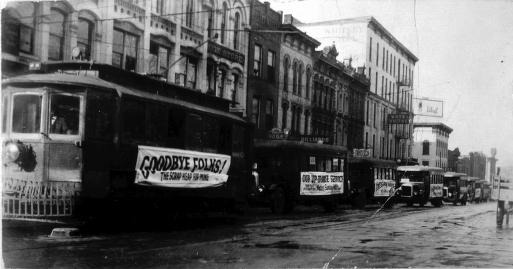 Street scene of Ann Arbor with trolley car and buses, circa 1925. The banners on the trolleys sported messages such as "Goodbye Folks! The Scrap Heap For Mine." Buses in the back of the line were to take over public transit service.
Courtesy Bentley Historical Library
Transit lines of the past, Hildebrandt explained, were privately-owned ventures meant to address a need in the marketplace - not as a public service. In the early days, trolley cars were a more pleasant and attainable transit option than their predecessor - the horse.
Before trolley cars became popular in the early 1900s - and long before Henry Ford mastered mass production - a person who wanted to get from one side of town to the other had 3 options: walk, ride a horse or borrow a friend's horse.
But horses were expensive, large and required food and storage. Given the chance to trade in a horse for a fare card, men and women around Washtenaw County gladly chose the latter.
It was good business for the companies that ran the trolley systems. But as Hildebrandt noted, Ann Arbor's streetcar era was a short one.
One photograph Hildebrandt brought to his talk showed an electric trolley system in Saline, circa 1905. The system's tracks occupied the bulk of the road. A car was parked on the shoulder of the road on the grass, as if no one knew exactly how it would fit into the grand scheme of things.Â
By the late 1920s, the die had been cast. The automobile won out.Â
Hildebrandt cited the 1925 folding of the Ypsilanti-Saline interurban line after the line was ordered to vacate a main thoroughfare for the back roads to make room for automobile traffic.
Most of what remained of the trolley lines was pulled up for scrap metal in the early stages of World War II.
Today, leaders like Michael Ford, CEO of the Ann Arbor Transportation Authority, are envisioning a new mass transit system.
The city of Ann Arbor has been working for years to provide alternatives to the automobile -Â by expanding bus service, offering incentives for riders to leave their cars at home during the work day, and increasing bike lines.
But there's just something exciting about light rail, Hildebrandt said. A retired Ann Arbor pediatrician, Hildebrandt has been collecting photographs, postcards and memorabilia related to trolley systems around the world - but especially the local system - for decades.
He met co-author Martha Churchill, an attorney from Milan, when she came looking for a source for a story she was writing on a failed rail line off Platt Road. Churchill wasn't at the lecture, but Hildebrandt said their shared love of trolleys built a friendship that turned into a partnership.
Local historian and author Grace Shackman, who attended the lecture, said when it comes to transit-related issues, Hildebrandt is a reliable and regular source.
Hildebrandt believes a light-rail system would be viable in Ann Arbor, even though upgrades to the bus system would come cheaper. And unlike the trolley lines of old, a light-rail system run by the AATA wouldn't be expected to make a profit.
"(Light rail) isn't going to survive on the money from the fare box," Hildebrandt said. "It's something we have to decide we want and something we've got to pressure the people in charge to invest in."
James David Dickson can be reached at JamesDickson@AnnArbor.com.
Comments
mw
Sun, Dec 13, 2009 : 5:23 p.m.
The old West Side in Ann Arbor has most of these features throughout except the alleys and is therefore a highly desired place to live. But there are many post WWII suburbs built with small lots and grid-style streets. And there are 'random path' neighborhoods in cities that predate WWII. Palmer Woods in Detroit dates from the 1920s (as do many of the houses on 'random path streets' in Ann Arbor in Ives Woods and on the other side of Washtenaw--Oxford, Cambridge, Day, Berkshire). These are all forms of suburban-style, single-family detached housing. Older and less affluent suburban subdivisions tend to have smaller lots and gridded streets. Wealthier and newer subdivisions tend to have larger lots and winding streets. But they're all suburban. Where homes are constructed using these principles, they are typically worth 20-30% more due to demand and the desirability of living in those neighborhoods than the same home built in a "random path" suburban style subdivision with garages in front of the homes on 0.5 to 2 acre lots. No -- take the average Old West Side house and transplant it to a lot in Ives Woods, and I am certain it would be worth considerably more in that location. Old West Side houses are worth more than very similar smallish, hundred-year-old houses on gridded streets in, say, Manchester simply because they are MUCH closer to employment opportunities in Ann Arbor. Don't get me wrong--we live withing walking/biking distance of downtown and like it very much. We definitely prefer it over living in a subdivision out in a township somewhere. But we also like having a yard and a garage, and have no desire for a car-free existence. Like the vast majority of Ann Arborites (and the even vaster majority of Michiganians).
E. Manuel Goldstein
Sun, Dec 13, 2009 : 12:55 p.m.
Seems to me that between $700 billion in bank bailouts, wars in Afghanistan and Iraq (with a pricetag of $Trillions and counting), Bush's tax cuts to the wealthy, and a host of other spending "priorities", we as a nation could have placed a decent down payment (if not purchased outright) a nationwide transit system that would employ many with a decent, liveable wage for years to come. I think Americans should reconsider how all of our tax monies are being misspent, and consider investing in America.
Stephen Lange Ranzini
Sun, Dec 13, 2009 : 9:46 a.m.
A "traditional style urban town" is laid out in a square grid with streets and an alleyway between two of the streets. Lot sizes are small, 60 to 100 feet wide and long, running back to the alley. This allows the construction of homes with a large front porch or front stoop to sit and socialize with neighbors passing by. Garages are located behind the home on the alley. The old West Side in Ann Arbor has most of these features throughout except the alleys and is therefore a highly desired place to live. Where homes are constructed using these principles, they are typically worth 20-30% more due to demand and the desirability of living in those neighborhoods than the same home built in a "random path" suburban style subdivision with garages in front of the homes on 0.5 to 2 acre lots. It is true that expressways and high speed rail will always co-exist, just like streets and subways co-exist. Freeways cost a lot of money to build and widen too (and cost even more in Michigan where we don't build them properly and they fall apart in 5-10 years and have to be rebuilt continuously!). The most extensive high speed intercity rail system is actually now in Spain.
mw
Sat, Dec 12, 2009 : 6:13 p.m.
I live downtown in Ann Arbor, whose downtown area is a traditional style urban town. I'm not sure what a 'traditional style urban town' is, but Ann Arbor's neighborhoods are nearly all 'suburban style', and have been for much longer than since WWII. By 'suburban' I mean single-family detached houses with yards -- which characterizes the old West Side as well as Pittsfield Township. Ann Arbor has never looked like New York or Chicago, with large fractions of its citizens living in apartments. In fact, Ann Arbor is more like those cities now than ever in its history (with the new downtown loft and condo developments). But in terms of numbers, the downtown apartment/loft scene is still small -- the huge majority of Ann Arborites live in suburban-style neighborhoods. This vision requires high speed intercity rail. Talk in terms of 300 miles an hour - with that you could be in Chicago or Toronto in an hour, Detroit in 10 minutes or the Airport in 5 minutes! Many countries in Europe have that now. Sign me up for that here in Michigan! Yes, France has the TGV. But it accounts for a small fraction of personal travel. France also has an extensive network of expressways, and they are heavily used. Have you ever tried to drive the 'Peripherique' (or any autoroute near Paris) during commuting hours? It is *far* worse than anything you'll experience in Atlanta. A 300mph train from Detroit to Chicago would be ruinously expensive to construct and run--and even after it was there, the vast majority of people would continue to travel via expressway (just as they do in France). Given your taste for car-free urban living, I can see why you'd love to have a subsidized TGV to take you back and for to Chicago, but I hope you understand why, given our preferences for detached houses with yards and garages with cars in them, most of the rest of use would rather not pay for it (especially when the state has so many, many other pressing needs).
Stephen Lange Ranzini
Sat, Dec 12, 2009 : 12:11 p.m.
For 5,000 years, people built cities in a certain way that worked very well. After WWII we got the *brilliant* idea that we should each live out in the countryside in our own house with a large yard, "the American Dream" - i.e. Suburbia. Today that house is a huge McMansion made with glue and plastic that will fall apart in 30 to 40 years. The facts are in, the "perfect Suburban city" is Columbine, Colorado (where the dysfunctional kids of broken suburban homes buy submachine guns and become mass murderers), the most "suburban" major city is Atlanta, Georgia (where each "trip" takes on average 40 minutes each way through gridlocked streets and "freeways" and virtually all trips are by car). Suburbia makes us: * Unhealthy, people who live in suburban towns live 10 years less on average than those who live in traditional style cities such as @crowcat's Berlin, Germany, and the last 10 years of life of suburban residents are less healthy than those of urban residents who walk around more; * Use unhealthy amounts of resources in our lifestyle in a world with finite resources; * Pollute more; * Isolate us from our neighbors, so that we have less contact with them than those living in urban areas with negative impacts on our mental health and the mental health of our children. I live downtown in Ann Arbor, whose downtown area is a traditional style urban town. My wife and I love walking around town with our son, jumping on the train for Chicago, bicycling to work, walking to the many parks, walking to the many restaurants, walking to the Farmer's Market & etc. I grew up in a suburb. It took a long time for me to figure out that I liked living in a town the best and that it helped me to maintain a healthy lifestyle. I believe that we need a vision of how to move towards "New Urbanism", which is really the old style of urbanism we had worldwide before WWII and then we can walk to work, recreation, shopping and worship. We will live longer, be healthier and happier. This vision requires high speed intercity rail. Talk in terms of 300 miles an hour - with that you could be in Chicago or Toronto in an hour, Detroit in 10 minutes or the Airport in 5 minutes! Many countries in Europe have that now. Sign me up for that here in Michigan! If you want to read more about how we all got screwed by Suburbia and what you can do about it, read Andreas Duany's "Suburban Nation: The Rise of Suburbia and the Decline of the American Dream", an easy read with a lot of great illustrations and ideas. Available at any local bookstore and a great book to curl up with on a lazy weekend day.
baker437
Sat, Dec 12, 2009 : 9:42 a.m.
"An interesting fact, no country has achieved a profitable transit system because people want the freedom to go wherever they want at any time" Your right on.
Jonas Dainius Berzanskis
Sat, Dec 12, 2009 : 8:56 a.m.
We can only imagine what rail would be like today in Michigan if the auto industry's influence and President Truman's railroad union busting tatics had not taken place. I always marvel when I take the Metro North railroad in New York from Grand Central ( On time and smooth), and then I am disgusted when I take the Amtrak from Ann Arbor to Chicago with delays that can last hours. Bring back rail!
Val Losse
Fri, Dec 11, 2009 : 5:58 p.m.
Does anyone remember the electric buses in Detroit? There were overhead wires and the buses had spring loaded rods that road up against the wire to pour the bus. It could go anywhere the wires went. There were no rails. The wires made the sky look ugly but it worked. The buses could run in either direction. An interesting fact, no country has achieved a profitable transit system because people want the freedom to go wherever they want at any time.
braggslaw
Fri, Dec 11, 2009 : 5:09 p.m.
I think light rail is a neat idea and adds to the character of the city. That being said, it makes absolutely no financial sense.
John Galt
Fri, Dec 11, 2009 : 5:01 p.m.
Seems like this country is running in reverse. With all the Green/Co2 concerns and legislation, we are going back to pre-industrial society. Sure, lets get back to the street cars. Soon it will be horses and carts. Already, there are those that are keeping chickens in the yards. Amusing.
antikvetch
Fri, Dec 11, 2009 : 3:04 p.m.
If you divide the cost of the system by the number of users, it would be cheaper to provide the users free taxi service. Guaranteed.
mw
Fri, Dec 11, 2009 : 3 p.m.
Eric S has it *exactly* right. On-street trolleys are far more expensive and much worse than buses (trolleys can't change routes and can't even go out around accidents). And if you can find route space for off-street light-rail lines, you can find the same space for express buses. In fact, the buses win again in that case, because those buses would be much more flexible (they could run in dedicated corridors for part of their routes and normal streets for other parts). NO, NO, NO to light rail!
crowcat
Fri, Dec 11, 2009 : 2:14 p.m.
This service would be fantastic! I lived in Berlin two years ago and NO ONE there needs a car unless they want to travel on the autobahn. It was totally convenient, comfortable and ran at all hours of the day and night! The stops were always convenient and the short walk to them was pleasant and interesting, kept me in shape, and allowed me to see my neighborhood, visit the stores on the way and get to know the people in my area. This system works equally well in Portland where small businesses thrive, partly because of the flexible city ordinances, and because of the increased foot traffic stopping in to neighborhood stores and restaurants. Come on Ann Arbor/Ypsi let's move ahead!
Eric S
Fri, Dec 11, 2009 : 1:22 p.m.
I'll second that, but let's set money aside for a moment. Ask yourself what problems are solved by light rail that aren't solved by the current subsidized bus service? If by "light rail" you mean in-street trolleys, then the answer is "none". They're actually worse. They have all of the traffic problems of buses, plus they can't maneuver and can be blocked easily by traffic and by each other. One ride on a Toronto trolley during rush hour will prove it for you. My 12-15 minute car commute would already be 75-85 minutes by AATA bus, and trolleys would be worse. If by "light rail" you mean dedicated rail paths, then you'd solve the time problem, but I see very few potential pathways in Ann Arbor. If you like this idea, I suggest building dedicated busways first. If you can get them built, retrofit them to rail when the rider levels justify it. If you can't imagine where you'd fit dedicated bus paths in our commercial areas and neighborhoods, then you aren't ready to think about rail.
budlaw
Fri, Dec 11, 2009 : 1:15 p.m.
I love all forms of rail travel, and a light rail system would be heavenly. The problem, as I see it, would be how many folks, today, would be willing to walk three blocks, or, maybe even a mile, to get to this rail system, because just as the buses do now, they do not drop, or pick you up, at the door of where you want to go. How many of us, complain when the parking lots, are so far away from our destination, like the mall, or, even downtown. Then there is the baggage, especially if your going to the airport, or, carting home our purchases, from the stores (groceries). It sounds great, but, I fear it is not practical.
Cash
Fri, Dec 11, 2009 : 1:12 p.m.
Top Cat, Is driving a car expensive? Is maintaining a highway system expensive? Is maintaining bridges expensive? We would need less highway maintenance. We would need less traffic police! We would need less city street maintenance, including bridges that have no funding for repairs. We would put less pollution in the air. We could relax while we were transported. I like that the best!
MikeAA
Fri, Dec 11, 2009 : 11:49 a.m.
Sounds like a tremendous idea, that provides a lot of benefit to the common taxpayer and very little benefit to the wealthy, ruling classes of Detroit and AA. For that reason, I say dont hold your breath.
E. Manuel Goldstein
Fri, Dec 11, 2009 : 11:42 a.m.
An inter-urban rail system would be fantastic, and practical, considering the flatness of most of Southeast Michigan. The main problem, as cited in the article, is the width of streets and the unlikelihood of widening them to be able to accomodate a 2-way light rail system. In thinking about this very subject over many years, I believe light-rail could be used to revive Southeast Michigan's economy. Key to this would be to design and build the system here in this area. We still have a skilled workforce, the know-how, and the facilities to build large transit vehicles. Perhaps the US auto companies could do this. Also key would be to build lines that we know people will use. A transit line going directly to Metro airport would be used by many. A line going to Detroit would be useful as well. In fact, a regional transit authority, including Detroit, Ann Arbor, and many other communities in Southeast Michigan could serve many of the 5 million people who live in this area, and spread out the costs of such a system. All it would take is political will and vision.