

Mosquito population swells in Washtenaw County after rainy spring and heat wave
A June heat wave and a blitz of storms in late May that left standing water and muddy conditions throughout Washtenaw County have combined to create a "perfect storm" for summer mosquitoes, experts say.
Michigan has 60 species of mosquitoes — including one that bites only frogs — but two types have capitalized on the recent extreme weather and are flourishing, said Ned Walker, a professor of microbiology and entomology at Michigan State University.
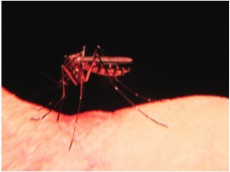
Summer floodwater mosquitoes like this one thrive in hot, wet weather.
Courtesy of Ned Walker
"It's been a perfect storm for mosquitoes," Walker said. “We don’t see this kind of mix every spring.”
Mixing up the spring mosquito scene are floodplain mosquitoes, which do not make an appearance every year, Walker said. They lay eggs during especially wet weather in water systems' floodplains. Eggs can live for up to 8 years waiting for extra soggy conditions to hatch.
“Once we get an extra heavy spring rainfall, they’re out there and they can hatch,” Walker said.
Other types of more common mosquitoes are buzzing around, too.
Summer floodwater mosquitoes like woodland pools, grassy meadows and roadside ditches. Repeat rains make conditions ripe for brood after brood. They can go strong all summer long.
Spring mosquitoes that hatch only once a year, after the snow melts, are still around, but they’re dying of, said Mike Kaufman, an MSU entomology research specialist
Meanwhile, disease-carrying mosquitoes haven't yet hit their stride.
West Nile virus is still alive and well in Michigan.
Northern house mosquitoes carry the virus, which can cause meningitis or encephalitis in humans or animals. Cases of West Nile typically first occur in late June and continue through October, Walker said.
West Nile sickened two people in Washtenaw County in 2010; in Michigan, 29 were sickened and three people died from the disease last year.
Northern house mosquitoes like to rest and buzz around in the homes of humans. And they like man-made breeding grounds like sewers and abandoned swimming pools. The mosquitoes bite birds and then pass the disease to humans and other animals.
But the emerging disease of the summer could be Eastern equine encephalitis.
The disease involves an inflammation of the brain, and it killed more than 100 horses and sickened three people in Michigan in 2010.
That’s the worst outbreak since 1981, Kaufman said.
A vaccine exists for horses, he said, but it’s thought that economic downturns coincide with equine encephalitis outbreaks because some horse owners forgo the vaccination to save money, Kaufman said.
According to Walker, Western Washtenaw County occasionally sees a case of equine encephalitis, but health department officials said there were no cases locally in 2010. Ann Arbor is not a hot spot for the disease, though there were reports last year of infected horses and deer in rural areas of Livingston County, Kaufman said.
Juliana Keeping covers general assignment and health and the environment for AnnArbor.com. Reach her at julianakeeping@annarbor.com or 734-623-2528. Follow Juliana Keeping on Twitter
Comments
Epengar
Wed, Jun 15, 2011 : 3:55 p.m.
The Washtenaw County Conservation District <a href="http://www.washtenawcd.org/" rel='nofollow'>http://www.washtenawcd.org/</a> is selling a mosquito repellent that you can spray in your yard. It's called "Mosquito Barrier" and is supposed to be non-toxic (made from garlic). Here's a quote from their June email update: "GOT MOSQUITOS? Try using "Mosquito Barrier", which is poison free, made with 99% garlic extract and is safe to use around children, pets and fish. When used as directed it does not harm vegetation, does not impart any garlic flavor or taste to food plants, and can be applied to open water. A spraying of Mosquito Barrier can last 2-4 weeks. The 1-quart bottle covers 1.25 acres, with multiple applications possible for smaller areas. The spray is applied to: grass, shrubs, trees, under porches or decks, roof gutters and pond banks. Mosquito Barrier has been used extensively by cities and municipalities across the U.S. with excellent results. For more information about Mosquito Barrier and to read numerous testimonials, visit the Mosquito Barrier web site at: <a href="http://www.mosquitobarrier.com/testimonials.html" rel='nofollow'>http://www.mosquitobarrier.com/testimonials.html</a> Mosquito Barrier is available at the Conservation District office, 7203 Jackson Road, Ann Arbor (located ¼ mile east of Baker Rd. on 3-L's Drive. Cost for the 1-quart bottle is $24.00 tax included. For more information, call the Conservation District at: (734) 761-6721 X 5." They also have contact information on their website.
American Family
Sun, Jun 12, 2011 : 5:12 a.m.
Either bring back the use of DDT, or start using Malathion. Or deal with the itch and possible deadly diseases. Pick :)
Epengar
Sun, Jun 12, 2011 : 9:36 p.m.
Right, because pest-control technology hasn't advanced in 40 years. Sheesh.
lukn2lrn
Sun, Jun 12, 2011 : 3:49 a.m.
We're thinking about installing a ceiling fan in our outdoor area, hoping the breeze will keep the mosquitoes at bay. We' ve tried a large floor fan, and it seemed to make a significant improvement. I suppose we'll also have to break down and use deet. I' ve read that you can apply the deet in spots, rather than all over, as the odor keeps mosquitoes away, so just dab it on hete and there, with several inches between dabs being ok. Not sure if this is accurate, but wondering if anyone else had tried this with success?
Homeland Conspiracy
Sun, Jun 12, 2011 : 2:24 a.m.
Be afraid be very afraid!!!
Enso
Sat, Jun 11, 2011 : 9:57 p.m.
How about subsidized bat housing?
Epengar
Sun, Jun 12, 2011 : 2:17 a.m.
Bats eat more moths and junebugs (actually beetles) than mosquitos, but bat houses are a good idea. Especially as they are getting nearly wiped out by an epidemic disease (a fungus that doesn't attack people), and need more places to live. Bat Conservation International has lots of information on how to make bat houses, <a href="http://www.batcon.org/index.php/get-involved/install-a-bat-house.html" rel='nofollow'>http://www.batcon.org/index.php/get-involved/install-a-bat-house.html</a> and how to get bats out of your house and keep them out: <a href="http://www.batcon.org/index.php/bats-a-people.html" rel='nofollow'>http://www.batcon.org/index.php/bats-a-people.html</a>
Epengar
Sat, Jun 11, 2011 : 6:04 p.m.
It would be nice if this article also included some information or links to what residents can do to help control mosquitos. Here are a few things: --eliminate standing water where mosquitos breed. Any container that traps water for a week or two can be used by mosquitos: flower pots, old tires, garden ponds, even just a styrofoam cup sitting on the ground can be used. Some of the species that carry West Nile evolved to breed in tree holes up off the ground, so poorly maintained eaves troughs (roof gutters) that don't drain are perfect for them. Natural woodland ponds (e.g. those in Eberwhite Woods) host a diversity of insect predators that eat mosquito larvae, so while these ponds are a source, they are not as large a source as similar volumes of artificial containers might be. Also, they actually produce few mosquitos as they get deeper, because the predators can hunt more effectively when the water is not so shallow. --rain barrels and garden pools can be treated with "dunkers" that disperse a type of BT that kills mosquitos and other flies but is harmless to vertebrates. --bug zappers, the electric kind with the ultraviolet light, are worse than useless. They don't particularly attract mosquitos, and the insects they do attract are more beneficial predators than pests. Also when they electrocute a bug, the bug's body fluids boil and it sort of explodes, produces a fine mist of nastiness. Not something you want to be near. --the big mosquito traps that burn propane and have a fan apparently do sometimes work, depending on how they are located with respect to prevailing breezes and the source of mosquitos.
Macabre Sunset
Sat, Jun 11, 2011 : 5:15 p.m.
Unfortunately, it will take the death of a politician's child to bring back mosquito control. Let's hope it doesn't come to that. Politicians themselves are immune, because they don't actually have flowing blood.
Roger Roth
Sat, Jun 11, 2011 : 3:56 p.m.
Mowing? You cannot be serious! We've got wars to fight, banks to bail out and corporations to subsidize and you think there's money to make a person's walk in the park a little more pleasant?????? If there were an infestation of mosquitoes that sucked the blood of only politicians, DDT would be voted back in in a matter of hours as the main weapon in an all out War on Mosquitoes! OPERATION SACK THE SUCKERS
Technojunkie
Sat, Jun 11, 2011 : 1:26 p.m.
The bats should be very happy this year.
Melissa
Sat, Jun 11, 2011 : 1:37 p.m.
yep, if any survived the mass die-off
RunsWithScissors
Sat, Jun 11, 2011 : 11:58 a.m.
Let's not forget about ticks! One of my favorite walking paths (Pittsfield Preserve) is so lousy with ticks that I don't dare venture there anymore. They seem more numerous then in the past. It would help if the park administration would mow the paths but that hasn't happened yet this year.
John B.
Sat, Jun 11, 2011 : 9:53 p.m.
Our dog had two ticks on her simultaneously just a couple weeks ago. That was a first - she rarely gets even one per year.
Huron74
Sat, Jun 11, 2011 : 1:07 p.m.
Amen to that. I've never seen Michigan so lousy with ticks in my entire life.
Barb
Sat, Jun 11, 2011 : 12:37 p.m.
No adding. The lack of mowing in the parks is nuts and does contribute to more bugs. :(
DDOT1962
Sat, Jun 11, 2011 : 11:40 a.m.
Can we request more of the mosquitoes that bite only frogs and fewer of the mosquitoes that feast on humans?
Huron74
Sat, Jun 11, 2011 : 1:07 p.m.
Who would you make the request to?